Too many dull interludes and not enough derring-do derails this gritty, atmospheric European melodrama about an ex-Interpol agent (rugged looking Thomas Tryon of "The Cardinal") who is hired by an infamous drug-lord Marcos (Jose Bodalo of "Captain Apache) to find a missing shipment of narcotics. Along the way our hero hooks up with a hippie chick with a guitar, Jill (Lorenza Guerrieri of "Operation Snafu") whom he uses to act as a cover during his investigation. Inexplicably, in the middle of this Euro thriller, Richard Deacon of "The Dick Van Dyke Show" appears briefly as a records clerk.
The Spanish scenery is spectacular and the photography is breathtaking, but there simply isn't enough intrigue to fuel this indifferent actioneer. A scene near the beginning where the villains conceal a shipment of narcotics under the hood of their automobile is cool and director Julio Coll's understated staging of their demise in hail of gunfire during a downpour generates a modicum of excitement. There's also a decent scene in a garage where out hero gets doused with gas. The problem here is that the action lags between the better scenes. Sergio Donati, who co-scripted with Sergio Leone on "For A Few Dollars More" and "Duck, You Sucker," contributed to the loquacious screenplay. The chief villain Marcos sports a pair of spectacles with one clear lens and a dark lens. He is ruthless but he isn't as ruthless as he needs to be to stand out from the pack. This disposable thriller is no diamond in the rough and only die-hard action fans who want to say that they have seen it for the record need waste their time on it.

CINEMATIC REVELATIONS allows me the luxury of writing, editing and archiving my film and television reviews. Some reviews appeared initially in "The Commercial Dispatch" and "The Planet Weekly" and then later in the comment archives at the Internet Movie Database. IMDB.COM, however, imposes a limit on both the number of words and the number of times that an author may revise their comments. I hope that anybody who peruses these expanded reviews will find them useful.
Thursday, November 13, 2008


TV REVIEW OF "SUSPENSE: THE CASK OF AMONTILLADO'' (1949)
The live-action CBS-TV "Suspense" anthology presentation of Edgar Allan Poe's classic tale of terror "The Cask of Amontillado" updates the author's 1846 short story (first published in the magazine "Godey's Lady's Book") with its eighteenth century setting so that the action takes place just after World War II has ended, and everybody is celebrating the success of the Allied victory over Hitler. A U.S.A.F.F. sergeant (Ray Walston of "My Favorite Martian") approaches his intoxicated superior officer, a major (Frank Marth of "Satan's School for Girls") and explains that the Count (Romney Brent of "The Sign of Zorro") has come to report a murder. The major collapses in a drunken stupor onto a nearby cot, and the sergeant decides to transcribe the Count's deposition in short-hand. The Count, an older looking gentleman with patrician features, a neatly clipped mustache, a trim Vandyke beard, in the wardrobe of an aristocrat, primly informs the sergeant that the palace where the Americans are billeted once belonged to him. They sit down, and the Count begins his story.
"Early in the war," he states, "when the Fascists were in full power, I had to give the property to a General Fortunato. Actually, Fortunato used to be a stable boy here, but he rose by devious means until he became one of Mussolini's favorites and after that a general." The Count informs the sergeant that far beneath the palace lays a catacomb where "for thousands of years my ancestors have been buried . . . " The besotted major revives briefly to point out that in the catacomb is about a quarter of a mile below "down a long spiral staircase every few steps a corridor leads off." The officer pronounces it the greatest wine cellar that he has ever seen during the three years that he has spent in Italy. The sergeant mentions to the Count that it is off bounds to the troops. However, by that time, the major has passed out for good. The Count goes on to say that the catacomb: "It is so far down it is actually under a river bed." When the Fascists came to power, explains the Count, General Fortunato (Bela Lugosi of "Dracula") commandeered the palace and forced the Count to let him marry the Count's "youngest and dearest sister." The sergeant suggests that the Count should have refused, but the Count reminds him that Fortunato could summon storm troopers and resort to torture chambers. Fortunato confined the Count and his wife to a small suite over the stable. At this point, "3:10 to Yuma" writer Halsted Welles and "Never Love A Stranger" director Robert Stevens shift the story into flashback mode at about six minutes into the action.
The Count works in an office and his sister in the hospital. Meanwhile, the Count's snooty wife dines with the general on the terrace. The amorous but disheveled general and the Count's wife discuss their relationship. Fortunato values his sister-in-law's judgment above that of his simpleton wife. Nevertheless, he fails to convince her to accompany him to Rome. She refuses because she feels their flirtatious behavior appear too brazen. Stevens shifts back to the present in 8 minutes so that he can see the sergeant light up a cigarette and say: "And then?" Stevens racks focus from the sergeant to the flashback again. A year later, Fortunato returns to the palace. The general's wife has died and the Count's wife has moved to Rome. Indeed, Fortunato is bent on killing the Count. Fortunato's infidelity with the Count's wife precipitates his moral demise and seals his doom.
The Count and General Fortunato spend more of their time together in the second act traipsing down the eternal spiral staircase. Initially, they are lounging on the terrace when the Count reveals to the general that he has bought a cask of amontillado from a black marketer and has hidden it in the catacomb. Fortunato demands to taste his share of it. Eventually, the Count lures him into a nave that is partially bricked up. He gets the drop on Fortunato, appropriates his revolver, and claps him in shackles facing the wall. Afterward, he bricks up the wall completely, and the cries of Fortunato from behind the wall are haunting. Essentially, the entire story serves as the Count's confession. He explains that he fled to Switzerland afterward and then joined the anti-Nazi underground. Finally, the story resumes in the present day, the smashed major is sitting up and listening as attentively to the Count as the sergeant. As the story concludes, the Count leaves his fate to judgment.
Welles' talkative teleplay provides a wealth of pertinent plot details that foreshadow events in the first and second acts, primarily the geographical logistics. Lugosi delivers the best line of dialogue: "You know, life is nothing but . . . uh . . . a lot of steps, either you go up, or you go down." Stevens doesn't let the action dawdle. In extreme contrast to his supernatural horror roles, Bela Lugosi is superb as the drunken, egotistical Italian general that winds up shackled in a nave. Walston is memorable as a gum-chewing sergeant who uses slang in the modern day sequences. Alas, Romney Brent delivers the only flawed performance. During his expository scene about his sister having to marry Fortunato, he goofs up and refers to her as his daughter but he recovers quickly.
The original Poe story never specified what triggered the Count's murderous rage. Indeed, the idea of being burying alive—in this instance, immurement—was a fear that preoccupied Poe. Immurement occurs when an individual is trapped and bricked up within a building and left to starve or dehydrate to death. The chief problem with this otherwise competently done drama is its flimsy sets and props. The walls of the spiral staircase set flutter when the actors breeze past them. Clearly, "Suspense" had to cut corners to keep their production costs down.
FILM REVIEW OF ''THE EVIL THAT MEN DO'' (1984)
J. Lee Thompson's "The Evil That Men Do" (*** out of ****) casts tough guy actor Charles Bronson of the "Death Wish" franchise as a no-nonsense professional killer who reluctantly comes out of retirement on his desert island to eliminate an individual who specializes in human torture. Dr. Clement Molloch (Joseph Maher of "Heaven Can Wait") interrogates and tortures prisoners for Third World Latin American dictators. The villain's surname 'Molloch' is a variation of the word 'Moloch,' an Old Testament god of the Ammonites and the Phoenicians to whom children were sacrificed by burning. The Molloch here doesn't torture children, but he is appropriately nefarious when he makes his adult victims suffer. Unquestionably, the evil doctor is a human rights violator like few you will ever see in movies. The scene at the outset of the action where his men and he attach electrodes to the nipples and genitals of a highly respected journalist Jorge Hidalgo (Mexican actor Jorge Humberto Robles) and gives him bursts to electricity to learn what he knows is pretty strong stuff even for an R-rated movie. Mind you, Thompson doesn't show the devastated areas, we simply see a completely nude man hanging in a sling with the wires trailing from his chest and pelvis. Dr. Hector Lomelin (Jose Ferrer of "The Shrike") visits Holland (Charles Bronson) on his island, where he resides in a kind of self-imposed exile and asks him to kill Molloch. Holland is saddened by the news of his journalist friend's death and then he watches several videos that Lomelin provides of interviews with Molloch's victims and hears about the man's horrendous crimes against mankind. Nevertheless, Holland refuses to accept Lomelin's offer until a later scene when he shows up unexpectedly at the professor's class room.
Nothing gets in Holland's way once he takes the job. He refuses to work for pay. He arranges for Lomelin to get him a woman and a child to pose as his wife and daughter so that he will attract less attention from the locals. In one amusing scene, Holland and his faux wife Rhiana Hidalgo, wife of the death journalist (Theresa Saldana of "Defiance") enter a dive of a bar. While Holland gets their drinks, an enormous Hispanic guy decides to join them and fondle Rhiana. Holland surprises this gigantic hombre by knocking the table out of the way and seizing the dastard by the testicles and crushing them in the iron grip of his fist. Of course, this hulk crumples into a huddle of arms and legs at Holland's feet and offers no further interference. This display of self-defense attracts the attention of Molloch's bodyguard, Randolph (Raymond St. Jacques of "Cotton Comes to Harlem") and he joins our hero and heroine. Shrewdly, Holland tells Randolph that Rhiana and he are looking for someone else to have sex with and the deal is sealed. They go back to Holland's motel and Holland immediately kills Randolph with a knife and hangs him upside down to bleed his corpse out in the shower.
"Guns of Navarone" director J. Lee Thompson pulls no punches in this hard-as-nails thriller with his depiction of either Molloch's savage torture techniques or Holland's icy methods of disposing with his antagonists. Consequently, "The Evil That Men Do" still retains its edgy quality some twenty years after its initial release. On the other hand, Thompson doesn't resort to sensationalism for the sake of sensationalism, and this thriller is fairly straightforward without any outlandish or unbelievable scenes. This is one reason that I think makes it so good. The closest that you get to exploitative sleaziness involves Molloch's evil sister Claire (Antoinette Bower)who is a lesbian. Another scene has our hero wielding a mean pump action shotgun with deadly proficiency. Although he was past his prime at this point in his career, Bronson is nevertheless in fine form as the gimlet-eyed, tight-lipped assassin. The grim finale at a mining compound where Molloch gets his comeuppance from past disfigured victims resembles the ending of Todd Browning's horror classic "Freaks." The miners surround Molloch's car and shove long spikes through it with the villain trapped in the back seat with nowhere to run. The wild thing is that Joseph Maher is totally convincing as the heinous villain, but as an actor he didn't specialize in villainous roles. Theresa Saldana is convincing as Jorge's wife who accompanies Holland on his mission. People who prefer their crime dramas with a hard boiled intensity will savor this grim saga. Ken Thorne's offbeat music is a plus.
Wednesday, November 12, 2008
FILM REVIEW OF ''YOU ONLY LIVE TWICE'' (1967)
James Bond heads off for Japan to avert World War III in “Alfie” director Lewis Gilbert’s “You Only Live Twice,” the fifth entry in the Harry Saltzman & Albert R. Broccoli 007 series from the 1960s. “You Only Live Twice” resembles a souped up version of the first Bond adventure “Dr. No” in that it involves SPECTRE (Special Executive for Counter-intelligence, Terrorism, Revenge, and Extortion) again. Instead of tampering with the guidance system of American rockets and knocking them out of the air, SPECTRE is stealing American spacecraft and making it look like the Soviets are to blame. The villain works out of a secret base and he has a fabulous art collection.
This Bond introduced a number of firsts of the franchise. First, this represents the first time that audiences saw 007’s previously anonymous nemesis Ernst Stavro Blofeld. British character Donald Pleasance took over the role at the last minute when Czech actor Jan Werich fell ill and had to be replaced. Second, there are no scenes set in the United Kingdom. Bond doesn’t receive his usual briefing in M’s office. Third, the movie differed even more from the novel than earlier efforts. Fourth, Sean Connery had grown fat and sassy because he is no longer the lean, wolfish secret agent that he was in “Dr. No.” Fifth, the producers hammered home the dangers of cigarette smoking in three scenes. Sixth, this is also the first time that we see Ian Fleming’s super spy decked out in his naval uniform. Indeed, “You Only Live Twice” served as the template for the military, World War III Bonds such as “The Spy Who Loved Me” and “Tomorrow Never Dies” where our protagonist donned his naval togs. Sixth, 007 never introduces himself as “Bond, James Bond.”
The action opens in outer space as U.S. astronauts are space walking when a mysterious space craft approaches them and its nose cone opens and engulf the American capsule and cuts the lifeline of the astronaut. Since “You Only Live Twice” took place during the Cold War, the Americans accused the Soviet Union of this abduction in outer space. His Majesty’s government isn’t convinced that the Russians hijacked the American spacecraft. The action cuts to James Bond in bed with a Japanese beauty that is really setting him up for a hit squad. Before she lets the killers into her apartment to shoot our hero, she promises Bond that she will give him the very best “duck.” Pressing a button on the wall, the mechanism closes the bed in which 007 is strewn up into the wall and a couple of machine-gun toting thugs break in and pepper the bed with a hail of bullets. When British authorities arrive, they find an unconscious Bond in the sack with blood on the sheets. As it turns out, the killing is nothing more than a ruse to throw Bond’s enemies off the scent while he goes in for—as M (Bernard Lee)—his most important mission. The Americans are teetering on the edge of war with the Kremlin and the Kremlin has scheduled a space flight of their own.
The scene where Bond’s shroud encased body is dumped into Tokyo Bay in a mock funeral is too cool. As his body settles on the ocean floor, scuba divers swim up, retrieve his body, and take him onboard a submarine where M awaits him with his mission orders. After Bond is told that this mission is “the big one,” he is fired out of a torpedo tube in the ocean and swims to the mainland where an operative of Japan’s Special Intelligence Service. Bond meets with a British official, Dikko Henderson (Charles Gray of “Diamonds Are Forever”), and learns that the head of Japanese S.I.S., Tiger Tanaka (Tetsuro Tamba of “The 5-Man Army”) has his own suspicions about a giant industrial concern, Soto Chemical Corporation. Before Bond meets Tiger, he has an encounter with the villains after they murder Henderson. Bond kills the killer and masquerades as him, despite the fact that he is clearly taller than the killer. Anyway, he bundles himself into the back of the sedan driven by another Osato person and winds up in the giant building. The villain who carried him inside is shocked when Bond surprises him and one of the best hand-to-hand combat scenes in the entire series plays swiftly with Bond wielding a couch to knock the villain down. Afterward, our hero plunders the corporation owner’s vault and discovers that fishy things are going on near an island. It seems that an innocent American tourist took a photo of a cargo ship and “was eliminated as a precaution.”
Tiger assembles an army of Ninjas at his castle training ground and—very improbably—Bond masquerades again as a Japanese fisherman to reconnoiter the island where the ship is seen. Tanaka sneaks Bond onto the island as a newlywed of a local girl. They discover a cave that contains poison gas and later learn that it gives access to the volcano. Meanwhile, the suspense mounts as the United States launches another spacecraft and threatens to go to war with the Soviet Union if their space capsule is abducted. Matters aren’t helped when Blofeld capsule gobbling spacecraft swallows a Russian space capsule. The big, bang-up finale in the volcano where Blofeld has his headquarters as well as a rocket launching site is deliciously outlandish stuff.
Indisputably, “You Only Live Twice” qualifies as the most outrageous of the Bond movies at the time and you have to realize as you watch it that much of what occurs is incredibly far-fetched. Nevertheless, the stunning Japanese scenery, the invigorating fight sequences, and Blofeld’s mind-blowing headquarters in an extinct volcano overshadow many of the unbelievable scenes. As another Bond director—Guy Hamilton—used to say, you have to watch these extravaganzas with your mind turned off because too many incredible things occur. John Barry’s orchestral score ranks as one of the most memorable and Nancy Sinatra’s song is one of the best.
Tuesday, November 11, 2008
FILM REVIEW OF ''THE TRAIN ROBBERS'' (1973)
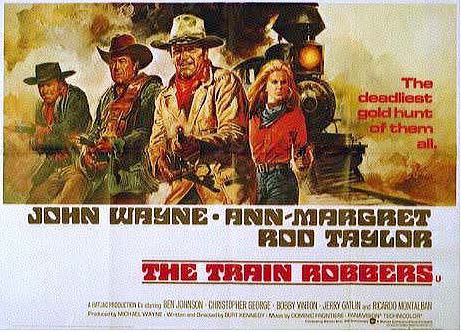
John Wayne and voluptuous Ann-Margret co-star in writer & director Burt Kennedy's "The Train Robbers" (**1/2 stars out of ****), a traditional but rambunctious western shoot'em up about a notorious outlaw's widow who hires the Duke to recover a half-a-million in stolen gold from her husband's last robbery five years old. She wants the money returned to Wells Fargo so she clear her husband’s name as well as keep her young son from growing up thinking that his father went around robbing trains. Wayne summons his trusty old saddle pals Rod Taylor, Ben Johnson and Bobby Vinton to accompany him on this perilous journey. Taylor brings along a couple of young gunmen, Christopher George and Jerry Gatlin, to find the buried treasure. No sooner has Wayne, Ann-Margret, and company saddled up and crossed the border into Mexico to find the fortune in gold than a train load of gunslingers show up and pursue them. Meanwhile, lurking on the fringes of the action is a mysterious but elegantly-attired, cigar-smoking hombre who never loses sight of them. He turns out to be a pretty fair shot with a Winchester rifle.

Our heroes meet at an isolated railway station in Liberty, Texas, rather like the one in Sergio Leone's "Once Upon a Time in the West." The small town appears empty. The wind gusts across the boardwalk at the hotel and sways the rocking chairs back and forth. A metal sign buckles in the breeze. Jesse (Ben Johnson of "Rio Grande") awaits the arrival of Lane (John Wayne) on a train that was due in the day before, and everybody is astonished when Mrs. Lowe (Ann-Margret of "Viva Las Vegas") gets off the train with Lane. Jesse and Grady (Rod Taylor of "Dark of the Sun") remember Lane as "bull-headed" and they discover to their relief that he hasn't changed an iota. Later, we learn that Jesse and Grady served together under Lane in the Union Army during the American Civil War where they endured their baptism under fire at Vicksburg. Life for these three has been going up one hill of adversity after another. Feisty Calhoun stands up to Lane, and Lane wallops Grady. Grady thinks that Lane ought to be happy that Calhoun stood up to him. Conversely, Lane wants men who will stand alongside him not against him. Calhoun demands to know what they are getting themselves into, and Lane observes that they are doing what any hired gun does . . . risking their lives. Earlier, before Lane and Mrs. Lowe got off the train, Grady told Jesse that he has shown up for the job simply because it amounted to "something to do."
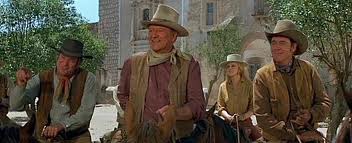
After initial misgivings about endangering a woman on a long ride through the desert, Lane and company head out. Before they leave the station, Lane has Mrs. Lowe's shirt boiled so that she will stand out and her late husband’s pallbearers won't mistake her as a man and try to shoot her. An army of gunmen—we never see these guys up close—shadow our heroes across the parched terrain to the accompaniment of "Rat Patrol" composer Dominic Frontiere's giddy-up score that signals the change of locale when everybody plunges across the Rio Grande into old Mexico. Along the way, during several campfire scenes we learn more about our heroes. Eventually, the feuding between Calhoun and Lane ends and they become friends. Finally, our heroes find the railroad train in the middle of the Mexican desert. They dig into the boiler and find the gold, but they aren't about to go anywhere because that ubiquitous army of gunmen that has been trailing them arrives. As our heroes fortify themselves for the ensuing gun battle, Jesse and Grady swap memorable but pithy dialogue. "Don't get old," Grady warns Jesse, "you'll live to regret it." The twenty gunmen attack them, but our heroes emerge unscathed largely because—in Lane's words—"they could shoot worth a damn."

Our heroes head back across the border, but the remaining gunmen beat them back to Liberty and prepare a reception for them. Everything ends with a bang-up shoot-out at the railway station where Lane met Jesse and Calhoun. Our heroes virtually blow the town to bits with dynamite so they can defeat the villains. During this fracas, Mrs. Lowe pulls a fast one on our heroes in what constitutes an O’Henry reversal. The well-dressed stranger (Ricardo Montalban of "Star Trek: The Wrath of Khan") turns out to be a Pinkerton detective who has been on Mrs. Lowe for five years. He explains that she was never married and that Lowe died with a bullet in the back in the bordello where Mrs. Lowe worked. She reveals that Mrs. Lowe’s name is Lily. Our heroes scramble after the departing train that carries the pseudo Mrs. Lowe and the gold.
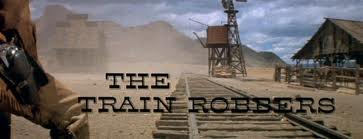
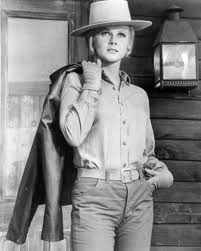
Burt Kennedy got his start writing laconic but entertaining oaters for director Budd Boetticher in the 1950s. Wayne’s film production company Batjac produced many of Boetticher’s existential westerns so it is no surprise that Kennedy went on to pen westerns for Wayne. The first collaboration between Wayne and Kennedy was the superlative "The War Wagon." Mind you, "The Train Robbers" isn't half as exhilarating as "The War Wagon," but this nifty little sagebrusher never runs out of steam and the dialogue is fun to hear. Rod Taylor is nothing short of brilliant as Wayne and Johnson's friend. Okay, all the characters are pretty much stereotypical and of them gets so much as a scratch. Wayne plays his usual stalwart hero and leathery Ben Johnson is his wise sidekick. Naturally, Ann-Margret is a feast for the eyes. The scene where Wayne tries to get her drunk so she will reveal the whereabouts of the gold is amusing. Later, when she comes onto Wayne, he deflects her amorous advances with the line, "M'am, I've got a saddle older than you."

Thursday, November 6, 2008
FILM REVIEW OF ''ZACK AND MIRI MAKE A PORNO" (2008)
"Zack and Miri Make a Porno" (**** out of ****) is "Clerks" director Kevin Smith's best blue-collar, romantic comedy since "Chasing Amy.” The eponymous protagonists have been best friends since the first grade who make a porno to pay off their mounting rent and utility bills during chilly Thanksgiving in Pittsburgh. Zack and Miri live together in the same apartment, but they sleep in separate rooms and in separate beds. In other words, they do not have sex. They share the rent and the utilities, alternating who pays what each month. Unfortunately, these two slackers barely make ends meet because they blow their bucks on sex toys. The heroine relies on a vibrator, she says, because no man has ever made her cum the way that a vibrator does, while the hero maxs out his credit card so that he can buy a flesh light, a portable pocket pussy that resembles a flashlight. Clearly, if you’re a prude about sex and profanity, “Zack and Miri Make a Porno” will probably offend you with its alphabet soup of A-words, C-words, F-words, and s-words that pervade the dialogue.
The first funny gag in “Zack and Miri” involves the use of those palm-sized chemical packets that provide warmth when the user kneads them with their hands. Miri (Elizabeth Banks of "W.") breaks out one as she awaits Zack (Seth Rogen of “Knocked Up”) to join her as she drives them to work. Zack snatches the chemical packet from Miri and unceremoniously stuffs it into his crotch. Later, as they drive to work, Miri smells something toasty and poor Zack realizes that his genitals are on fire and struggles to remove the packet. Miri has to pull off the road, and Zack has to shed his coat to remove the packet from his crotch. When he claims that the packet singed his hairy testicles, Miri laughs out loud at the absurdity of it all.
The action finally cranks up when our protagonists decide to attend their high school reunion. Miri is dressing for the occasion in the back room at a coffee shop called "Bean'N Gone” where Zack works as a counter attendant. Two slackers see Miri changing out of her clothing and freak at the granny panties that Miri has on. No sooner have they video-taped Miri’s derrière than Zack walks in front of their cell phone camera and moon them. Anyway, Miri wants to hook up with former high school football player and all-around jock, Bobby Long (Brandon Routh of “Superman Returns”), while Zack cruises the party. Zack runs into Brandon (Justin Long of “Live Free or Die Hard”) and learns that Brandon is attending the festivities with his homosexual lover. Brandon explains to Zack that he is a gay male porno star and that he is rolling in dough. Predictably, Miri reacts with shock when she discovers Bobby’s sexual orientation.
Our heroine and hero leave the reunion and go back to their apartment. Since Zack forgot to pay the light bill because he had to buy a pair of ice hockey skates, our heroine and hero find themselves plunged into darkness. Miri observes over a brew at a nearby bar that their predicament is what forces some people to prostitute themselves or appear in a porno. Since neither Zack nor Miri have any living relatives, they are not ashamed to flaunt their sex organs. Our protagonists decide to make a porno movie in the hopes that the over 800 people in their high school graduating class will buy a copy for twenty dollars a DVD.
Zack approaches his fellow employee, Delaney (Craig Robinson), about serving as the producer. Delaney scraps his dream of buying a big-screen TV so that he can finance Zack's porno. However, the racially sensitive Delaney, who lives with an abrasive wife with sagging breasts, throws himself into the production when he realizes that he gets to ogle breasts during actress auditions. The first male that they hire is none other than Kevin Smith's co-hort from his "Jay and Silent Bob" comedies. Zack and Miri select Lester (Jason Mewes) strictly on the basis that he can attain an erection almost instantly. Later, Lester saunters around in the nude with his beans and franks hanging out for all to see. The audience that I sat with the second time that I saw “Zack and Miri” nearly choked on their collective breath at the sight of his genitals.
Notorious real-life former teen porn star Traci Lords of "Blade" plays a character named "Bubbles" who farts into a bubble-blowing loop and makes bubbles. Yes, "Zack and Miri Make a Porno" has front frontal nudity but the sexual exploits are clearly simulated. Nude bar hostess Stacy (Katie Morgan of "Hot Cherry Pies 3") displays her ample breasts in one scene with Lester as our heroes videotape after hours in their workplace. They lose their first studio because a huckster named Jenkins (make-up artist Tom Savini of “Night of the Living Dead”) took a month’s rent from them but refused to tell them that the building that houses their studio is scheduled to be destroyed. Our resourceful protagonists decide to relocate the setting of their porno to the coffee shop after everyone has gone for the evening.
If profane, randy, politically-incorrect language about sex offends you, then you should skip "Zack and Miri Make a Porno.” Seth Rogan is perfectly cast as a wise-acre coffee shop server who has a deep crush on Miri and their romantic involvement in each other takes on a different light when they shoot their own porno. Each is so self-conscious about themselves and absorbed in each other that they forget to remove their clothing. Miri realizes that she has found true love at long last. Smith shoots this scene with an overhead camera as Miri sprawls out on coffee bean sacks. It almost looks like a homage to a similarly shot scene in Sergio Leone's "Once Upon A Time in the West" when Claudia Cardinale laid back on a huge bed with a gauzy canopy.
The usual complications that occur when two people become intimate create problems that drive them apart and forces the shutdown of the movie. Despite the formulaic plot, "Zack and Miri Make a Porno" is a sweet, sometimes sour, sentimental romantic plot about the wacky way that love works. The 'Dutch rudder' scene between Seth Rogen and Jason Mewes at the end is hilarious.
FILM REVIEW OF ''THE HAUNTING OF MOLLY HARTLEY" (2008)
Since he produced 50 episodes of “Everwood,” executive producer Mickey Liddell has gotten some other ideas about the trials that single fathers face raising their teenage daughters. Liddell transplants the “Everwood” premise to a horror setting in his directorial debut with “The Haunting of Molly Hartley” (** out of ****), a lukewarm supernatural chiller about the demonic possession of a paranoid 17-year old prep school student and her single dad who worries about her safety. Clearly, Liddell and his scenarists missed the spectacular “Omen” sequel “Damien: Omen II” (1978) about a 13-yeard old private school student who took advantage of his powers as the anti-Christ to wreak anarchy. Imagine what the Roman Polanski classic “Rosemary’s Baby” (1968) would have been like if the infant had been forced to wait until her 18th birthday to emerge as evil incarnate, and you’ve got a good idea what is in store for you with this predictable PG-13 thriller.
Additionally, “The Haunting” does itself no favors with its negative frontal assault on mainstream evangelical Christianity. As one of the villains, a deranged female Christian teen tries to drown our troubled heroine so Satan cannot claim her soul. “The Haunting” may rake in millions at the box office east, west, and north, but you can already hear Tupelo-based Donald Wildman leveling broadsides against it here in the South. Aside from some intense scares that may startle some, this low-budget, derivative thriller lacks the element of surprise. “The Haunting” qualifies as a revisionist horror movie, too. In traditional horror pictures, Good conquers Evil. In revisionist horror epics, however, Evil triumphs over Good. “American Zombie” scenarist Rebecca Sonnenshine rewrote freshman writer John Travis’ script, but neither Mickey Liddell nor she can do much with this hokum. Banal dialogue, contrived predicaments, incoherent writing, and hopeless stereotypes eviscerate the horror content.
“The Haunting” opens with a pre-credit scene whose characters that have nothing to do with the rest of the film, but serve to put the plot into context. The year is 1997, and Laura (Jessica Lowndes) has a rendezvous with her boyfriend Michael (Randy Wayne) in the woods at an abandoned house. Laura’s father (Jamie McShane) appears unexpectedly and hauls his daughter away from Michael and into his truck. Careening off down the road with her, the father pulls into the path of a laden farm vehicle that T-bones them in a violent crash. The grieving father grabs a broken piece of mirror and stabs his daughter to death to save her from ‘the darkness.’ “The Haunting” then shifts to the present day and the problems that Molly Hartley (Jodie Foster look-alike Haley Bennett of “Music & Lyrics”) faces as she shows up at an elitist prep school Huntington Academy.
Molly’s life has been anything but a picnic. Molly’s mom Jane (Marin Hinkle of “Quarantine”) tried to kill her by stabbing her in the chest. Since the incident occurred, Jane Hartley has been locked away in an asylum near the town that Molly’s dad Robert (Jake Webber of “U-571”) has decided to locate near so they can visit her. Molly is neither crazy about her new school nor its atrocious uniform apparel. Strange things happen when Molly enters an English class where they are analyzing British poet John Milton’s “Paradise Lost.” At one point, blood drips from her nose when she opens the Bible. Clearly, old Nick isn't happy. Moreover, Molly has begun to hear voices. Worse, she hallucinates that her mother is trying to finish what she started. Desperate to save herself, Molly converts to Christianity at the insistence of Alexis who tries to drown her in the baptistery.
“The Haunting” relies on a gallery of stereotypes. Molly’s father forever frets about her welfare. Huntington Academy hunk Joseph Young (Chase Crawford of “The Covenant”) has babes smacking each other around over him. Joseph is the son of the wealthiest man in town. Joseph’s jealous, blond, ex-girlfriend Suzie (AnnaLynne McCord of “Transporter 2”) refuses to give him up without fighting Molly. Their catfight concludes too quickly, but Suzie’s comeuppance is amusing. You know dark-haired Leah (Shannon Marie Woodward of “The Comebacks”) is the bad girl because she smokes marihuana in the girl’s lavatory, pilfers cafeteria lunch items, and wears torn fishnet hose. Born-again scholarship babe Alexis (Shanna Collins of “War of the Worlds”) alienates everybody with her complete lack of tact.
Altogether, “The Haunting” qualifies as a chick-flick friendly horror opus about a teenager-in-turmoil. Hardcore horror fanatics will feel cheated by the scarcity of blood & gore. The menacing moments consist of birds flying out of nowhere and snarling dogs suddenly lunging up against chain-link fences. Mail plunging through a drop slot in the door at Molly’s house sounds like an avalanche. Indeed, Liddell suggests the violence more often than shows it. You won’t see any knives penetrating flesh. Several characters die, but Liddell artfully conceals the gruesome details. Typically, mainstream PG-13 movies for teens cannot show them imbibing alcoholic beverages without receiving an R-rating that cuts into the film's box office earnings. Molly’s mother takes a header off a balcony, somersaulting between the floors before she lands face down on the bottom with virtually no damange done to her physique. Clocking in at 86 marginal minutes, “The Haunting of Molly Hartley” will leave you wanting for something more stimulating like “Rosemary’s Baby.”
Subscribe to:
Posts (Atom)