Translate

Sunday, November 24, 2013

FILM REVIEW OF ''IDENTITY THIEF" (2013)


Jason Bateman contended with social media as a concerned father in the dramatic movie “Disconnect” where he discovered that his misfit son tried to commit suicide as a result of pictures that his teenaged son had posted on the Internet.  Now, Bateman plays another father in “Horrible Bosses” director Seth Gordon’s improbably but entertaining fish-out-of-water comedy “Identity Thief” with Melissa McCarthy.  Bateman is cast as father who loses his identity to a clever con artist over the telephone.  McCarthy plays the eponymous character with gusto.  “Scary Movie 3” scenarist Craig Mazin and Gordon have a field day pitting straight-laced Bateman against the comical McCarthy and humiliating him at every turn.  Eventually, these two emerge as an odd couple.  The ways they change during the course of the movie make “Identity Thief” (*** OUT OF ****) an engaging laffer.  You’ve got to love comedy, tolerate profanity, and resign yourself to sexually offensive situations to be able to laugh off what transpires.  While McCarthy hams it up as the cunning Diana, Bateman delivers a flawless, deadpan performance as a well-meaning milquetoast.  Morris Chestnut, Jon Favreau, John Cho, Robert Patrick, Eric Stonestreet, and Jonathan Banks contribute strong supporting performances.
 

This madcap comedy of errors finds our clueless, chumpster hero leaving his pregnant wife (Amanda Peet of "Sax and Violins") and two daughters in comfortable Denver, Colorado, to cruise south to Winter Park, Florida, where he hopes to persuade a gluttonous identity thief, Diana (Melissa McCarthy), to accompany him back to the City of the Plains.  Early in "Identity Thief," Sandy Bigelow Patterson (Jason Bateman of “Smokin' Aces") answers the phone at work and makes the fatal mistake of divulging his full name, birthday, and social security number to the eponymous villainess who is posing as a computer security associate.  She embarks on a spending rampage and gets so plastered at a bar that the police take her to jail on a DUI. Naturally, she misses her court date.  Not surprisingly, the Winter Park police contact the Denver Police and they pull Sandy over and take him into custody.  Eventually, Sandy convinces Detective Reilly of the Denver Police that he is not the same person as the scam artist in Winter Park.  Reilly points that it may take between six months and a year for him to clear up his identity thief crisis.  Now, Sandy is in trouble with his boss, Daniel Casey (John Cho of "Star Trek") because of his huge credit card debt.  No sooner does our upright family guy protagonist track down his identity thief than he winds up helping her flee from two, gun-toting, Hispanic narcotics dealers.  Diana conspired with Marisol (Genesis Rodriguez of "Man on a Ledge") and Julian (Clifford Joseph Harris Jr. of “The Hangover”) to forge credit cards for them and their crime boss.  During their escape, Patterson claps handcuffs on her a la “The 39 Steps,” but Diana extracts herself without difficulty from the cuffs.  These two wind up helping each other while the villains head off in hot pursuit.  


Gordon and Mazin raise the ante with various plot complications during the road trip.  A notorious, big-time mobster behind bars, Paul (Jonathan Banks of “Beverly Hills Cop”) who is linked to Diana dispatches a hell-bent-for-leather hit man, Skiptracer (Robert Patrick of “Terminator 2”), to eliminate Diana.  After Skiptracer abducts Diana, Sandy manages to run them off the road and Skiptracer’s van overturns during the collision.  Moments after Sandy gets Diana out of the van, a semi-truck demolishes Sandy’s car so they appropriate Skiptracer’s van.  The van overheats on them, and Sandy and Diana find themselves on foot.  They wind up lost in the woods and camp out until first light.  While Sandy tries to sleep, a snake slithers up one pants-leg.  The snake scene in the woods will keep you laughing, even if the snake is CGI.  Watching Diana trying to drive the serpent off with a flame stick is amusing, too.  However, things turn truly zany when the snake bites Sandy on the neck! Diana’s favorite move is to smash her adversary’s throat with her fist.
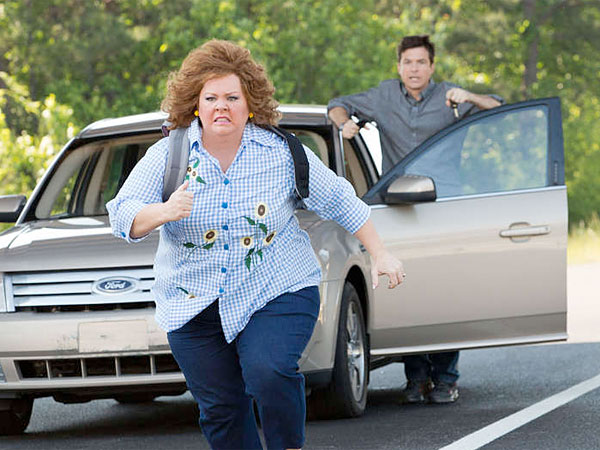

The chief problem with “Identity Thief” is its messy morality. Our protagonist tells his daughter at the outset of the action that bad behavior is punished, but he engages in such antics.  Meanwhile, as much as our heroine tries to change her stripes, Diana never entirely renounces her amoral ways.  At least one plot line involving Jonathan Banks’ incarnated criminal is never taken advantage of and the fates of three villains sent to kill McCarthy are left unraveled. McCarthy’s riotous shenanigans and Bateman’s straight-arrow businessman and the charisma that they generate salvage this otherwise formulaic saga.


Sunday, November 17, 2013

FILM REVIEW OF ''12 YEARS A SLAVE" (2013)


A searing indictment of chattel slavery in the antebellum South, “12 Years a Slave” (**** OUT OF ****) depicts the tragic odyssey of a free-born African-American violinist shanghaied and sold into slavery by unscrupulous white chiselers.  Solomon Northup’s literary chronicle implicates himself as much for his own naivety as the avarice of the assailants who hoodwinked him for monetary gain.  Two smooth-talking con artists in top-hats persuade our hero to leave the safety of New York so he can play his fiddle at a concert in Washington, D.C.  They assure Northup that they will pay him handsomely for his services and reimburse him for any expenses incurred during the trip to and from the capitol.   The surprises and shocks that ensue as a consequence of their mendacity turn Northup’s life upside-down.  British-born, black director Steve McQueen and “Red Tails” screenwriter John Ridley pull few punches in their largely realistic portrayal of Northup’s exploits.  They adapted Northup’s eloquent autobiographical account of his captivity between 1841 and 1853.   Of course, nobody should be flabbergasted that Northup’s memoirs contain a far greater wealth of information than the film.  Naturally, McQueen and Ridley had to eliminate some Northup’s various adventures to make a movie under two-and-a-half-hours in length.  Northup’s hanging provides one clear example.  Three bitter whites resolve to string up Northup until an overseer intervenes.  In Northup’s memoir, he was never actually hanged.  In McQueen’s film, Northup is hanged, but he manages to balance himself on the tip-toes until somebody cuts down.   “

Mind you, this isn’t the first time that Northup’s horrific ordeal has been presented in the media.   “Shaft” director Gordon Parks produced “Solomon Northup's Odyssey” back in 1984 for PBS's “American Playhouse” anthology television series.   After its original telecast, the Parks’ teleplay came out on home video as “Half Slave, Half Free.”  Inexplicably, McQueen had never heard about Solomon Northup and his plight when he was searching for a story to shoot about slavery.  Unlike Parks and his “American Playhouse” production, Mc Queen and Ridley were not restrained by the straitlaced standards of television censorship.  As much as “12 Years a Slave” is a yarn about courage in the face of  wholly insurmountable odds, this Fox Searchlight release qualifies as a horror movie that provides little relief from our protagonist’s travails until the end credits roll.  Happily, McQueen doesn’t paint all whites as unrepentant dastards.  Indeed, our hero survives this adversity because compassionate whites stand up to unsavory whites. Nonetheless, for all but a quarter-hour of its running time, “12 Years a Slave” makes you abhor the individuals who abuse Solomon.  The worst plantation owner of the bunch rapes his most productive black female slave repeatedly on a regular basis while his jealous wife dreams up schemes to drive the object of her husband’s lust from their property.

Movies about Southern slavery, sometimes referred to as the “peculiar institution,” usually focus on slaves born into bondage.   McQueen sought to make a film that would appeal to broader audience.  Ridley and he found in Northup’s memoir the perfect vehicle for this perspective.  Since Northup had been born free, we can identify with him more than we might a poor soul who never possessed his freedom.  Similarly, the same is true of those 18th century British sea-faring tales about helpless lads kidnapped by press gangs and forced into service by His Majesty’s Government because they happened to be in the wrong place at the right time.  In “12 Years a Slave,” two grifters posing as traveling entertainers appealed to Solomon’s vanity as a musician to earn some quick, easy cash.  When things seem too good to be true is when you should flee temptation.  Solomon trusts these gentlemen implicitly, and they escort him to the nation’s capitol.  Once they arrive, they wine and dine him at an elegant restaurant and then slip him a Mickey Finn, the equivalent of the date rape drug Rohypnol, in his libation.  When he entered Washington, Solomon was dressed as splendidly as any Caucasian gentleman.  When he awakens the following morning on the outskirts of the capitol, Solomon finds himself attired in a night gown with a web of chains on both his wrists and ankles.  When he protests his status as a free-born black, the slave traders whip him into submission with a wooden paddle.  At this point, our hero winds up far from home in Louisiana where he must pick cotton, cut sugar cane, and grovel before his bullwhip wielding masters.

“12 Years a Slave” lives up to its R-rating.  The film contains considerable violence and cruelty, with extreme profanity as well as some nudity and brief sexuality.  Various characters utter the politically incorrect N-word as many as 60 times in the company of other derogatory adjectives.  The violence is far more disturbing than the sexuality.  Nude scenes occur when the slaves must bathe before an auction. Similarly, when buyers inspect the slaves, they force them to strip naked.  According to Northup’s memoirs, slaves whose bodies bore the mark of the lash were not as easy to sell as slaves with unblemished bodies.  A slave with too many scars was regarded as rebellious and considered poor prospect for sale.  12 Years a Slave” makes the Hollywood classic “Gone with the Wind” look like a fairy tale.  Although nobody suffers the loss of body parts as in the television mini-series “Roots,” the torture scenes where a female slave is lashed so badly that her back resembles a chopping board and male slaves are hoisted atop tree branches to hang until dead equal any of the ghastly horrors in Steven Spielberg 1993 Holocaust epic “Schindler's List.” English actor Chiwetel Ejiofor of “American Gangster” gives an unforgettable performance as Solomon Northup who suffered untold terror at the hands of his sadistic captors.   Naturally, as formidable as McQueen’s film is, Solomon Northup’s memoir is ten times more fascinating.

Friday, November 8, 2013

FILM REVIEW OF "THE LAST STARFIGHTER" (1984)


“Tag: The Assassination” director Nick Castle's adventurous but derivative science-fiction fantasy "The Last Starfighter"(*** OUT OF ****) features allusions both visual and literary to "Star Wars" and "Back to the Future."  Nevertheless, this harmless, lightweight, but incidentally-romantic, PG-rated saga boasts enough originality and excitement to emerge as more than just another George Lucas clone.  Tom Hanks lookalike Lance Guest plays the eponymous protagonist with boyish charm, while Robert Preston, Catherine Mary Stewart, and Dan O'Herlihy all make impressions.  “Corvette Summer” composer Craig Safan's boisterous orchestral music heightens the heroics.  Although digital special effects were in their infancy, “The Last Starfighter” distinguished itself as the first Hollywood film to generate its own visual effects with a computer.  Some could complain about the primitive quality of the CGI, but this material was ground-breaking during its theatrical release.  Visually, Castle and “Invaders from Mars” lenser King Baggott have created some spectacular, outer space, starscapes, particularly when Centauri ferries Alex to Rylos in one breath-taking panning shot.  Honestly, the only flaw with the state-of-the-art CGI technology is that the small screen amplifies everything so that it appears too sleek, too clean, but lacking in detail.  Surely, on the big screen, the interstellar battle sequences of “The Last Starfighter” must have looked dazzling both in depth and composition.  Narratively, "My Science Project" scenarist Jonathan R. Betuel and Castle have fashioned an appealing, sentimental, but exciting actioneer that alternates between space and Earth.  
All-American, nice guy teenager Alex Rogen (Lance Guest of “Halloween 2”) lives in a rural trailer park with his mom Jane (Barbara Bosson of “) and younger brother Louis (Chris Hebert), while Maggie Gordon (Catherine Mary Stewart of “Night of the Comet”) and he date each other.  Castle and Betuel rely on Louis for comic relief; Alex threatens to tell his mom about his little brother’s secret stash of “Playboy” magazines.  The plot concerns Alex’s dexterous skill at racking up high scores on a first-person shooter video game about cosmos dogfights.  Actually, this arcade game was not supposed to be shipped to Alex's trailer park but to another location.  One evening, Alex achieves the highest recorded score, with friends and family applauding his triumphant victory.   


Before Alex realizes it, an eccentric ne'er-do-well, Centauri (Robert Preston of “The Music Man”), cruises up in a DeLorean and extends Alex an intriguing offer.  Alex's record-breaking score has qualified him to serve as a pilot in the Star League an alien space fleet that is waging a rebellion against a greater evil. Centauri's DeLorean transforms into a spacecraft, and they chart a course for the stars.  At the same time, Centauri has provided Alex with a Beta Unit that masquerades as our hero while Alex joins the good guys.  Mind you, Alex constitutes a reluctant hero.  During the briefing scene, Alex is alarmed when his new colleagues rant about “Victory or Death” against their adversaries.  Initially, he doesn't want to sacrifice his life in what he sees as a lopsided battle that pits the Rylan Star League against the “Black Terror” of the Kodan Empire.  Indeed, the gigantic, disembodied noggin of the opposition leader, Xur (Norman Snow), appears as a holographic image at Rylan Headquarters, and we learn Xur is the son of Ambassador Enduran (Kay E. Kuter) and that the Star League exiled him because of his Xurian cult.  “I have returned for the good of all Rylans,” the outcast Ur proclaims to Enduran.  Moreover, he assures his father, “There are some Rylans who would welcome me, Father.”  He displays nothing but contempt for his father as well as Rylos and calls it, “A refuge for weak worlds not worthy to be our equals.”  The evil Kodans launch a pre-emptive strike against Rylos and wipe out all the starfighters. 


Meanwhile, Centauri has taken Alex back home so our hero can confront his Beta Unit.  He discovers the evil Kodans have learned that he is the last starfighter. Unwilling to leave any loose ends, the aliens dispatch killers to eliminate Alex. Of course, Alex is the underdog who saves the good aliens from the evil ones and reunites with his girlfriend. Castle keeps the action moving with no loss of momentum. Sure, Alex is no more than a Luke Skywalker clone, but Guest makes him a nice guy. In his final film performance, Robert Preston stands out as the finagling Centauri. The aliens resemble those in the cantina scene from George Lucas' "Star Wars."  Some minor profanity crops up, but nothing truly offensive.  


"The Last Starfighter" ranks as a lot of fun.

FILM REVIEW OF ''CARRIE'' (1976)


“Scarface” director Brian De Palma had made about ten feature-length films and several shorts when he made his first classic horror chiller “Carrie” with Sissy Spacek, Piper Laurie, John Travolta, William Katt, Amy Irving, Nancy Allen, and P.J. Soles.  If you look closely, you’ll spot “Miami Vice” regular Michael Talbot, who played Detective Stan Switek, cast as Travolta’s accomplice.  This was author Stephen King’s first novel that Hollywood adapted, and he approved of De Palma and “Ghost Story” scenarist Lawrence D. Cohen’s adaptation.  Performances are uniformly top-notch, with Spacek garnering an Oscar nomination for Best Actress while Laurie received a nomination for Best Supporting Actress.  These two make a convincing daughter and mother combination.  Spacek is a revelation when she goes full-tilt telekinetic in the final quarter hour, devastating friends and foe alike. She walked off with the National Society of Film Critics Award for Best Actress.  Amy Irving and Betty Buckley are sympathetic as Carrie’s friend and mentor.  Nancy Allen and John Travolta play a villainous who orchestrated an evening of mayhem with pig’s blood galore. “Carrie” is all about the terrible effects of bullying.

Our poor, disadvantaged heroine grows up with a tyrannical mother whose husband abandoned her and turns into a radical Christian who sees sin in her innocent daughter.  Furthermore, Carrie is an outsider at Bates High School, and her only friend is her gym teacher, Miss Collins (Betty Buckley of “Wyatt Earp”), who struggles to help.  Things get off to quick start after gym class one day when Carrie has her first period in the locker room shower.  Virtually everybody ridicules Carrie’s ignorance and they sling a storm of tampons and feminine napkins at her.  Honestly, Carrie has no idea what is happening because her prudish, repressed mother has told her anything about growing up and the changes that occur with puberty.  Miss Collins reprimands the girls and threatens to revoke their prom privileges if they don’t spend time after classes with her performing calisthenics.   Sue Snell (Amy Irving) regrets her behavior and arranges a prom date between her handsome football hero boyfriend, Tommy Ross (William Katt of “Butch & Sundance: The Early Years”), who reluctantly goes along with her best intentions scheme.  Meanwhile, Sue’s class mate Chris Hargensen (Nancy Allen of “RoboCop”) smolders with rage from the treatment that Miss Collins accords her.  Only in the 1970s could a high school teacher assault a student by slapping her face in front of her peers and getting away with no repressions.  Secretly, Chris plots revenge with her class mate Norma (P.J. Soles of “Halloween”) and boyfriend Billy Nolan (John Travolta of “The Devil’s Rain”) and Billy’s buddy Freddy (Michael Talbot) to fix the prom vote so Carrie and Tommy will win.  At the moment that Carrie receives her flower, Chris plans to tip a bucket of swine blood so that Carrie is drenched from head to toe in the gore.  

What nobody knocks is that with the onset of her period, Carrie has developed telekinetic powers.  We see some foreshadowing of this awesome power early in the shower scene and later in the principal’s office when Mr. Morton (Stefan Gierasch of “High Plains Drifter”) mispronounces Carrie’s name as Cassie and the cigarette ashtray fragments.  Later, at home with her warped mother, Carrie shatters a mirror with an etching of Jesus in the background.  Tommy has to harass Carrie before she accepts his invitation to go to the prom with him.  Predictably, Carrie’s mother is dead set against her daughter donning a dress that will prominently display her ‘dirty pillows’ and plans some retribution of her own.  Meanwhile, Miss Collins suspects initially that Sue and Tommy are up no good with Sue’s decision to skip prom and her insistence that Tommy take Carrie.  The night before all Hell breaks loose, Chris, Billy, and Freddy place the bucket of pig’s blood directly over the stage.  Freddy and Norma decide to fix the prom couple vote without anybody knowing any better. 
Naturally, things go smoothly for the evil villains, but they are in no way prepared for the electrifying outcome.  After she is covered in the hog’s blood, Carrie unleashes all her telekinetic powers and all but burns down the auditorium where the prom occurred.  She walks out of these fireworks.  When Chris and Billy try to run her down with his car, she turns her powers on them, their car rolls several times, ignites in a fireball explosion and incinerates them.  Talk about a spectacular way to die!  At home, Carrie washes off all the swine blood and seeks her mother’s loving arms for comfortable only to scream when mom buries a knife in her back.  Carrie has another telekinetic bout and skewers her mom with seven kitchen utensils.  Suddenly, Carrie’s small white house collapses around him, and the sole survivor of this nightmare is Sue.  Sue goes to the flat, level site of Carrie’s house to put flowers on the for sale sign and an arm from Hell soars up from the rocks to seize her, and she awakens to find her own mother consoling her after experiencing a nightmare.  The ending will startle you because this is the last thing that you expect.  Four years later, Sean S. Cunningham appropriated the shocker of a finale in his gruesome but seminal slasher “Friday the 13th” with a small boy exploding from the calm surface of a lake to stab at a girl after the heroine had taken refuge in a boat to escape the villainess at Camp Crystal Lake.

Director Brian De Palma never wears out his welcome with this 98-minute melodrama about a young girl and her supernatural powers and went on to exploit it in his next film “The Fury.”  “The Fury,” however, was not the memorable experience that “Carrie.”  A belated, a non-related sequel, “The Rage: Carrie 2” (1999), followed along with a 2002 television remake in 2002 that never became  a weekly series, and more recently Kimberly Peirce’s remake based on Cohen’s screenplay hit theaters with Chloë Grace Moretz as the eponymous and Julianne Moore as her disturbed mother.  Incredibly, the “Carrie” remake surpass De Palma’s classic while it updates the action.  For example, during the shower scene, Chris shoots a video of Carrie groveling in the shower while the girl rain down tampons on her as they chant “Plug it up!”