"The Great Escape" director John Sturges serves up a platter of Cold War paranoia and tension with "Ice Station Zebra" (**** out of ****), his riveting 1968 submarine thriller. Uncle Sam and the British rush to the North Pole to recover the contents of a Soviet satellite that the Russians have lost which contains ultra-classified film of every missile silo both American and Communist on the globe. Brawny Rock Hudson stars as Captain James Ferraday, commander of the U.S.S. Tigerfish (SNN-509), a nuclear sub, who receives his hush hush orders as well as his hush hush passenger, a laconic British Intelligence agent known only as Jones (Patrick McGoohan of "The Prisoner") who wants to beat the Russkies to the prize.
This glossy Metro-Goldwyn-Mayer action-adventure blockbuster received Academy Award nominations for David L. Fapp's cinematography as well as its visual effects. Slow-moving in a peasant old-fashioned way, the Douglas Heyes screenplay introduces all the characters as they assemble at different times aboard the Tigerfish, generates some tension as a mysterious saboteur tries to sink the sub, and then breaks out into frigid North Pole frontier during its final hour with a showdown that reveals the identity of the saboteur and a showdown with Russian paratroopers. The Sturges film is based on the Alistair MacLean novel that isn't as epic in scope as the film and future "Dirty Harry" scenarist Harry Julian Fink adapted it with "Little Caesar" scribe W.R. Burnett contributing uncredited portions. Reportedly, Alstair MacLean's novel was partly based on an actual incident that occurred in 1959. If you like your Cold War thrillers with a snap, you'll love this taut 152-minute epic that never deploys a gratuitous minute. "Ice Station Zebra" was not only Rock Hudson's favorite movie, but also millionaire Howard Hughes' watched this movie repeatedly toward the end of his life. Interestingly, Hughes hired Sturges to helm his own subterrean adventure thriller "Underwater" back in
1955.
John Sturges was an old hand at making action films with predominantly all male casts by the time that producer Martin Ransohoff signed him on to helm "Ice Station Zebra." Some of the windy scenes after the heroes reach the eponymous site are reminiscent of Sturges' early work in "The Walking Hills" and the journey to site recalls his western "The Law and Jake Wade." Sturges orchestrates this big, international actioneer without a false turn but that means that it has to unfold at a slow but sturdy pace. Ferraday receives his orders out of uniform in a pub in Scotland from Admiral Garvey (Lloyd Nolan) and back at the naval base a clandestine secret agent, David Jones arrives who casually admits that Jones isn't his real name. Not long after Jones' arrival the Tigerfish receives a platoon of U.S. Marines, all of whom are young, and equally young lieutenant, Lt. Russell Walker (Tony Bill)leads them. The passengers keep piling up with the additional of a Soviet defector, Boris Vaslov (Ernest Borgnine of "The Dirty Dozen"), who Jones smuggled out of the Berlin Wall in 1961. Not surprisingly, Jones trusts Vaslov implicitly. The final passenger who is picked up in route is U.S. Marine Captain Anders (Jim Brown of "100 Rifles") who comes aboard ready to kick ass. The first scene in Ferraday's cabin with Anders and later Lt. Walker is terrific! Anders makes it clear to Walker who the boss is in no time at all.
Once Sturges and Heyes have everybody aboard the Tigerfish and the orders are clear, the tension and suspense sets in the action. Vaslov loves to roam the ship without escort, while Jones worries about their most recent arrival, Captain Anders, who was picked up in transit. About 45 minutes to an hour later, the Tigerfish reaches the polar ice cap and tries to surface, but the ice above is far too thick. Ferraday decides it is time to fire a torpedo through the ice and then surface. Out of nowhere a disaster occurs. Somebody have tampered with the torpedo tube and let water into the tube so that when our guys go to load the fish, water erupts in a flood and fills the torpedo room. Down does the Tigerfish to alarming depths with its hull sure to implode at any moment as the depth gauge dial clicks over numbers rapidly. Miraculously (well they could die this earlier, of course) the Navy sub escapes but Jones is now certain in his suspicions that Anders is the guilty party and a mustache, taciturn Jim Brown convinces us that if he isn't the villain then he is a very sinister dude.
From this point onward, Sturges and Heyes add the man versus nature theme to the action. Once they have broken through the ice—it's intermission time—they encounter an Artic storm that has them bent down and using canes to cross the ice cap. There is one particularly thrilling moment—especially if you're watching this flick during the winter—when three guys plunge into a crevasse and require rescue. It's rather like the "Star Wars" scene where our heroes are trapped in the trash compactor and the walls are gradually closing in on them. The ice gradually closes in on the navy guys. After they reach Ice Station Zebra, they realize that a fire broke out and now it's time for Jones and Ferraday to huddle and cover all the plot's expository points. An entire scene is allocated to the description of the goods that they are scavenging the area for and how its wound up in Soviet hands with no small amount of espionage involved. Again, the weather has kept the Russians from moving, but we learn that once the storm clears, here comes the Russkies!
McGoohan is essentially replicating his "Secret Agent" man persona and Hudson is tall, dark, and monosyllabic as the rock-solid submarine skipper. Borgnine has never been better as a slippery Russian defector and Jim Brown gives his best performance ever. The photography is top-notch and it's cool that Sturges often stages scenes in the submarine from an angle, not entirely shot at normal, eye-level range with everything horizontal. The scenes under the thick ice are simply incredible! Clint Eastwood's "Firefox" and the last Sean Connery James Bond thriller "Never Say Never Again" borrowed some of this spectacular submarine footage. Ferris Webster's editing deserves a nod, especially in the fight between Vaslov and Anders. Although it didn't match the earnings of another MacLean thriller "Where Eagles Dare," "Ice Station Zebra" is still worth catching.
An excellent book to peruse if you are interested in John Sturges, his life, and his films is Glen Lovell's top-notch biography on Sturges entitled "Escape Artist: The Life and Films of John Sturges." Mr. Lovell spent 10 years writing and researching this seminal text about Sturges.

CINEMATIC REVELATIONS allows me the luxury of writing, editing and archiving my film and television reviews. Some reviews appeared initially in "The Commercial Dispatch" and "The Planet Weekly" and then later in the comment archives at the Internet Movie Database. IMDB.COM, however, imposes a limit on both the number of words and the number of times that an author may revise their comments. I hope that anybody who peruses these expanded reviews will find them useful.
Showing posts with label British Intelligence. Show all posts
Showing posts with label British Intelligence. Show all posts
Friday, July 31, 2009


Monday, December 29, 2008
FILM HISTORY OF "ADVENTURE IN IRAQ" (1943)
Warner Brothers released their “B” movie "Adventure in Iraq" on September 27, 1943. Like many of the studio’s low budget features, this picture amounted to a remake, drawing its plot from the 1930 film "The Green Goddess." Warner Brothers scenarists George R. Bilson and Robert E. Kent retained most of the plot from Scottish writer William Archer’s Broadway play. Unlike Archer’s stage play or Julien Josephson’s "Green Goddess" screenplay, both of which set the action in the imaginary kingdom of Rukh, the Warner Brothers remake left nothing to the imagination and pointedly established Iraq as the setting in both title and action.
Former Flying Tiger fighter pilot Doug Everett and his two passengers, estranged couple George and Tess Torrence are flying from India en route to Cairo, Egypt, when a cracked cylinder head and a broken fuel line forces them to land somewhere in Iraq. When George tries to radio Cairo about their forced landing, he discovers that the tubes are dead and that Doug carries no spares onboard. The three Americans set off on foot and miles later enter an Arab village. Doug believes the inhabitants are a sect of devil worshippers, and George nearly cooks their collective geese when he sits on the ceremonial idol of a snake. About that time, Sheik Ahmid Bel Nor arrives to welcome them and offers them the hospitality of his palatial residence.
No sooner have the heroes and heroine accustomed themselves to the Sheik’s generosity than he reveals that he plans to forfeit their lives because the British are about to kill his three brothers for espionage. Sheik Ahmid Bel Nor offers to spare Tess if she will consent to marry him. Of course, Tess refuses. Meanwhile, Doug and George try to bribe the sheik’s English butler to wire Cairo of their whereabouts, but Devins has nothing but bad memories about English and does not cooperate with them. Eventually, George steals some tubes from the Sheik’s large radio receiver and replaces the tubes in his plane with them. The Sheik and his armed tribesmen catch them at their plane trying to contact Cairo and a gun battle breaks out. Before he dies from a gunshot wound from one of the Sheik’s disciples, George lies to the ruler that he never got through to Cairo. The Sheik and his tribesmen return with Doug and Tess and are about to execute them when a squadron of USAAF planes arrive. One lands, and the commander warns him that they will drop bombs unless he releases his hostages. The Sheik releases Doug and Tess. In the last shot, the Sheik decides that Tess would only have proved a nuisance, and he is better off without her.
The PCA file on "Adventure in Iraq" contained two letters to Warner Brothers. In his August 31, 1942, letter, Breen acknowledged that the PCA had read the final script dated August 27, 1942, and reported that aside from a couple of routine problems that the film met the basic requirements of the Production Code. In the scene where the Sheik’s servant girls provide Tess with a wardrobe, however, Breen warned the filmmakers “care must be used in the costuming of these oriental girls at the bath. Also in the undressing scene of Tess in scene 75, care should be used that there is no undue exposure of Tess’ person.” Breen further complained about the ambiguity surrounding a woman in Sheik’s palace. According to Breen, “the dialogue of Devins’ seems to infer that Timah is not his wife, and we suggest that the underline portion of his dialogue [‘Yes, sir. I suppose you would say so.’] be deleted, to remedy that.” Breen also voiced his concern about a break in the dialogue when the Sheik says to Tess, “If Madame would be so gracious as to favor me with her - - society.” Evidently, based on the final cut of Adventure in Iraq, Warner Brothers complied with all of Breen’s demands, because the second and last PCA letter dated October 1, 1942, approved of all the requested changes. In its Analysis Chart, the Production Code classified Adventure in Iraq an action melodrama with four killings along with little drinking and violence ranging from shooting, fighting, and bombing. The PCA gave Warner Brothers a certificate of approval to release Adventure in Iraq.
Typically, the OWI prepared a script review and then at a later date a film review, but this was not the routine with Adventure in Iraq. Ulric Bell wrote a letter to OWI Chief Elmer Davis in early 1943 complaining that Warner Brothers “did not submit material on these films [The Desert Song and Adventure in Iraq] until they were completed.” Bell’s implication was that getting the studio to reedit the film might prove virtually impossible. Apparently, the OWI did not impose any penalties on the filmmakers for their lack of cooperation in letting the analysts read a preliminary script so that many of the problems could have been eliminated during that stage of the production.
The OWI-BMP feature review of Adventure in Iraq dated December 21, 1942, noted immediately that it was a remake of The Green Goddess with the action relocated to Iraq. “This is an unfortunate choice,” wrote the analyst, “because Iraq is of strategic importance to the war effort and because the picture they present of that country is a distorted one.” The analysts felt that Warner Brothers had ignored several facets of the war effort. They enumerated eight problems, balanced against only one asset, the folly of trying to negotiate with Hitler. Doug questions a treaty that the Sheik is going to enter into with the Nazis, saying, “Don’t you know that Hitler’s treaties aren’t worth the paper they’re written on?”
First, they argued that the filmmakers accused all of Iraq and its inhabitants of not only being pro-Axis but also murderous fiends. The movie could “only serve to alienate a country which is still technically neutral.” Worse, because the filmmakers depicted the Arabs as devil worshippers, the analysts feared that such “a presentation is bound to offend the Arabs in other parts of the world who have shown themselves friendly to the Allied cause.” While they presented Iraq and the rest of the world an offensive view of Arabs, the moviemakers had also given the American public a distorted picture of the country where Americans were stationed.
Second, Adventure in Iraq created a negative impression of the British. The analysts felt that the British came off as villains. Specifically, the OWI-BMP stated, “There is the statement by the Sheik that he was learned to speak English, among other languages, because the British covet his oil lands and he has to protect himself against their designs.” The OWI-BMP also interpreted this to mean that had the Sheik not learned English, then the British might have taken advantage of him. Furthermore, the Sheik shows more alacrity to conduct business with the Axis because they will give him more money than the English. What disturbed the analysts about this anti-British commentary was that the Nazis had disseminated extensive propaganda about British imperialism and the Axis could exploit this to their own use. The OWI-BMP also took issue with the villainous character of Devins, the British butler, because it was “bound to cause resentment among the British and will certainly not contribute to any better understanding of the British on the part of the Americans.” They objected especially to Devins’ line of dialogue in reference to his life before he went to work for the Sheik, “What did the English ever do for me but put me in a reformatory?”
Fourth, Adventure in Iraq emphasized the superiority of the white race. The three Americans look down their noses at the Arabs throughout the film. The analysts also pointed out that, “The members of the U.S. [Army] Air Force who come to rescue the prisoners show the same intolerance and lack of understanding of the natives.” When Doug and George attempt to bribe Devins, they do business with him because he is white, or as they say, “You’re one of us.” The OWI-BMP review stated concisely about this issue, “This distinction between races is in direct contradiction to this country’s war aims. We are fighting for all races and all creeds”
Fifth, the film raised the specter of class distinction. The Americans hold Devins in contempt, because the butler pretends to be a gentleman in his negotiations with Doug and George. Wrote the analysts, “To make social distinction in the middle of a war that is being fought by all the people and for all the people is a little absurd.” They explained that this attitude can generate resentment from individuals lacking the educational advantages of others.
Sixth, the OWI-BMP analysts decided that the pro-Axis Sheik emerged as far more benevolent than intimidating. “The Sheik is so charming,” they admitted, “that one is apt to forget he is a villain.” The filmmakers neglected to present the Sheik as treacherous, especially in light of his collaborating with the enemy and his decision to sign a treaty with the Nazis.
Seventh, the filmmakers misrepresented the role of the American Army Air Force in wartime. The analysts complained that the Air Force came to the rescue of the Americans and bombed a technically neutral village. They argued that this gave the impression that “the U.S. Government clubs them [the villagers] into submission, ” and were “using the very methods we object to in the Axis.”
Eighth, Adventure in Iraq gave the impression that British authorities would voluntarily release three deadly prisoners for three American civilians. The OWI-BMP noted, “To suggest that three civilians, two of whom at least, are making no contribution to the war, would be a fair exchange for three dangerous spies, creates a false sense of values.”
OWI-BMP Hollywood chief Nelson Poynter contacted Steve Trilling at Warner Brothers on December 28, 1942, about Adventure in Iraq and urged the studio to withhold release of the movie until they had given some solemn deliberation to what the analysts had written about it. Poynter used this incident to demonstrate “the wisdom of submitting scripts to this office.” He wrote, “The morale situation in the Middle East and among the Arabs is such as to give the OWI and the British greatest concern, and I know that Warner Brothers do not want road to the confusion.”
OWI Overseas Film Bureau Chief Robert Riskin wrote to Ulric Bell about this very objectionable film,
In case you didn’t get this review of the horrible Warner Bros. Adventure in Iraq, here it is. In the event you don’t know that it has been stopped dead in its tracks for export I am glad so to report to you. It was one of those pictures Warner Bros. hid away until they presented it to the censor. He [Rothacker] passed it—he says before the African invasion—but recanted after the State Department stepped in. We made vigorous objection to it to the censor and to Warner Bros. as soon as we heard about it.
Despite Warner Brothers’ assurances of cooperation they clearly sometimes did not cooperate to the OWI-BMP’s satisfaction.
Warner Brothers executive Steve Trilling wrote to Rothacker on January 9, 1943, and informed him that “’Iraq would not be submitted for export without first consulting you or your office.” Trilling went on to write, “You can appreciate that when this war is over or even prior to it the whole censorship situation might change, especially any fears of pictures carrying an adverse propaganda influence, and we might wish to revise our whole views on the matter.” At the conclusion of his letter, Trilling added, “You can always be assured of our complete cooperation--and with my kindest regards.” Rothacker replied on January 11, 1943, to Trilling that “what you say in your communication is quite all right [,] and it is, therefore, understood that no prints of Adventures [sic] in Iraq will be submitted for export without the approval of this office.” Warner Brothers released their “B” movie Adventure in Iraq in America on October 9, 1943. The film still gave cause for all eight of the OWI’s objections discussed above.
The controversy over Adventure in Iraq lingered in Bell’s mind at the OWI, and he sent Rothacker a letter dated September 27, 1943, to clarify the situation. Bell pointed out that “you have an iron clad agreement under which Warners Bros. will not attempt to export this without giving due notice to your office—meaning, in effect, that they will withhold it from overseas exhibition indefinitely.”
In a letter dated August 13, 1944, George Barnett of the Antilles Department of the U.S. Army Motion Picture Service wrote to Rothacker about the Warner Brothers’ films Adventure In Iraq and Murder on the Waterfront (1943). Barnett wanted to show them to the troops because his organization showed a different movie every night, thus they required 365 movies a year. Barnett requested prints of the films because, “Under present curtailed production you can realize that we are hard-pressed to obtain that number of reasonably suitable films.” Barrett reminded Rothacker that “the export ban does not apply to men in uniform, nor on shipments to Puerto Rico, which is our port of destination.” Consequently, Barrett asked Rothacker to request that Warner Brothers be allowed to send them the films. In a letter dated August 23, 1944, Rothacker assured Barrett “that insofar as the Office of Censorship is concerned there are no restrictions on shipments of motion pictures to Puerto Rico.” Unfortunately for Barrett and the soldiers, in a letter dated September 29, 1944, Francis S. Harmon of the War Activities Committee in New York City, informed Barnett that Adventure in Iraq would not be available to them. Some sixty years later, Adventure in Iraq made its worldwide debut on DVD without a whisper of the controversy that it had aroused in World War II.
Former Flying Tiger fighter pilot Doug Everett and his two passengers, estranged couple George and Tess Torrence are flying from India en route to Cairo, Egypt, when a cracked cylinder head and a broken fuel line forces them to land somewhere in Iraq. When George tries to radio Cairo about their forced landing, he discovers that the tubes are dead and that Doug carries no spares onboard. The three Americans set off on foot and miles later enter an Arab village. Doug believes the inhabitants are a sect of devil worshippers, and George nearly cooks their collective geese when he sits on the ceremonial idol of a snake. About that time, Sheik Ahmid Bel Nor arrives to welcome them and offers them the hospitality of his palatial residence.
No sooner have the heroes and heroine accustomed themselves to the Sheik’s generosity than he reveals that he plans to forfeit their lives because the British are about to kill his three brothers for espionage. Sheik Ahmid Bel Nor offers to spare Tess if she will consent to marry him. Of course, Tess refuses. Meanwhile, Doug and George try to bribe the sheik’s English butler to wire Cairo of their whereabouts, but Devins has nothing but bad memories about English and does not cooperate with them. Eventually, George steals some tubes from the Sheik’s large radio receiver and replaces the tubes in his plane with them. The Sheik and his armed tribesmen catch them at their plane trying to contact Cairo and a gun battle breaks out. Before he dies from a gunshot wound from one of the Sheik’s disciples, George lies to the ruler that he never got through to Cairo. The Sheik and his tribesmen return with Doug and Tess and are about to execute them when a squadron of USAAF planes arrive. One lands, and the commander warns him that they will drop bombs unless he releases his hostages. The Sheik releases Doug and Tess. In the last shot, the Sheik decides that Tess would only have proved a nuisance, and he is better off without her.
The PCA file on "Adventure in Iraq" contained two letters to Warner Brothers. In his August 31, 1942, letter, Breen acknowledged that the PCA had read the final script dated August 27, 1942, and reported that aside from a couple of routine problems that the film met the basic requirements of the Production Code. In the scene where the Sheik’s servant girls provide Tess with a wardrobe, however, Breen warned the filmmakers “care must be used in the costuming of these oriental girls at the bath. Also in the undressing scene of Tess in scene 75, care should be used that there is no undue exposure of Tess’ person.” Breen further complained about the ambiguity surrounding a woman in Sheik’s palace. According to Breen, “the dialogue of Devins’ seems to infer that Timah is not his wife, and we suggest that the underline portion of his dialogue [‘Yes, sir. I suppose you would say so.’] be deleted, to remedy that.” Breen also voiced his concern about a break in the dialogue when the Sheik says to Tess, “If Madame would be so gracious as to favor me with her - - society.” Evidently, based on the final cut of Adventure in Iraq, Warner Brothers complied with all of Breen’s demands, because the second and last PCA letter dated October 1, 1942, approved of all the requested changes. In its Analysis Chart, the Production Code classified Adventure in Iraq an action melodrama with four killings along with little drinking and violence ranging from shooting, fighting, and bombing. The PCA gave Warner Brothers a certificate of approval to release Adventure in Iraq.
Typically, the OWI prepared a script review and then at a later date a film review, but this was not the routine with Adventure in Iraq. Ulric Bell wrote a letter to OWI Chief Elmer Davis in early 1943 complaining that Warner Brothers “did not submit material on these films [The Desert Song and Adventure in Iraq] until they were completed.” Bell’s implication was that getting the studio to reedit the film might prove virtually impossible. Apparently, the OWI did not impose any penalties on the filmmakers for their lack of cooperation in letting the analysts read a preliminary script so that many of the problems could have been eliminated during that stage of the production.
The OWI-BMP feature review of Adventure in Iraq dated December 21, 1942, noted immediately that it was a remake of The Green Goddess with the action relocated to Iraq. “This is an unfortunate choice,” wrote the analyst, “because Iraq is of strategic importance to the war effort and because the picture they present of that country is a distorted one.” The analysts felt that Warner Brothers had ignored several facets of the war effort. They enumerated eight problems, balanced against only one asset, the folly of trying to negotiate with Hitler. Doug questions a treaty that the Sheik is going to enter into with the Nazis, saying, “Don’t you know that Hitler’s treaties aren’t worth the paper they’re written on?”
First, they argued that the filmmakers accused all of Iraq and its inhabitants of not only being pro-Axis but also murderous fiends. The movie could “only serve to alienate a country which is still technically neutral.” Worse, because the filmmakers depicted the Arabs as devil worshippers, the analysts feared that such “a presentation is bound to offend the Arabs in other parts of the world who have shown themselves friendly to the Allied cause.” While they presented Iraq and the rest of the world an offensive view of Arabs, the moviemakers had also given the American public a distorted picture of the country where Americans were stationed.
Second, Adventure in Iraq created a negative impression of the British. The analysts felt that the British came off as villains. Specifically, the OWI-BMP stated, “There is the statement by the Sheik that he was learned to speak English, among other languages, because the British covet his oil lands and he has to protect himself against their designs.” The OWI-BMP also interpreted this to mean that had the Sheik not learned English, then the British might have taken advantage of him. Furthermore, the Sheik shows more alacrity to conduct business with the Axis because they will give him more money than the English. What disturbed the analysts about this anti-British commentary was that the Nazis had disseminated extensive propaganda about British imperialism and the Axis could exploit this to their own use. The OWI-BMP also took issue with the villainous character of Devins, the British butler, because it was “bound to cause resentment among the British and will certainly not contribute to any better understanding of the British on the part of the Americans.” They objected especially to Devins’ line of dialogue in reference to his life before he went to work for the Sheik, “What did the English ever do for me but put me in a reformatory?”
Fourth, Adventure in Iraq emphasized the superiority of the white race. The three Americans look down their noses at the Arabs throughout the film. The analysts also pointed out that, “The members of the U.S. [Army] Air Force who come to rescue the prisoners show the same intolerance and lack of understanding of the natives.” When Doug and George attempt to bribe Devins, they do business with him because he is white, or as they say, “You’re one of us.” The OWI-BMP review stated concisely about this issue, “This distinction between races is in direct contradiction to this country’s war aims. We are fighting for all races and all creeds”
Fifth, the film raised the specter of class distinction. The Americans hold Devins in contempt, because the butler pretends to be a gentleman in his negotiations with Doug and George. Wrote the analysts, “To make social distinction in the middle of a war that is being fought by all the people and for all the people is a little absurd.” They explained that this attitude can generate resentment from individuals lacking the educational advantages of others.
Sixth, the OWI-BMP analysts decided that the pro-Axis Sheik emerged as far more benevolent than intimidating. “The Sheik is so charming,” they admitted, “that one is apt to forget he is a villain.” The filmmakers neglected to present the Sheik as treacherous, especially in light of his collaborating with the enemy and his decision to sign a treaty with the Nazis.
Seventh, the filmmakers misrepresented the role of the American Army Air Force in wartime. The analysts complained that the Air Force came to the rescue of the Americans and bombed a technically neutral village. They argued that this gave the impression that “the U.S. Government clubs them [the villagers] into submission, ” and were “using the very methods we object to in the Axis.”
Eighth, Adventure in Iraq gave the impression that British authorities would voluntarily release three deadly prisoners for three American civilians. The OWI-BMP noted, “To suggest that three civilians, two of whom at least, are making no contribution to the war, would be a fair exchange for three dangerous spies, creates a false sense of values.”
OWI-BMP Hollywood chief Nelson Poynter contacted Steve Trilling at Warner Brothers on December 28, 1942, about Adventure in Iraq and urged the studio to withhold release of the movie until they had given some solemn deliberation to what the analysts had written about it. Poynter used this incident to demonstrate “the wisdom of submitting scripts to this office.” He wrote, “The morale situation in the Middle East and among the Arabs is such as to give the OWI and the British greatest concern, and I know that Warner Brothers do not want road to the confusion.”
OWI Overseas Film Bureau Chief Robert Riskin wrote to Ulric Bell about this very objectionable film,
In case you didn’t get this review of the horrible Warner Bros. Adventure in Iraq, here it is. In the event you don’t know that it has been stopped dead in its tracks for export I am glad so to report to you. It was one of those pictures Warner Bros. hid away until they presented it to the censor. He [Rothacker] passed it—he says before the African invasion—but recanted after the State Department stepped in. We made vigorous objection to it to the censor and to Warner Bros. as soon as we heard about it.
Despite Warner Brothers’ assurances of cooperation they clearly sometimes did not cooperate to the OWI-BMP’s satisfaction.
Warner Brothers executive Steve Trilling wrote to Rothacker on January 9, 1943, and informed him that “’Iraq would not be submitted for export without first consulting you or your office.” Trilling went on to write, “You can appreciate that when this war is over or even prior to it the whole censorship situation might change, especially any fears of pictures carrying an adverse propaganda influence, and we might wish to revise our whole views on the matter.” At the conclusion of his letter, Trilling added, “You can always be assured of our complete cooperation--and with my kindest regards.” Rothacker replied on January 11, 1943, to Trilling that “what you say in your communication is quite all right [,] and it is, therefore, understood that no prints of Adventures [sic] in Iraq will be submitted for export without the approval of this office.” Warner Brothers released their “B” movie Adventure in Iraq in America on October 9, 1943. The film still gave cause for all eight of the OWI’s objections discussed above.
The controversy over Adventure in Iraq lingered in Bell’s mind at the OWI, and he sent Rothacker a letter dated September 27, 1943, to clarify the situation. Bell pointed out that “you have an iron clad agreement under which Warners Bros. will not attempt to export this without giving due notice to your office—meaning, in effect, that they will withhold it from overseas exhibition indefinitely.”
In a letter dated August 13, 1944, George Barnett of the Antilles Department of the U.S. Army Motion Picture Service wrote to Rothacker about the Warner Brothers’ films Adventure In Iraq and Murder on the Waterfront (1943). Barnett wanted to show them to the troops because his organization showed a different movie every night, thus they required 365 movies a year. Barnett requested prints of the films because, “Under present curtailed production you can realize that we are hard-pressed to obtain that number of reasonably suitable films.” Barrett reminded Rothacker that “the export ban does not apply to men in uniform, nor on shipments to Puerto Rico, which is our port of destination.” Consequently, Barrett asked Rothacker to request that Warner Brothers be allowed to send them the films. In a letter dated August 23, 1944, Rothacker assured Barrett “that insofar as the Office of Censorship is concerned there are no restrictions on shipments of motion pictures to Puerto Rico.” Unfortunately for Barrett and the soldiers, in a letter dated September 29, 1944, Francis S. Harmon of the War Activities Committee in New York City, informed Barnett that Adventure in Iraq would not be available to them. Some sixty years later, Adventure in Iraq made its worldwide debut on DVD without a whisper of the controversy that it had aroused in World War II.
Thursday, October 2, 2008
FILM REVIEW OF ''WHERE EAGLES DARE''

Clint Eastwood probably killed more of Adolf Hitler's German soldiers in director Brian G. Hutton's "Where Eagles Dare" (**** out of ****) than he did western outlaws as either Sergio Leone's Man with No Name in the "Dollars" trilogy or criminals as "Dirty Harry" in his five Warner Brothers crime movies. Bestselling British author Alistair MacLean penned the splendid screenplay that he later converted into a much tamer novel about a team of elite British M.I. 6 secret agents that parachute into Germany to rescue one of the top-ranking officers with a mother lode of knowledge about the June 6th Normandy landings. This MGM blockbuster that runs 158 minutes is probably the greatest action-adventure movie with a World War II setting ever produced. We're talking wall-to-wall gunfire with more surprises and complications than most movies ever attempt. Richard Burton and Eastwood as in top form and they get considerable help and guidance from busty Ingrid Pitt and Mary Ure as undercover female agents. "Where Eagles Dare" is also notable for its percussive orchestral soundtrack by composer Rod Goodwin, who carved a niche for himself in World War II movie soundtracks with "633 Squadron," "Force 10 from Navarone," "Operation Crossbow," and "The Battle of Britain." Some war movies take an anti-war stance, but neither Hutton nor MacLean had higher ideals on their collective minds when they made this war-as-an-adventure epic. If you are a World War II movie buff and you haven't seen "Where Eagles Dare," then you need to get yourself a copy of this memorable massacre.
 Admiral Rolland (Michael Hordern of "Royal Flash") sends a group of British commandos on a suicidal mission to rescue U.S.A.F.F. General George Carnaby, (Robert Beatty of "2001: A Space Odyssey") one of the overall coordinators of planning for the second front who is imprisoned in an impregnable mountain fortress called the Schloss Adler, a.k.a 'the Castle of the Eagles.' As it turns out, the Schloss Adler is the headquarters for the German Secret Service in Southern Bavaria. Colonel Wyatt Turner, DSO MC (Patrick Wymark of "The League of Gentlemen") informs them that the castle is named appropriately "because only an eagle can get to it." Apparently, on a night flight to Crete, Carnaby's British Mosquito was shot down by a wandering Luftwaffe Messerschmitt and the Mosquito crashed in near the town of Werfen. Major Jonathan Smith (Richard Burton of "Raid on Rommel"), Lieutenant Morris Schaffer (Clint Eastwood of "Kelly's Heroes"), Captain James Christiansen (Donald Houston of "633 Squadron"), Sergeant Harrod (Brook Williams of "The Wild Geese"), Captain Philip Thomas (William Squire of "Alexander the Great"), Sergeant Jock MacPherson (Neil McCarthy of "Zulu"), and Edward Berkeley (Peter Barkworth of "Seven Keys") are to parachute into Germany, enter the castle and snatch Carnaby.
 One of the sergeants suggests at the briefing that the R.A.F. fill a bomb-laden plane and crash it into the mountain fortress. Rolland reminds him that killing an American general might anger General Eisenhower. No sooner have our heroes bailed out than one of them, the radio operator, is found dead in the snow with a broken neck. The Gestapo raids a tavern in Werfen and arrests the rest and takes them separately for questioning. Smith and Schaffer are hauled away together, but they manage to escape after their car crashes. Smith and Schaffer then climb atop the cable car that ascends to the Schloss Adler. Simultaneous, one of their undercover agents, Mary Ure, is being escorted by a suave but sadistic Gestapo officer in the cable car to work in the castle.
Once our heroes have gotten into the castle, Smith interrupts a meeting between high ranking German officers and General Carnaby. Smith proves beyond a doubt to SS-Standartenführer Kramer (Anton Diffring of "Heroes of the Telemark") and Gen. Rosemeyer (Ferdy Mayne of "The Fearless Vampire Killers") that he is a double-agent working for the Nazis as well as the British with a night-time call to another high-ranking German general.

Eventually, when it comes time to break out of the castle, Smith relies on Schaffer who plasters the place with trip-wire explosives. Once the Nazis realize what is going on, all hell breaks loose. "Where Eagles Dare" the movie surpasses MacLean's own novel; he wrote the screenplay and he provides Richard Burton with some of the greatest lines that you'll ever hear in the World War II movie. Indeed, "Where Eagles Dare" is the best World War II thriller that Burton and Eastwood ever made, with Burton making more W.W. II thrillers than Eastwood. The rest of the cast is first-rate and composer Rod Goodwin of "633 Squadron" provides a memorable score that ramps up the action and intrigue. At 158 minutes, "Where Eagles Dare" never lets up on either action or excitement. The surprises that crop up in the narrative match the sizzling action sequences. Clearly, this is Brian Hutton's most memorable film, far better than the action comedy romp that he went on to direct "Kelly's Heroes" with Clint Eastwood after "Where Eagles Dare" wrapped. For the record, the propeller driven plane that appears during the opening credits is vintage Nazi plane. Unfortunately, the same cannot be said about the fighter planes that Smith and Schaffer blow up in the last major shoot out sequence.
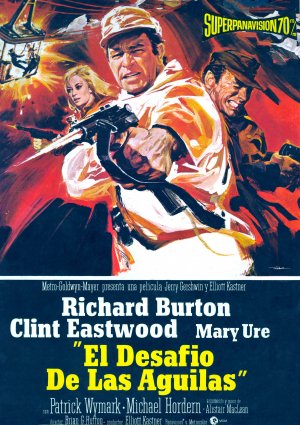
Hollywood has yet to equal "Where Eagles Dare."

Subscribe to:
Posts (Atom)