Translate

Showing posts with label Hollywood. Show all posts

Sunday, January 13, 2013

A FILM REVIEW OF ''GANGSTER SQUAD" (2013)


Most movies give you a chance to get comfortable with their narratives before they hit you with the hard stuff.  “Zombieland” director Rueben Fleischer’s profane, bullet-riddled, urban crime thriller “Gangster Squad” (*** OUT OF ****) cherishes no such illusions.  Early into the action, the arch villain of Angel City—real-life hoodlum legend Mickey Cohen—threads chains around the rear bumpers of two automobiles with an angry out-of-town mobster entangled in a hammock of chains between the cars.  Native Americans saved this ghastly fate for only the most repugnant whites in old movie westerns, except with horses rather than cars.  After a brief conversation, Cohen orders the cars to careen off in different directions.  An aerial long shot depicts the poor dastard as his body bursts apart in the middle.  Indeed, “Gangster Squad” isn’t for everybody.  This suspenseful, often violent, but thoroughly melodramatic law and order epic recounts how an undercover unit of Los Angeles cops fought fire with fire in their war on crime.  They destroyed Cohen’s dreams of turning California into his own private criminal empire.  Movies like “Gangster Squad” used to be the bread and butter for Warner Brothers.  The landmark Burbank studio produced the earliest and most controversial gangster thrillers in the 1930s with the three most memorable stars: James Cagney, Edward G. Robinson, and Humphrey Bogart.


Los Angeles Police Chief Bill Parker (a beefy Nick Nolte of “48 HRS”) summons World War II veteran, Sergeant John O’Mara (Josh Brolin of “Jonah Hex”), because he needs somebody fearless enough to tackle a special assignment.  Lately, Jewish crime figure Mickey Cohen (Sean Penn of “Bad Boys”) has been creating chaos in the City of Angels.  Not only does he own a respected judge, but he has also been cheating on his mobster cronies both in Chicago as well as Los Angeles.  The Chicago mob isn’t happy with Mickey’s behavior.  The King of the Sunset Strip refuses to bow and scrape to the Windy City hoodlums.  He has nothing but contempt for local crime boss Jack Dragna (Jon Polito of “The Big Lebowski”) and orders hits on his life.  At one point, a shoeshine kid dies in an attempt on Dragna’s life.  Cohen has established himself as a warlord, and he refuses to share and share alike with the mob.  Incidentally, for the sake of armchair movie historians, “Gangster Squad” takes place after the demise of Benjamin Siegel, a.k.a. “Bugsy” (1991) with Warren Beatty as the notorious gangster who forged Las Vegas into the gambling capital of America.  At one time, Mickey Cohen worked for Siegel as a henchman.  Two bullets to the head scrapped Siegel’s criminal career in 1947.  “Gangster Squad” opens in 1949 during the rising tensions of the Cold War between the U.S. and the U.S.S.R.  


Essentially, Chief Parker asks O’Mara to assemble a unit to harass Cohen.  "Don't make arrests," Parker grumbles. "This is occupied territory. Wage guerrilla warfare." O’Mara forms a rainbow-colored “A-Team” consisting of African-American Officer Coleman Harris (Anthony Mackie of “Real Steel”), older white cop, Officer Max Kennard (Robert Patrick of “Terminator 2: Judgment Day”), his Hispanic partner, Officer Navidad Ramirez (Michael Peña of “End of Watch”), Officer Conway Keeler (Giovanni Ribisi of “Ted”), and eventually Sergeant Jerry Wooters (Ryan Gosling of “Drive”).  One of the first things that they do is plant a bug in Cohen’s house so they can monitor him.  Methodically, these guys shoot up Cohen’s bars, casinos, and disrupt his narcotics traffic.  Wooters takes an interest in Cohen’s girlfriend, Grace Faraday (Emma Stone of “Easy A”), who is supposed to be teaching Mickey etiquette.  True events "inspired" “Gangster Squad,” and this means that Hollywood has taken dramatic license with history.  Actually, the movie is based loosely on Paul Lieberman’s book.  As far as I know, our tall, rugged hero didn’t go toe-to-toe with the considerably shorter Cohen in a public place and beat him to a bloody pulp.  Of course, movies have to be both heroic and confrontational, and "Gangster Squad" possesses both of these attributes. 
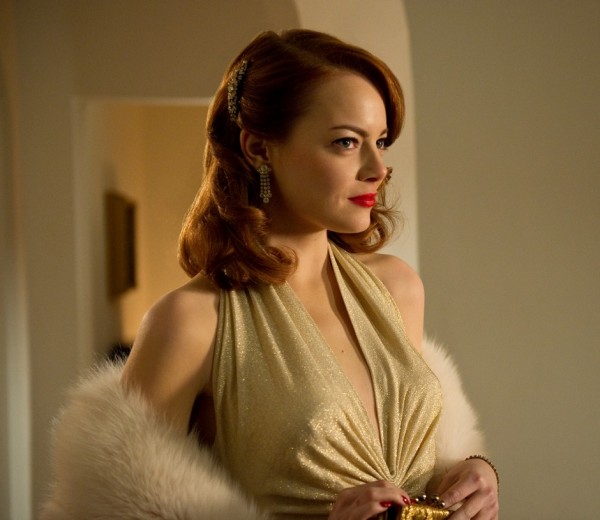

This obstreperous, 110-minute, R-rated, shoot’em up doesn’t flinch when it comes to episodes of violence.  Despite the recent bloodbaths both in movie theaters and elementary schools, this standard-issue, old school Warner Brothers release embraces wholesale violence with relish.  Fleischer features fashionable thugs armed with machine guns strafing anybody in sight, including poor white shoeshine boys.  Fleischer stages the action with considerable finesse, and he relies on a charismatic cast to deliver a synthesis of “The Untouchables” with Kevin Costner and “L.A. Confidential” with Russell Crowe.  Despite a plethora of action, largely frontal assault firefights on gritty city streets with .45 caliber Thompson submachine guns, “Gangster Squad” suffers from halfheartedly etched characters, a contrived screenplay by former LAPD homicide investigator and novelist Will Beall, and a numbing sense of predictability.  You can guess what is going to happen before it does, but everybody looks good doing it.  Nevertheless, genre fans should appreciate the studious lengths that the filmmakers have taken to recreate Los Angeles in the late 1940s.  Some of the action was lensed on genuine L.A. locations and enhances the authenticity of the action. Flinty-eyed Josh Brolin makes a sturdy hero, while Ryan Gosling channels Humphrey Bogart.  Sadly, Emma Stone lingerfs on the periphery as the love interest who eventually figures in the demise of Sean Penn’s Mickey Cohen. Penn chews the scenery as Cohen.  No doubt he watched both "Scarface" and "The Untouchables." Altogether, “Gangster Squad” qualifies as a good actioneer, with good performances, and good cinematography.

Saturday, January 3, 2009

FILM REVIEW OF ''PAPARAZZI" (2004)

Out of all the new movies that producer Mel Gibson could have made to follow up his triumphant "Passion of the Christ," the "Lethal Weapon" superstar selected "Paparazzi" (*1/2 out of ****), a shoddy, sadistic, inconsequential, melodramatic revenge thriller about a film star's tribulations with a gang of tawdry tabloid photographers. Casting Cole Hauser against type as a hero after his villainous roles in "Pitch Black" and "2 Fast 2 Furious" seems almost inspired. Indeed, when Hauser embraces vigilantism in the finest tradition of the best known screen vigilantes (anybody remember Charles Bronson in "Death Wish" or "Mr. Majestyk"?), you believe that he not only can kill without remorse, but also he can get away with homicide because his reasons justify his actions. Nevertheless, effective casting cannot overcome the cynicism and mean-spirited violence in freshman writer Forrest Smith's formulaic screenplay. "Paparazzi" recycles every cliché that audiences have come to expect in a movie about retribution.

Reportedly, Gibson concocted the idea for "Paparazzi," and he makes a cameo appearance as himself about 30 minutes into the plot as a patient at an anger management clinic. Yes, Gibson has had his share of close encounters with the paparazzi, so it doesn't take much imagination to figure out that the "Paparazzi" hero may be based loosely on Gibson. Back in 1990, Gibson destroyed a shutter bug's camera outside a Modesto, California, nightclub. Casting closer to the bone, the filmmakers take advantage of "Saving Private Ryan's" Tom Sizemore, whose own destructive real-life antics must have given him certain insights into making the sleazy villain that he plays seem as morally repugnant as possible. Although Hauser looks right for his role and Sizemore indulges himself with hammy 'big bad wolf' histrionics, "Law & Order's" Dennis Farina as a suspicious "Columbo" type detective delivers the best performance and steals the show. Ambiguity makes Farina's character look compelling. Is he a conscientious cop or a lowdown blackmailer? Sadly, "Paparazzi" lacks the artistic ambiguity of the Farina cop character. Furthermore, this predictable potboiler endorses vigilantism.

As "Paparazzi" opens, we're introduced to rugged Montana-born actor Bo Laramie (Cole Hauser) who has just become Hollywood's hottest celebrity hunk as well as prime prey for the paparazzi. The paparazzi--for the uninitiated--consist of unethical photographers who take morally compromising pictures of celebrities when the stars aren't looking or struggle to avoid being caught-on-camera. These troublemakers stalk their prey, sometimes climbing trees to obtain stills of celebrities sun-bathing in the nude. Naked photos of Bo and his wife Abby (Robin Tunney of "Vertical Limit") show up on the front page of a national tabloid, and bottom-feeding photog Rex Harper (Tom Sizemore of "True Romance") resolves to get even more sordid pictures of our clean-cut hero. At a soccer game, Rex snaps pictures of Bo's young son Zach (Blake Michael Bryan of "Jurassic Park III") and Bo warns Rex to stop. The obnoxious, low-life Rex eggs Bo into hitting him. When Bo punches Rex, the van behind Rex pops open to reveal more shutter-bugs taking pictures and videotape of Rex and Bo. Bo settles out of court with Harper, paying the scoundrel over $100-thousand. Moreover, the judge orders Bo to enter anger-management therapy. Bo has little use for psychotherapy, especially after the paparazzi assail him in traffic with a barrage of camera bulbs flashing all around him like strobes. Rex and his low-lifers, including actor Daniel Baldwin as Wendell Stokes, race up alongside Bo on either side and virtually blind him with their camera lights. Bo stomps the brakes to elude them. No sooner has Bo gotten away from the paparazzi than out of nowhere a truck slams into him! The truck driver dies instantly from the impact of the collision. Abby and Bo lay unconscious in their wrecked car, while Zach in the back seat suffers from what we later learn is a coma. After they call 911 to report the wreck, Rex and his cronies have a field day clicking photos of the accident. Later, after this near death experience, Bo decides to exact a little Montana style vigilante justice from the paparazzi. Nosy Detective Burton (Dennis Farina of ''Snatch''), the cop assigned to investigate the car crash, complicates matters, because Bo wants to get his revenge without incriminating himself to the police.

Hair stylist-turned-movie director Paul Abascal curbed the on-screen violence so that "Paparazzi" could acquire a family-friendly PG-13 rating, just as he reins in the running time to a scant 85 minutes. Unfortunately, "Paparazzi" looks like it has been hacked to the marrow. The film lurches along unevenly in fits and starts with important information withheld to maintain momentum. "Paparazzi" wallows in cynicism and violence, too. The hero has no room to negotiate with the villains. It's all or nothing. You know from the get- go that the villains are going to burn. They commit the worst sin of movie villains: they put a child in peril. Anybody who harms a kid in a movie usually dies a horrible death. Although the violence itself isn't basted in blood and gore, the ease with which the hero resorts to it and our complicity as vicarious eavesdroppers who sympathize with him makes the violence doubly immoral. Scenarist Forrest Smith contrives one improbable plot point after another to draw out this forgettable fodder. After having his wife and himself photographed in the nude on a beach, our hero should have had enough sense not to put themselves on display again. Incredibly, they leave themselves wide open to the villains throughout the film. Surprisingly, the Los Angeles Police Department has not protested about the way that the movie makers portray the LAPD as trigger-happy. Watching "Paparazzi" is like rubbernecking at the scene of an accident after the bodies have been removed.