"Autopsy" director Armando Crispino's historically inaccurate but nevertheless gripping World War II behind-enemy-lines, secret-mission thriller "Commandos" (***1/2 out of ****) qualifies as a rugged, gritty, suspenseful combat epic. This cynical Italian produced melodrama about a group of Italian-Americans masquerading as Royal Italian infantry so they can capture an oasis on the eve of the North African campaign in early 1942 removes any traces of glamour about war. Crispino and fellow scenarists Lucio Battistrada of "Crime Boss," Stefano Strucchi, and Dario Argento of "Suspiria" drew their robust screenplay from a short story by Israel filmmaker Menahem Golan as well as a story by Don Martin of "The Storm Rider" and Teutonic producer Arthur Brauner. Brauner is a landmark German filmmaker who refurbished the "Dr. Mabuse" franchise in the early 1960s. Lee Van Cleef of “For A Few Dollars More” delivers a riveting performance as a belligerent, battle-scarred Bataan hero who survived, along with two other companions, a death-defying ordeal. He relives the horror of the experience throughout “Commandos.” Van Cleef has a lot to sink his teeth into and he dominates the action.
The supporting cast is good, particularly Joachim Fuchsberger as Oberleutnant Heitzel Agen, nicknamed the professor because he studied insects at the university. Götz George shines as Oberleutnant Rudi, the type who could have excelled as dedicated Hitler Youth. The most unusual role—as it says something about the difference between the Allied armies and the Axis foe—belongs to actress Marilù Tolo who plays a prostitute named Adriana. Although she doesn't play a major part, she poses an interesting complication for our heroes. Interestingly, she points out that she canearn more money in the army camp than back home. The two characters who triumph over adversity at the conclusion were well known character actors. Giovanni Scratuglia played in many Spaghetti westerns, while Heinz Reincke played one of the two German pilots that strafed the beaches in “The Longest Day.”
The conceit of "Commandos" is that our heroes are descendents of genuine Italians, and Sergeant Sullivan and his right-hand man Dino (Romano Puppo of "Death Rides A Horse") have spent a month training them for the mission. Sullivan has little regard for most of them, but he has nothing but sheer contempt for his superior officer, Captain Valli (Jack Kelly of "To Hell & Back") who has never baptized in combat. Sullivan and Valli get off to a bad start when Sullivan describes their objective as “some harebrained mission you made up yourself.” Valli defends the mission and his knowledge. “I know this operation exactly, right down to the last detail.” Sullivan criticizes Valli’s shortage of experience. “You got a lot of bright ideas, Captain, but do you know what killing is—exactly—with these (makes gestures with his hands) and (brandishing a bayonet) this?”
Later, during the inevitable briefing session,Valli explains they will parachute near their destination. They will drop two or three miles from the objective and then take an hour to march to the Italian garrison and occupy it. Arriving after dark, they encounter soon opposition and have to resort to their machine guns instead of knives. Captain Valli refuses to watch Sullivan turn the raid into a massacre and he spares the lives of Italian Lt. Tomassini (Marino Mase of "The Five Man Army") and many of his troops. Valli warns Tomassini that the lives of his men depend on his cooperation with Sullivan and him. “I mean exactly what I say so you better get that through your head.” Germans from a nearby base show up for spaghetti and our heroes struggle to suppress any suspicious behavior, especially from Rudi who wants to locate his missing engineers. Sullivan kills the surviving German engineer, but during the struggle the German fires Sullivan's pistol. Everybody stops what they are doing and disperses into the open with guns drawn. A soldier apologizes for shooting at a jackal. No sooner do the Germans leave than the Italian hatch a plan of escape.
They rig up a hook that enables them to shut off the electricity in the barracks where they are being held. They jump the guards, disarm them, disable a couple of transports and take off in another truck to the German camp. Early the next day, Valli and Sullivan cut them off and gun them down. Meanwhile, the Germans are about to pull out and the German commanding officer lets Oberleutnant Heitzel Agen inform the Italians to blow up the wells before they leave. Initially, Agen believes that he is just going to visit an old friend. After Agen leaves, one of the wounded Italians makes it to the German lines and informs them that the Italians are impostors. Agen is wearing the headset and talking to his commandant when he learns this alarming news. Eventually, the Germans arrive and it turns into a pitched battle. Only one Italian and one German survive the firefight and they throw away their guns and march off into the desert at fade-out
The themes of "Commandos" include the inhumanity of war, experienced versus inexperienced combatants, battlefield shock, and the duty that an officer has both to his men and the mission. The irony is that the Germans and the Italians are depicted with greater sympathy than the tough guy Americans. The German soldiers get along with each other as do the Italians, but the Americans clash, principally Sullivan and Valli. Other instances of irony occur that heighten the philosophical mindset of “Commandos.” The ending summarizes the madness of war as depicted here. Allied command scrubs the mission that Captain Valli has carefully orchestrated and he cannot accept this change of mind. Surprisingly, Sergeant Sullivan refuses to obey higher authority. Consequently, "Commandos" concludes with the Americans exploding the water holes and fighting the Germans with tragic results for both Sullivan and Valli.
Mind you, the authenticity of the action doesn't bear close scrutiny. Most military
enthusiasts will recognize the flaws immediately. For example, the Afrika Korps tanks are not the genuine vehicles. Instead, they are repainted U.S. Army Chaffee and Walker Bulldog tanks with German insignia, and the M3A1 submachine guns that the Americans tote weren't available for another year. Allowances must be made, however, and the Cold War tanks overlooked since the German tanks were long since kaput, while the "Dirty Dozen" machine guns look cool. Incidentally, the first American commandos were the U.S. Rangers as portrayed in the James Garner World War II movie "Darby's Rangers."
The sun-scorched widescreen photography of "Taste of Death" lenser Benito Frattari makes this desert-locked minor war film look sprawling and the nocturnal actions scenes have a perilous, primitive quality. The strident music of composer Mario Nascimbene enhances the suspense, especially when Sullivan and his men search for a wounded German engineer who remains at large in the compound. Nascimbene makes superb use of classical music from composer Edvard Grieg, specifically "In the Hall of the Mountain King." Whatever the case, “Commandos” neither glorifies nor glamorizes combat. Fighting is a hard sweaty business. Sergeant Sullivan summarizes it succinctly to Captain Valli in an earlier scene. “Do you know what blood smells like, Captain? It’s a hot smell, and it can get things messed up, too, because most men die hard.”

CINEMATIC REVELATIONS allows me the luxury of writing, editing and archiving my film and television reviews. Some reviews appeared initially in "The Commercial Dispatch" and "The Planet Weekly" and then later in the comment archives at the Internet Movie Database. IMDB.COM, however, imposes a limit on both the number of words and the number of times that an author may revise their comments. I hope that anybody who peruses these expanded reviews will find them useful.
Showing posts with label North Africa. Show all posts
Showing posts with label North Africa. Show all posts
Thursday, November 26, 2009


Tuesday, September 15, 2009
A Comparison of the war movies "Tobruk" and "Raid on Rommel"
Neither Arthur Hiller’s “Tobruk” (1967), starring Rock Hudson and George Peppard, nor Henry Hathaway’s “Raid on Rommel” (1971), with Richard Burton, qualify as classic Hollywood war movies. Nevertheless, “Tobruk” (*** OUT OF ****) and “Raid on Rommel” (*** OUT OF ****) rank in the upper middle third of all W.W.II tough-guy actioneers. Each film depicts a desperate Allied commando strike against the Nazi-held, Mediterranean port of Tobruk in 1942. These two war movies have an interesting but not unusual relationship. Producer Harry Tatelman dug the “Tobruk” action footage out of the Universal Studios film vault and integrated it into “Raid on Rommel.” The use of stock footage is not unheard of, and film studios have relied on it to cut costs. The difference with “Raid on Rommel” is it relies almost entirely on “Tobruk” for its action scenes, so much so that certain characters had to match the apparel of their “Tobruk” counterparts. Unlike the more commercially successful “Tobruk,” “Raid on Rommel” suffered the fate of its title character. Six months after its theatrical debut, “Raid on Rommel” showed up on television.
“Tobruk” and “Raid on Rommel” share more than the same action footage. The plots are practically identical. As the more ambitious of the two, “Tobruk” sets higher sights for itself. Sadly, the pretentious commentary about Judaism and violence detracts from the film’s fireball momentum. Indeed, Leo Gordon’s “Tobruk” script weaves messages skillfully into the dialogue, but the characters spend more time snarling than shooting. Hiller and Gordon pile on the subplots as if they were sandbags. Their strategy is shrewd but futile. The filmmakers struggle to avoid telling a predictable story by introducing something new about every 20 minutes. Ultimately, Hiller and Gordon fail to exploit the squabbles among the heroes because the storyline brings in some new danger that sidetracks the drama. “Tobruk” lacks a villain, too, a terrible flaw for any action movie. Action pictures are measured by the villain’s audacity. Challenging villains compel the hero to scale greater heights to triumph over evil. Rock Hudson impersonates an inconsistently written hero. One minute he rejects heroics, and then the next minute he’s leading the fight!
In “Tobruk,” Captain Kurt Bergman (George Peppard of “The A-Team”) heads an elite band of German Jews fighting for the British. They rescue Major Donald Craig (Rock Hudson) from a French prison and fly the uncooperative Craig from Algiers to Libya. Craig meets old school British Colonel Harker. According to Harker, his commandos have eight days to link up with British naval assault troops to blast Rommel’s fuel bunkers in Tobruk. Before the commandos can rendezvous with the navy, Harker’s men have to spike the harbor guns. “Your primary responsibility,” Colonel Harker (Nigel Green) briefs Craig in “Tobruk,” “is to route our convoy through 800 miles of the worse desert that the Sahara has to offer to the back door of Tobruk.” Disguised as German Africa Korps troops, Bergman’s German Jews escort Colonel Harker’s men, posing as British P.O.W.s, into the port city. Once he hears the plan, Craig grimaces: “It’s suicide.” “It’s orders,” Harker snaps. Moreover, Harker informs Craig that the major’s knowledge of the terrain is the key to the success of the mission.
Commandeered against his wishes to participate in this suicidal mission, Craig shrugs and espouses an anti-heroic posture, “My mother didn’t raise any heroes, colonel.” Violence, bloodshed, explosions, and treachery pave the road to “Tobruk” with considerable excitement. Colonel Harker doesn’t trust Bergman and his German Jews. Six years in Palestine gave Harker a lifelong suspicion of the Jews. The salty colonel represents the old school of the stiff upper lip. Harker irritates Major Craig when Craig charges that the mission is “impossible.” The Gordon script huddles these unhappy characters and tests their mettle in several tight spots. Unfortunately, these episodes serve more to pad out the action than propel it forward.
Rock Hudson’s Major Craig sloughs off his anti-hero attitude not long after he makes his pledge. He helps shoot down an Allied fighter that mistakes the German convoy with the real thing. Craig guides the British through a dangerous minefield, and commandeers a tank with a dummy grenade. As the sacrificial Jew, George Peppard’s sardonic Bergman wears the doomed look of Siegfried. If “Tobruk” were filmed today, Peppard’s smoking would epitomize his brazen attitude about death and risk taking. Sadly, Peppard’s death scene lacks luster; he dies far too easily. Such is not the case with Harker. After surrendering to the Germans, the colonel discovers the identity of a traitor and shoots him. Naturally, the German execute Harker on the spot. Harker’s death scene bursts with old school gallantry.
As a shoot’em up war epic, “Tobruk” more than makes the grade. Director Arthur Hiller is better known for his comedy movies, but he manages to keep the action moving despite the loquacious interludes about violence and Judaism. Several incidents that occur on the way to Tobruk are fodder. The problem here is that only Colonel Harker’s schedule keeps them moving, a flimsy excuse for motivation. The climatic battle on the cliff above the beach near the coastal gun emplacements is first-class war stuff. Veteran movie director Joseph Kane staged these sequences, and they crackle with excitement. Finally, “Tobruk” is more ambitious, but the film’s pretentiousness interferes. The producers assembled too much plot for “Tobruk” and lost sight of the basic drama.
The people who made “Raid on Rommel” contented themselves with less plot and created situations of greater dramatic value. The more satisfying of the two movies, “Raid on Rommel” avoids sermons about Judaism. Every good war movie should deal with the theme of war and its impact on morality, but not to the extent that “Tobruk” spews the familiar cliches. Far more scaled down, “Raid” succeeds because veteran director Henry Hathaway knew how to convert a routine commando mission into an exciting, old-fashioned yarn with heroes and villains.
“Raid on Rommel” opens at dawn in the deserts of Libya. English troops riddle a British half-track with a machine gun. Captain Alec Foster (Richard Burton) disguises himself as a corporal. Watching Richard Burton scowl and snarl is half of the fun of “Raid on Rommel.” Foster watches while the medical staff loads the pale corpses of two British soldiers into the half-track. Foster climbs in and drives off into the desert.
Meanwhile, a German plane lands at a Nazi camp in the desert, and Captain Heinz Schroeder (Karl-Otto Alberty of "Kelly's Heroes") receives orders to evacuate to Tobruk. An incredulous Major Tarkington (Clinton Greyn), the medical officer, complains that moving wounded prisoners into an active war zone violates the Geneva Convention. Schroeder dismisses the objection. The Germans now occupy the port city, and Schroeder assures him that Tobruk is safe. Afterward, Schroeder deals with the obstreperous mistress of an Italian general, Vivi (Danielle DeMetz). She hates Schroeder, the Nazis, and the English, too. She has few romantic notions about men since her Italian general abandoned her. Although she appears distinctly out of place, director Henry Hathaway manages to integrate Vivi into the action in a useful way unlike the expendable civilian spies in “Tobruk.”
The Germans spot Foster’s half-track veering erratically through the desert. Foster is passed out on the steering wheel when the Germans capture him. Schroeder’s men drag him out of the half-track, and dump him unceremoniously in the sand. Foster acts as if he were unconscious. Tarkington plays along with Foster’s sham. He diagnoses him as suffering from shock and exposure. Later, Foster is furious when he learns that the Fifth Commandos have been afflicted with dysentery and shipped off to a concentration camp. The Fifth Commandos were the guys who he was supposed to lead. The plan called from them to take over the convoy before it reached Tobruk.
Reluctantly, he enlists the aid of the few remaining commandos and Tarkington’s hospital unit to spike the coastal guns at Tobruk. On the road to Tobruk, Foster and Sgt.Maj. Allen MacKenzie (John Colicos) whip these green troops into shape. They force them to jog alongside the transports, rappel off the sides of the trucks, and teach them how to use machine guns, mortars, and a flamethrower. Richard Burton’s presence bolsters this standard issue war movie. He looks cool in a German uniform, and his escapade in the tank at the fuel bunker is memorable.
As Nazi Captain Heinz Schroeder, Karl-Otto Alberty qualifies as the villain. He rubs everybody the wrong way. He takes particular delight at infuriating Vivi. He thrives on war and observes that desert warfare is pure warfare. No women, children, or civilians clutter things up, just soldiers fighting soldiers. Major Tarkington shakes his head in revulsion. He shares none of Schroeder’s sentiments about the glory of war. Finally, Schroeder confirms his villainy when he shoots a Quaker corpsman in the back as the man is nursing Foster’s wounds. Foster empties his pistol into Schroeder. Later, Tarkington crosses swords with Foster on similar incidents. They argue about warfare and its brute nature. Ironically, “Raid on Rommel” is the better of the two films because the filmmakers tell a better story. Director Henry Hathaway of “True Grit” fame streamlined everything in “Raid on Rommel” so that it appeared a part of the plot. No self-respecting W.W. II cinemaphile should deprive himself of the pleasure of watching these two movies. Happily, “Tobruk” and “Raid” are enjoying a second lease on video life.
“Tobruk” and “Raid on Rommel” share more than the same action footage. The plots are practically identical. As the more ambitious of the two, “Tobruk” sets higher sights for itself. Sadly, the pretentious commentary about Judaism and violence detracts from the film’s fireball momentum. Indeed, Leo Gordon’s “Tobruk” script weaves messages skillfully into the dialogue, but the characters spend more time snarling than shooting. Hiller and Gordon pile on the subplots as if they were sandbags. Their strategy is shrewd but futile. The filmmakers struggle to avoid telling a predictable story by introducing something new about every 20 minutes. Ultimately, Hiller and Gordon fail to exploit the squabbles among the heroes because the storyline brings in some new danger that sidetracks the drama. “Tobruk” lacks a villain, too, a terrible flaw for any action movie. Action pictures are measured by the villain’s audacity. Challenging villains compel the hero to scale greater heights to triumph over evil. Rock Hudson impersonates an inconsistently written hero. One minute he rejects heroics, and then the next minute he’s leading the fight!
In “Tobruk,” Captain Kurt Bergman (George Peppard of “The A-Team”) heads an elite band of German Jews fighting for the British. They rescue Major Donald Craig (Rock Hudson) from a French prison and fly the uncooperative Craig from Algiers to Libya. Craig meets old school British Colonel Harker. According to Harker, his commandos have eight days to link up with British naval assault troops to blast Rommel’s fuel bunkers in Tobruk. Before the commandos can rendezvous with the navy, Harker’s men have to spike the harbor guns. “Your primary responsibility,” Colonel Harker (Nigel Green) briefs Craig in “Tobruk,” “is to route our convoy through 800 miles of the worse desert that the Sahara has to offer to the back door of Tobruk.” Disguised as German Africa Korps troops, Bergman’s German Jews escort Colonel Harker’s men, posing as British P.O.W.s, into the port city. Once he hears the plan, Craig grimaces: “It’s suicide.” “It’s orders,” Harker snaps. Moreover, Harker informs Craig that the major’s knowledge of the terrain is the key to the success of the mission.
Commandeered against his wishes to participate in this suicidal mission, Craig shrugs and espouses an anti-heroic posture, “My mother didn’t raise any heroes, colonel.” Violence, bloodshed, explosions, and treachery pave the road to “Tobruk” with considerable excitement. Colonel Harker doesn’t trust Bergman and his German Jews. Six years in Palestine gave Harker a lifelong suspicion of the Jews. The salty colonel represents the old school of the stiff upper lip. Harker irritates Major Craig when Craig charges that the mission is “impossible.” The Gordon script huddles these unhappy characters and tests their mettle in several tight spots. Unfortunately, these episodes serve more to pad out the action than propel it forward.
Rock Hudson’s Major Craig sloughs off his anti-hero attitude not long after he makes his pledge. He helps shoot down an Allied fighter that mistakes the German convoy with the real thing. Craig guides the British through a dangerous minefield, and commandeers a tank with a dummy grenade. As the sacrificial Jew, George Peppard’s sardonic Bergman wears the doomed look of Siegfried. If “Tobruk” were filmed today, Peppard’s smoking would epitomize his brazen attitude about death and risk taking. Sadly, Peppard’s death scene lacks luster; he dies far too easily. Such is not the case with Harker. After surrendering to the Germans, the colonel discovers the identity of a traitor and shoots him. Naturally, the German execute Harker on the spot. Harker’s death scene bursts with old school gallantry.
As a shoot’em up war epic, “Tobruk” more than makes the grade. Director Arthur Hiller is better known for his comedy movies, but he manages to keep the action moving despite the loquacious interludes about violence and Judaism. Several incidents that occur on the way to Tobruk are fodder. The problem here is that only Colonel Harker’s schedule keeps them moving, a flimsy excuse for motivation. The climatic battle on the cliff above the beach near the coastal gun emplacements is first-class war stuff. Veteran movie director Joseph Kane staged these sequences, and they crackle with excitement. Finally, “Tobruk” is more ambitious, but the film’s pretentiousness interferes. The producers assembled too much plot for “Tobruk” and lost sight of the basic drama.
The people who made “Raid on Rommel” contented themselves with less plot and created situations of greater dramatic value. The more satisfying of the two movies, “Raid on Rommel” avoids sermons about Judaism. Every good war movie should deal with the theme of war and its impact on morality, but not to the extent that “Tobruk” spews the familiar cliches. Far more scaled down, “Raid” succeeds because veteran director Henry Hathaway knew how to convert a routine commando mission into an exciting, old-fashioned yarn with heroes and villains.
“Raid on Rommel” opens at dawn in the deserts of Libya. English troops riddle a British half-track with a machine gun. Captain Alec Foster (Richard Burton) disguises himself as a corporal. Watching Richard Burton scowl and snarl is half of the fun of “Raid on Rommel.” Foster watches while the medical staff loads the pale corpses of two British soldiers into the half-track. Foster climbs in and drives off into the desert.
Meanwhile, a German plane lands at a Nazi camp in the desert, and Captain Heinz Schroeder (Karl-Otto Alberty of "Kelly's Heroes") receives orders to evacuate to Tobruk. An incredulous Major Tarkington (Clinton Greyn), the medical officer, complains that moving wounded prisoners into an active war zone violates the Geneva Convention. Schroeder dismisses the objection. The Germans now occupy the port city, and Schroeder assures him that Tobruk is safe. Afterward, Schroeder deals with the obstreperous mistress of an Italian general, Vivi (Danielle DeMetz). She hates Schroeder, the Nazis, and the English, too. She has few romantic notions about men since her Italian general abandoned her. Although she appears distinctly out of place, director Henry Hathaway manages to integrate Vivi into the action in a useful way unlike the expendable civilian spies in “Tobruk.”
The Germans spot Foster’s half-track veering erratically through the desert. Foster is passed out on the steering wheel when the Germans capture him. Schroeder’s men drag him out of the half-track, and dump him unceremoniously in the sand. Foster acts as if he were unconscious. Tarkington plays along with Foster’s sham. He diagnoses him as suffering from shock and exposure. Later, Foster is furious when he learns that the Fifth Commandos have been afflicted with dysentery and shipped off to a concentration camp. The Fifth Commandos were the guys who he was supposed to lead. The plan called from them to take over the convoy before it reached Tobruk.
Reluctantly, he enlists the aid of the few remaining commandos and Tarkington’s hospital unit to spike the coastal guns at Tobruk. On the road to Tobruk, Foster and Sgt.Maj. Allen MacKenzie (John Colicos) whip these green troops into shape. They force them to jog alongside the transports, rappel off the sides of the trucks, and teach them how to use machine guns, mortars, and a flamethrower. Richard Burton’s presence bolsters this standard issue war movie. He looks cool in a German uniform, and his escapade in the tank at the fuel bunker is memorable.
As Nazi Captain Heinz Schroeder, Karl-Otto Alberty qualifies as the villain. He rubs everybody the wrong way. He takes particular delight at infuriating Vivi. He thrives on war and observes that desert warfare is pure warfare. No women, children, or civilians clutter things up, just soldiers fighting soldiers. Major Tarkington shakes his head in revulsion. He shares none of Schroeder’s sentiments about the glory of war. Finally, Schroeder confirms his villainy when he shoots a Quaker corpsman in the back as the man is nursing Foster’s wounds. Foster empties his pistol into Schroeder. Later, Tarkington crosses swords with Foster on similar incidents. They argue about warfare and its brute nature. Ironically, “Raid on Rommel” is the better of the two films because the filmmakers tell a better story. Director Henry Hathaway of “True Grit” fame streamlined everything in “Raid on Rommel” so that it appeared a part of the plot. No self-respecting W.W. II cinemaphile should deprive himself of the pleasure of watching these two movies. Happily, “Tobruk” and “Raid” are enjoying a second lease on video life.
Thursday, October 2, 2008
FILM REVIEW OF ''RAID ON ROMMEL'' (1971)


Indeed, "Major Payne" producer Harry M. Tatelman plundered the Universal Studios' stock footage archives for all of the exciting action footage from Hiller's "Tobruk" and "Ride to the Hangman's Tree" editor Gene Palmer seamlessly incorporated it into "Raid on Rommel." I would even argue that the action footage fares better in "Raid on Rommel" than in Hiller's "Tobruk." "Tobruk" was a "Guns of Navarone" clone with Rock Hudson as a Canadian and George Peppard as a German Jew fighting against the Nazis. Mind you, recycling footage in Hollywood is an age-old, time-honored practice. For example, every low-budget caveman or lost continent movie that came out of Hollywood in the 1950s exploited footage from "One Million B.C."
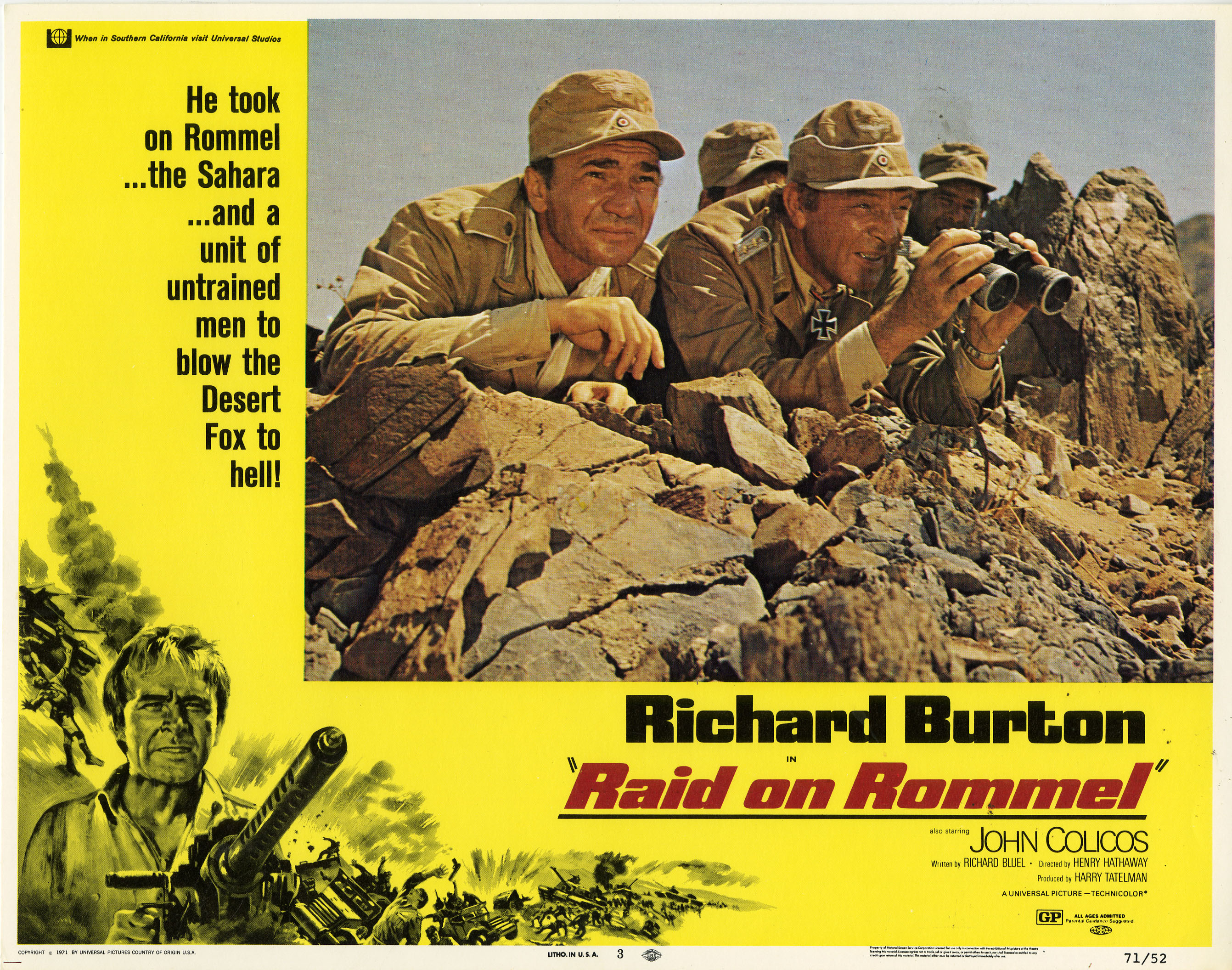
In "Raid on Rommel," Burton is cast as Captain Alex Foster. British Intelligence riddles a Nazi half-track with machine gun fire and Foster climbs into it and drives off into the desert seemingly oblivious as to his destination. Later, a Nazi convoy ferrying sick P.O.W.s discovers Foster and picks him up. Initially, Major Hugh Tarkington (Clinton Greyn of "Robbery") knows that Foster isn't suffering from heat exhaustion, but he warns him that he wants to know his orders. Foster reveals his mission to Tarkington, only to learn that he has stumbled onto the wrong convoy. Instead of seasoned commandos at his disposal, he has the sick and the injured. Boy, is Foster upset and Tarkington isn't inclined to help him. Eventually, Tarkington changes his mind.

Meanwhile, Foster manages to make something of the men at his disposal thanks largely to Sgt. Maj. Allan MacKenzie (John Colios of "Scorpio") and the British overpower their Nazi captors and disguise themselves as the enemy. Talk about improvising! On their way to Tobruk, Foster and MacKenzie give their men a boot camp in firing mortars and rappelling down ropes by slinging them to the sides of the personnel carriers. Along the way, they pick up a civilian and a beautiful woman and use them as a part of their masquerade. Our valiant heroes enter Tobruk, meet Rommel at his headquarters where Foster learns the whereabouts of a fuel depot, and then they blow everything to hell and gone. The scene at Rommel's headquarters is especially neat because Tarkington gets into a polite argument with a cultured Rommel about collecting postage stamps, thereby giving Foster—disguised as a Nazi officer—time to study secret German maps.
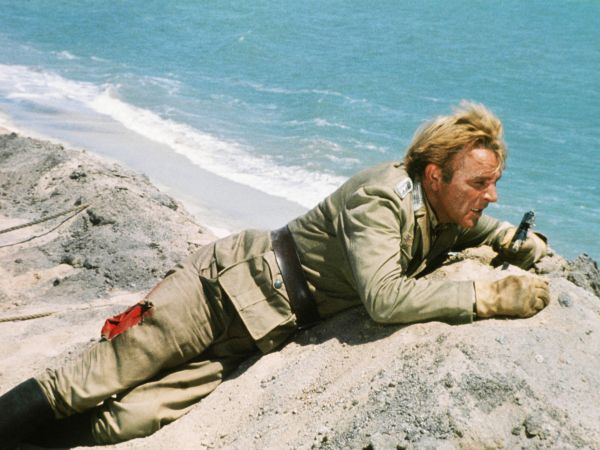
No, "Raid on Rommel" is not the most historically accurate World War II film by any stretch of the imagination. However, few films produced about historical events are faithful to history. If you see a movie to get the facts straight, you're a misguided soul. Hollywood doesn't specialize in history lessons; movie makers want to entertain us first and then second strive for accuracy. During the last half of the 20th century, all World War II movies contained historically inaccurate equipment. American 'Cold War' army tanks usually masqueraded as Nazi Tiger Tanks and vintage Navy propeller driven fighters doubled for Japanese Zeroes. As far as that goes, most filmmakers ignored the fact that Nazis spoke German and Hitler's madmen uttered their lines with obvious ersatz accents. These problems became conventions largely because American audiences couldn't speak the foreign dialects and subtitles were confined to foreign art films. "Raid on Rommel" contains one of the most obvious conventions of World War II movies that "Catch-22" changed. During one scene, an Allied P-40 Tomahawk fighter attacks the Nazi convoy that Foster has joined. The enemy manages to hit the fighter and it streaks off, pouring smoke, and crashes behind a sand dune with a fireball explosion rolling heavenward to mark its demise. Of course, the producers no more than the owner of that vintage plane were about to destroy it for this inconsequential movie. In "Catch-22," you actually get to see a plane crash nose first into the side of mountain!

Meanwhile, the significance of "Raid on Rommel" is undoubtedly lost on today's audience. In 1951, Hathaway helmed an ahead-of-its-time World War II biography "The Desert Fox" and portrayed Rommel (James Mason) in sympathetic terms. In fact, Hathaway's portrait of Rommel proved too sympathetic and most film critics scourged Twentieth Century Fox for this depiction. A couple of years later to set the record straight, Mason reprised his role as Rommel in "The Desert Rats" and he was not accorded the sympathy that outraged critics in the Hathaway gem. Read the major reviews of "The Desert Fox" in Time, Newsweek, and the New York Times and you will see for yourself that Hathaway stirred up controversy.
Yes, "Raid on Rommel" is a potboiler of sorts, probably memorable to World War II fans more for Hathaway's brief but sympathetic Rommel scene and for—according to one Burton biographer—Burton's sober performance. He didn't drink a drop while he was acting, but then crusty old Henry Hathaway, who never gave any actor a break, probably kept his eye on the Welshman. The performances are standard and one of the most respected Bavarian actors who specialized in playing German officers—Wolfgang Preiss—plays Field Marshal Rommel.

Subscribe to:
Posts (Atom)