Translate

Showing posts with label the Old West. Show all posts

Monday, May 21, 2012

FILM REVIEW OF ''THE GRAND DUEL" (Italian-1972)


Prolific Spaghetti western scenarist Ernesto Gastaldi penned the script for this Lee Van Cleef continental oater "The Grand Duel," directed with considerable competence by Giancarlo Santi. Although he didn't helm any Spaghetti westerns aside from "Grand Duel" on his own, Santi served as Sergio Leone's assistant director on "The Good, the Bad, and the Ugly" (1966) and his masterpiece "Once Upon A Time in the West" (1968) as well as Giulio Petroni's assistant director on "Death Rides A Horse"(1967). In short, not only did Santi know how to stage gunfights, but he also knew about the conventions of the Spaghetti western bullet ballet. Originally, Santi was hired to direct "Duck You Sucker," but Rod Steiger's complaints prompted Leone to replace Santi. "The Grand Duel" ranks high up in the lower 25 Spaghetti westerns out of the best 100. Three things make it memorable.  First, this above-average shoot'em up benefits largely from Lee Van Cleef's iconic gimlet-eyed presence. Second, the mystery gradually unraveled --presented in surrealistic flashbacks--generates suspense and tension. Third, Sergio Bardotti & Luis Enriquez Bacalov’s unforgettable orchestral score that signals the tonal changes in the narrative.

Roughly speaking, the motives of the characters in "The Grand Duel" reverse the relationship between the old gunslinger (Henry Fonda) and youthful gunfighter (Terence Hill) in Tonino Valerii's "My Name Is Nobody." Meanwhile, Van Cleef's entrance in "The Grand Duel" imitates his striking introduction in Leone's "For A Few Dollars More." In these Italian horse operas, Van Cleef is presented initially as a commercial passenger. In "The Grand Duel," he rides in a stagecoach, while he rides in a train with his head bowed beneath a black hat in "For A Few Dollars More." In the latter film, Van Cleef concealed his face behind a huge Bible when he asked the conductor about the train making an unscheduled stop. The conductor warns him they aren't going to stop where Van Cleef's frock-coated, black hat clad character wants. Nevertheless, Van Cleef tugs the emergency cord, halting the train, and disembarks to fetch his horse from the freight car.

As "The Grand Duel" opens, lawmen fire warning shots at the stagecoach that Sheriff Clayton (Lee Van Cleef) is riding in and refuse to let Big Horse (Jess Han of "Escape from Death Row") enter Gila Bend. They explain that escaped killer Philipp Wermeer (one-time-only actor Peter O'Brien, aka Alberto Dentice) has holed up with a girl in town after breaking out of jail in Jefferson. The authorities have posted a $3-thousand bounty on Vermeer's head. Nevertheless, Clayton disembarks and strolls without any apparent concern past two lawmen and several bounty hunters to quench his thirst in Gila Bend. This introductory scene unfolds at a leisurely pace as it covers points, such as where the bounty hunters are hidden and Clayton's imperturbability in the face of death. Clayton indicates the positions of all the bounty hunters to Vermeer. Later, after our wrongly convicted hero eludes the bounty hunters during a furious horse chase. The villains kill his horse, but he flags down a stagecoach. The entire scene resembles the scene from John Ford's "Stagecoach" when Ringo (John Wayne) who was afoot clambered inside the vehicle.


The omniscient Lee Van Cleef hero dominates the action. The hooked-nosed, veteran Hollywood heavy delivers a stern but seasoned performance as the worldly-wise elder. Van Cleef smokes his signature curved pipe. Actually, when we meet Clayton, he is no longer the sheriff of Jefferson. He protested Philip Vermeer's conviction, and the authorities stripped him of his badge. Earlier, he had taken the Patriarch to court three times. Eventually, as the best man with a gun in the entire state, Clayton ushers in justice above the law. Anyway, one of the Patriarch's sons Eli Saxon (bald headed Marc Mazza of "Moonraker") accused Philipp Vermeer of killing the Patriarch, (Horst Frank in a dual role wearing whiskers), a wealthy, unscrupulous power-broker abhorred by half of the state. Vermeer suspects that the Patriarch had his father shot in the back because he learned about the silver on Vermeer's land. Meanwhile, Eli demands to know the identity of the man who killed his father. Clayton reminds Eli that the Patriarch was gunned down from behind and that Vermeer stood in front of them at the railway depot. Clearly, Vermeer couldn't have killed the Patriarch.
 
The vicious and degenerate "Grand Duel" villains qualify as challenging adversaries. David (Horst Frank of "Johnny Hamlet") rules the Saxon clan, while Eli serves as Saxon City's marshal, and Adam Saxon (Klaus Grunberg of "Fire, Ice, and Dynamite") runs the saloon. Grunberg plays Adam as a depraved homosexual who wears a vanilla-white suit, fedora, and constantly caresses a long scarf looped around his neck. The first time that we see Adam, he guns down an old man that his henchmen have thrown out of the saloon. Later, Adam massacres a wagon train with a machine gun and Brother David orders him to leave no eyewitnesses. David's words: "In a violent country, he who seizes today, controls tomorrow," epitomizes his treachery.


"The Grand Duel" plays out in three settings: first in Gila Bend; second at the isolated Silver Bells stagecoach station, and third in Saxon City where a showdown occurs in the stock pens in traditional western style. The final showdown scene is very atmospheric with Lee Van Cleef and his adversaries opening huge gates to each of the stock pens before they finally settle down to the shootout.  Santi never lets the action malinger. He does a good job with the first large-scale gunfight at the stagecoach station. The bounty vermin not only blow-up the stagecoach, but also shoot each other to increase their shares after Vermeer surrenders. The Saxon City shootout when Vermin pole vaults to safety is neat. The black & white night sequence that he stages during the Patriarch's killing has surrealistic quality. Meantime, hardcore Lee Van Cleef fans won't want to miss "The Grand Duel" for its several shootouts as well as the twists and turns in Gastaldi’s screenplay. Get the letterboxed Wild East DVD; it surpasses the full-frame, public domain DVD or the foreign, semi-letterboxed version.

Friday, July 8, 2011

FILM REVIEW OF "BIG JAKE" (1971)

Several things about director George Sherman’s last western shoot’em-up “Big Jake” (** out of ****)are significant. First, this represented the last time John Wayne and Maureen O’Hara co-starred in a film. Earlier, Wayne and O’Hara made “Rio Grande” (1950), “The Quiet Man” (1952), “The Wings of Eagles” (1957), and “McLintock!” (1963). O’Hara has two scenes in “Big Jake,” but she appears in only one with the Duke. They neither kiss nor do they embrace such is the animosity that keeps them apart. Second, this was the tenth and last time Wayne and Sherman worked together. Sherman had called the shots on several strictly average "Three Mesquiteers" B-movie westerns with Wayne for Republic Studios back in the late 1930s. Reportedly, Wayne stepped in to helm some scene when the ailing Sherman could not. Third, this violent turn-of-the-century oater also re-teams Wayne with a poncho-clad Richard Boone as a slimy main villain. Previously, they appeared together in “The Alamo” (1960) and later confronted each other again in a bar room shoot-out in Wayne’s final western “The Shootist” (1976).

Scenarists Harry Julian Fink and Rita M. Fink penned the formulaic screenplay about the kidnapping of a wealthy but aging cattleman’s grandson. The Finks were responsible for Don Siegel’s controversial police thriller “Dirty Harry” with Clint Eastwood and later “Cahill U.S. Marshal.” Unfortunately, despite some serviceable dialogue, “Big Jake” amounts to a sloppy, unsavory western with no sense of closure. The villains are a dastardly bunch, but they never truly challenge the heroes. The set-piece in an abandoned collection of buildings generates nothing in the way of suspense and tension. Further, “Big Jake” lacks the characteristic scene where Wayne one-ups an opponent. The closest thing to this scene is a shower scene, but it doesn’t cut the muster compared to scenes like in “McLintock!,” “Chism,” “The Train Robbers,” and “The Undefeated.” Some scenes that are clearly horseplay are embarrassingly bad, such as the automatic pistol scene at the river. Not only should O’Hara have returned for a final scene, but some sympathy should have been made to the hero’s dog and his Native American friend. As “Big Jake,” John Wayne spends most of his time riding around Mexico trying to keep himself and his two half-witted sons alive. One of his sons recoils at the thought of killing an animal to provide meal for supper and gets angry when he learns that he has killed somebody over a chest filled with paper clippings. Although this is largely a traditional Wayne western, “Big Jake” pits the weapons and transportation of an old-fashioned western (horses, revolvers, and shotguns) against the new-fangled western where people ride in cars or on motorcycles and wield automatic weapons. Predictably, ‘Big’ Jake wins the day with his old-fashioned approach. Sherman does a solid job of establishing the setting of this sagebrusher and the time period with a lengthy prologue.

John Fain (Richard Boone of “The Alamo”) leads a gang of murderous cutthroat outlaws who raid the McCandles ranch. This opening shoot-out qualifies as the bloodiest gunfight in a Wayne western. When bullets hit bodies, huge smears of red paint appear. Remember, the Duke objected to those exploding blood squibs in Sam Peckinpah’s “The Wild Bunch” and felt that it was obscene. Wayne’s second oldest son Patrick co-stars with him and Wayne’s youngest son Ethan Wayne plays the abducted child. A gallery of seasoned western character actors fleshes out this rugged western with Bruce Cabot, John Doucette, John Agar, Roy Jenson, Jim Davis, Hank Worden, and Harry Carey, Jr.

“Big Jake” unfolds with a historical prologue that contains narration accompanied by a slide show of ancient photographs. “1909, The Edwardian golden days. Genteel civilization had come to England, the continent, and the eastern United States. New York rivaled London and Paris as one of the great metropolises of the world. Albert Einstein had expounded his theory of relativity back in 1905 and science had brought us the wonders of the modern world. Culture and refinement had arrived on the east coast of America. Caruso was singing Pagliacci in the Met. Arturo Toscanini was conducting. The Barrymores were performing and the Ziegfeld Girl was the rage. 1909 in the western part of the 46 United States was not so refined. The surviving Indian warriors were now being rounded up by the U.S. Army. In Washington, William Howard Taft, 300 pounds of pure Republican, was president and life was comfortable. In other parts of the country men were fighting each other and the elements. In New York department stores, a lady could buy maxis and boots and live in style. Out west, they didn’t think about style, just living. Eastern empire builders had secured their fortunes, the Morgans, Vanderbilts, and Carnegies. There were empires in the west, too, such as the great McCandles Ranch. But these huge ranches were held together only by having enough men and guns.

Notre Dame teams were playing football with end Knute Rockne catching the forward pass. In the Arizona Territory, another team, the Arizona Rangers, were busy just trying to keep the peace. Anna Pavlova, the prima ballerina of the Russian Ballet was dancing “Swan Lake.” The dance-hall girl in the Klondike gold rush saloons was somewhat different. By 1909, still photographs had come to life. Motion pictures had been born with The Great Train Robbery. While that make-believe was on the movie screens, nine men crossed the Rio Bravo into Texas. The turbulent years between the Civil War and the turn of the century brought out the best in some people, but in others it brought out the worst. Example: O’ Brien, a half-breed Apache, born of a Chiricahua mother and Irish father. A professional gunfighter, one of the last of his kind. Pop Dawson, rode with the James boys in Kansas and Missouri. Said to have murdered more than a dozen men, one for as little as seven dollars. Trooper, name unknown. A back-shooter. Considered a coward. Reputed to have been a cavalry soldier sometime in the past, but not to the personal knowledge of his confederates. William Fain, youngest of the Fain brothers, favors a shotgun, a Greener, for its bloody killing effect at short range. James William Duffy. At age 14, killed his first man, who was an admirer of his prostitute mother. Dead shot with a rifle. William Devries, young Billy, not quite 21. This raid was thought to have been his first outlaw act. Walt Devries, his older brother by twenty years. He looks more like a farmer than a professional killer. John Goodfellow maybe the worst of them. An indiscriminate killer. Women, children, no consequence at all. Prefers to work close. Favors a razor-edged machete.”

Since most of the ranch hands are away on a round-up, Fain and his trigger-happy marauders have little trouble when they start blasting away after some friendly conversation with the foreman. Without a qualm, they wound and/or kill ten men, women and children few qualms. They wound McCandles' eldest son Jeff (Bobby Vinton of “Surf Party”) and kidnap the youngest McCandles son, eight-year old (Ethan Wayne) and post a a ransom of $1 million. ‘Big’ Jake McCandles’ wife, Martha (Maureen O'Hara of “The Quiet Man”) summons her estranged husband through some messengers. They meet at a railway station, and she hands him the ransom note. Jake fishes out his spectacles to peruse it. Jake and Martha have been estranged for almost a decade, but they both love little Jake and ‘Big Jake’ vows to bring him back. Waiting for their father at the depot are his sons James McCandles (real-life son Patrick Wayne of “The Alamo”) and Michael (Christopher Mitchum of “Rio Lobo”) and their reception is soured by James’ sarcasm toward his father. James calls him “Daddy” in a snide voice and Jake pulls him off his horse and hurls him into a mud puddle. Jake informs James with any subtlety: "You can call Dad, you can call me Father, you can call me Jacob and you can call me Jake. You can call me a dirty old son-of-a-bitch, but if you EVER call me Daddy again, I'll finish this fight." Jake takes custody of a huge red strongbox with a million dollars in it and rides off with his old friend Sam Sharpnose (Bruce Cabot) while James and Michael follow Buck and the Texas Rangers.

A conventional and often predictable oater, “Big Jake” springs no real surprises. The revelation that the strong box that our heroes have been guarding contains nothing but paper clippings comes as no surprise. No sooner have Buck and the Texas Rangers entered Mexico than Fain’s men ambush them, kill three of them, and shoot up their cars. Meanwhile, it appears that Michael has been shot because he crashes his motorcycle and lays sprawled in the dust. Jake is more surprised than we are when his son gets up. Naturally, this calls for Wayne to punch his lights out. Jake leaves the Texas Rangers to fend for themselves while he rides out to the rendezvous with Fain. At about a hour into the plot, Jake and Fain meet in Jake’s camp. Fain instructs them to go to the nearby Mexican town of Escondero and await their orders. Later that evening, gunmen try to storm room number eight where our heroes are lying in wait for them. Jake, James, and Sam leave Michael alone in the room. Jake stages a distraction so Sam can slip back into the room, while James guns down to bullies in the saloon with his automatic pistol. Not long afterward, a suspicious Pop Dawson fetches Jake and company and they ride out to meet Fain and ransom the youngster. It is a classic stand-off again when Fain and Jake confront each other with Little Jake in plain sight. Michael has ascended to the top of water tower and uses his high-powered rifle to knock out a sniper in an adjacent belfry. What started as an interesting scene degenerates into a free-for-all shoot-out without a shred of suspense. The brute with a machete manages to slash poor old Sam to death and later kills the dog. Jake throws a lantern at Fain and lights him up before he perforates him with a bullet. No sooner has Little Jake been reunited with his family than the film freeze-frames them and comes to an end.


“Big Jake” is a mediocre Wayne effort with more blood than usual, but it is nothing memorable. Elmer Bernstein provides an okay orchestral score.

Thursday, December 30, 2010

FILM REVIEW OF ''TRUE GRIT" (2010)

Remaking a classic movie is often a risky proposition. More often than not, Hollywood filmmakers aim high but wind up shooting low. "O, Brother Where Art Thou?" co-writer and directors Ethan and Joel Coens' remake of director Henry Hathaway's "True Grit" (1969), with John Wayne in his only Oscar winning performance, qualifies as the exception to the rule. Not only do the Coens aim high, but they also hit the bull's-eye. Ostensibly, they have done a splendid job with their first horse opera, and Jeff Bridges has filled some mighty big boots without stumbling. Strictly speaking, the Coens' "True Grit" (***1/2 OUT OF ****) isn't the first remake. Few remember director Richard T. Heffron's TV remake of "True Grit" with character actor Warren Oates donning the eye patch as Marshal Rooster Cogburn. Heffron's 1978 television pilot for a proposed TV series went belly up. Meanwhile, the salient differences between Hathaway's version and the Coens' remake boils down to the differences in the respective performances between Wayne and Bridges. Mind you, Bridges doesn't impersonate Wayne so much as deliver his own interpretation of the cantankerous protagonist from author Charles Portis' western bestseller. Indeed, Bridges sports his eye patch over his right eye rather than the left as Wayne did. The Coens have gone back to the Charles Portis novel and shifted the emphasis from the pugnacious Cogburn to plucky teenage heroine Mattie Ross.

When family man Frank Ross is gunned down in cold blood in Fort Smith, Arkansas, his 14-year old daughter Mattie (newcomer Hailee Steinfeld) leaves her ranch in Yell County near Dardanelle to avenge his death. Hired hand Tom Chaney (Josh Brolin of "Jonah Hex") murdered the Ross patriarch, robbed him, stole his horse and then disappeared into the Indian Territory. The Indian Territory here is what eventually became the state of Oklahoma . Mattie arrives in Fort Smith by train determined to bring her father's killer to justice. She learns that the Fort Smith authorities have issued a warrant on Chaney. Unfortunately, they can't arrest Chaney since the Indian nation lies beyond their jurisdiction. Eventually, Mattie finds the right man to help her. U.S. Marshal Reuben J. Cogburn, better known thereabouts as 'Rooster,' is described to her by the sheriff as "a pitiless man, double-tough, and fear don't enter into his thinking." The sheriff adds that Rooster craves liquor. Mattie manages to recruit Rooster (Jeff Bridges of "The Big Lebowski") with an offer to pay him $100. About that time an upstart, cocksure Texas Ranger, LaBoeuf (Matt Damon of "The Departed"), shows up and derails Mattie's plans. LaBoeuf convinces Rooster to leave Mattie behind. Chaney, it seems, shot a Texas senator, and LaBeouf has been tracking him for the enormous reward that the family will pay. LaBoeuf promises to share the reward with Rooster.

Tenacious little Mattie refuses to be left behind. She pursues Rooster and LaBoeuf, swims her horse across a treacherous river, and demands that the marshal return her money. She threatens to prosecute Rooster for betraying her, and LaBoeuf gives her a spanking to silence her. The sight of LaBoeuf whipping the poor teen changes Rooster's mind, and he allows Mattie to ride along with them. A disgusted LaBoeuf parts company with them. Later, Rooster and Mattie sneak up on two grubby gunmen inside a remote cabin. Rooster shoots one of them after the other kills his criminal cohort. The two outlaws fell out with each other after the younger one informed Rooster that they were holding fresh horses for notorious outlaw Lucky Ned Pepper. When Ned (Barry Pepper of "Saving Private Ryan") and his gang show up at the cabin, they run into LaBoeuf. LaBoeuf finds himself caught up in the cross-fire between Rooster and Ned. Accidentally, Rooster wounds LaBoeuf in the melee, and Ned escapes. Inexplicably, this is the only scene that the Coens changed substantially that Portis did not have in his novel.

Mattie cannot believe they have lost their only lead to Tom Chaney. Earlier, the Fort Smith authorities said that Chaney had thrown in with Ned and helped rob a train. Everybody is set to ride their separate ways when Mattie stumbles onto Chaney. She has gone to the river to fetch water for Rooster when she encounters Chaney. Without a qualm, Mattie brandishes her father's black powder revolver and shoots Chaney. The villainous Chaney survives Mattie's shot and takes her prisoner. Ned rides up and warns Rooster that he will kill Mattie if Rooster doesn't ride off. Ned leaves Mattie with Chaney and warns the outlaw to refrain from harming her. Naturally, Chaney has other ideas. Anybody who has seen the original knows about the infamous snake pit scene when Mattie tumbles into the craggy rocks and gets snake bitten. The consequences are more realistic in this version.

You'll have to look long and hard to complain about the differences between the Coens' "True Grit" and the Hathaway original. Sure, some differences are obvious. Ultimately, however, those differences don't amount to much. The opening and the ending scenes differ. The original "True Grit" dramatized the exposition that opens the new "True Grit." Mattie appears as a fully grown woman in the ending. Bridges doesn't leap a four-rail fence with his horse, and co-star Matt Damon fares better than country music crooner Glen Campbell did in the Wayne version. Actually, Damon winds up in what constitutes a supporting role rather than a co-starring role. Josh Brolin is probably too luminous a star to be shoe-horned into his cameo as the villain that character actor Jeff Corey created. Barry Pepper has a difficult time banishing the memory of Robert Duvall who played the first Lucky Ned Pepper. As Mattie Ross, Hailee Steinfeld is closer in actual age to the heroine than 21-year old Kim Darby was in the first film. The audiences that may be most upset with the new "True Grit" will likely be those who have seen every Coen movie. "True Grit" doesn't bristle with their usual trademark helping of irony and eccentricity. Surprisingly, for a change, the Coens play things pretty much straight down the line. In other words, their remake of the Hathaway classic is reverential.

Saturday, December 11, 2010

FILM REVIEW OF ''THE WARRIOR'S WAY'' (2010)

Freshman writer & director Sngmoo Lee pays tribute to all those East-meets-West horse opera/samurai adventure epics from the 1970s with “The Warrior’s Way.” This action-paced saga synthesizes elements of vintage Shaw Brother martial arts spectacles and violent revenge-themed Spaghetti westerns. A number of these culture-clash oaters appeared in the 1970s where coiffed swordsmen and kung fu masters teamed up with swift-shooting serape-clad gunslingers. Some of these memorable mash-ups with Asian warriors and frontier ruffians were Terence Young’s “Red Sun” (1971) co-starring Charles Bronson and Toshirô Mifune; Antonio Margheriti‘s “The Stranger and the Gunfighter” (1974) with Lee Van Cleef and Lieh Lo; Mario Caiano‘s "The Fighting Fists of Shanghai Joe" (1974) with Klaus Kinski and Chen Lee, and Sergio Corbucci‘s “Shoot First . . . Ask Questions Later” (1975) Eli Wallach and Tomas Milian. Contemporary audiences probably remember Jackie Chan and Owen Wilson in Tom Dey’s “Shanghai Noon” (2000) and perhaps Takashi Miike’s more recent “Sukiyaki Western Django” (2007) with Quentin Tarantino and Hideaki Itô. “The Warrior’s Way” (***½ out of ****) teems with gravity-defying ninjas that magically materialize out of thin-air and hordes of plug-ugly pistoleros who look like they are taking a siesta from the “Mad Max” franchise.


“The Warrior’s Way” opens with our hero, Yang (South Korean superstar Dong-gun Jang of “Tae Guk Gi: The Brotherhood of War”), wiping out an entire clan of swordsmen and ending a 500-year rivalry between the Sad Flutes army of assassins and an anonymous clan. Yang has emerged from his final battle without a scratch and needs only to slay a defenseless infant princess. Before he can carve up the adorable little girl, he feels the petal of a flower float down onto his cheek and he experiences a change of heart. Mind you, Yang has been taught from youth by his wise master, Saddest Flute (Lung Ti of “A Better Tomorrow”), to slash anything to ribbons for which he feels the slightest affection. Something about the infant princess, Baby April (Analin Rudd) alters our pugnacious warrior’s attitude. Yang embarks on a journey with the child in tow. Most critics compare these two to the “Lone Wolf and Cub” film franchise, but the Charlie Chaplin and Jackie Coogan silent classic “The Kid” (1921) where the Little Tramp befriends a cast off child seems far more appropriate.

Since Yang and Baby April aren’t safe in Asia, they climb aboard a sailing ship to America. Nevertheless, Yang is hounded every step of the way by Sad Flute assassins. Some of these killers are quite inconspicuous at first glance, but Yang can spot them just by the murderous vibes that they exude. One such incident occurs at a café as a hunched over woman with more wrinkles than a shar pei dog serves them food and tries to slip a knife out of a scabbard cleverly disguised as a plank in the table. Yang skewers her left eye with matched chopsticks, torches the café and continues on his way. Trouble is that our hero has left behind clues to his destination and the Sad Flutes follow. Yang knows that the Sad Flutes are committed to following him to the far corners of the earth, but he also realizes that the only thing that will give away his location is the sound of his sword unsheathed. He decides to look up an old friend Smiley who has taken up residence in a town smack in the middle of nowhere with a desert sealing it off from the outside world.


Running away from violence is easier said than done for our protagonist. He winds up in the inauspicious town of Lode. The citizens welcome Yang and April but Yang learns that his old friend has died. Lode ran a laundry and Yang decides that this might be the best thing to do to throw his enemy off his scent. Yang meets a cute sexy gal, Lynne (Kate Bosworth of “Blue Crush”), and she falls head-over-heels in love with our hero and little April. Unfortunately, like the remote frontier settlement in Don Siegel’s made-for-TV western “Stranger on the Run” with Henry Fonda, the town of Lode suffers from the depredations of an insanely evil man called the Colonel (Danny Huston of “Edge of Darkness”) rode into the town with his army of men to rape and pillage. He attacked Lynne when she was much younger, but she retaliated with a skillet of sizzling potatoes that permanently scarred his face and drove him out of town. Eventually, the Colonel returns looking like the Phantom of the Opera with another army of killers to finish what Lynne started.


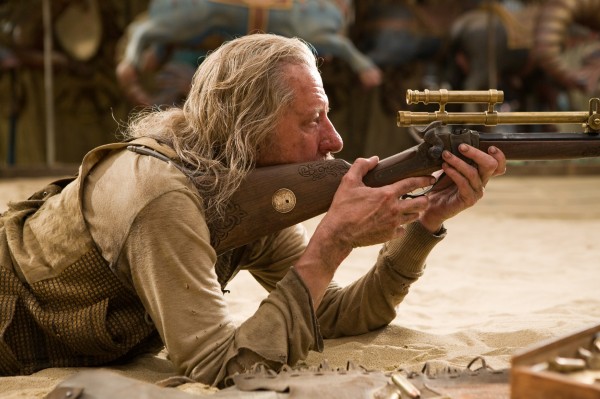
No sooner has our hero arrived in Lode looking for anonymity than the Colonel and his army of sadistic killers threaten to destroy the town. A drunken gunslinger, Ron (Academy Award winning Geoffrey Rush of “Shine”), swears off his cactus juice long enough to wield a high-powered rifle to perforate the Colonel’s low-down minions as they storm the town. Ron’s strategy resembles the sharp-shooting protagonist in Tonino Valerii’s classic Spaghetti western “My Name Is Nobody” where Henry Fonda targeted saddle bags stuffed with dynamite on the backs of an army of horsemen. Every time that he put a bullet in the shining conchos of the saddle bags, a horseman vanished in a dusty explosion. Predictably, Ron eliminates his share of riders before Yang slices up the rest with his razor-sharp sword. In the middle of this mayhem, Saddest Flute shows up with his army of ninjas and all hell really breaks loose.

“The Warrior’s Way” features stoic Korean superstar Dong-gun Jang. This handsome, dark-haired individual exudes presence as he peers out from beneath his Veronica Lake hairstyle and wields a samurai saber with the finesse of a chef slashing up a meal. Oddly enough, this dust raiser of a western was lensed in location in Australia with the liberal use of computer-generated imagery so it has a contrived “Wizard of Oz” staginess that some critics have derided. Nevertheless, Lee displays enviable style as he orchestrates several ultra-violent showdowns between the heroes and villains. “Lies” cinematographer Woo-Hyung Kim provides visually compelling compositions galore that clinch your attention. Indeed, Lee and Kim have conjured up a very kinetic piece of blood and gore that should make “The Warrior’s Way” an eventual cult hit on video since audiences aren’t turning out in droves to see it. Basically, “The Warrior’s Way” is a glorified B-movie actioneer brimming with eccentric characters and wholesale bloodshed.

Thursday, July 22, 2010

FILM REVIEW OF "FOUR FAST GUNS" (1960)

The title of “Four Fast Guns” (*** out of ****) refers to the hero’s expertise with a six-shooter as well as the three pistoleros hired to kill him. “Hell Bound” director William J. Hole Jr.’s western melodrama “Four Fast Guns” qualifies as a low-budget but above-average ‘town tamer’ sagebrusher with a good cast, compelling characters, and several surprises. This black and white, 72-minute oater reminded me of the Wayne Morris B-western “Two Guns and A Badge.” In “Two Guns and A Badge,” Morris is appointed as the deputy marshal of a lawless town. In reality, he isn’t the man that the townspeople were supposed to have as deputy marshal. Similarly, “Four Fast Guns” protagonist Tom Sabin (James Craig of “Drums in the Deep South”) has been run out of Kansas by the hired gunman, Haggerty, who was paid to clean up the territory. The obnoxious ‘town tamer’ encounters Sabin along the trail. Haggerty warns Sabin to steer clear of Purgatory where his next job is. Sabin ignores him so Haggerty goads Sabin into a gunfight. Indeed, Haggerty gets the first shot and wings Sabin’s right arm between the shoulder and the bicep and then demands that Sabin show him the palm of his hand. Presumably, Haggerty intends to put a bullet through Sabin’s hand and end his days as a gunfighter. Haggerty has his own gun drawn when Sabin surprises him and drops him with one shot.

Sabin rides into the town of Purgatory. Inscribed on an archway that welcomes visitors are the words: Purgatory: When you ride into Purgatory, “Say goodbye to God.” The citizens have never laid eyes on Haggerty. When Sabin shows up, they ask him if he is the ‘town tamer?’ Like the Wayne Morris hero in “Two Guns and a Badge,” Sabin tells them that the ‘town tamer’ Haggerty sent him to Purgatory all the way from Kansas. At first, Sabin isn’t altogether certain that he wants to maintain this masquerade. They citizens offer him $500 for the job. When somebody suggests that Sabin may be afraid, Sabin accepts the job. The townspeople want to see the owner of The Babylon Saloon, Hoag (Paul Richards of “The St. Valentine's Day Massacre”), run out of town since he controls all of the killing, rustling and gambling in the area. Sabin and the citizens strike a compromise. They will try him out and pay him after he cleans up Purgatory. When they want to know who to send the $500 to, Sabin gives them the Santa Fe address of the widow of Jay Cassavedas. Later, when Sabin prowls around the marshal’s office, he spots a wanted poster of himself on the wall. He is wanted for the killing of Jay Cassavedas.

Hoag indulges himself in a hobby of importing works of art as well as minions of evil. The first work of art is a small replica of Venus De Milo. Ironically, Hoag is an invalid confined to a wheelchair. He spends his time playing the piano in his bar. Later, Hoag’s pretty wife, Mary Hoag (Martha Vickers of “The Big Sleep”), explains that they were on the stagecoach for Wichita to get hitched when the vehicle wrecked and broke her husband’s back. Nevertheless, Hoag is a power neither to be taken lightly nor ignored. Hoag is as cold-blooded as they come, and he antes up a thousand dollars to see Sabin lying dead in the dust. Hoag sends one of his henchmen, Grady, over to kill the sheriff after their first meeting, but Sabin kills Grady. As each gunslinger botches the job, Hoag increases his offer, until the third gunslinger, Johnny Naco, arrives and takes the three grand to kill Sabin. Hoag never really ventures beyond the premises of the Babylon and he emphasizes his sophistication when he quotes a poem to Sabin when the 'town tamer' visits him in his office. Cleverly, the scenarists have Hoag quoting a passage from the Robert Herrick poem "To Virgins, to Make Much of Time": "Gather ye rosebuds while ye may/Old Time is still a-flying;/And this same flower that smiles today,/Tomorrow will be dying."

No sooner has Sabin arrived in Purgatory than Hoag dispatches a gunman to kill him. Sabin is in the marshal’s office when his would-be assassin enters and tries to kill him. Predictably, Sabin survives this fracas, but the twists are what distinguish this western. He has to contend with three gunslingers before he cleans up Purgatory and rides away to Tombstone. Along the way, Sabin makes a rather good friend of the alcoholic living in the abandoned marshal’s office, Dipper (Edgar Buchanan of “Texas”), who wears a small cup around his neck with which he uses to drink his whiskey. Despite his drinking, Dipper is a lot smarter than most people take him. Essentially, Dipper serves as the quasi-narrator of sort. Although he isn’t seen until later in the action, Dipper provides narration at the outset. “This man came along the trail one Sunday morning back in ’73 talking it slow and easy keeping his open and his gun hand ready. Came from nowhere I guess. Anyhow, he never said from where and we never asked. He was going to stop off in Purgatory, make his stand, like he lived alone. This is number one. He called himself Sabin.” The number one in the narration refers to the first of the “Four Fast Guns.”

Dipper becomes Sabin’s greatest ally. Not only does Dipper serve as the film’s narrator, but also he is chief source of comic relief. Hoag’s wife is another interesting character. She stands by her husband, but her sentiments toward Sabin change over time. Ultimately, she grows attached to Sabin, but she refuses to end her marriage to Hoag. The second time that Sabin visits the Babylon, Hoag tries to convince him to leave town. He shows him three letters that he intends to send to three gunslingers that he will pay to kill Sabin. Hoag suggests Sabin tear up the letters, but Sabin refuses to violate a federal law pertaining to the sanctity of the U.S. mail. Ironically, Sabin winds up mailing Hoag’s letters, letters to men who will come to kill him. The three gunslingers are worthy of note, particularly the Brett Halsey character.

The first of them is a Mexican named Quijano. Quijano (Richard Martin of “Bombardier”) catches his girlfriend in the bath tub and asks her to translate Hoag’s letter. Quijano rides to Purgatory. Along the way, he asks for directions and the settlers warn him to ride clear of Iron Town. Marshal Becker of Iron Town is pretty quick with a pistol. Quijano shoots the lawman on the trail, but he loses his lucky charm, a necklace with a cross. Later, Mary tries to bride Quijano out of killing Sabin, but he refuses her offer. He had been whipped into submission like a dog by a ‘town tamer’ and hates them. Quijano slaps leather with Sabin in the Babylon and Sabin blows a hole in the Mexican. After he drops Quijano, Sabin gets a lecture from Mary Hoag. “You’ll be destroyed by a man without a gun. A man you can’t shoot because he can’t stand up to you in the only kind of fight you understand—a gunfight.” Actually, “A Day of Fury” scenarist James Edmiston and “When the Clock Strikes” scribe Dallas Gaultois provide a lot of foreshadowing in Mary’s speech because “Four Fast Guns” concerns honor. Sabin’s sense of honor compelled him to take up the townspeople on their offer. Similarly, a sense of honor prevents him from simply shooting Hoag while the villain plays his piano.

The second of the three is the laconic Farmer Brown (Blu Wright of "Squad Car")and he has cultivated a reputation for being a fast draw and an accurate shot. He proves his accuracy when he blows a coin out of a stable boy's hand. The Farmer never carried a gun until he was shot in the face. Now, he totes one and he has the personality of an ogre. He tries to shoot Sabin from under table as they are playing poker. Sabin outsmarts him. He pulls out his revolver and cocks it as soon as he sits down so the weapon is on his thigh within easy reach. Since the outcome to this duel is such a foregone conclusion, director William J. Hole Jr., doesn’t even show us how it happened. This strategy occurred in an earlier scene when Grady the gunslinger entered the jail, while Hole keeps the viewer outside with the camera. The gunfire is audible and then the gunslinger stumbles outside and falls dead on the street.

The third of the three, Johnny Naco (Brett Halsey of "Roy Colt and Winchester Jack"), trails the Farmer into Purgatory. Johnny is dressed like a classic villain from Stetson to boots in black. He is a ladies man and has the utmost confidence in his ability to out draw everybody else. Mary tries to distract him initially from his showdown with Sabin in the saloon. Naco clears the bar and waits for Sabin to enter. The tension mounts as Sabin walks into the bar. The director shows close-up shots of their opposing faces. They appear to know each other. One of the major surprises in “Four Fast Guns” occurs at this point and everything afterward clashes with the typical ‘town tamer’ western. Finally, as the tension melts between them but nobody shucks iron. Sabin turns and walks out of the Babylon. This is the last thing that you expect out of this western with eighteen minutes left to go. The townspeople are surprised and the one who constantly derides Sabin makes a wisecrack, while Naco hands Hoag back his $3-thousand. "I'll kill the man, but it's going to be a little more difficult than I figured." When Hoag demands to know why Naco didn't draw on Sabin, Naco tells him that Sabin is his brother! Naco also informs Mary that Sabin and he are brothers. They relocate to the church that hasn't been used because Purgatory has no preacher. Earlier, a woman told the townspeople taking up a collection for the 'town tamer' that she thought they needed a minister instead of a gunslinger. In the church, Naco explains that Sabin and he had trouble with a man called Cassavedas. Naco shot Cassavedas, but Sabin took responsibility for what Naco had done.

“Ambush at Cimarron Pass” lenser John M. Nickolaus Jr.’s black & white, widescreen cinematography is an asset. Nickolaus shoots this low-budget western as if it were a big-budget opus. He set-ups his cameras in the best possible positions and his pictorial composition is virtually flawless. For example, the Farmer Brown scene in the Babylon opens with a medium long shot of the legs of the gamblers under the table. Using the frame of the chair that Sabin will occupy, Nickolaus shows us Farmer Brown's lap with his gun on his thigh. You can tell that the Production Code censors had mellowed by 1960 because we get a glimpse of a Mexican girl's buttock and Dipper goes to sleep with a picture of a scantily-clad woman on the wall. The Code may have objected to Dipper's picture on the basis that it implies that the old drunk will have a 'wet dream.' The performances are good. James Craig is appropriately tight-lipped and honor-bound. He doesn’t look very appealing without his usual mustache. Martha Vickers, who plays Hoag’s wife, is very good. She might have become a well-known actress if she had stuck to playing bad girl roles in the late 1940s. Good movies contain surprises which usually enliven the narrative. The surprise ending caps this corker. “Four Fast Guns” never wears out its welcome.

Thursday, October 2, 2008

FILM REVIEW OF ''HOUR OF THE GUN'' (1967)

"Bad Day at Black Rock" director John Sturges revisits the Wyatt Earp/Ike Clanton feud in "Hour of the Gun" with James Garner and Jason Robards that he began in 1957 with Burt Lancaster and Kirk Douglas in the Hal B. Wallis production of "Gunfight at the O.K. Corral." Although Sturges' "Hour of the Gun" (**** out of ****) boasts greater visual and historic realism than "Gunfight at the O.K. Corral," this sequel of sorts veers off course toward the end and two-time Oscar-winning scenarist Edward Anhalt of "Becket" contrives scenes that are not historically accurate principally for the sake of dramatic license to provide audiences with closure. Unlike the Paramount release that featured Rhonda Fleming as Wyatt Earp's love interest, Sturges dispenses with women altogether in this United Artists release and confines himself to the feud. The practically all male cast features lean, rugged Robert Ryan as Earp's chief real-life nemesis Ike Clanton and in his second motion picture lanky Jon Voight of "Midnight Cowboy" fame. Indeed, as much as possible Anhalt and Sturges have tried to stick with history. For example, the dialogue in the courtroom sequences came verbatim from the actual transcripts. Moreover, unlike previous Wyatt Earps, James Garner is allowed to play the legendary lawman without a halo. This Earp wants to kill out of brotherly vengeance than take the villains in to stand trial. After all, the tagline for the film reads: Wyatt Earp - hero with a badge or cold-blooded killer? Known for the affable screen characters that he played over the years, Garner makes a great change of pace as a vengeful Earp in a taut, grim-faced performance unlike anything that he had done before and not again until he starred in Vic Morrow's spaghetti western "A Man Called Sledge." The action opens on the main street of Tombstone as our black-clad in business suited heroes: Wyatt Earp (a mustached James Garner), Doc Holiday (two-time Oscar-winner Jason Robards of "Once Upon a Time in the West"), Morgan Earp (Sam Melville of "Big Wednesday"), and Virgil Earp (Frank Converse of the TV show "Movin' On") march down to the O.K. Corral after Ike Clanton's gunmen have assembled for the fateful showdown. The shoot-out is over in a mere matter of minutes. During the shooting, Ike Clanton ducks into a photography shop and sits out the gun battle. Morgan takes a slug in the shoulder while Virgil receives bullet in the leg. After the gunfight, County Sheriff Jimmy Ryan (Bill Fletcher of "5-Card Stud") and his deputy Frank Stilwell (Robert Phillips of "The Dirty Dozen") confront the Earps and Holiday. Ryan tries to arrest them. "Not today, tomorrow, or ever," growls Wyatt. "You don't have jurisdiction in the city of Tombstone. If you did, you couldn't make it stick if you did." Clanton parades the bodies of his dead through Tombstone and charges that the Earps murdered them. In court, however, Judge Herman Spicer (William Schallert of "Will Penny") concludes otherwise based on factual evidence, and the Earps and Holiday are exonerated. Clanton's gunmen, principally Curly Bill Brocius (Jon Voight), Andy Warshaw (Steve Inhat of "Madigan"), and Stilwell ambush Virgil Earp at night while he is checking doors. Virgil is crippled for life and cannot run for city marshal so Morgan replaces him. Morgan wins the election, but before he can serve, the same three Clanton gunmen blast him in the back with a shotgun while he is playing billiards. Wyatt accuses Clanton's men of homicide but he cannot furnish a witness and the killers go free. Meantime, the honest citizens of Tombstone get Wyatt an appointment as Deputy U.S. Marshal and warrants to serve on those Clanton men alleged to have participated in the shootings of Wyatt's brothers. Wyatt hires Tucson lawman Sherman McMasters (Monte Markham of "Guns of the Magnificent Seven") to help him out while Doc decides to observe the letter of the law and join Earp's posse. Doc recruits a couple of gunmen, Turkey Creek Johnson (Lonny Chapman of "Baby Doll") and Texas Jack Vermillion (William Windom of "Cattle King") and they pursue Clanton's killers.

The joy of watching any John Sturges western lies in the choreography. Sturges is one of the few directors who can make the simple act of men crossing a dusty frontier street look like very cool. Mind you, he knows how to block a scene so that everybody is shown moving around for a purpose. Sturges' movies are full of these cinematic maneuvers. Sturges stages all of the shoot-outs with his customary aplomb. "Gunfight at the O.K. Corral" differs drastically from "Hour of the Gun." "Gunfight" qualified as a more bombastic western than the subdued "Hour of the Gun." Sturges has eliminated any love interest for Earp in "Hour of the Gun" so this biographical western is all about business. The photography, the settings, and the atmospheric help make this western outstanding. Sturges generates suspense with Wyatt Earp's moral decline; his willingness to let his personal feelings overwhelm his judgment. Jerry Goldsmith's evocative music seems inseparable from the gritty action. Jason Robards is both brilliant but ironic as the morally unscrupulous gambler who provides commentary on his friend's moral lapses.

An excellent book to peruse if you are interested in John Sturges, his life, and his films is Glen Lovell's top-notch biography on Sturges entitled "Escape Artist: The Life and Films of John Sturges." Mr. Lovell spent 10 years writing and researching this seminal text about Sturges.