Translate

Showing posts with label the desert. Show all posts

Monday, April 24, 2017

FILM REVIEW OF ''PHOENIX FORGOTTEN" (2017)


Combine “The Blair Witch Project” with “Close Encounters of the Third Kind,” and you’ve got the gist of freshman director Justin Barber’s found-footage, sci-fi, horror chiller “Phoenix Forgotten” (* OUT OF ****), involving an alleged UFO sighting in Phoenix, Arizona, on Thursday, March 13, 1997.  “Maze Runner” scenarist T.S. Nowlin and Barber have appropriated that larger-than-life incident known as “Phoenix Lights” for their superficial saga about three teens who took off into the desert to document this phenomenon with a camcorder.  Unfortunately, they vanished without a trace, but left behind their camcorder.  For the record, “Phoenix Lights” made national headlines, and experts have described as it as “the most widely seen mass UFO sighting in US history,” second only to the renowned Roswell UFO crash in 1947.  Nevertheless, I’m fed up with low-budget, found-footage thrillers as uninspired as “Phoenix Forgotten.”  They neither make my skin crawl nor make me feel sympathetic about the plight of characters too asinine to know better.  Basically, the actors and actresses play stock characters, with little aside from biology and apparel to differentiate them.  Neither the original (and extremely overrated) “Blair Witch Project” (1999) nor its abysmal 2016 remake did little to arouse either my curiosity or raise my hackles.  Mind you, found-footage movies aren’t all awful.  The Vietnam war epic “84 Charlie Mopic” (1989) was one of the best.  “The Paranormal Activity” franchise has been consistently gripping.  You may have your favorites, too. Nothing in “Phoenix Forgotten” will make you gnaw your fingernails, unless you’ve never watched a horror movie.  Furthermore, this formulaic film features pedestrian performances by unknown thespians without a bit of charisma who were cast largely for their ordinary, inconspicuous looks.  Nowlin & Barber have forged characters that aren’t interesting for their own sake, and their dialogue isn’t quotable.  Worse, the film doesn’t spring any surprises that would make you scream.  The first half of “Phoenix Forgotten” is dreary enough to lull you into a stupor.  The marginally better second half struggles to compensate for the somnambulance of its monotonous first half.  The convenient found-footage sequences are predictably designed to trouble you with lots of wobbly camera work with sporadically scrambled video imagery.   

Sophie (Florence Hartigan of “Magik and Rose”) has returned to her hometown of Phoenix. She plans to produce a documentary film about her older brother Josh (Luke Spencer Roberts of “Hail, Caesar!”) and his two friends, Ashley (Chelsea Lopez of “Novitiate”) and Mark (newcomer Justin Matthews), who got lost in the desert 20 years ago while making their own documentary about the “Phoenix Lights.”  Josh had been a videophile for years.  The first time that we see Josh, he is recording his younger sister Sophie’s sixth birthday party when mysterious lights illuminate the skies over Phoenix.  Local television stations broadcast reports about the suspected UFOs, while public officials stage a press conference with a guy masquerading as an extraterrestrial to defuse the paranoia surrounding the sightings.  The UFO coverage whetted Josh’s curiosity, and he started shooting interviews with anybody who had either witnessed or heard about the unidentified flying objects over Phoenix.  Naturally, the military discredited those UFO sightings.  Indeed, Air Force officials issued a statement that aircraft on training maneuvers had deployed flares that would have resembled a UFO. 

When Sophie comes home, she interviews her parents, who have been divorced because the search for their son devastated their marriage, as well as Josh’s friends to find closure.  Sophie and her cameraman are about to call off their documentary when a high school librarian discovers a package stashed in the school’s storage facility.  The package contains another camcorder with a cassette cartridge in it.  Sophie’s hopes soar when she learns that not only can the tape still play but also that Josh shot the footage.  All along everybody, including local law enforcement, could never adequately explain why Josh would have left behind his camcorder in his vehicle.  The revelation is that Josh had two camcorders!  Sophie lends the footage to a military official to examine.  He warns Sophie that she shouldn’t show that tape to anybody.  The remainder of “Phoenix Forgotten” concerns what Josh and his friends recorded after they plunged into the desert.  The three wind up lost, and tempers flare as they struggle to find their way back to Josh’s SUV.  After they get back on the road to Phoenix, Arizona, something with a glaring light approaches them from behind and overtakes them. Inexplicably, Josh’s vehicle conks out, and the three set out on foot on a lonely highway.  Before long other mysterious things occur, and they are swept up in turbulent winds, explosive sounds, and bright lights.

Presumably, producer Ridley Scott, who directed the original “Alien,” must have felt that teen audiences afflicted with ADDH would mob the multiplexes and parlay this $2.8 million feature into a weekend blockbuster, like “The Blair Witch Project.”  The trouble with Barber’s film is that he takes too long to establish both the characters and set up the predicament. Unfortunately, the filmmakers wear us out keeping track of a lot of insignificant details about the characters and their environment designed to enhance the plausibility of “Phoenix Forgotten.” The staccato editing stresses the spontaneity of the moment, but Barber neglects to align our sympathies with those characters.  As the chief protagonist of “Phoenix Forgotten,” Sophie searches desperately to determine what became of her ill-fated sibling.  Incredibly, “Phoenix Forgotten” partially duplicates the plot of a 1989 micro-budgeted, straight-to-video epic entitled “UFO: Abduction.”  The big brother in the latter film is taping his niece’s fifth birthday with a hand-held camera when UFOs blasted out of nowhere.  Afterward, the hero and his two brothers rushed into the woods to investigate their sighting.  They located the flying saucer and encountered three aliens.  Frantically, the brothers withdrew to their house, and the aliens besieged them.  Predictably, Josh’s found footage suggests that aliens abducted the trio.  Altogether, “Phoenix Forgotten” is best forgotten as just another crackpot conspiracy theory orchestrated with little imagination.

Saturday, May 25, 2013

FILM REVIEW OF "HELL RIDE" (2008)


"Savage Seven" actor Larry Bishop must have seen "Escape from New York" before he wrote, produced, and directed the R-rated, Dimension Films release "Hell Ride" (*** OUT OF ****) with Quentin Tarantino serving as executive producer. Bishops dresses as if he were channeling Kurt Russell's Snake Plissken from the John Carpenter classic. Bishop plays 'Pistolero,' the president of a notorious motorcycle gang called 'the Victors.' This unsavory synthesis of Spaghetti western and the Biker flick, about outlaw bikers, booze, and booty concerns revenge. A cast of familiar faces, including Michael Madsen, Dennis Hopper, Francesco Quinn, Vinnie Jones, Eric Balfour, and David Carradine, circle each other with gimlet eyed glares when they aren't drooling on delicious dolls, and either shooting or setting folks afire. Most of the action transpires in the desert, at a motel, and at a bar called Dani's Inferno. According to Bishop, "Hell Ride" was shot in twenty days and on a shoe string. Bishop says he based his casting choices on the motorcycle that they straddle and the motorcycle had to look good. Nothing about this low-budget homage to grind-house sagas is anything that most people, other old B-movie fans will, want to suffer through. This amoral
melodrama has its share of moments. Bishop looks like a demented version of Al Pacino. Nudity, violence, and profanity are rampant throughout "Hell Ride."


The opening scene with Bishop flat on his back with an arrow protruding his belly is unforgettable. The suspense of this scene is mitigated somewhat by the appearance of a sexy babe who squats on our hero's face and extracts the arrow. The action shifts then to 32 earlier as some ruffians storm into a motel room, slash a gal's throat while a teenager watches, and then ignites her like a bonfire. Moments later, the scene shifts 32 years later, Billy Wings gives an old grizzled man, St. Louie (Pete Randall), similar treatment. The biker's funeral in the desert with the gang taking a last swig on their beer bottles before they
christen the coffin in an oblong hole carved at of the desert is strikingly stuff. Indeed, everything about "Hell Ride" is over-the-top, with larger-than-life bastards who have no compunction about murder. After our heroes conclude their farewell to their biker friend, then barge into a trailer and mow down four opposing biker gang members. The Gent (Michael Madsen of "Reservoir Dogs") apologizes after the shooting to Pistolero (Larry Bishop) for pulling the trigger one time too many, "My finger got stuck." Pistolero replies, "Next time share a little." Pistolero wields a Smith & Wesson and administers a coup de grace. Not to be outdone, fellow biker Comanche (Eric Balfour of "Skyline') wants trophies. "So I say we cut off their heads, we take'em with us." The Gent disagrees with Comanche while he admires the nude women in an issue of the pornographic magazine "Club," "I say we just take a few pinkies and call it a day." Ultimately, Pistolero rules. "How's about we take their stash, torch the trailer, and get the f%*k out of here?" The next shot depicts Comanche, The Gent, and Pistolero sauntering away from the trailer as it blows up behind them and is engulfed in the flames. If you look closely, you can see that The Gent has the Club magazine in his britches at his crotch as he walks away from the trailer. Mind you, all this mayhem occurs in the first seven minutes of this 84-minute biker flick. What's not to like? At this point, Bishop presents the opening credits. By this time, if you're not grooving on this retro-fitted biker flick, you need to find something that appeals more to your taste.


Chilean actress Leonor Varela shows up for her second scene in a big house with a long porch. Pistolero encounters her after he enters the premises and spots her at a pool table. A scene involving verbal sexual fencing commences with Nada begging Pistolero to have screw her or suffer the damnation of Hell. Pistolero informs her that he is in Hell. What sets her performance apart is Leonor convinced Bishop in this scene as well as the opening gambit that she didn't have to appear naked to look sexy. Leonor proves her point many times over. Pistolero learns from her that the Six-Six-Sixers biker gang, including The Deuce (David Carradine of the "Kill Bill" movies) and Billy Wings (Vinnie Jones of "Swordfish"), are itching for vengeance. Nada elaborates that the whole Deuce business has "something to do with that Cherokee Kisum woman." Eventually, Eddie leads Billy Wings into a shoot-out, and the Gent literally jumps the gun and drills him.  Later, Pistolero finishes him off rather painfully.  Not only does he shoot Eddie, but he also slits his throat and torches him.  The influence of Tarantino is evident when Comanche finds a safe deposit box in the desert, but we never learn what it contains.


The scene when Comanche urinates on Eddie's boots is hilarious. Comanche and his buddies later follow Eddie who straddles a bike with a sidecar. The second encounter between Nada and Pistolero uses fire as a metaphor for their love talk. Later, our hero takes a trip on peyote. This scene leads up to the opening scene when Nada shoves the arrow into Pistolero. For the record, Carradine does show up until almost 44 minutes have elapsed. "Hell Ride" is an atmospheric steel horse opera with quotable dialogue, rugged desert scenery, gritty action, and interesting performances.

Monday, August 27, 2012

FILM REVIEW OF ''HIT AND RUN" (2012)


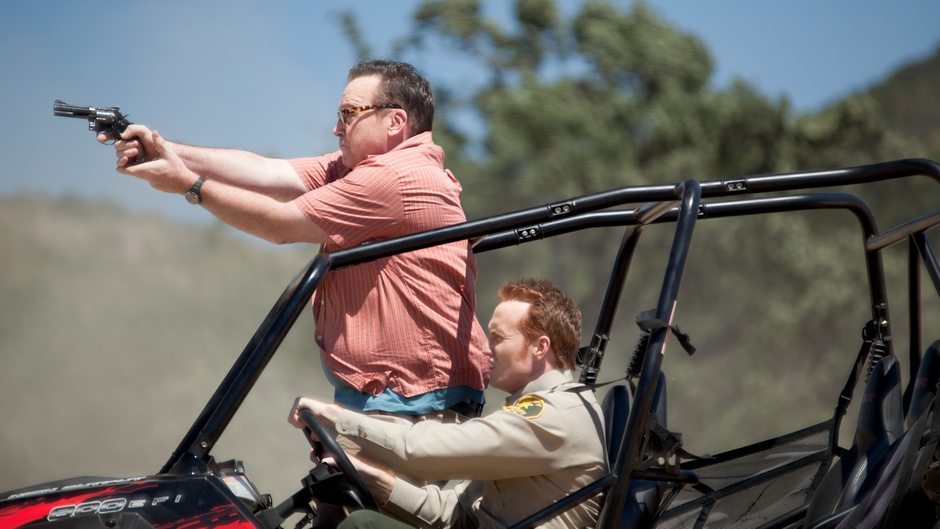
 Dax Shepard and his fiancée Kristen Bell co-star in the witless romantic comedy “Hit and Run”(* OUT OF ****) that Shepard wrote and co-directed with his pal George Palmer. Palmer and Shepard helmed the video short “Reunited” (2010) as well as the spoof documentary “Brother’s Justice.” The style of comedy that they espouse mingles dry humor with slapstick. The garrulous characters never cease making asses of themselves. This half-baked buffoonery about a goofy getaway driver in the Witness Relocation Program who shacks up with a brainiac, drop-dead gorgeous, community college professor delivers more run than hit. Nothing about this low-brow, tread-burning, crime melodrama will make you either smile or flinch. The grossest scene resembles something that Sasha Baron Cohen might have removed from one of his offensive comedies. Our hero and heroine are on the run when they check into a motel. They find a sex orgy in their room with participants who are old, fat, and ugly. This tasteless scene qualifies as so gratuitous that the MPAA probably had no choice but to slap “Hit and Run” with an R-rating for nudity. Shepard and Palmer aren’t content to show this unsightly scene once but twice for maximum impact. Meantime, you’ll lose count of the number of times that the F-word is uttered. The violence remains relatively mild by today’s standards. A felon takes a slug in the back with a splash of blood for realism. A man is shown mercilessly slugging another. An assailant smashes our hero’s nose with a golf club. Nevertheless, despite their lame-brained humor and lackluster car chases, Shepard and Palmer have assembled a first-class, straight-faced cast that contributes a modicum of hilarity to the antics. Bradley Cooper, Tom Arnold, Kristin Chenoweth, Michael Rosenbaum, and David Koechner run circles around our leads. “Hit and Run” amounts to one long, drawn-out, vehicular chase with no memorable stunts. The biggest stunt involves a dune buggy hurtling “Dukes of Hazard” style over several parked cars. Nothing about the driving will turn your knuckles white and make you gasp, but the automobiles look ultra-cool.


“Hit and Run” starts out in a backwater California town named Milton with a community college. Basically, our heroine Annie Bean (Kristen Bell of “Forgetting Sarah Marshall”) learns that she is about to be fired from her job as a community college professor. Happily, Annie’s potty-mouthed boss, Debby (Kristin Chenoweth of “You, Again”), alerts her about an opening at UCLA where she can land her dream job as the head of a conflict-resolution department. The major drawback for our ambitious heroine is when her tattooed boyfriend, Charlie Bronson (Dax Sheppard of “When In Rome”), divulges his participation in Witness Relocation.  Charlie is pretty much condemned to live an eternity in the sleepy little town of Milton because his former partners-in-crime want to track him down and terminate him with extreme prejudice. Eventually, Charlie changes his mind about Witness Protection and pulls the tarp off his jacked-up 1967 Lincoln Continental with suicide doors to chauffeur Annie in style to Los Angeles. Annie’s green-eyed, ex-boyfriend, Gil (Michael Rosenbaum of TV’s “Smallville”), gets wind of Charlie’s real identity and sends a message via Facebook to Charlie’s number one nemesis. As it turns out, and Annie discovers later, Charlie is really Yul Perrkins. Charlie’s father Clint Perrkins (Beau Bridges of “Max Payne”) named him after legendary actor Yul Brynner of “The Magnificent Seven.” Charlie hated the name Yul so much that he changed it to Charles Bronson.  Mind you, Yul wasn’t thinking about  movie superstar Charles Bronson of “Death Wish” fame, but the notorious British inmate Charles Bronson who is known as the most violent man in British prisons. Naturally, Annie is appalled by these revelations. What she really isn’t prepared for the gun-toting trio that come calling on them as they are about to leave for L.A.  Alex Dmitri (Bradley Cooper of “The A-Team” in dreadlocks) hates Charlie because Charlie’s testimony put him behind bars long enough for a Phillipino prisoner to rape him. Now, Alex yearns to kill Charlie as much his accomplices Neve Tatum (Joy Bryant of “Spider-Man 2”) and Allen (Ryan Hansen of “Friday the 13th”). Predictably, our hero has a savior, bungling U.S. Marshal Randy Anderson (Tom Arnold of “Exit Wounds”) who doesn’t know where the brakes are on his car. The people who make FX's "Justified" have used this gag before. Worse, he has to dodge the bullets that his own gun bangs out at him as it bounces around in his car.  The scene with the bowling ball in his smashed up car will make you grin.


“Hit and Run” blends elements of both “True Romance” and “Smokey and the Bandit.” The romance between Annie and Charlie and their flight from the desperate villains recalls the predicament that Clarence and Alabama face in “True Romance.”  Bradley Cooper’s arch villain resembles the Gary Oldman bad guy that Christian Slater tangled with in “True Romance” when he went to fetch Alabama's luggage. Shepard has made it well known in the media how much he loved the Burt Reynolds' comedy "Smokey and the Bandit," and the plot follows it, especially the use of a series of careening car chases. U.S. Marshal Randy is the equivalent of "Smokey." Unfortunately, this sloppy, low-octane, pursuit potboiler conjures up little tension and delivers few thrills.  Meantime, Shepard struggles to capture the spontaneous, off-the-cuff Tarantino dialogue about controversial subject matter. Instead, they wind up sounding nothing less than loquacious. Shepard and Palmer look like they not only shot this 96-minute feature on the shoe-string but also improvised many scenes. They stage their dialogue scenes with the same lack of finesse that they do their automotive maneuvers. You should sit and shun “Hit and Run.”


Thursday, July 1, 2010

FILM REVIEW OF ''BUCHANAN RIDES ALONE" (1958)

Randolph Scott plays a rugged, happy-go-lucky, soldier-of-fortune in Budd Boetticher’s western “Buchanan Rides Alone,” and the eponymous character stirs up a lot of trouble with the powers-that-be in a corrupt little American border town in this brisk, well-photographed sagebrusher based on author Jonas Ward’s novel “The Name’s Buchanan.” Until Buchanan rides across the Mexican-American border into Argy Town, everything is rosy for our stalwart protagonist. He has spent enough time fighting in the Mexican revolution so that he has enough money to buy a ranch in West Texas. Buchanan is savoring a life of leisure when he clashes with the family Argy. Although this entertaining oater isn’t as memorable as either “Comanche Station” or “Ride Lonesome,” “Buchanan Rides Alone” (***1/2 out of ****) differs from those two straight-faced, dramatic dustraisers. Boetticher and “Decision at Sundown” scenarist Charles Lang put the accent on humor and the villains—while appropriately greedy with villainy—are neither as flawed nor narcissistic as most Boetticher foes. One of the third string villains played by L.Q. Jones is mildly reminiscent of the James Coburn villain in “Ride Lonesome.” At least one director who worshipped Boetticher believes that the feuding Argy clan that squabbles over the control of the town foreshadowed Sergio Leone’s similarly themed “Fistful of Dollars.” Scott and Boetticher teamed up for the fourth time as star and director of another compelling but low-budgeted horse opera.

No sooner has Tom Buchanan (Randolph Scott of “The Texans”) left Mexico and ridden into Agry Town than Sheriff Lew Agry (Barry Kelley of “The Tall Stranger”) and his deputy search him. The sheriff allows Buchanan in Agry Town but advises our hero not to “linger.” Buchanan reassures the sheriff: “I ain’t going to linger no place until I get back to where I belong.” After getting a $10 room at the Agry Hotel managed by Amos Agry (Peter Whitney of “Destination Tokyo”), Buchanan ambles over to the Agry Palace Saloon for whiskey and a steak. Earlier, the youngest Agry, Roy (William Leslie of “Return to Warbow”), had galloped into town from Mexico and gone into the saloon. Roy demands a drink. The bartender, Nacho (Nacho Galindo of “The Big Steal”), obeys Simon Agry’s strict orders not to let Roy drink. Initially, Buchanan knocks Roy down and disarms him. Later, Buchanan offers Roy a shot but Roy snatches the bottle. Roy swears that he’ll kill him. Roy gets so drunk that Buchanan walks out without a scratch. Not long afterward a Mexican, Juan de la Vega (Manuel Rojas of “The Magnificent Matador”), plunges into the saloon and kills Roy in a gunfight. Lew arrests Juan for Roy’s death and beats him up. When Buchanan tries to intervene for Juan, Lew throws Buchanan in jail, too. Initially, Lew doesn’t know Juan’s identity. Meanwhile, after his hired gunman Carbo (Craig Stevens of “Gunn”) contacts him about the death in the family, Roy’s father Judge Simon Agry (Tol Avery of “The Satan Bug”) refuses to let Lew string them up. Simon arrives in the nick of time to save them. Simon’s speech reeks of hypocrisy. Not only is wily Simon considering his future in politics, but he also is considering a suitable ransom that he could demand from the de la Vega clan for their son. The internecine strife between Agry brothers Simon and Lew puts them at loggerheads. Each man works at cross purposes when they hatch them individual schemes with their third brother Amos scrambling for crumbs.

At the trial, the jury clears Buchanan of any wrongdoing in the death of Roy Agry. They convict Juan, however, and Simon sentences him to swing an hour before sunset. Meanwhile, Buchanan discovers that Lew has looted his money belt that held $2000. Furthermore, Lew assigns Lafe (Don C. Harvey of “Utah Blaine”) and Pecos to escort Buchanan out of town. “I’m making sure you don’t show up in Agry Town again,” Lew says with relish. Of course, Lew plans to have Lafe liquidate Buchanan, but fellow West Texan Pecos finds this intolerable and he disposes of Lafe. While this is going on, Juan’s father sends an emissary, Esteban Gomez (Joe De Santis of “The Professionals”) to cut a deal with Simon. Gomez offers Simon 30 blooded horses in exchange for Juan, but instead Simon demands $50-thousand. Later, Lafe and Pecos take Buchanan out to the middle of nowhere. Lew’s two deputies aim their rifles at Buchanan and the crash of rifle fire fills the air as Buchanan dives to the ground. Pecos helps him up and they have to bury Lafe’s body on a tree because the gravesite filled with water. How many times do you see a western where they dig a grave and it fills up with water so they have to tie the corpse to a tree?

Anyway, Amos informs Lew about Simon’s plans to make Juan’s wealthy father fork over $50-thousand and he wants $10-thousand for helping him. The earlier reference to “Fistful of Dollars” holds from “Buchanan Rides Alone” and Amos is the equivalent of the bell ringer in Sergio Leone’s western. Lew sends Juan out of town with Waldo (Robert Anderson of “Mission over Korea”) his henchmen to stash him at an abandoned shack. Lew’s henchmen stumble onto Pecos at the shack as he is cooking bacon. Buchanan gets the drop on Waldo and company. Pecos and Juan tie up the henchmen and Buchanan heads back to Agry Town. Meantime, Pecos accompanies Juan to the border. Things become a little repetitive at this point. Waldo and his two gunmen untie themselves and ambush Pecos and Juan. Pecos dies and Juan is a prisoner again. At Simon’s ranch, Esteban shows up with the $50-thousand. Carbo goes to Agry Town to get Juan and discovers Lew’s perfidy. He leaves and Lew finds himself facing Buchanan. Our protagonist demands the return of his gunbelt and his money. Lew counts out all that is left of the loot: $1,700.

As Buchanan is leaving the jail, he runs into Waldo and company with Juan in their custody. Buchanan surrenders and Juan and he wind up in the hoosegow again. Carbo rides back into town with Simon and they find Gomez negotiating a deal with Lew. Carbo discovers that Juan is back in jail. Carbo misses Waldo and his henchmen as they head to see Lew. Carbo releases Juan and Buchanan. Meanwhile, Lew turns on Simon uses him as a shield to get into his own jail. Buchanan surprises them, takes Simon hostage, and Juan, Gomez, Buchanan and Simon flee. Gomez is wounded in the arm. Buchanan and Juan make it across the bridge at the border, but their vehicle overturns and the saddle bags with $50-thousand in them lay on the bridge. Buchanan negotiates the release of Gomez for Simon. Lew shoots Simon when he makes it to bridge and picks up the saddle bags. Buchanan scrambles for the saddle bags, but he runs out of bullets and Lew gets the drop on him. Simon musters his last breath to shoot his own brother. A fatally wounded Lew finishes off Simon. Buchanan retrieves the saddle bags and gives them to Juan. Carbo makes threats, but Buchanan points out that Agry Town now belongs to him. Carbo recommends that Buchanan ride.

Boetticher and “Prince Valiant” lenser Lucien Ballard shot “Buchanan Rides Alone” on location at Old Tucson so the film evokes a gritty, authentic feel for the old West. Nary a minute is wasted in this 78-minute, Columbia Pictures release that co-starred Craig Stevens as an elegant-looking gunman. If you are looking to a traditional, leathery-tough cowboy epic, “Buchanan Rides Alone” has more than enough action, irony, quotable dialogue and humor to keep you interested without wearing out its welcome.

Monday, June 28, 2010

FILM REVIEW OF ''ONE-EYED JACKS" (1961)

Academy Award Winning actor Marlon Brando directed one movie during his prestigious 50-year career in Hollywood. Brando's Pennebaker Productions decided that a western might be a worthwhile investment since westerns had been profitable during the 1950s. The company shelled out $40,000 for the rights to author Charles Neider’s seminal western novel “The Authentic Death of Hendry Jones” and several scenarists came and went before “One-Eyed Jacks” (***1/2 out of ****) was completed. Among the scenarists were a young Sam Peckinpah, but novelist Calder Willingham replaced Peckinpah. This amoral western melodrama dealt with the themes of friendship, greed, deception, betrayal, and revenge. The troubled production history of this splendid horse opera casts a shadow over its artistry. First, Brando created several legends about his use of six or more takes for a scene. Second, the story goes that the star waited for the most dramatic waves to break on the shore. Brando toiled for six months on “One-Eyed Jacks.” Initially, “Paths of Glory” helmer Stanley Kubrick started out as the director. Artistic differences arose between Brando and Kubrick that prompted Kubrick’s dismissal. Reportedly, Kubrick preferred Spencer Tracy over Karl Malden as the villainous Dad Longworth. Brando objected on the basis, however, that Pennebaker Productions had already paid Malden the sum of $300-thousand. Afterward, when nobody stepped forward to helm the film, Brando decided he would try. Paramount executives should have had their heads examined for letting a temperamental actor like Brando call the shots on a film.

Three American outlaws, Rio (Marlon Brando of “Julius Caesar”), Dad Longworth (Karl Malden of “Baby Doll”), and Doc (perennial character actor Hank Worden of “Red River”) hold up a Mexican bank. Dad and Doc ride off to shack up with prostitutes in a bordello, while Rio heads off to romance a refined lady at her hacienda. Mexican Rurale captain (Rodolfo Acosta of “Hondo”) leads a posse to the bordello and they kill Doc when they raid the place. Dad slips out by the window with his gun, but he forgets his boots. Dad rides off to alert Rio. Together they light out into desert with the Rurales on their trail. Rio loses his horse and has to double up on Dad’s mount. They take refuge on a hill and exchange gunfire with the Rurales. Our heroes decide that one of them must round up fresh horses so they can escape from the Rurales. Rio draws two bullets and grips them in his fist. Interestingly, our protagonist lets Dad win and Dad sets out for fresh horses while Rio holds up the Rurales. Dad rides into a tiny ranch and buys a horse. He is shifting the gold coins around in his fist when he decides to leave Rio to the Rurales. Eventually, the Rurales surround Rio and he surrenders. He spends the next five years in a stinking Sonora Prison, while Dad lives high off the hog in Monterey, California, where he has gotten himself elected sheriff. Moreover, Dad has married Maria (Katy Jurado of “High Noon”) and adopted Maria’s daughter, Louisa (Pina Pellicer of “Macario”) as his own. He owns a house about 10 miles out of town.

Rio and Chico Modesto (Larry Duran of “Viva Zapata!”) break out of the Sonora Prison. They are in a cantina when Bob Amory (Ben Johnson of “Rio Grande”) approaches Rio about robbing a bank in Monterey. Rio learns Dad Longworth is the town lawman. Rio visits Dad before Amory and his sidekick, Harvey Johnson (Sam Gilman of “The Young Lions”), show up in Monterey. Initially, Dad believes Rio has come to kill him for double-crossing him back in Sonora. Rio doesn’t want to shoot Dad. Rio explains he gave the Rurales the slip and eluded them. Dad introduces Rio to his family and Louisa takes an immediate interest in him. Later, Rio guns down a drunken man in a Monterey bar, Howard Tetley (Timothy Carey of “The Killing”), who was abusing a helpless woman. Dad has had enough of Rio. Primarily, Dad is angry because Louisa spent the night on the beach with Rio. Dad’s sleazy Deputy Lon Dedrick (Slim Pickens of “Rocky Mountain”) has had his eye on Louisa and hates Rio. Dad arrests Rio for killing Tetley. Disarming Rio, Dad lashes his wrists to a horse’s hitching rack. Wielding a bullwhip on Rio, Dad sends him to his knees. Dad reverses a shotgun and smashes the butt of the weapon against Rio’s right hand to destroy his hand.

Rio and company flee Monterey, but our protagonist is even more determined to kill Dad. Rio recuperates on the beach and gets back the use of his gun hand. Bob and company ride into town to rob the bank. The robbery is a bust, but a little girl dies during the shoot-out. Rio is riding back to town when Dad’s deputies arrest him. Although Rio had no part in the robbery, Dad locks him up and prepares the gallows for his inevitable hanging. Louisa tries to smuggle a derringer into Rio by hiding it in a bowl of soup, but Lon discovers the firearm. He escorts Louisa from the jail and Rio smashes up his bunk for a piece of wood attached to a strap thathe can use to sling out at the table in front of his cell. Lon has forgotten about the derringer and left it on the table. Brando generates some great suspense as Rio repeatedly tries to get the derringer. At the same time that Rio is trying to get the derringer, Dad is taking a liesurely ride along the beach back into town. Rio bluffs Lon with the derringer when he returns. What Lon doesn't know is that the derringer contains no bullets. Rio escapes from jail and shoots it out in the town plaza with Dad. They confront each other with a water fountain between them and Rio slips around behind Dad and shoots him in the back. After he rides out of town, Rio and Louisa rein up and discuss their future together. Rio must clear out of the territory, but he plans to return in the spring when Louisa gives birth to his child.

The striking locales set “One-Eyed Jacks” apart from most westerns. When Brando left the production, he had filmed about five hours of footage and assembled his own cut. Paramount whittled the unwieldy opus down to two hours and forty-one minutes. Interestingly, the title refers to the two sides of a jack rabbit's face. Rio brags that he knows who the real Dad is and he isn't the man who duped the town of Monterey. Financial woes aside, “One-Eyed Jacks” qualifies a good, often compelling western about two bad men who clash at the outset over stolen gold. One lands in a filthy Sonora prison, while the other one ends up in California with a badge on his chest. The cast is stupendous, particularly Malden who plays a thoroughly treacherous dastard. Ben Johnson, Slim Pickens, Katy Jurado, Timothy Carey, and Pina Pellicer all contribute memorable performances, but it is “The Magnificent Seven” lenser Charles Lang who makes the scenic Monterey coast with his crashing surf and the rugged Mexican locations look absolutely dazzling. Unfortunately, the studio shots involving back projection detract from Lang’s visual real-world composition. Indeed, Brando himself received a nomination for Best Director. Sadly, “One-Eyed Jacks” never recouped its negative cost, the amount that it took to produce this exotic western.