Translate

Showing posts with label western. Show all posts

Sunday, September 25, 2016

FILM REVIEW OF ''THE MAGNIFICENT SEVEN" (2016)

“Training Day” director Antoine Fuqua’s bloodless, bullet-riddled remake of the classic western “The Magnificent Seven” (1960) lacks both its prestigious predecessor’s ultra-cool pugnacity under fire and its complex character development.  Nevertheless, while it doesn’t eclipse the first-class Yul Brynner & Steve McQueen shoot’em up, neither does the new “Seven” embarrass itself as some remakes such as “Ben-Hur.”  Loaded for bear, with a triple-digit body count, and rawhide performances by Denzel Washington, Chris Pratt, and Ethan Hawke, Fuqua’s “Magnificent Seven” (*** OUT OF ****) qualifies as an entertaining, above-average, horse opera.  Shunning a scene-for-scene rehash of the original, “True Detective” scenarist Nic Pizzolatto and “Expendables 2” scribe Richard Wenk have shifted the setting from Mexico to America, as well as created fresh characters in no way related to anybody else in the three earlier “Magnificent Seven” sequels.  Interestingly, in changing the physical setting, Fuqua’s film resembles the short-lived CBS-TV series “The Magnificent Seven” (1998-2000) where the seven defended a frontier town against outsiders. Similarly, in both the television show and Fuqua’s version, a woman is responsible for recruiting the seven.  For the record, director John Sturges’ “The Magnificent Seven” was itself a remake of Japanese director Akira Kurosawa’s landmark film. If retooling a samurai saga as a sagebrusher sounds bizarre, consider this: Sergio Leone’s groundbreaking Spaghetti western “A Fistful of Dollars” (1964) with Clint Eastwood was a remake of another Kurosawa samurai slash’em-up “Yojimbo” (1961) again with ToshirĂ´ Mifune.  Furthermore, later in 1964, American director Martin Ritt adapted yet another Kurosawa yarn “Rashomon” (1950) into the Paul Newman & William Shatner western “The Outrage.” Incidentally, science fiction aficionados should know that George Lucas has said that Kurosawa’s film “The Hidden Fortress” (1958), served as inspiration for his own historic “Star Wars” franchise. 

The original “Magnificent Seven” took place in Mexico.  Seven mercenaries who were down on their luck accepted a gold eagle--$20--for six weeks to safeguard a destitute farming village from the depredations of marauding banditos.  Calvera and his bandits would strike during harvest, but leave the farmers with adequate food to survive until they returned to plunder anew.  The “Magnificent Seven” reboot relocates the action to a traditional American western town.  Malignant capitalist Bartholomew Bogue (Peter Sarsgaard of “Black Mass”) plans to buy up all the property in the town of Rose Creek to mine gold.  As the story unfolds, Bogue visits the townspeople at their church where they have assembled to settle this intolerable predicament.  The mustache-twirling Bogue offers them $20 each for their land parcels.  Furthermore, he stipulates that they have three weeks either to accommodate him or suffer the dire consequences.  Were this miserly offer not insulting enough for the settlers, Bogue draws first blood and shoots some of them in cold blood.  Bogue’s Native American sidekick derives special relish from burying his hatchet in the back of a fleeing woman.  Bogue blasts one dissenter, Matthew Cullen (Matt Bomer of “The Nice Guys”), at point blank range without a qualm. After grieving over her husband, Emma Cullen (Jennifer Lawrence lookalike Hayley Bennett of “Hardcore Henry”) approaches bounty hunter Sam Chisolm and implores him to help her fellow townspeople thwart Bogue’s ambitions. “Sir,” she addresses Sam. “I have a proposition. We're decent people being driven from our homes. Slaughtered in cold blood.” Decked out head to toe in black on a black horse, Sam Chisolm (Denzel Washington of “Unstoppable”) queries Emma: “So you seek revenge?” The widow replies,” I seek righteousness. But I'll take revenge.”

Sam recruits a nimble cardsharp, Josh Faraday (Chris Pratt of “Guardians of the Galaxy”), who cannot seem to avoid trouble or its consequences.  Clearly, Pratt’s character is forged in the mold of Steve McQueen’s character. These two spout a similar story about a hombre who jumped off a hotel roof. As the gent plunged past each window, spectators heard him say: “So far, so good.”  Fuqua gets more mileage out of this story than the John Sturges film imagined.  Fuqua appropriates one of original villain’s best lines for Bogue, who philosophically ponders the fate of the townspeople. “If God had not wanted them sheared, he would have not made them sheep.”  This seven amounts to a rugged multicultural outfit: an Asian gunslinger Billy Rocks (Byung-hun Lee of “Terminator Genisys”) wields knife with deadly grace; a lethal Comanche archer (newcomer Martin Sensmeier) never misses; a flinty Hispanic pistolero Vasquez (Manuel Garcia-Rulfo of “Term Life”) displays enviable marksmanship skills, a Grizzly Adams mountain man Jack Horne (Vincent D’Onofrio of “Full Metal Jacket”) likes to work in close with a hatchet, and a former Confederate sniper Goodnight Robicheaux (Ethan Hawke of “The Purge”) struggles to conceal the nerve that he has lost.   Robicheaux combines the characters of Lee and Harry Luck from the original film, while Billy Rocks is the James Coburn character.       

Some abhor remakes more than sequels.  I saw “The Magnificent Seven” during its initial theatrical release in 1960, and I’ve seen it so many times since I can recite its many quotable lines, savor the slap and draw six-gun scene, and hum the evocative Elmer Bernstein title theme.  Happily, as the end credits roll, Fuqua cues Bernstein’s two-time Oscar nominated orchestral score.  Leathery tough “Magnificent Seven” fanatics will applaud this homage.  Hollywood had been pondering a remake of the Sturges’ western for almost decade.  Initially, the thought of such a remake filled me with dread.  Anybody who suffered through the abysmal remake of “Ben-Hur” (2016) knows the kind of blasphemy that can occur when a remake goes sideways.  The Charlton Heston version of “Ben-Hur” has withstood the ravages of time and nothing Hollywood can conjure up will surpass it. Fortunately, while it doesn’t contain as much clever, incisive dialogue as its predecessor, “The Magnificent Seven” remake isn’t the disaster I feared.  Indeed, Fuqua’s ensemble shootout ranks as one of the best westerns since the Coen Brothers’ “True Grit.”  Denzel Washington, Chris Pratt and Ethan Hawke stand out in a gifted cast. Peter Sarsgaard scores as a repulsive villain, but he doesn’t boast the cutthroat humor that the original “Magnificent Seven” villain Calvera (played by Eli Wallach) had.  Nonetheless, what Sarsgaard’s villain lacks in dimension, he compensates for with murder.  Altogether, despite some idiotic comic relief, the remake of “The Magnificent Seven” is worth saddling up to see.

Saturday, May 2, 2015

FILM REVIEW OF ''GUNFIGHT IN ABILENE" (1967)

Some celebrities weren't born to be leading men. Handsome but slight of stature Bobby Darin is a prime example. The "Splish Splash" songwriter and singer is miscast as a resourceful but tortured sheriff in William Hale's lackluster Universal Picture's western "Gunfight in Abilene" (** OUT OF ****) with Leslie Nielsen. Mind you, Darin had proved he could act. After all, he received an Academy Award nomination for Best Supporting Actor for his performance in the Gregory Peck movie "Captain Newman, M.D." Meantime, this thoroughly predictable law & order oater about the usual tension simmering between pugnacious cattlemen and resentful sodbusters is nothing more than an uninspired remake of director Charles F. Haas' "Showdown in Abilene" (1956) that top billed a far more formidable Jock Mahoney. Comparatively, in an early scene when the hero intervenes in
the action from hotel balcony, Darin wears his shirt open partially, while Mahoney displays his naked muscular torso. Interestingly enough, producer Howard Christie bankrolled the original sagebrusher, and he doesn't deprive this dreary horse opera of anything that a polished western requires. The streets teem with lots of extras, and the stores appear less generic than either might in the typical B-movie oater. The stock footage of cattle in long shots doesn't look like stock footage used one time too many. In other words, like its star, "Gunfight in Abilene" is a handsome looking western, but it lacks the grit of the original.

An immaculate, silver-tongued, Leslie Nielsen plays the chief villain, but he is no match for Lyle Bettger in the original "Abilene. He differs from Bettger because he sports a wooden hand rather than a stump. Nevertheless, Nielsen isn't a helpless cripple who solicits
sympathy. He uses his wealth to keep Abilene under his thumb. Nielsen is an urbane, well-dressed, cattleman and his hooligans ride the range roughshod over the passive farmers. These were the days, we're told, when you could shoot trespassers on sight because you were within your legal rights. The farmers are struggling to cast off Evers' dominance,
but they lack the courage. Darin is former Confederate officer Cal Wayne. During the American Civil War prologue, Darin makes a convincing officer, but he doesn't retain a shred of believability when he arrives in Abilene. As it turns out, Wayne accidentally shot and killed Nielsen's younger brother during a chaotic battle. Impulse more than caution prompted Cal to gun down his friend before he recognized that he wasn't the enemy. Our mentally castrated hero experiences so much guilt for killing his friend that he shuns guns. Captured while struggling to get his friend to a hospital, Wayne wound up languishing
for the remainder of the war in a Union prisoner-of-war camp.

After the South surrenders, Wayne rides back to Abilene to find Grant Evers (Leslie Nielsen of "Airplane!") making life unbearable for the farmers. For example, in an early scene, Evers' men tear down a barbed wire fence, and its owner gets entangled in the wire as it coils around him. Evers's men then stampeded their steers through the farmer's property, and the cattle trampled the crops. Later, a young farmer, Cord Decker (Michael Sarrazin of "Sometimes A Great Notion"), comes home from the war to his wife. Unlike Cal, Decker served in the Union Army. Unfortunately, he incurs the wrath of Evers' right-hand henchman Slate when he suggests Cal is better qualified to be the town sheriff. It is only a matter of time until the wicked Slate (Donnelly Rhodes of "Touched by a Killer") crosses paths with Decker and bullwhips him. This scene is probably the most violent. This is all the timid farmers need to unit them and rise up against Evers. Slade hates the way that his boss Evers has given into the farmers. First, Evers convinced Slade to resign as sheriff; Slade had bullied the farmers as Evers' bought and paid for gunman. Second, Evers showed weakness when he gave into the farmer's initial claims for his steers devastating crops. After this moment of reconciliation with the farmers, Evers persuaded his old friend Cal to pin on the sheriff's badge. It seems that Cal was responsible for Evers' missing hand. Predictably, Cal posts an ordinance that firearms are forbidden now inside the city limits, and he has to beat up one of Evers' unruly ruffians to prove that he can still defend himself.

Of course, there is the question of the woman, Amy Martin (Emily Banks) who promised herself to Cal. Everybody, including Amy, believed Cal had died during the war. She has since agreed to marry Grant Evers. When Cal shows up in Abilene, Amy regrets her decision. Slowly, the wedge between Cal and Evers deepens, but it is the evil Slate who precipitates the bloodshed when he whips Cord to death. At the same time, a gulf of discontent has been widening between Slade and his boss. Slade kills Evers after Evers tries to pay him off and send him packing. It is always a dramatic mistake to let the second-string villain kill the first-string bad guy. Inevitably, Cal musters the strength of mind to buckle on a pistol belt. Similarly, sticking to the western formula, Slade must have the first shot before our hero can vanquish him. "Journey to Shiloh" director William Hale qualifies as a thoroughly conventional craftsman until the inevitable showdown between Slade and Cal. At this point, Hale relies on Dutch tilt camera angles to depict the gunplay. Make no mistake, the gunfight looks good, but it isn't high drama. This may qualify as Donnelly Rhodes' best
performance; he is a villain you love to hate.  The title tune about Amy is the first sign of trouble that this western has.  Basically, the song is bland and doesn't conjure suspense like the typical title tune in a sturdy western. Anybody who doesn't know that Leslie Nielsen used to play straight roles instead of specialize in comedy may be alarmed at his villainous turn as Darin's adversary. Altogether, "Gunfight in Abilene" is a tolerable western,
but "Showdown in Abilene" completely overshadows it in virtually every respect.

Friday, November 29, 2013

FILM REVIEW OF "HANG'EM HIGH" (1968)


Hang 'Em High


Director Ted Post's "Hang ‘em High" (*** OUT OF ****) qualifies as Clint Eastwood's least appealing western.  This United Artists release served as the first Eastwood epic after Sergio Leone's "The Good, the Bad, and the Ugly."  Composer Dominic Frontiere's powerful orchestral score ranks as its best asset and enhances the formulaic Leonard Freeman & Mel Goldberg screenplay about western justice, circa 1889. Frontiere composed the scores for television shows such as "The Invaders" and "The Rat Patrol."  His score for the Lee Van Cleef western "Barquero" sounds like variations on his "Hang ‘em High" theme.  Mind you, Eastwood looks cool as a glacier in his dark blue outfit and flat-brimmed hat, and he kills bad guys who deserve to die without a qualm.  Nevertheless, "Hang ‘em High" resembles a tautly made television drama. The surroundings, even the sandy desert scenes, lack the majestic sprawl of his inspired Italian westerns and his later sagebrushers such as "The Outlaw Josey Wales," "The Pale Rider," and "Unforgiven."  Clearly, since he hadn't made a strong enough impression on Hollywood, Eastwood had to play it safe with a low-budget.  In retrospect, the wily Eastwood surrounded himself with an incredible cast of supporting actors that assumes far greater significant now than back in 1968 when “Hang ‘em High” swung into theaters.

No, "Hang ‘em High" was NOT a Spaghetti western like the Sergio Leone trilogy that preceded them.  Lensed entirely in Southern California, this thoroughly routine oater springs its one and only surprise when our hero gets his neck stretched in the first scene. The sly ploy resembles Hitchcock's "Psycho" in this respect.  The last thing that you’d expect is that the star would be hanged at the outset.  Jed Cooper is a former St. Louis lawman-turned-cattleman wrongly hanged for rustling who survives the near fatal ordeal.  "Hang ‘em High" focuses primarily on the theme of revenge that figured prominently in most Italian westerns.  The lynch mob found our innocent hero after he had bought cattle from a murdered sixty-something rancher.  No matter what Jed says, Captain Wilson and his nine conspirators refuse to believe him.  He provides a fairly detailed description of the man who sold him the cattle, but this doesn’t dissuade the Captain from his decision. As it turns out, the dastard who killed the rancher gave Jed (Clint Eastwood) a forged bill of sale. This is what prompts the villains to see Jed swing dramatically during the opening credits as the title “Hang ‘em High” slams into the foreground in blood red letters.  Cooper finds himself briefly imprisoned after a tough-as-nails lawman, Marshal David Bliss (Ben Johnson of "Chism") cuts him down and takes him back stand trial at Fort Grant before the stern Judge Adam Fenton.

Judge Fenton (Pat Hinlge of "The Gauntlet")is a quasi-Judge Roy Bean. He has the last word on justice, and Hingle delivers a commanding performance. The villains led by Captain Wilson (an elderly Ed Begley of "Boots Malone") are an ineffectual lot. They botch hanging Jed Cooper, and he comes after them with warrants issued by Fenton. As much as Fenton warns Cooper that he better bring the hanging party in,  Cooper winds up killing several of them. The town where all the action occurs has another character, Rachel Warren (Inger Stevens of "Five Card Stud"), who has Fenton's permission to look at all new prisoners.  She is searching for the fiends that wronged her.  The romance between Jed and Rachel is as contrived as most of this weak western. Meanwhile, Jed realizes that Fenton may be a bigger bastard than he is with his iron-fisted rules about legality. In his spaghetti westerns, Clint Eastwood bowed to nobody, but his lawman character here takes orders, something that clashes against the Eastwood characters in
"Two Mules for Sister Sara" and "Joe Kidd."

One of the casting decisions defies logic, specifically Alan Hale Jr. as one of Wilson's riders who hangs Cooper. The portly Hale had played the beloved Skipper from "Gilligan's Island," but he had played less lovable roles before "Hang'em High." Nonetheless, it is jarring to see Hale in such a role.  One of the best casting decisions was veteran B-movie cowboy star Bob Steele.  Bob Steele grew up as the son of the same B-movie director who helmed numerous John Wayne westerns during the 1930s.  Indeed, Steele himself was a B-movie cowboy who starred in his share of low-budget oaters in the 1930s and afterward.  Meanwhile, Bruce Dern makes an excellent villain. "Hawaii 5-0" actor James MacArthur has a memorable cameo as the gallows Preacher.  Dennis Hooper as well as a line-up of familiar faces, including L.Q. Jones of "Battle Cry" and Ned Romero of "Dan August," flesh out "Hang ‘em High."  Not surprisingly, Hooper plays an insane prisoner called 'The Prophet.'  There are no spectacular looking shoot-outs because Ted Post shoots everything like one of his "Gunsmoke" or "Rawhide" episodes.  The scene where Jed is riddled with bullets and Rachel has to take care of him adds a tearjerker text to the story.  Happily, Eastwood would go on to make "Two Mules for Sister Sara" and redeem himself for this lackluster effort. The neatest touch occurs when they hang a number of men and one of them loses a boot as they plunge through the trap doors.

Happily, Post's next outing with Eastwood would come with the highly superior "Dirty Harry" sequel "Magnum Force." If you're looking for a better lynch law western, watch "The Ox-Bow Incident" with Henry Fonda that was made back during World War II.
 Hang 'Em High

Sunday, January 27, 2013

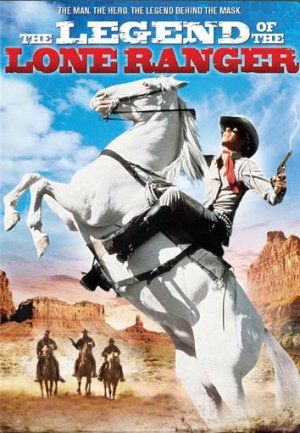
FILM REVIEW OF "THE LEGEND OF THE LONE RANGER (1981)


Scenic locales, gorgeous cinematography, superb set design, atmospheric art direction, and a first-class supporting cast cannot salvage "Monte Walsh" director William A. Fraker's lame western "The Legend of the Lone Ranger" with a impassive Klinton Spilsbury cast as the Masked Man. Spilsbury is a tall, lean gent with a strong chin and a dashing profile. In other words, he would have made a great Marlboro Man, but he conveys no sense of presence. Not only is this western an origins epic establishing the genesis of the Lone Ranger, but it is also an abduction opus since the hero must rescue President Ulysses S. Grant from the villainous Major Bartholomew 'Butch' Cavendish (Christopher Lloyd of "Back to the Future") who attacks his train. You would think President Grant would have surrounded himself with an army of soldiers as his bodyguards, but they are nowhere to be seen.
The Legend of the Lone Ranger

 When we get our first glimpse of the Lone Ranger, John Reid is an adolescent who saves a young Tonto from a gang of ruthless ruffians. No sooner has young Reid saved Tonto from these villains than he scrambles back to his home to find these same dastards attacking his ranch. They gun down both his mother and father in cold blood, and later his big brother packs him off to Detroit. Of course, Detroit would be the perfect place since the original "Lone Ranger" radio series aired there on WXYZ in the first place in 1933. Later, after he has grown up and graduated from law school, he visits his brother, Captain Dan Reid (John Bennett Perry of "Independence Day"),and they ride off in pursuit of the gunmen who hanged a crusading newspaper publisher (John Hart of "The Lone Ranger") in the dusty town of Del Rio, Texas. It seems that Lucas Striker has printed some unkind words about Cavendish, and he repays the favor by dispatching his hooligans to slip a noose around his neck.
The ambush at Bryant's Gap—one of the few events that distinguish this horse opera-- is staged with gusto. Cavendish's men launch wagons laden with explosives off promontories at either end of the gap and cut the Rangers off from escaping while his army of riflemen massacre them. They use a Gatling gun to mow down the poor lawmen. In this version of the legend, Cavendish is no longer an ordinary outlaw but a former U.S. Army officer court-marshaled by Grant. Cavendish plans to establish his own kingdom in Texas and intends to use Grant as his bargaining chip to realize his dream. Christopher Lloyd plays Cavendish as a tight-lipped martinet, and he does some strange things himself. When he orders the execution of two of his henchmen (Ted Gehring and Buck Taylor of TV's "Gunsmoke"), he has them blindfolded and seated in chairs before a firing squad. Believe it or not, one of Cavendish's other henchmen is portrayed by no less than Tom Laughlin of "Billy Jack" fame.

THE LEGEND OF THE LONE RANGER, from left: Michael Horse, Kointon Spilsbury, 1981. ©Universal Pictures 

This 98-minute horse opera perished at the box office partially because of an ill-fated public relations campaign that stripped the original Lone Ranger--Clayton Moore--of his mask. After he finished making "The Lone Ranger and the Lost City of God," Moore appeared in various commercials with sidekick Jay Silverheels and attended movie conventions where he signed autographs. The was the primary way that the former Masked Man generated revenue for himself and his family in his later years. Something must have gone wrong in the process of making the movie because the producers used John Hart, who took over the role momentarily after a contract dispute. Particularly objectionable is the reliance upon a balladeer (country singer Merle Haggard) to provide musical narration that serves no purpose. We know everything that we need to know and then here comes Merle underlining what we already know.  


The problems with the script are numerous. A relationship between John Reed and Amy Striker has its moments when they swap spit, but it goes no farther. Instead of the outlaws killing Amy's father, they should have killed her accidentally when she got in their way. This would have ended the romance and given the Lone Ranger another reason to ride the back trails for justice. The scene where the Masked Man gallops alone into Del Rio to rescue Tonto from a hangman's noose is inferior. He faces little opposition from the townspeople. Although the finale with the Lone Ranger and Tonto infiltrating Cavendish hidden fort turns out to explosive stuff, this entire scene makes it too easy for our heroes who encounter no trouble. The screenplay includes historical figures such as Buffalo Bill Cody, Wild Bill Hickok, and General George A. Custer. Jason Robards is good as Grant, but the story is formulaic. 

If you didn't know any better, "The Legend of the Lone Ranger" might make a tolerable rainy day movie. Michael Horse plays Tonto, but the two generate little sense of camaraderie. "Your sins will be paid for in the fires of hell," proclaims Grant when he sentences Cavendish to prison. He could have been the idiots who took away Clayton Moore's mask and came up with this oater. Stacy Keach's younger brother James dubbed Klinton Spilsbury's dialogue, but not even he can cry "Hi, Yo-Silver" with any enthusiasm. I grew up watching Clayton Moore and Jay Silverheels ride across the small screen as well as the big screen in "The Lone Ranger" and "The Lone Ranger and the Lost City of Gold," and both of these outings surpass this technically elegant looking sagebrusher. The DVD release of this inferior western is just as lame because it is presented in the Pan & Scan format until the end credits roll and the images appear in widescreen letterb0xed format. 


Monday, June 18, 2012

FILM REVIEW OF ''DAWN RIDER" (2012)


Hollywood has all but forsaken westerns. Typically, the sagebrushers that are produced turn out lame. "Recoil" director Terry Miles and "Knockout" scenarists Eric Jacobs and Joseph Nasser prove the exception to the rule with their above-average remake of the vintage John Wayne B-movie western "The Dawn Rider.” The Wayne oater was a remake of director Lloyd Nosler's oater "Galloping Thru" (1931) with Tom Tyler.  As it turns out, "Dawn Rider" (*** out of ****) is the second time that "The Dawn Rider" has been remade; director George Waggner's "Western Trails" (1938) preceded it as the first remake of "The Dawn Rider." In their remake, Miles and his scribes have opened up the action considerably and supplemented the narrative with greater depth as well as length.  The original ran a scant 53 minutes compared with the second remake at 94 minutes. Mind you, Christian Slater couldn't fill John Wayne's boots, but he makes a credible western hero in his own right. Donald Sutherland co-stars as a heavily-bearded, bulletproof lawman on our protagonist's trail.  No lawman pursued Wayne in director Ray N. Bradbury's 1935 original. Indeed, the Sutherland character recalls the sheriff that Harry Carey, Sr., portrayed in a later Wayne horse opera "Angel and the Badman." According to Miles, he appropriated the indefatigable lawman figure from another of his own screenplays. Lochlyn Munro makes a good villain, while Jill Hennessy emerges as our hero's romantic partner. She isn't relegated to the periphery.  She brandishes a revolver and holds her own against the guys. The production values are sturdy, and the cast looks seasoned as well as believable. Miles stages the shoot-outs with reasonable flair, but this oater doesn't break any ground, except casting Slater as a western hero. The villain resorts to a life of crime to pay off a bill involving ownership of a ranch. The hardware appears authentic enough, with cap and ball pistols sometimes substituting for cartridge carrying sidearms.  Although it won't win any Oscars, "Dawn Rider" ranks as one of the better westerns to trot across the screen.
"Dawn Rider" opens as John Mason (Christian Slater of "True Romance") urinates in the woods and then checks the cherry tomatoes in his garden.  Mason marks an X through October 13 on a calendar.  He has been holed up in the cabin for over three months. Later, U.S. Marshal Cochrane (Donald Sutherland of "M.A.S.H.") and two trigger-happy gunmen ride up and cut loose with a barrage of rifle-fire.  Cochrane reprimands them for shooting indiscriminately into the cabin.  He stands to lose a $500 bonus if he doesn't bring Mason in alive.  When they storm the cabin, these fellows hear an explosion, and trapdoor in the floor shudders as Mason makes his escape through a tunnel without injury.  Meantime, in Sarsaparilla, Wyoming, a gang of outlaws wearing flour sacks as masks shoot it out in broad daylight, kill a marshal, and steal a bag that contains only mail but no money.  Rudd Gordon (Lochlyn Munro of "Recoil") is desperate to round up $5000 to pay the debt on the ranch he owes to the Standard Rail Company.  Rudd's sister Alice (Jill Hennessy of "Wild Hogs") lives with him.  Mind you, Alice has no idea that her brother is a desperado. 

In Grey Falls, Montana, Mason is drinking in a saloon when he intervenes on behalf of Ben McClure (Ben Cotton of "Brothers and Sisters") who is being cheated in poker game. The locals recognize Mason from the reputation that he acquired in Cincinnati in a gunfight. Mason denies ever having been in the Ohio town. Miles turns this into a running gag. This is similar to a line in the John Wayne movie "Big Jake" where Wayne contradicts everybody that he comes into contact with about being dead.  Later, McClure and he share the same campfire. Ben shows Mason a ring that he plans to give to his beloved.  As it turns out, Ben works alongside Mason's father in the freight office in Promise, Wyoming. Dad Mason (Kenneth W. Yanko of "Ignition") greets his son with a rifle in the face. Dad likes to speak Spanish as a second language. Mason objects to Dad's Spanish. He abhors Dad's use of Spanish because his father married a Mexican woman after his mother died.  Mason has never forgiven his father. The use of Spanish is another running gag that pays off later because Dad recognizes the killers that rob him from double X-brand on them.  These owlhoots literally have the ranch brand in their skill. Afterward, Mason collides with Alice on main street, and they flash their revolvers at each other. She offers to let him stay with them. When Mason rides into town another day, the flour sack gang robs the freight office and Dad dies during the robbery. During the fracas, Mason swaps shots with the outlaws and catches a bullet. Alice doctors him back to health. Each time that Mason gets close to figuring out who the outlaws are, Rudd intervenes and kills them. During one robbery, an outlaw steals Ben's ring and Rudd confiscates the ring from him. Rudd gives the ring to his sister. Ben is sweet on Alice, and he gets jealous when he learns from Rudd that Alice and Mason are lovers.  Mason suspects something when he spots the ring on Alice's finger.  Later, to throw the scent off their trail, Rudd and his gunmen massacre Cochrane and his deputies in a meadow.


Miles and his scenarists have changed quite a bit from the John Wayne version of "Dawn Rider."  Not only does Mason have a reputation as a gunslinger from Cincinnati, but he has also spent time in a Mexican prison.  The John Wayne protagonist in the 1935 version was lily-white pure.  Miles' remake preserves the plot device involving McClure's ring, but adds the complication that drives Rudd to crime to pay off his debt.  Alice and Mason are old friends, too, unlike the couple in the Wayne original.  She sleeps with a revolver stashed under her pillow.  This plot device is introduced right after she nurses Mason and paid off later when one of Rudd's gunman tries to rape her. "Dawn Rider" benefits from fresh scenery, enough shoot-outs, and a twist at the end involving the shooting of Cochrane. 


Sunday, November 23, 2008

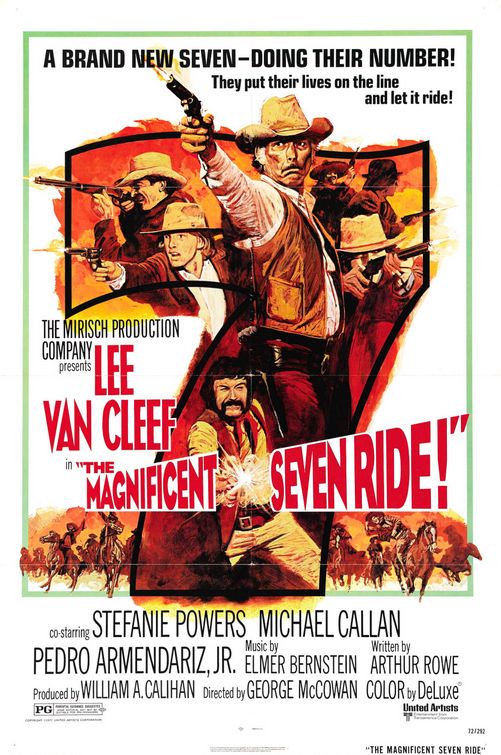
FILM REVIEW OF ''THE MAGNIFICENT SEVEN RIDE!" (1972)

"The Magnificent Seven Ride!" (** out of ****) qualifies as a saddle sore sequel compared to the two previous sequels, Burt Kennedy's "Return of the Seven" (1966) and Paul Wendkos' "Guns of the Magnificent Seven" (1968) and the incomparable John Sturges original "The Magnificent Seven." Lee Van Cleef is the best thing about "The Magnificent Seven Ride." He looks like he belongs in this tame horse opera and his performance is top-notch. No, he doesn't resemble either Yul Brynner or George Kennedy. He lends a commanding presence that this woebegone western desperately needs. The rest of the cast look like they're collecting a paycheck. Moreover,this "Seven" lacks depth of character and generates no more than a modicum of sympathy, unlike their forerunners.

"Frogs" director George McCowan manages to keep the action galloping along for its 100 minutes, and seasoned TV scenarist Arthur Rowe has altered the formula for this outing. For example, unlike the original, our heroes attack the Hispanic villain's camp before they engage him in a fight to the death in the village at the end. Unfortunately, "The Magnificent Seven Ride!" breaks far too many rules. The villain amounts to a one-dimensional cipher with no personality. Indeed, he doesn't utter a word. The best part of this lackluster western occurs in the last twenty minutes as the seven prepare for the onslaught of De Toro's men. "The Magnificent Seven Ride!" looks tired, empty, and worn out owing to its ersatz back lot setting and familiar television locales. Clearly, McCowan could not surmount the obstacles inherent in the low budget. Interestingly, while he doesn't stage the action scenes with distinction, McCowan does frame the gunfights occasionally so that we see more participants in the same shot with the shooter killing his adversary, something that used to be frowned upon back in the Golden Age of Hollywood. Walter Thompson does a competent editing job, but he doesn't have much with which to work so the film has a routine rhythm to it. Talented "Patton" lenser Fred J. Koenekamp had little time to make this sagebrusher look as majestic as the earlier "Seven" entries.

Die-hard "Magnificent Seven" fans have every right to abhor this lame western. I saw it in the theatre when it came out in 1972 and found it nothing short of deplorable. "The Magnificent Seven Ride!" doesn't live up to the Sturges, Kennedy, and Wendkos films. In fact, Geoff Murphy's television pilot surpasses the McCowan film. I remember "Playboy" magazine film critic Bruce Williamson commented that "TM7R" got by "on bits and pieces." In retrospect, more than 30 years later, my aversion to this film has dissipated. Although the McCowan film has its good points, the bad points set aside most of its assets. The stupendous Elmer Bernstein orchestral score seems to have lost its grandeur, too.

"The Magnificent Seven Ride!" opens with Chris (Lee Van Cleef) and another horseman skedaddling out of town. One of Chris' pals from the past,former bounty hunter Jim McKay (Ralph Waite of "The Stone Killer"), is riding to see him in the hope that he can enlist Chris' help against a dastardly Mexican bandit called De Toro. Two of De Toro's men lay in ambush for Jim, but Chris guns down them without mercy and saves his old friend's life. When Jim asks Chris to ride with him, our pipe-smoking protagonist refuses. Not only has he ridden to Mexico three times before, but now he has taken a wife, Arrila (Mariette Hartley of "Barquero"), "who's still practically a bride." McKay reminds Chris that he saved his life, but Chris isn't about to budge. MacKay reminds them about the first time that they went south and earned only $50 dollars per man. Chris still turns him down.

Meanwhile, an out-of-work journalist, Noah Forbes (Michael Callan of "Cat Ballou"),wants to immortalize Chris the same way that Ned Buntline did Buffalo Bill Cody. While all this is transpiring, Arrila pleads with Chris to turn loose an 18-year old robber Shelly (Darrell Larson) who is about to be sent to serve a stretch in Tucson Territorial Prison. Eventually, Arrila wears her husband down and Chris frees Shelly. Shelly repays him by robbing the town bank, wounding him in the shoulder, and abducting Arrila. Chris and Noah track down Shelly's accomplices and Chris shoots them down in cold blood. Chris crosses trails with Jim again. Jim is the law in a Sonora village called Magdalena. Magdalena is a farming village that consists primarily of Mexicans with a few American families. De Toro (Ron Stein)and his army of gunmen terrorize the border. Neither the Rurales nor the U.S. Calvary have had any luck thwarting his notorious activities. Worse, neither refuse to work with the other. When Chris runs into Jim the second time, he learns that Shelly has ridden by and left. Chris learns later that Shelly joined De Toro's gang and showed them a rear approach (a la "The 300 Spartans")and the bandit killed Jim. As it turns out, Jim killed Shelly. "He's done my job," Chris observed, "I'll do his."

Chris rides into Magdalena and discovers a village comprised now of wives who are widows and some children. They don't have enough horses to escort the wives out of the village, and Chris refuses to let them walk across the desert where they would be easy targets for the villains. Since De Toro and his gang have ridden north across the border, Chris promises Mrs. Laurie Gunn (Stephanie Powers of "Hart to Hart")that he will return. She has her doubts. Noah and Chris ride to Tucson Territorial Prison where Chris presented pardons signed by the governor and the warden reluctantly paroles into his custody Walt Drummond (William Lucking), Scott Elliot (Ed Lauter of "The Longest Yard"), Matt Skinner (Luke Askew of "Pat Garrett & Billy the Kid"), Pepe Carral (Pedro ArmendĂ¡riz Jr.), and ex-Army officer Andy Hayes(James B. Sikking of "Star Trek 3"). Chris warns them that he has to consign the pardons before they can be freed and that he dies under any circumstances that the law will track them down. Chris has Elliot, who is a demolitions expert, ride a
wagon filled with explosives. They set out for De Toro's hacienda and attack it. The closest thing to cool in this western is when Pepe sits perched on the roof with a cigar glowing in his mouth, ignites a stick of dynamite, and uses his bullwhip to deliver it under the awning where two Mexicans are operating a Gatling gun during their attack. The problem, however, is that you can see the dummy explode when the dynamite detonates. Our heroes takes De Toro's woman hostage and Chris lets one of De Toro's men go to warn his boss. Before he releases the Mexican, he identifies himself and the rest of his men. Now, the convicts cannot escape and hide in Mexico if Chris dies because De Toro will track them down, and they cannot escape across the border because the law will come after them. In other words, these five convicts aren't the saintly bunch that filled the ranks of the seven in the other movies. Okay, this serves as a nod to realism, but it doesn't endear them to us.


"The Magnificent Seven Ride!" looks completely different from the three earlier oaters. "The Magnificent Seven" was made in Mexico, and "Return of the Seven" and "Guns of the Magnificent Seven" were shot in scenic Spain. In fact, "TM7R" was shot at Universal Studios back lot where "Laredo," "Alias Smith & Jones," and "The Virginian" were made. The exterior desert scenes were lensed at Vasquez Rocks where Captain Kirk battled an alien in the "Star Trek" episode "Arena" and where virtually every cheapjack genre B-movie has been shot.


"The Magnificent Seven Ride! isn't very magnificent.