The silent 1922 epic movie "Down to the Sea in Ships" looks more like a documentary about the whaling business and the religious practices of Quakers than a nail-biting melodrama about a young man who desperately wants to wed his childhood sweetheart. Today, director Elmer Clifton's seafaring saga is primarily remembered as "It" actress Clara Bow's theatrical film debut at age seventeen. The Whaling Film Corporation produced this vintage adventure and they lensed it on location at New Bedford, Massachusetts. Of course, by the time that "Down to the Sea in Ships" was produced, the whaling industry in America was on the decline because oil pumped out of the ground had replaced whale oil in most instances.
The authenticity of several sequences at sea is noted in the opening screen credits which praises the work of both cameramen A.G. Penrod and Paul H. Allen "who, in small boats, stood by their cameras at the risk of their lives to photograph the fighting whales." Literally, "Down to the Sea in Ships" reenacts the practices of New England whalers. Fans of "Flipper" may not enjoy the scene where the hero harpoons a dolphin, and the animal enthusiasts may regard the whale harvesting techniques are barbaric. Unfortunately, restored though the film is, it looks terrible and can be a real chore to watch for those that aren't accustomed to silent cinema. Moreover, you have to pause to read some of the lengthy title cards, some of which contain allusions to Herman Melville's "Moby Dick." However, on the whole, "Down to the Sea in Ships" proves to be a rewarding experience, more for its realistic depiction of religion and whale fishing than its melodrama.
"Down to the Sea in Ships" takes place in mid-19th century New Bedford. Thomas Allan Dexter (Raymond McKee) loves Patience Morgan (Marguerite Courtot) but her devout father, whaling ship-owner William Morgan (William Walcott), forbids her to marry any man that isn't a whaler. Early in the film we learn during a Quaker worship service that anybody that marries anyone that is not a Quaker is expelled and ostracized. A college graduate, Dexter refuses to let a little thing like not having served as sea aboard a whaling ship to prevent him from having Patience. Meanwhile, Jake Finner (Patrick Hartigan) and Samuel Siggs (Jack Baston) scheme to undermine Morgan's business. First, Siggs masquerades as a Quaker so that Morgan will hire him as an accountant, while Finner signs onto Morgan's whaling ship so that he can steal it. At the same time, Siggs sees the hand of Patience with her father's approval which is almost assured because Siggs has great references. You see, old man Morgan's son perished in a whaling accident and he wants grand children so he compels Patience against her will to betroth herself to the villainous Siggs. Siggs fears Dexter and Finner drugs the young suitor and shanghais him for the voyage. As it turns out, this works out to Dexter's advantage.
Similarly, Morgan's granddaughter Dot Morgan (Clara Bow) has a crush on Jimmie (James Thurfler), the cabin boy. Dot disguises herself as a boy and sneaks aboard the ship, only to be discovered by Jimmie after the vessel has gone to sea. Unbelievably, Dot remains hidden below deck in a cloth covered box until the evil Finner finds her. Finner kills the captain and takes over the ship, but Dexter recovers the ship from Finner and imprisons him. The whalers catch a whale and Dexter is instrumental in harpooning the beast and bringing it back. The scene where Dexter's boat capsizes after the whale attacks it is fabulous stuff, especially when the real-life shark swims into view and menaces the men as they scramble back into their boat. Eventually, the sailors exhaust the whale and return to the ship with it.
Film historians and film buffs will enjoy this glimpse of the past. The film covers the themes of man versus man, man versus society, women versus society and their confining role in society. For the record, this version of "Down to the Sea in Ships" has nothing to do with 20th Century-Fox's 1949 whaling saga starring Richard Widmark, Dean Stockwell and Lionel Barrymore.
Interestingly, director Elmer Clifton worked as an assistant director to the famed D.W. Griffith on "The Birth of a Nation" and "Intolerance." One of his more notorious films that he helmed was the 1937 cautionary movie "Assassin of Youth," also known under the title "Marihuana!"

CINEMATIC REVELATIONS allows me the luxury of writing, editing and archiving my film and television reviews. Some reviews appeared initially in "The Commercial Dispatch" and "The Planet Weekly" and then later in the comment archives at the Internet Movie Database. IMDB.COM, however, imposes a limit on both the number of words and the number of times that an author may revise their comments. I hope that anybody who peruses these expanded reviews will find them useful.
Wednesday, November 26, 2008


FILM REVIEW OF ''HIGH TENSION" (2003)
Scary films—like nightmares—shun logic. After all, what else would you expect from movies about vampires, werewolves, ghosts, zombies, mutated creatures, and sadistic maniacs?
Searching for logic in a scary movie is like skinny dipping in quicksand.
If the vampires, werewolves, ghosts, zombies, creatures, and madmen defy logic, their victims fare no better. Folks in horror movies behave foolishly. When they confront horror, they freeze in their footsteps and belt out a blood-curdling screams. Or they flee in the wrong direction, fall down, and sprain an ankle. Even if the girl doesn't sprain her ankle, she will run in a circle and collide with the villain. If the victims reach their car, they must crank up their jalopy repeatedly before the engine finally turns over, just as the monster or killer looms large in their rearview mirror. Indeed, the only reason that the engine doesn't fire-up the first time out is that it would make it too easy for the victims to escape.
Alas, horror movie villains are as unreal as they are undead, and their victims qualify as the least resourceful humans on earth. Now, keeping this in mind, do you watch scary movies to see the victims apply cold, hard logic to an illogical crisis while keeping a cool head under pressure? Anybody that goes to horror movies hoping that the villain will be realistic or that the victims won't do idiotic things clearly doesn't know much about horror movies and life-in-general. Some moviegoers love to berate the victims for their crazy behavior. If you saw a vampire, werewolf, zombie, mutated creature, or homicidal maniac, you'd probably freeze-up and howl, too. If logic has no place in horror movies, neither does realism. People ridicule creature-features routinely because Godzilla doesn't look like the genuine article. Has anybody seen a radioactive prehistoric monster? Werewolves aren't real, so how can they look genuine? Basically, criticizing horror movies for lapses in logic or lack of realism makes no sense. Criticizing horror movies as a type of movie makes better sense, and people who hate horror movies have no right to single out horror movies that abuse logic and defy realism.
The French horror movie "High Tension" (***1/2 out of ****) definitely gives both logic and realism the axe. As the best and bloodiest horror chiller since "Saw," "High Tension" qualifies as a ghastly valentine for gorehounds. First, "High Tension" narrowly avoided an NC-17 rating from the Motion Picture Association of America, but the MPAA must have been in a generous mood when they gave this nerve-jangler an R-rating. You'll see more blood and gore on display here than those recent remakes of "The Texas Chainsaw Massacre," "House of Wax," or nail-biters like "Bogyman." Second, director Alexandre Aja doesn't waste time with a lot of cheap false alarms to make the hair rise on the back of our necks. He is too busy showing a homicidal maniac killing people to indulge in those moments designed to make you jump when he can plunge you up to your neck into a blood-soaked situation.
Just for the record, don't see this movie if you are the squeamish. "High Tension" will scare the puke out of you. Aja doesn't pull any punches when it comes to depicting violence. The scene where the maniac breaks out a huge buzz saw that resembles something firefighters wield to free people trapped in cars illustrates this idea. The villain approaches a stalled-out car that his victim has flagged down on a deserted road. As the driver frantically cranks the vehicle, the maniac smashes the windshield then mangles the driver with this hideous weapon, turning the interior of the car into a bloodbath. In some horror circles, gorehounds call these movies splatter movies instead of slasher movies.
Actually, "High Tension" combines slasher with splatter for a bloodbath of a life-time. Plot wise, "High Tension" concerns two female college students in contemporary France who spend a weekend in the country to catch up on their school work. Marie (Cecile De France of "Around the World in 80 Days") and Alex (Maiween Le Besco of "The Fifth Element") cruise into remote Southern France where Alex's family live on an isolated farm house. No sooner has everybody turned in for the evening than a homicidal madman (Philippe Nahon of "Irreversible") barges into their house. This one-man home invasion army slashes the father, jams his head in the rails of the staircase, and decapitates the breadwinner with a piece of furniture. This madman opens the wife's throat from ear to ear like a watermelon and pursues the little boy into a cornfield with a shotgun. He shackles poor Alex in chains, gags her, and prowls the rest of the house in vain to find anybody else. Miraculously, Marie avoids detection in scenes of heart-stopping suspense. The maniac tools around in a rusty old truck like the monster drove in the "Jeepers Creepers" movies and sticks Alex in the back. At the last second, unbeknownst to the killer, Marie scrambles aboard with Alex. Marie resolves to save her best friend.
Before it's all over with, "High Tension" evokes chilling memories of the original "Texas Chainsaw Massacre." Compared with "Friday the Thirteen's" Jason or "Halloween's" Michael Myers, the maniac her make them look like pansies. Although the first hour or so of "High Tension" is a brutally straight-forward exercise in stomach-churning terror, the last half-hour takes a bizarre 180 degree spin reminiscent of the Brad Pitt movie "Fight Club." Already, Aja has been tapped to helm the remake of "The Hills Have Eyes." If you're looking for a movie that will make you scream and wet your pants at the same time, look no farther than "High Tension."
Tuesday, November 25, 2008
FILM REVIEW OF ''QUANTUM OF SOLACE'' (2008)
Cobra-faced actor Daniel Craig—the fifth to play James Bond—is in better shape than the new 007 epic “Quantum of Solace." If the previous Bond movie “Casino Royale” struck you as abysmal, the threadbare “Quantum of Solace” (* out of ***) scrapes the bottom of the barrel. David Bradley’s rough & tumble second-unit action sequences and Simon Crane’s stunts provide the only bright spots. Unfortunately, neither Craig’s virile 007 nor the gripping fisticuffs can salvage this mundane melodrama that resumes the narrative where “Casino Royale” left off with Bond confronting one of the villains. Subsequently, if you missed “Casino Royale,” “Quantum's” plot convolutions may mystify you. Since Bond producer Cubby Broccoli died, the Bond movies have hit the skids. “Quantum” is the briefest Bond in history and the least compelling if you’re a traditional 007 fan. In fact, “Monster’s Ball” director Marc Forster looks like he is making a replica of a Jason Bourne thriller rather than a James Bond movie.
Ian Fleming’s secret agent hero made his cinematic debut in 1962 with a lean, mean Sean Connery in Terence Young’s “Dr. No,” and the Bond movies revolutionized spy thrillers. Before most people could pick up a Fleming novel, United Artists churned out a sequel “From Russia, With Love." The third 007 caper “Goldfinger” created the template for Bonds and "Thunderball" ensured the longevity of the franchise. No sooner had Bond redefined the spy thriller than everybody cloned the amoral, womanizing British secret agent with his double-entendre puns in knock-off versions.
Of course, Bond extravaganzas have always embraced adventure rather than espionage. Incredibly, in the Cold War era, the Bond producers—unlike most others—refused to demonize the evil Soviet empire. Instead, 007 battled S.P.E.C.T.R.E, a.k.a. Special Executive for Counter-Terrorism, Revenge, and Extortion with larger-than-life villains straight out of old cliffhanger movies like Ming the Merciless from the Flash Gordon serials. The Bond movies displayed no qualms about occasionally slamming the Red Chinese. After "You Only Live Twice" in 1967 the Bonds backed off Mao’s minions.
Since “Casino Royale,” the new Bonds have forsaken everything that made the longest running franchise original. Audiences watch Bond movies for 007’s gadgets, the sexy bikini-clad babes, Bond's wisecracks, the exotic locales, and the outlandish stunts. Not only were the Bond foes arch villains who wanted to destroy the world and remake it in their own demented images, they hatched bizarre plans to achieve these means. Sometimes, Bond movies scuttled credibility to keep up with the times. For example, “Star Wars” inspired “Moonraker.” Nevertheless, 007 gallivanted from one bed to the next for nymphs with naughty names, trumping a gallery of deadly henchmen, and saving the world from extinction.
By 1989, Cubby Broccoli overhauled the series with the gritty, hard-as-nails “License to Kill.” Cubby's strategy backfired, and United Artists refused to promote the picture. After the “License to Kill” debacle, Pierce Brosnan donned the tuxedo and Cubby restored the Roger Moore formula. When production costs escalated, the new Bond producers sacked Brosnan and started from scratch. “Casino Royale” harkened back to the level-headed “For Your Eyes Only,” but the success of prequels—primarily George Lucas’s second “Star Wars” trilogy—caught on and convinced daughter Barbara Broccoli to re-start the franchise with Bond earning his license to kill.
“Quantum of Solace” goes where no Bond has gone. The trademark gun barrel opening scene that started the 20 previous Bonds precedes the end credits. Actually, “Quantum” qualifies as a sequel to “Casino,” something the Bonds have never done. Neither Ms. Moneypenny or Q return. “Casino Royale” wrapped with Bond getting the drop on the villainous Mr. White. “Quantum” opens with 007 careening in his Aston Martin through scenic Italy with a carload of trigger-happy thugs blasting away at him. (Sean Connery's Bond would have made short work of them with a oil slick.) Bond has Mr. White of “Casino Royale”) stashed in the trunk. He delivers White to M for interrogation. No sooner has their interrogation begun than M’s bodyguard Mitchell (utility stunt man Glenn Foster) starts blasting and White makes a break for it. Before he escapes, White chuckles about how the anonymous criminal syndicate that he belongs to has infiltrated virtually every intelligence agency in the world. Scenarists Paul Haggis, Neal Purvis, and Robert Wade reveal nothing about this syndicate and their screenplay is virutally incoherent where details are concerned. Bond cruises throughout "Quantum" on a mission to find who made Vesper die, but surprisingly we never see Vesper in a flashblack, so it is difficult for newcomers to savor the depth of Bond's rage.
Bond chases Mitchell and kills him. Meanwhile, British Intelligence traces the money Le Chiffre, the chief “Casino Royale” villain, used to a geologist in Panama. Bond tangles briefly with a goon hiding in the dead geologist’s motel room. Every time 007 grapples with a bad guy, Green’s people kill Bond's opponent and frame 007 for the killing. Mistakenly, M believes that Bond has gone amok in his quest to exact revenge on those who killed Vesper in "Casino Royale." Anyway, 007 recovers an attaché case that leads him to a mysterious dame. Camille (Olga Kurylenko of “Hitman”)has been sleeping with Dominic Green (Mathieu Amalric of “Marie Antoinette”), a hypocritical megalomaniac environmentalist. Green plans to topple the Bolivian government so he can buy up the country’s water supply and resell it at higher prices to its new president. Green comments a deal with the corrupt General Medrano (Joaquín Cosio of “Hitgirl”) to install him in the presidential palace. Medrano, it turns out, murdered Camille’s father, strangled her mother and her sister. Moreover, Medrano set a fire that cremated her family and left our heroine with a permanent scar on her back. Unfortunately, Medrano doesn't amount to much of a villain. He does little more than rough up two women at the end of the movie and we have no reason to hate him as much as Camille. Camille’s pursuit of Medrano resembles the Roger Moore Bond movie “For Your Eyes Only,” but "For Your Eyes Only" was far exciting. Bond teams up with Camille to thwart both Green and Medrano.
Just as the villains in “Casino Royale” emerged as lightweights, the “Quantum of Solace” villains are twerps that pose little danger to our hero. Green tries to kill Bond with an axe and chops himself in the foot. Green’s scheme to monopolize natural global resources is negligible compared with better Bond villains. The stakes are small potatoes. The fights and the shoot-outs are monotonously repetitive. The dialogue is disposable, and both hero and heroine are too preoccupied with revenge to worry about romance. The Jack White & Alicia Keyes title theme song “Another Way to Die” is a yawner. Judi Dench returns as Bond’s matronly master, but she spends more time being duped while Bond is on the run. The oil covered corpse of Strawberry Fields here is a homage to "Goldfinger." The share the parachute scene recalls the opening stunt from "Moonraker." The fight with the Special Branch operative is straight out of the Cairo scene in "The Spy Who Loved Me." “Quantum of Solace” barely registers on the Richter scale of excitment.
Sunday, November 23, 2008
FILM REVIEW OF ''THE MAGNIFICENT SEVEN RIDE!" (1972)
"The Magnificent Seven Ride!" (** out of ****) qualifies as a saddle sore sequel compared to the two previous sequels, Burt Kennedy's "Return of the Seven" (1966) and Paul Wendkos' "Guns of the Magnificent Seven" (1968) and the incomparable John Sturges original "The Magnificent Seven." Lee Van Cleef is the best thing about "The Magnificent Seven Ride." He looks like he belongs in this tame horse opera and his performance is top-notch. No, he doesn't resemble either Yul Brynner or George Kennedy. He lends a commanding presence that this woebegone western desperately needs. The rest of the cast look like they're collecting a paycheck. Moreover,this "Seven" lacks depth of character and generates no more than a modicum of sympathy, unlike their forerunners.

"Frogs" director George McCowan manages to keep the action galloping along for its 100 minutes, and seasoned TV scenarist Arthur Rowe has altered the formula for this outing. For example, unlike the original, our heroes attack the Hispanic villain's camp before they engage him in a fight to the death in the village at the end. Unfortunately, "The Magnificent Seven Ride!" breaks far too many rules. The villain amounts to a one-dimensional cipher with no personality. Indeed, he doesn't utter a word. The best part of this lackluster western occurs in the last twenty minutes as the seven prepare for the onslaught of De Toro's men. "The Magnificent Seven Ride!" looks tired, empty, and worn out owing to its ersatz back lot setting and familiar television locales. Clearly, McCowan could not surmount the obstacles inherent in the low budget. Interestingly, while he doesn't stage the action scenes with distinction, McCowan does frame the gunfights occasionally so that we see more participants in the same shot with the shooter killing his adversary, something that used to be frowned upon back in the Golden Age of Hollywood. Walter Thompson does a competent editing job, but he doesn't have much with which to work so the film has a routine rhythm to it. Talented "Patton" lenser Fred J. Koenekamp had little time to make this sagebrusher look as majestic as the earlier "Seven" entries.
Die-hard "Magnificent Seven" fans have every right to abhor this lame western. I saw it in the theatre when it came out in 1972 and found it nothing short of deplorable. "The Magnificent Seven Ride!" doesn't live up to the Sturges, Kennedy, and Wendkos films. In fact, Geoff Murphy's television pilot surpasses the McCowan film. I remember "Playboy" magazine film critic Bruce Williamson commented that "TM7R" got by "on bits and pieces." In retrospect, more than 30 years later, my aversion to this film has dissipated. Although the McCowan film has its good points, the bad points set aside most of its assets. The stupendous Elmer Bernstein orchestral score seems to have lost its grandeur, too.

"The Magnificent Seven Ride!" opens with Chris (Lee Van Cleef) and another horseman skedaddling out of town. One of Chris' pals from the past,former bounty hunter Jim McKay (Ralph Waite of "The Stone Killer"), is riding to see him in the hope that he can enlist Chris' help against a dastardly Mexican bandit called De Toro. Two of De Toro's men lay in ambush for Jim, but Chris guns down them without mercy and saves his old friend's life. When Jim asks Chris to ride with him, our pipe-smoking protagonist refuses. Not only has he ridden to Mexico three times before, but now he has taken a wife, Arrila (Mariette Hartley of "Barquero"), "who's still practically a bride." McKay reminds Chris that he saved his life, but Chris isn't about to budge. MacKay reminds them about the first time that they went south and earned only $50 dollars per man. Chris still turns him down.
Meanwhile, an out-of-work journalist, Noah Forbes (Michael Callan of "Cat Ballou"),wants to immortalize Chris the same way that Ned Buntline did Buffalo Bill Cody. While all this is transpiring, Arrila pleads with Chris to turn loose an 18-year old robber Shelly (Darrell Larson) who is about to be sent to serve a stretch in Tucson Territorial Prison. Eventually, Arrila wears her husband down and Chris frees Shelly. Shelly repays him by robbing the town bank, wounding him in the shoulder, and abducting Arrila. Chris and Noah track down Shelly's accomplices and Chris shoots them down in cold blood. Chris crosses trails with Jim again. Jim is the law in a Sonora village called Magdalena. Magdalena is a farming village that consists primarily of Mexicans with a few American families. De Toro (Ron Stein)and his army of gunmen terrorize the border. Neither the Rurales nor the U.S. Calvary have had any luck thwarting his notorious activities. Worse, neither refuse to work with the other. When Chris runs into Jim the second time, he learns that Shelly has ridden by and left. Chris learns later that Shelly joined De Toro's gang and showed them a rear approach (a la "The 300 Spartans")and the bandit killed Jim. As it turns out, Jim killed Shelly. "He's done my job," Chris observed, "I'll do his."

Chris rides into Magdalena and discovers a village comprised now of wives who are widows and some children. They don't have enough horses to escort the wives out of the village, and Chris refuses to let them walk across the desert where they would be easy targets for the villains. Since De Toro and his gang have ridden north across the border, Chris promises Mrs. Laurie Gunn (Stephanie Powers of "Hart to Hart")that he will return. She has her doubts. Noah and Chris ride to Tucson Territorial Prison where Chris presented pardons signed by the governor and the warden reluctantly paroles into his custody Walt Drummond (William Lucking), Scott Elliot (Ed Lauter of "The Longest Yard"), Matt Skinner (Luke Askew of "Pat Garrett & Billy the Kid"), Pepe Carral (Pedro Armendáriz Jr.), and ex-Army officer Andy Hayes(James B. Sikking of "Star Trek 3"). Chris warns them that he has to consign the pardons before they can be freed and that he dies under any circumstances that the law will track them down. Chris has Elliot, who is a demolitions expert, ride a
wagon filled with explosives. They set out for De Toro's hacienda and attack it. The closest thing to cool in this western is when Pepe sits perched on the roof with a cigar glowing in his mouth, ignites a stick of dynamite, and uses his bullwhip to deliver it under the awning where two Mexicans are operating a Gatling gun during their attack. The problem, however, is that you can see the dummy explode when the dynamite detonates. Our heroes takes De Toro's woman hostage and Chris lets one of De Toro's men go to warn his boss. Before he releases the Mexican, he identifies himself and the rest of his men. Now, the convicts cannot escape and hide in Mexico if Chris dies because De Toro will track them down, and they cannot escape across the border because the law will come after them. In other words, these five convicts aren't the saintly bunch that filled the ranks of the seven in the other movies. Okay, this serves as a nod to realism, but it doesn't endear them to us.

"The Magnificent Seven Ride!" looks completely different from the three earlier oaters. "The Magnificent Seven" was made in Mexico, and "Return of the Seven" and "Guns of the Magnificent Seven" were shot in scenic Spain. In fact, "TM7R" was shot at Universal Studios back lot where "Laredo," "Alias Smith & Jones," and "The Virginian" were made. The exterior desert scenes were lensed at Vasquez Rocks where Captain Kirk battled an alien in the "Star Trek" episode "Arena" and where virtually every cheapjack genre B-movie has been shot.

"The Magnificent Seven Ride! isn't very magnificent.
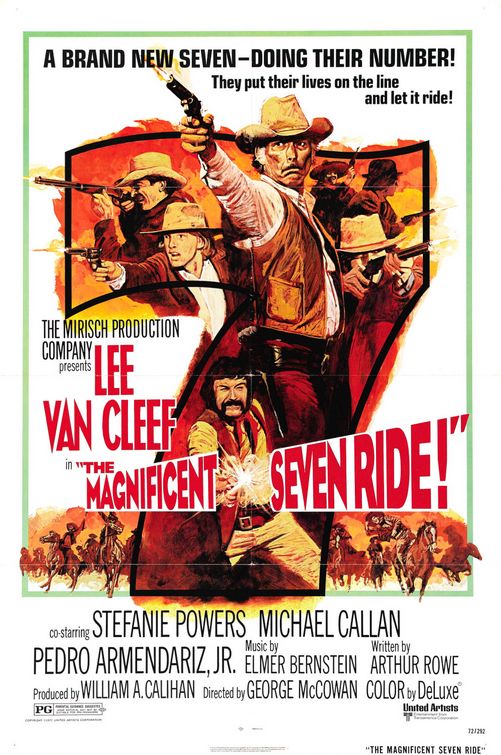
"Frogs" director George McCowan manages to keep the action galloping along for its 100 minutes, and seasoned TV scenarist Arthur Rowe has altered the formula for this outing. For example, unlike the original, our heroes attack the Hispanic villain's camp before they engage him in a fight to the death in the village at the end. Unfortunately, "The Magnificent Seven Ride!" breaks far too many rules. The villain amounts to a one-dimensional cipher with no personality. Indeed, he doesn't utter a word. The best part of this lackluster western occurs in the last twenty minutes as the seven prepare for the onslaught of De Toro's men. "The Magnificent Seven Ride!" looks tired, empty, and worn out owing to its ersatz back lot setting and familiar television locales. Clearly, McCowan could not surmount the obstacles inherent in the low budget. Interestingly, while he doesn't stage the action scenes with distinction, McCowan does frame the gunfights occasionally so that we see more participants in the same shot with the shooter killing his adversary, something that used to be frowned upon back in the Golden Age of Hollywood. Walter Thompson does a competent editing job, but he doesn't have much with which to work so the film has a routine rhythm to it. Talented "Patton" lenser Fred J. Koenekamp had little time to make this sagebrusher look as majestic as the earlier "Seven" entries.
Die-hard "Magnificent Seven" fans have every right to abhor this lame western. I saw it in the theatre when it came out in 1972 and found it nothing short of deplorable. "The Magnificent Seven Ride!" doesn't live up to the Sturges, Kennedy, and Wendkos films. In fact, Geoff Murphy's television pilot surpasses the McCowan film. I remember "Playboy" magazine film critic Bruce Williamson commented that "TM7R" got by "on bits and pieces." In retrospect, more than 30 years later, my aversion to this film has dissipated. Although the McCowan film has its good points, the bad points set aside most of its assets. The stupendous Elmer Bernstein orchestral score seems to have lost its grandeur, too.

"The Magnificent Seven Ride!" opens with Chris (Lee Van Cleef) and another horseman skedaddling out of town. One of Chris' pals from the past,former bounty hunter Jim McKay (Ralph Waite of "The Stone Killer"), is riding to see him in the hope that he can enlist Chris' help against a dastardly Mexican bandit called De Toro. Two of De Toro's men lay in ambush for Jim, but Chris guns down them without mercy and saves his old friend's life. When Jim asks Chris to ride with him, our pipe-smoking protagonist refuses. Not only has he ridden to Mexico three times before, but now he has taken a wife, Arrila (Mariette Hartley of "Barquero"), "who's still practically a bride." McKay reminds Chris that he saved his life, but Chris isn't about to budge. MacKay reminds them about the first time that they went south and earned only $50 dollars per man. Chris still turns him down.
Meanwhile, an out-of-work journalist, Noah Forbes (Michael Callan of "Cat Ballou"),wants to immortalize Chris the same way that Ned Buntline did Buffalo Bill Cody. While all this is transpiring, Arrila pleads with Chris to turn loose an 18-year old robber Shelly (Darrell Larson) who is about to be sent to serve a stretch in Tucson Territorial Prison. Eventually, Arrila wears her husband down and Chris frees Shelly. Shelly repays him by robbing the town bank, wounding him in the shoulder, and abducting Arrila. Chris and Noah track down Shelly's accomplices and Chris shoots them down in cold blood. Chris crosses trails with Jim again. Jim is the law in a Sonora village called Magdalena. Magdalena is a farming village that consists primarily of Mexicans with a few American families. De Toro (Ron Stein)and his army of gunmen terrorize the border. Neither the Rurales nor the U.S. Calvary have had any luck thwarting his notorious activities. Worse, neither refuse to work with the other. When Chris runs into Jim the second time, he learns that Shelly has ridden by and left. Chris learns later that Shelly joined De Toro's gang and showed them a rear approach (a la "The 300 Spartans")and the bandit killed Jim. As it turns out, Jim killed Shelly. "He's done my job," Chris observed, "I'll do his."

Chris rides into Magdalena and discovers a village comprised now of wives who are widows and some children. They don't have enough horses to escort the wives out of the village, and Chris refuses to let them walk across the desert where they would be easy targets for the villains. Since De Toro and his gang have ridden north across the border, Chris promises Mrs. Laurie Gunn (Stephanie Powers of "Hart to Hart")that he will return. She has her doubts. Noah and Chris ride to Tucson Territorial Prison where Chris presented pardons signed by the governor and the warden reluctantly paroles into his custody Walt Drummond (William Lucking), Scott Elliot (Ed Lauter of "The Longest Yard"), Matt Skinner (Luke Askew of "Pat Garrett & Billy the Kid"), Pepe Carral (Pedro Armendáriz Jr.), and ex-Army officer Andy Hayes(James B. Sikking of "Star Trek 3"). Chris warns them that he has to consign the pardons before they can be freed and that he dies under any circumstances that the law will track them down. Chris has Elliot, who is a demolitions expert, ride a
wagon filled with explosives. They set out for De Toro's hacienda and attack it. The closest thing to cool in this western is when Pepe sits perched on the roof with a cigar glowing in his mouth, ignites a stick of dynamite, and uses his bullwhip to deliver it under the awning where two Mexicans are operating a Gatling gun during their attack. The problem, however, is that you can see the dummy explode when the dynamite detonates. Our heroes takes De Toro's woman hostage and Chris lets one of De Toro's men go to warn his boss. Before he releases the Mexican, he identifies himself and the rest of his men. Now, the convicts cannot escape and hide in Mexico if Chris dies because De Toro will track them down, and they cannot escape across the border because the law will come after them. In other words, these five convicts aren't the saintly bunch that filled the ranks of the seven in the other movies. Okay, this serves as a nod to realism, but it doesn't endear them to us.

"The Magnificent Seven Ride!" looks completely different from the three earlier oaters. "The Magnificent Seven" was made in Mexico, and "Return of the Seven" and "Guns of the Magnificent Seven" were shot in scenic Spain. In fact, "TM7R" was shot at Universal Studios back lot where "Laredo," "Alias Smith & Jones," and "The Virginian" were made. The exterior desert scenes were lensed at Vasquez Rocks where Captain Kirk battled an alien in the "Star Trek" episode "Arena" and where virtually every cheapjack genre B-movie has been shot.

"The Magnificent Seven Ride! isn't very magnificent.
Tuesday, November 18, 2008
FILM REVIEW OF ''SOUL MEN'' (2008)
Samuel L. Jackson and the late comedian Bernie Mac team up as blues singers in “Undercover Brother” director Malcolm D. Lee’s new movie “Soul Men” (** out of ****), a raunchy, R-rated, musical comedy that co-stars late rhythm & blues legend Isaac Hayes. The camaraderie between the cantankerous Jackson and the comedic Mac surpasses their half-witted shenanigans as they embark on a cross-country trip to pay tribute to a dead lead singer with whom they once shared the limelight. Robert Ramsey and Matthew Stone's episodic script trots out all the obligatory jokes about Viagra, rectal exams, and infidelity. Our heroes emerge from obscurity and find redemption and success where they least expected. Ironically, “Soul Men” fares better as a drama about two washed-up blues brothers struggling to make a comeback than as a comedy of errors. Although neither Jackson nor Mac can tote a tune in a bucket, they conjure up more than enough charisma to compensate for their lack of vocal talent. Basically, “Soul Men” boils down to an African-American spin on “The Sunshine Boys” meet “Planes, Trains, and Automobiles” with a hefty part of the plot taking place in Memphis, Tennessee.
“Soul Men” unfolds like a VH-1 music documentary as we learn about the soul trio Marcus Hooks and the Real Deal. These fellas start out warbling on Memphis street corners and wind up in the big time. Eventually, Marcus (Johnny Legend, a.k.a. John Stephens) abandons his back-up singers, Louis Hinds (Samuel L. Jackson of “Pulp Fiction”) and Floyd Henderson (Bernie Mac of “Transformers”), to pursue a solo career. Marcus finds fame, but our heroes—the Real Deal—burn out as one-hit wonders. Creative differences drive them apart in 1979 and they go their separate ways. Floyd reaps greater monetary fame promoting an L.A. car wash with bikini-clad babes soaping up bumpers, while Louis botches a bank robbery and serves time in prison.
“Soul Men” shifts from the past to the present. Floyd finds himself put out to pasture in a luxurious retirement village by his goofy son Duane (Mike Epps of “Next Friday”) who has taken over his father’s business. Predictably, Floyd gets bored playing golf and has to gobble Viagra galore to keep up with a voluptuous neighbor who wants his body more than his soul. Floyd suffers from insomnia. One night while watching television, he learns that Marcus has died during a concert performance in Stockholm. No sooner does Floyd hear about this tragedy than record label owner Danny Epstein (Sean Hayes of “The Bucket List”) rings him up. Epstein wants Floyd and Louis to perform at Marcus’ tribute at the world famous Apollo Theatre in Harlem. Naturally, Floyd leaps at the offer and looks up Louis.
Louis, on the other hand, doesn’t jump at the offer. Out on parole, Louis toils as a mechanic and lives in hopeless squalor. After a tough day at the garage, Louis comes home to his depressing apartment to find Floyd rummaging through his things. Before Floyd can say something, Louis decks him with a right cross to the jaw that crumples Floyd to the floor. When he recovers, Floyd tries to reason with Louis and begs him to appear at the Apollo so that he can reboot their blues singing career. Louis flatly refuses until Floyd tells him that they can pick up an easy twenty grand. Shrewd, cynical Louis reluctantly agrees to join Floyd, but only if Floyd gives Louis sixty per cent of the split and they drive across country rather than fly.
A frustrated Floyd caves in to Louis’ demands. They hit the road in a lime-green Cadillac and do a series of one-night performances at motel lounges across Arizona, Texas, and Oklahoma. Things get complicated along the way when they try to visit an old girlfriend, discover that she is dead, and meet her beautiful daughter, Cleo (Sharon Leal of “Dreamgirls”), who contends with an abusive boyfriend. Louis and Floyd rescue her from the boyfriend, Lester (Affion Crockett of “Compton Cowboy”), and she accompanies them. She finds her voice as a blues singer on the road. When our heroes chill in Memphis, local sensation Isaac Hayes offers Cleo a contract. While things soar from Cleo, everything goes south for our protagonists. Louis and Floyd get into trouble, end up in jail, and then Floyd pulls a real boner. The Memphis Police release Floyd, but they hold Louis since he has violated his parole. Floyd realizes he cannot sing solo at the Apollo, so he breaks his old partner out of jail. The surveillance camera footage makes the news. Now, our heroes are the object of a nation-wide manhunt, so when they arrive in Harlem, they have to dodge the N.Y.P.D.
Predictably, everything works out. “Soul Men” qualifies as neither a great movie nor a good movie, more like a minor movie. However, you cannot take your eyes off either Samuel L. Jackson or Bernie Mac when they do their routines. They spend most of the film’s 100 minute running time hurling hardcore expletives at each other. Depending on your sense of humor, you'll either hurt yourself laughing when they badmouth each other or you will hang your head in despair. Jackson and Mac are fun to watch, especially when they don their flashy outfits and perform choreographed dance numbers. Isaac Hayes pretty much plays himself in a subplot. Bernie Mac deserved a better film than “Soul Men” to conclude his career. Spike Lee's younger brother director Malcolm D. Lee wraps up the film with a tribute to Mac’s career.
Sunday, November 16, 2008
FILM REVIEW OF ''DARK CITY' (1998)
Austrian novelist Franz Kafka would probably applaud everything but the aliens and the ending in “The Crow” director Alex Proyas’ “Dark City.” This gloomy but hopeful science-fiction murder-mystery features Rufus Sewell, Jennifer Connelly, William Hurt and Kiefer Sutherland. Best when only gazed at, “Dark City” relies more on its hypnotic visuals than its shallow, predictable script.
Comparatively, “Dark City” resembles Orson Welles’ 1963 classic “The Trial,” based on the Kafka novel. An innocent man (Anthony Perkins) awakens one morning to find himself accused of an unknown crime that he didn’t commit in what resembles a police state. Kafka serves merely as an aesthetic departure point for “Dark City.” After establishing its metaphorical bond with Kafka, “Dark City” degenerates into a humdrum, happy-ending melodrama of the comic book variety.
Despite its stunning technical virtuosity, “Dark City” (** out of ****) frustrates anyone who scrutinizes its eye-popping style for a modicum of substance. Proyas’ cinematic effort delivers few fresh ideas with its contrived, low-brow saga about humanity, individuality and alien mind control. Worse, most of the ideas and imagery cobbled together in this predictable futuristic opus came from more entertaining movies. Suffice to say, “Dark City” contains more kaka than Kafka.
“Dark City” unravels as a pallid yarn about paranoia. Rufus Sewell of “Dangerous Beauty” impersonates a nondescript nobody who emerges as the savior of Proyas’ brooding potboiler. Waking up in a dingy bathtub in a strange hotel, John Murdoch (Sewell) finds blood leaking from his forehead. Afflicted with amnesia, he stumbles onto the naked corpse of a murdered hooker. No sooner has Murdoch gathered his wits than he gets a sudden phone call from creepy Dr. Schreber (Kiefer Sutherland of “Young Guns”). Murdoch learns that he is supposed to be a serial killer of prostitutes. Eluding an ominous gang of knife-wielding fiends, our hero embarks on a search for his identity.
Murdoch confronts a grave new world where the sun never shines. Everything grinds to a spooky halt every night at midnight. A bizarre cabal of aliens is secretly experimenting with humans. They want to see how people react to a variety of different circumstances. They change the memories of these poor humans as if their minds were Rubik’s cubes. These vaguely understood characters are called ‘Strangers.’ This pale, cadaverous mob dresses alike in long, black leather coats and dark hats to cover their white cue ball heads. Not only does sunlight irritate them, but they also abhor moisture.
We’re told by the mad scientist narrator that the ‘Strangers’ are as old as time. They travel great distances by levitation. Endowed with the power to alter physical reality by a telepathic process called ‘tuning,’ these dour ‘Strangers’ can create doors in walls where no portals existed. Visually, their power is depicted as a slinky-like series of transparent concentric circles rippling out from the center of their foreheads. Oddly enough, these ‘Strangers’ are dying. All men and one boy, they are convinced that their survival lies in mankind. Before they can achieve their goal, these ‘Strangers’ must deduce what makes mankind ‘human.’ The ‘Strangers’ have abducted humans and taken them to a world they have created to figure out what makes mankind tick.
“Dark City” has a drab, monolithic plot with several inherent theatrical flaws.
First, the filmmakers provide less than sensational heroics in the various skirmishes between the hero and the villains. “Dark City” fails to thrill because the leads are never in jeopardy. Moreover, when characters find themselves in danger, the challenge has a muted quality. The climactic ‘tuning’ battle between Mr. Book (Ian Richardson of “Man of La Mancha”) and Murdoch lacks a credible quotient of violence. Second, too many characters clutter up the film! Inspector Frank Bumstead, a supporting character who is clearly more interesting than Murdoch, should have been the hero. Further, the moviemakers should have combined Bumstead’s role with the insane victim cop, Eddie Walenski (Colin Friels of “Darkman”). Their synthesized characters would have made a more exciting hero. Third, we’re never told how the hero acquired his ability to ‘tune.’ This is a pretty serious flaw because ‘tuning’ makes Murdock equal to his enemies. Worse, Dr. Schreber has no idea either, and he is the guy who concocted the stuff that he injects into the foreheads of the human with his baroque syringes. Fourth, “Dark City” suffers because the filmmakers refuse to tell us enough about these enigmatic ‘Strangers.’ They are a cryptic bunch that occupies space somewhere between Uncle Fester of “The Adams Family” and Clive Barker’s Pin-Head.
William Hurt of “The Big Chill” appears as a hard-boiled, accordion-playing detective determined to capture Murdoch. Wasted in a subordinate role, Hurt has little chance to develop anything more than a sketchy character. While it’s always a pleasure to watch the eloquent Hurt, his cop character receives deplorable treatment. “Dark City” consigns sexy Jennifer Connelly to the cosmetic role of the woman-in-distress. Murdoch eventually gets around to saving her from the clutches of the Strangers near the end of the movie. Connelly and Sewell generate few sparks as lovers. She spends most of her screen time doing unremarkable things.
Droopy-eyed Kiefer Sutherland chews the scenery as a stereotypical Dr. Moreau geneticist with everything but a Peter Lorre sneer. He sports quirky clothes, adopts an accent and shuffles rather than walks. As one of the movie’s chief characters, Dr. Schreber strikes neither a villainous nor heroic posture. He mixes and matches genes in lab test tubes to draft new identities and memories. Proyas and his scenarists cannot figure out whether audiences should like or loathe him. Proyas generates an air of mystery, but this genre has been so overdone that “Dark City” illuminates nothing more than its own shortcomings. If Dungeons and Dragons entertain you, “Dark City” may mesmerize you.
FILM REVIEW OF ''A FISTFUL OF DOLLARS'' (ITALIAN-1964)

Sergio Leone’s “Per un pugno di dollari” (***1/2 out of ****) ranks not only as a landmark horse opera in the history of the western but also in evolution of the spaghetti western. Hollywood had been churning out westerns since “The Great Train Robbery” in 1903, and the Italians had been cloning those westerns before Leone revolutionized them with this Clint Eastwood epic. Indeed, mainly on the plains of Spain, Leone would reinvent the western and make it more violent than it had been until Sam Peckinpah broke new ground with his controversial 1969 western “The Wild Bunch.” “Per un pugno di dollari” altered everything and forged a new hero who was for all practical purposes an anti-hero. Joe (Clint Eastwood) shoots first in a duel, wears stubble on his jaws, and seems motivated largely by money. At one point, he behaves like a guardian angel, but for the most part, he is in it for what he can get out of it. Leone had to pare this sagebrusher down to its quintessential components because of a shoestring budget. Nevertheless, despite its financial shortcomings, this Italian-German-Spanish co-production looks fantastic in its 2.35.1 letterbox format and the Spanish and Roman locale double more or less invisibly to the simple but exciting plot. Most die-hand “Dollar” fans know that Leone and producers Arrigo Colombo and Giorgio Papi had to settle a copyright infringement suit with Japanese filmmaker Akira Kurosawa’s “Yojimbo” before they could release the film outside of Italy. Leone maintained that eighteenth Venetian playwright Carlo Goldoni’s play “A Servant with Two Masters” inspired “Per un pugno di dollari,” but the courts ruled in Kurosawa’s favor.
 The action unfolds as our anti-heroic protagonist rides up to a well located near two white-washed, single-storied dwellings in the middle of a parched desert. While he quenches his thirst, Joe watches as an ugly, gigantic Mexican gunman, Chico (Mario Brega of “Death Rides A Horse”), bangs off shots at the heels of a tiny boy, Jesus (Nino Del Arco), and chases him between the two houses. When Chico reaches the other house, he brutalizes the father, Julián (Daniel Martin of “The Last Tomahawk”), for letting the lad run loose. Little Jesus was only trying to see his mother, Marisol (Marianne Koch of “Clint, the Nevada's Loner”), who has been abducted by the gunmen for their boss. This unforgettable opening scene represents the first instance that we’re watching a different kind of western. Spaghetti westerns were notoriously violent yet seldom as sanguine as Sam Peckinpah’s oaters. The chief reason “A Fistful of Dollars” is not three times as bloody is that Leone was working on a low-budget and couldn’t afford such luxuries. Joe watches all of this transpire with mild curiosity. Unlike an American western hero, he doesn’t intervene, at least until later.


Joe and Silvanito follow the Mexican cavalry to the river. "It's like playing cowboys and Indians," the tavern owner remarks. The Mexican Army escort arrives at their rendezvous with the U.S. Calvary at the Rio Bravo. The Mexicans have brought gold to pay for guns. They are in for a rude awakening. The Americans have been killed, and coyote-faced Ramón and his men are impersonating them. Ramón wipes out the Mexican soldiers to the last man with a machine gun. The machine gun is all wrong for the time period as well as the fact that it houses no ammunition drum on it to feed it bullets. Ramón displays his accuracy with a Winchester when one lone Mexican tries to escape on horseback and he knocks him out of the saddle with one shot. When Ramón returns from the massacre, he meets Joe. Curiously, Joe decides to hand back what is left of the money that Don Miguel gave him. "I don't like to take money unless I feel I've earned it," Joe explains. This is unusual for a Spaghetti western where refunds weren't standard. Ramón scares Joe off because he wants to call a truce with the Baxters. When Ramón asks Joe if he doesn't prefer peace to violence, Joe shrugs and replies that he has little knowledge of peace. After Joe leaves, Don Miguel reiterates his respect for the American. "At shooting a pistol no one can touch him." Ramón remains suspicious about Joe: "When someone with that face works with his gun, you may counton two things. He's fast on the trigger, but he's also intelligent."

Later, Joe returns to the scene of the massacre and appropriates two Mexican bodies and deposits them in the local graveyard. He earns $500 from each the Rojos and the Baxters when he tells them about the surviving soldiers. While the two clans are shooting at each in the graveyard, Joe finds Ramón’s gold and runs into Marisol. He punches her in the face quite by accident and then hands her over to the Baxters who engineer a trade for their son.
 Sergio Leone displays a splendid flair for visuals as well as storytelling in “A Fistful of Dollars.” Ramón qualifies as the best kind of villain because he is dangerous, but Ramón’s pride at “aiming for the heart” is what leads to his destruction. Ennio Morricone’s distinctive music sets “A Fistful of Dollars” apart from all Spaghetti westerns and established new conventions for the genre. Clint Eastwood plays the anti-heroic Joe with glacial calm and Gian Maria Volontè is simply brilliant as Ramón. A number of people collaborated on the screenplay, among them Sergio Leone, Fernando Di Leo of “Wipe Out!,” Duccio Tessari of “A Pistol for Ringo,” Víctor Andrés Catena of “Three Sergeants of Bengal,” Jaime Comas Gil of “Danger! Death Ray," and even Clint Eastwood. Despite all these scribes, “A Fistful of Dollars” boasts several memorable lines.

"A Fistful of Dollars" is not without flaws. Of course,Ramón should have put a bullet in Joe's head instead of repeatedly shooting him in the heart in the final duel. Clearly, however, the villain must have his own flaws and Ramón's incredulity at his failure to kill Joe with his first shots undermined him. Chico should have smashed up Joe's right hand--his gun hand--instead of stomping on his left hand. Curiously, nobody ever gets the gold that Ramón stole from the Mexicans and concealed in his warehouse. Did the Baxters have to pour out of the front door of their headquarters during the massacre? Couldn't they have exited by the back doors. Presumably, the low budget prevented this alternative from being staged. Esteban could have shot Joe down from ambush when Joe empties his gun before the final duel with Ramón.

Subscribe to:
Posts (Atom)