Angelina Jolie and Johnny Depp make a great looking couple in German director Florian Henckel von Donnersmarck’s crime thriller “The Tourist,” an elegant but anemic homage to Alfred Hitchcock movies about strangers who meet on a train and fall in love. Everything about the PG-13 rated “Tourist” (** out of ***) looks great, too. “Dead Poets Society” lenser John Seale makes every shot of our well-coiffed heroine in control and our debonair hero in jeopardy around scenic Venice appear absolutely stunning. Aside from one scene where a man is strangled under rather unbelievable circumstances, the violence qualifies as standard-issue combat with nothing that particularly distinguishes it from ten-thousand other lackluster thrillers. In other words, the violence never escalates into the blood, gore, and more variety with blasted-off body parts or exotic forms of mayhem. Meantime, Donnersmarck and scenarists Christopher McQuarrie of “The Usual Suspects” and Julian Fellowes of “Vanity Fair” have contrived what amounts to a predictable potboiler about mistaken identities. The formulaic screenplay, sketchy characters, and absence of anything masquerading as momentum undercut this inert picture-postcard exercise in suspense. Not surprisingly, the filmmakers try to be clever with a surprise ending that may pull the rug out from under some audiences while others won’t be hoodwinked by this sloppy trick. Aside from Seale‘s sensational cinematography, “The Tourist” boasts a top-notch cast that features Paul Bettany, Rufus Sewell, Timothy Dalton, and Steven Berkoff. The lack of substance in the storyline ultimately diminishes this fine looking film.
Madison Community College mathematics instructor Frank Tupelo (Johnny Depp of “The Pirates of the Caribbean” franchise) is on a European holiday when he encounters the hopelessly beautiful Elise Clifton-Ward (Angelina Jolie of “Salt”) while on a Parisian train bound for Venice. They strike up an acquaintance that turns into a quirky one-sided romantic romp that takes up the better part of the action. Mind you, “The Tourist” qualifies as a lightweight, romantic comedy with one abrasive scene. No, Frank’s dark magnetism has nothing to do with Elise’s decision to approach him on the train. She is a mysterious dame herself who has been under constant surveillance by the authorities in England and France. French authorities, particularly the Financial Crimes Division, struggle to be inconspicuous as they follow her around in a van decked out with all the latest surveillance technology. They arrest anybody that she talks to that may fit the description of a criminal who has stolen over $744 million. Moreover, they stay in constant contact with Scotland Yard, specifically Inspector John Acheson (Paul Bettany of “Legion”), who has been trying to catch Elise with a notorious Englishman, an international fugitive named Alexander Pearce. They arrest a bicycle courier when he delivers a message to Elisa at a café and then later release him because he isn’t Pearce.
Pearce, it seems, appropriated his millions from the most malevolent gangster in Europe, Reginald Shaw (Steven Berkoff of “Beverly Hills Cop”), who doesn’t so much kill his adversaries as annihilate them and their families. He boasts at one point that he killed both anybody who made love to his wife before he met her as well as everybody afterward. Essentially, Shaw resembles Keyser Söze, the no-holds-barred Turkish criminal mastermind from Christopher Macquarie’s “The Usual Suspects” script.
When the French authorities send Acheson a photograph of the latest Pearce suspect, a corrupt Scotland Yard administrative assistant leaks word to Shaw about Pearce. Of course, Frank Tupelo isn’t Pearce. Indeed, Elisa strikes up an affair of sorts with Tupelo because the real Pearce asked her to find somebody that approximated his height and weight to mislead the authorities into thinking that he was Pearce. Before long, the clueless Frank Tupelo finds himself dodging bullets from Shaw’s trigger-happy Eastern Bloc gunmen. Later, Tupelo winds up handcuffed to a boat trying to escape more of Shaw’s incompetent henchmen. Shaw displays little patience for their ineptitude. He strangles one with a tailor’s measuring tape in front of the tailor as well as his own men. The villainous Shaw ranks as the toughest and least likeable character in “The Tourist.”
Acheson’s boss at Scotland Yard, Chief Inspector Jones (Timothy Dalton of “The Living Daylights”) has spent $8 million trying to track down the elusive Pearce. Now, Jones wants to waste no more time or money on the fugitive. Nevertheless, against Jones’ orders, Acheson decides to stick with the case and Elisa turns herself in to help him. The showdown in Venice with a Scotland Yard sniper team proving their enviable expertise with telescopic rifles is about as good as “The Tourist” gets before it pulls its switcheroo ploy. As clever as it appears initially, this reversal lacks credibility. At the same time, the international fugitive proves his love for the heroine and Jones walks away gratified, even though Acheson doesn’t believe a word of it!
Angelina Jolie plays a seductress who can wear an off-the-shoulder gown and pick a lock with ease. For the record, she wears 12 dresses in “The Tourist.” She is at her most elegant and cavorts about in fashionable apparel and high heels. Johnny Depp is at his most vulnerable in a role that provides him with little in the way of mystery. He wears his whiskers with style and smokes an ingenious looking device masquerading as a cigarette. This mechanical cigarette resembles an actual filter-tipped cigarette except it delivers only nicotine and water vapor so user appears to be smoking. The glow on the end is furnished courtesy of an LED. Keep your eyes on that cigarette if you want to enjoy this sly but shallow film. The British supporting cast, including former James Bond Timothy Dalton and Paul Bettany, make the police look good. The most interesting but least seen character is another Englishman (Rufus Sewell of “Dark City”) who skulks at the periphery. Sophomore Florian Henckel von Donnersmarck’s directing is flawless, but the same cannot be said of the thin screenplay. For the record, “The Tourist” is a remake of the French thriller “Anthony Zimmer” (2005) that toplined Sophie Marceau and Yvan Attal. Unfortunately, looks alone don’t give “The Tourist” what it needs to be either invigorating or mystifying. Ultimately, “The Tourist” is a sight that isn’t worth seeing.

CINEMATIC REVELATIONS allows me the luxury of writing, editing and archiving my film and television reviews. Some reviews appeared initially in "The Commercial Dispatch" and "The Planet Weekly" and then later in the comment archives at the Internet Movie Database. IMDB.COM, however, imposes a limit on both the number of words and the number of times that an author may revise their comments. I hope that anybody who peruses these expanded reviews will find them useful.
Saturday, January 8, 2011


Wednesday, January 5, 2011
FILM REVIEW OF ''DRACULA" (1931)


Initially, the studio sought Lon Chaney, Sr., for the part, but cancer claimed Chaney before the great thespian could make the film. Lugosi landed the role for a minimal $500-a-week and he never topped "Dracula," though he came close with "White Zombie." Eventually, he would thrive in Poverty Row studio chillers and comedies and ended his career in director Ed D. Wood's preposterous "Plan 9 from Outer Space." Browning went on to make the controversial "Freaks" with genuine freaks about intrigue and murder in a small traveling circus. Universal produced "Dracula" for about $341-thousand, but curiously enough they neglected to capitalize on their surprise hit until four years later when they produced "Dracula's Daughter" with no Lugosi in sight. Granted, Van Helsing had destroyed the Lugosi monster in the first film, but later films dismissed this consolation to realism. Lee's Dracula reconstitutes himself in virtually all the Hammer films.

"Dracula" opens with a long shot as a real-life, horse-drawn stagecoach threads its way through the Carpathian Mountains. Renfield (Dwight Frye of "The Doorway to Hell") is a London real estate agent who has come to Transylvania with a lease for Count Dracula to sign. Renfield is riding with several other passengers when an anxious native explains that they must reach the inn before sunset. "It is Walpurgis night, the night of evil." He pauses and then continues, "Nosferatu. On this night, Madame, the doors-they are barred and to the Virgin we pray." Meantime, at the inn, the workers are reciting the Lord's Prayer in Hungarian. The coach pulls up at the Inn, but Renfield has no plans to stay. "I say, porter, don't take my luggage down. I'm going to the Borgo Pass tonight." The innkeeper struggles to persuade Renfield to remain until sunrise the following day because the coachman is frightened. Renfield explains that a carriage awaits him at midnight at the Borgo Pass. He adds that his destination is Castle Dracula. The innkeeper warns Renfield not to enter Castle Dracula. "We people of the mountains believe at the castle there are vampires! Dracula and his wives. They take the form of wolves and bats. They leave their coffins at night and they feed on the blood of the living." Renfield discounts all this hokum. He believes they are all superstitious, something that Renfield isn't. The innkeeper's wife thrusts a crucifix into Renfield's hand. "If you must go, wear this for your mother's sake. It will protect you." The crucifix was a standard weapon in any vampire hunter's arsenal. In this 1931 production, the crucifix can stop a vampire. When Universal Studios remade "Dracula" in the 1970s with Frank Langella, the crucifix bursts into flames in Dracula's presence.

Renfield swaps stagecoaches at Borgo Pass and rides off to Castle Dracula. The coach is making good time when Renfield peers outside and sees a huge bat flapping its wings in front of the horses as if it were leading the steeds. Once they reach the castle, Renfield searches for the coachman who is nowhere in sight. Of course, we know from the instant that we saw the coachmen that he is Dracula and can shape-shift. Renfield enters the imposing but dilapidated Castle Dracula. The count guides his guest through the cob-web infested premises to more comfortable quarters. Dracula scrutinizes the lease to his future home in Carfax Abbey. Afterward, Renfield cuts himself accidentally with a paper clip. Dracula darts forward impulsively at the sight of blood on Renfield's middle finger. Just as he closes in for the kill, Dracula shrinks backwards in revulsion at the sight of the crucifix that topples onto Renfield's bloody hands. Later, Dracula bites Renfield after the head vampire has scared off his three wives.

Dracula boards a sailing vessel, the Vesta, for London. He arrives in London and tours the town dressed up in a silk top hat and a cape. He approaches a flower girl and bites her, but we are shown nothing. Dracula introduces himself to Dr. Seward, Jonathan Harker, and Professor Van Helsing at the opera house. Not long afterward Dracula strikes and kills Lucy (Francis Dade of "Raffles"). The mirror scene where Van Helsing exposes Dracula is good. The count exits the premises as a wolf so nobody will follow him. Later, Van Helsing and Harker track Dracula down and kill him in his coffin. "Dracula" qualifies a spooky classic horror thriller.

Sunday, January 2, 2011
FILM REVIEW OF ''LITTLE FOCKERS'' (2010)
After "Austin Powers" helmer Jay Roach made the first two Mike Myers retro-1960s spy spoofs, he made a completely different comedy "Meet the Parents" (2000) that spawned another profitable big-ticket franchise. Roach followed up the hilarious “Parents” with an even bigger and funnier sequel "Meet the Fockers" (2004) which coined nearly $300-million at the box office. These two lowest common denominator farces focused on the foul-ups that a WASP-Jewish couple made as they sought to accommodate their diametrically-opposite in-laws. The raunchy wit of Roach and his scribes and the terrific performances of Robert De Niro and Ben Stiller respectively as patriarch and prospective son-in-law fueled the humor. Now, Roach has handed “Little Fockers” (** out of ****) and the franchise over to "American Pie" director Paul Weitz. As talented as Weitz is, he lacks Roach's sense of humor. Indeed, Universal Studios had to negotiate with co-star Dustin Hoffman to retain his services for this largely lackluster sequel. Reportedly, Hoffman hated the soporific screenplay and lamented Roach's departure. Nevertheless, the “Rain Man” star showed up for six scenes. One major advantage of “Little Fockers” is that Universal lured back the original cast. You can always tell when a franchise is falling apart by the absence of original cast members. The filmmakers devote a large part of their 98 minute running time to the logistics of shuffling characters in and out of the complicated story, particularly the peripheral characters. Owen Wilson, Barbara Streisand, and Dustin Hoffman reappear, but they occupy strictly supporting roles.
Primarily, "Little Fockers" amounts to a fair-to-middling farce with a shortage of gross-out gags. Indeed, it pales by comparison with the zany original and the laugh riot sequel that featured a surfeit of infantile humor. The projectile vomit scene and the penile injection scene are the funniest scenes in this bland sequel. Sadly, "Meet the Fockers" suffers from one of its own comic plot devices--erectile-dysfunction--because it is hard-up for humor. “Meet the Parents” scenarist John Hamburg and newcomer Larry Stuckey spend more time on the complications than the comedy of errors. Predictably, they exploit the obscene-sounding surname of Ben Stiller's character for standard snickers. Meanwhile, they have contrived yet another lame confrontation between a straight-faced but scowling Robert De Niro and Ben Stiller's sympathetic but stumbling schlemiel. Mind you, De Niro and Stiller are still very good as mortal enemies.
The biggest difference between “Little Fockers” and the two earlier films is that Gaylord Focker (Ben Stiller of “Tropic Thunder”) and Pam (Teri Polo of “The Beacon”) are married now and living in Chicago with twins, a daughter and son, Samantha (Daisy Tahan) and Henry (Colin Baiocchi), who are going to celebrate their fifth birthday. Gregg, as he prefers to be called, has landed an administrative position at a Chicago Hospital. This time around gimlet-eyed, former CIA agent Jack Byrnes (Robert De Niro of “Taxi Driver”) tries to bust his son-in-law for an extramarital affair with Andi Garcia (Jessica Alba of “Machete”), a flirtatious prescription drug saleslady. She tools around in a red sports car with ‘Rx Grrrl’ on her license tag. Scenarists Hamburg and Stuckey are following up on the health-care minded lead of the recent Viagra comedy “Love and Other Drugs” with Jake Gyllenhaal and Anne Hathaway. Hamburg and Stuckey combine the erectile-dysfunction issue with Jack’s weak heart condition. The erectile-dysfunction medicine here is touted as user friendly for heart patients. Jack suffers a mild heart attack, but survives it by improvising his own defibrillation paddles. Meantime, the first time that drug rep Andi meets Gregg, she likes him. When an unhappy African-American patient protests about the way that Nurse Louis (Kevin Hart of “Soul Plane”) is giving him an enema, Andi snaps on the gloves happily to help and Gregg lends a hand. Everything that they say as they administer the enema is laden with sexual innuendo. Nurse Louis is grinning in the background, while the patient is swooning. Of course, Andi becomes infatuated with Gregg and wants him to serve as a spokesman for her company. Gregg and Pam, it seems, are living with Jack and Dina (Blythe Danner) because they are having their house renovated.
This part of “Little Fockers” dovetails with Gregg and Pam’s marriage. Gregg’s mom, therapist Roz Focker (Barbara Streisand), who hosts her own talk show “Sexpress Yourself,” discusses how child rearing often interferes with a couple’s sex life. Sometimes, she says, this complication drives the man to cheat. When Jack spots the samples of the erectile-dysfunction medicine "Sustengo" in a closet, he concludes that Gregg is up to something. Gregg wants to keep his business dealings with Andi a secret because he is trying to finance the remodeling of his suburban home, and he doesn’t want anybody to know where he is getting the money. Not surprisingly, Jack interprets things the wrong way. “Little Fockers” is basically another comedy of errors. Weitz and his scenarists bring Pam’s old flame, Kevin Rawley (Owen Wilson of “Marley and Me”) back into the action because Jack is having doubts that Gregg is best for Pam. Bernie (Dustin Hoffman) is off cavorting in Seville, Spain, learning how to dance the flamenco dance because it promotes sexual health.
This uninspired three-quel qualifies as a potboiler. The complications are basically Jack spying on Gregg again, and Gregg struggling to be a responsible breadwinner without confiding in Jack. Weitz and company tack on another ineffectual subplot about the Fockers enrolling the twins in an upper-scale kindergarten, the Early Human School, that isn‘t silly enough to be funny. Actress Laura Dern plays Prudence, the head mistress who interviews both the parents and children. Pam gets sick and cannot attend the tour day, so Gregg takes along ever inquisitive Jack. Naturally, Prudence leaps to the wrong conclusion that Gregg and Jack are a gay couple. Ironically, the title suggests that the twins will drive the story. Alas, the twins remain just as peripheral as Bernie, Roz, Kevin, and Dina. “Little Fockers” is too marginal to be anything but a rental.
Primarily, "Little Fockers" amounts to a fair-to-middling farce with a shortage of gross-out gags. Indeed, it pales by comparison with the zany original and the laugh riot sequel that featured a surfeit of infantile humor. The projectile vomit scene and the penile injection scene are the funniest scenes in this bland sequel. Sadly, "Meet the Fockers" suffers from one of its own comic plot devices--erectile-dysfunction--because it is hard-up for humor. “Meet the Parents” scenarist John Hamburg and newcomer Larry Stuckey spend more time on the complications than the comedy of errors. Predictably, they exploit the obscene-sounding surname of Ben Stiller's character for standard snickers. Meanwhile, they have contrived yet another lame confrontation between a straight-faced but scowling Robert De Niro and Ben Stiller's sympathetic but stumbling schlemiel. Mind you, De Niro and Stiller are still very good as mortal enemies.
The biggest difference between “Little Fockers” and the two earlier films is that Gaylord Focker (Ben Stiller of “Tropic Thunder”) and Pam (Teri Polo of “The Beacon”) are married now and living in Chicago with twins, a daughter and son, Samantha (Daisy Tahan) and Henry (Colin Baiocchi), who are going to celebrate their fifth birthday. Gregg, as he prefers to be called, has landed an administrative position at a Chicago Hospital. This time around gimlet-eyed, former CIA agent Jack Byrnes (Robert De Niro of “Taxi Driver”) tries to bust his son-in-law for an extramarital affair with Andi Garcia (Jessica Alba of “Machete”), a flirtatious prescription drug saleslady. She tools around in a red sports car with ‘Rx Grrrl’ on her license tag. Scenarists Hamburg and Stuckey are following up on the health-care minded lead of the recent Viagra comedy “Love and Other Drugs” with Jake Gyllenhaal and Anne Hathaway. Hamburg and Stuckey combine the erectile-dysfunction issue with Jack’s weak heart condition. The erectile-dysfunction medicine here is touted as user friendly for heart patients. Jack suffers a mild heart attack, but survives it by improvising his own defibrillation paddles. Meantime, the first time that drug rep Andi meets Gregg, she likes him. When an unhappy African-American patient protests about the way that Nurse Louis (Kevin Hart of “Soul Plane”) is giving him an enema, Andi snaps on the gloves happily to help and Gregg lends a hand. Everything that they say as they administer the enema is laden with sexual innuendo. Nurse Louis is grinning in the background, while the patient is swooning. Of course, Andi becomes infatuated with Gregg and wants him to serve as a spokesman for her company. Gregg and Pam, it seems, are living with Jack and Dina (Blythe Danner) because they are having their house renovated.
This part of “Little Fockers” dovetails with Gregg and Pam’s marriage. Gregg’s mom, therapist Roz Focker (Barbara Streisand), who hosts her own talk show “Sexpress Yourself,” discusses how child rearing often interferes with a couple’s sex life. Sometimes, she says, this complication drives the man to cheat. When Jack spots the samples of the erectile-dysfunction medicine "Sustengo" in a closet, he concludes that Gregg is up to something. Gregg wants to keep his business dealings with Andi a secret because he is trying to finance the remodeling of his suburban home, and he doesn’t want anybody to know where he is getting the money. Not surprisingly, Jack interprets things the wrong way. “Little Fockers” is basically another comedy of errors. Weitz and his scenarists bring Pam’s old flame, Kevin Rawley (Owen Wilson of “Marley and Me”) back into the action because Jack is having doubts that Gregg is best for Pam. Bernie (Dustin Hoffman) is off cavorting in Seville, Spain, learning how to dance the flamenco dance because it promotes sexual health.
This uninspired three-quel qualifies as a potboiler. The complications are basically Jack spying on Gregg again, and Gregg struggling to be a responsible breadwinner without confiding in Jack. Weitz and company tack on another ineffectual subplot about the Fockers enrolling the twins in an upper-scale kindergarten, the Early Human School, that isn‘t silly enough to be funny. Actress Laura Dern plays Prudence, the head mistress who interviews both the parents and children. Pam gets sick and cannot attend the tour day, so Gregg takes along ever inquisitive Jack. Naturally, Prudence leaps to the wrong conclusion that Gregg and Jack are a gay couple. Ironically, the title suggests that the twins will drive the story. Alas, the twins remain just as peripheral as Bernie, Roz, Kevin, and Dina. “Little Fockers” is too marginal to be anything but a rental.
Thursday, December 30, 2010
FILM REVIEW OF ''TRUE GRIT" (2010)
Remaking a classic movie is often a risky proposition. More often than not, Hollywood filmmakers aim high but wind up shooting low. "O, Brother Where Art Thou?" co-writer and directors Ethan and Joel Coens' remake of director Henry Hathaway's "True Grit" (1969), with John Wayne in his only Oscar winning performance, qualifies as the exception to the rule. Not only do the Coens aim high, but they also hit the bull's-eye. Ostensibly, they have done a splendid job with their first horse opera, and Jeff Bridges has filled some mighty big boots without stumbling. Strictly speaking, the Coens' "True Grit" (***1/2 OUT OF ****) isn't the first remake. Few remember director Richard T. Heffron's TV remake of "True Grit" with character actor Warren Oates donning the eye patch as Marshal Rooster Cogburn. Heffron's 1978 television pilot for a proposed TV series went belly up. Meanwhile, the salient differences between Hathaway's version and the Coens' remake boils down to the differences in the respective performances between Wayne and Bridges. Mind you, Bridges doesn't impersonate Wayne so much as deliver his own interpretation of the cantankerous protagonist from author Charles Portis' western bestseller. Indeed, Bridges sports his eye patch over his right eye rather than the left as Wayne did. The Coens have gone back to the Charles Portis novel and shifted the emphasis from the pugnacious Cogburn to plucky teenage heroine Mattie Ross.
When family man Frank Ross is gunned down in cold blood in Fort Smith, Arkansas, his 14-year old daughter Mattie (newcomer Hailee Steinfeld) leaves her ranch in Yell County near Dardanelle to avenge his death. Hired hand Tom Chaney (Josh Brolin of "Jonah Hex") murdered the Ross patriarch, robbed him, stole his horse and then disappeared into the Indian Territory. The Indian Territory here is what eventually became the state of Oklahoma . Mattie arrives in Fort Smith by train determined to bring her father's killer to justice. She learns that the Fort Smith authorities have issued a warrant on Chaney. Unfortunately, they can't arrest Chaney since the Indian nation lies beyond their jurisdiction. Eventually, Mattie finds the right man to help her. U.S. Marshal Reuben J. Cogburn, better known thereabouts as 'Rooster,' is described to her by the sheriff as "a pitiless man, double-tough, and fear don't enter into his thinking." The sheriff adds that Rooster craves liquor. Mattie manages to recruit Rooster (Jeff Bridges of "The Big Lebowski") with an offer to pay him $100. About that time an upstart, cocksure Texas Ranger, LaBoeuf (Matt Damon of "The Departed"), shows up and derails Mattie's plans. LaBoeuf convinces Rooster to leave Mattie behind. Chaney, it seems, shot a Texas senator, and LaBeouf has been tracking him for the enormous reward that the family will pay. LaBoeuf promises to share the reward with Rooster.
Tenacious little Mattie refuses to be left behind. She pursues Rooster and LaBoeuf, swims her horse across a treacherous river, and demands that the marshal return her money. She threatens to prosecute Rooster for betraying her, and LaBoeuf gives her a spanking to silence her. The sight of LaBoeuf whipping the poor teen changes Rooster's mind, and he allows Mattie to ride along with them. A disgusted LaBoeuf parts company with them. Later, Rooster and Mattie sneak up on two grubby gunmen inside a remote cabin. Rooster shoots one of them after the other kills his criminal cohort. The two outlaws fell out with each other after the younger one informed Rooster that they were holding fresh horses for notorious outlaw Lucky Ned Pepper. When Ned (Barry Pepper of "Saving Private Ryan") and his gang show up at the cabin, they run into LaBoeuf. LaBoeuf finds himself caught up in the cross-fire between Rooster and Ned. Accidentally, Rooster wounds LaBoeuf in the melee, and Ned escapes. Inexplicably, this is the only scene that the Coens changed substantially that Portis did not have in his novel.
Mattie cannot believe they have lost their only lead to Tom Chaney. Earlier, the Fort Smith authorities said that Chaney had thrown in with Ned and helped rob a train. Everybody is set to ride their separate ways when Mattie stumbles onto Chaney. She has gone to the river to fetch water for Rooster when she encounters Chaney. Without a qualm, Mattie brandishes her father's black powder revolver and shoots Chaney. The villainous Chaney survives Mattie's shot and takes her prisoner. Ned rides up and warns Rooster that he will kill Mattie if Rooster doesn't ride off. Ned leaves Mattie with Chaney and warns the outlaw to refrain from harming her. Naturally, Chaney has other ideas. Anybody who has seen the original knows about the infamous snake pit scene when Mattie tumbles into the craggy rocks and gets snake bitten. The consequences are more realistic in this version.
You'll have to look long and hard to complain about the differences between the Coens' "True Grit" and the Hathaway original. Sure, some differences are obvious. Ultimately, however, those differences don't amount to much. The opening and the ending scenes differ. The original "True Grit" dramatized the exposition that opens the new "True Grit." Mattie appears as a fully grown woman in the ending. Bridges doesn't leap a four-rail fence with his horse, and co-star Matt Damon fares better than country music crooner Glen Campbell did in the Wayne version. Actually, Damon winds up in what constitutes a supporting role rather than a co-starring role. Josh Brolin is probably too luminous a star to be shoe-horned into his cameo as the villain that character actor Jeff Corey created. Barry Pepper has a difficult time banishing the memory of Robert Duvall who played the first Lucky Ned Pepper. As Mattie Ross, Hailee Steinfeld is closer in actual age to the heroine than 21-year old Kim Darby was in the first film. The audiences that may be most upset with the new "True Grit" will likely be those who have seen every Coen movie. "True Grit" doesn't bristle with their usual trademark helping of irony and eccentricity. Surprisingly, for a change, the Coens play things pretty much straight down the line. In other words, their remake of the Hathaway classic is reverential.
When family man Frank Ross is gunned down in cold blood in Fort Smith, Arkansas, his 14-year old daughter Mattie (newcomer Hailee Steinfeld) leaves her ranch in Yell County near Dardanelle to avenge his death. Hired hand Tom Chaney (Josh Brolin of "Jonah Hex") murdered the Ross patriarch, robbed him, stole his horse and then disappeared into the Indian Territory. The Indian Territory here is what eventually became the state of Oklahoma . Mattie arrives in Fort Smith by train determined to bring her father's killer to justice. She learns that the Fort Smith authorities have issued a warrant on Chaney. Unfortunately, they can't arrest Chaney since the Indian nation lies beyond their jurisdiction. Eventually, Mattie finds the right man to help her. U.S. Marshal Reuben J. Cogburn, better known thereabouts as 'Rooster,' is described to her by the sheriff as "a pitiless man, double-tough, and fear don't enter into his thinking." The sheriff adds that Rooster craves liquor. Mattie manages to recruit Rooster (Jeff Bridges of "The Big Lebowski") with an offer to pay him $100. About that time an upstart, cocksure Texas Ranger, LaBoeuf (Matt Damon of "The Departed"), shows up and derails Mattie's plans. LaBoeuf convinces Rooster to leave Mattie behind. Chaney, it seems, shot a Texas senator, and LaBeouf has been tracking him for the enormous reward that the family will pay. LaBoeuf promises to share the reward with Rooster.
Tenacious little Mattie refuses to be left behind. She pursues Rooster and LaBoeuf, swims her horse across a treacherous river, and demands that the marshal return her money. She threatens to prosecute Rooster for betraying her, and LaBoeuf gives her a spanking to silence her. The sight of LaBoeuf whipping the poor teen changes Rooster's mind, and he allows Mattie to ride along with them. A disgusted LaBoeuf parts company with them. Later, Rooster and Mattie sneak up on two grubby gunmen inside a remote cabin. Rooster shoots one of them after the other kills his criminal cohort. The two outlaws fell out with each other after the younger one informed Rooster that they were holding fresh horses for notorious outlaw Lucky Ned Pepper. When Ned (Barry Pepper of "Saving Private Ryan") and his gang show up at the cabin, they run into LaBoeuf. LaBoeuf finds himself caught up in the cross-fire between Rooster and Ned. Accidentally, Rooster wounds LaBoeuf in the melee, and Ned escapes. Inexplicably, this is the only scene that the Coens changed substantially that Portis did not have in his novel.
Mattie cannot believe they have lost their only lead to Tom Chaney. Earlier, the Fort Smith authorities said that Chaney had thrown in with Ned and helped rob a train. Everybody is set to ride their separate ways when Mattie stumbles onto Chaney. She has gone to the river to fetch water for Rooster when she encounters Chaney. Without a qualm, Mattie brandishes her father's black powder revolver and shoots Chaney. The villainous Chaney survives Mattie's shot and takes her prisoner. Ned rides up and warns Rooster that he will kill Mattie if Rooster doesn't ride off. Ned leaves Mattie with Chaney and warns the outlaw to refrain from harming her. Naturally, Chaney has other ideas. Anybody who has seen the original knows about the infamous snake pit scene when Mattie tumbles into the craggy rocks and gets snake bitten. The consequences are more realistic in this version.
You'll have to look long and hard to complain about the differences between the Coens' "True Grit" and the Hathaway original. Sure, some differences are obvious. Ultimately, however, those differences don't amount to much. The opening and the ending scenes differ. The original "True Grit" dramatized the exposition that opens the new "True Grit." Mattie appears as a fully grown woman in the ending. Bridges doesn't leap a four-rail fence with his horse, and co-star Matt Damon fares better than country music crooner Glen Campbell did in the Wayne version. Actually, Damon winds up in what constitutes a supporting role rather than a co-starring role. Josh Brolin is probably too luminous a star to be shoe-horned into his cameo as the villain that character actor Jeff Corey created. Barry Pepper has a difficult time banishing the memory of Robert Duvall who played the first Lucky Ned Pepper. As Mattie Ross, Hailee Steinfeld is closer in actual age to the heroine than 21-year old Kim Darby was in the first film. The audiences that may be most upset with the new "True Grit" will likely be those who have seen every Coen movie. "True Grit" doesn't bristle with their usual trademark helping of irony and eccentricity. Surprisingly, for a change, the Coens play things pretty much straight down the line. In other words, their remake of the Hathaway classic is reverential.
Saturday, December 11, 2010
FILM REVIEW OF ''THE WARRIOR'S WAY'' (2010)
Freshman writer & director Sngmoo Lee pays tribute to all those East-meets-West horse opera/samurai adventure epics from the 1970s with “The Warrior’s Way.” This action-paced saga synthesizes elements of vintage Shaw Brother martial arts spectacles and violent revenge-themed Spaghetti westerns. A number of these culture-clash oaters appeared in the 1970s where coiffed swordsmen and kung fu masters teamed up with swift-shooting serape-clad gunslingers. Some of these memorable mash-ups with Asian warriors and frontier ruffians were Terence Young’s “Red Sun” (1971) co-starring Charles Bronson and Toshirô Mifune; Antonio Margheriti‘s “The Stranger and the Gunfighter” (1974) with Lee Van Cleef and Lieh Lo; Mario Caiano‘s "The Fighting Fists of Shanghai Joe" (1974) with Klaus Kinski and Chen Lee, and Sergio Corbucci‘s “Shoot First . . . Ask Questions Later” (1975) Eli Wallach and Tomas Milian. Contemporary audiences probably remember Jackie Chan and Owen Wilson in Tom Dey’s “Shanghai Noon” (2000) and perhaps Takashi Miike’s more recent “Sukiyaki Western Django” (2007) with Quentin Tarantino and Hideaki Itô. “The Warrior’s Way” (***½ out of ****) teems with gravity-defying ninjas that magically materialize out of thin-air and hordes of plug-ugly pistoleros who look like they are taking a siesta from the “Mad Max” franchise.

“The Warrior’s Way” opens with our hero, Yang (South Korean superstar Dong-gun Jang of “Tae Guk Gi: The Brotherhood of War”), wiping out an entire clan of swordsmen and ending a 500-year rivalry between the Sad Flutes army of assassins and an anonymous clan. Yang has emerged from his final battle without a scratch and needs only to slay a defenseless infant princess. Before he can carve up the adorable little girl, he feels the petal of a flower float down onto his cheek and he experiences a change of heart. Mind you, Yang has been taught from youth by his wise master, Saddest Flute (Lung Ti of “A Better Tomorrow”), to slash anything to ribbons for which he feels the slightest affection. Something about the infant princess, Baby April (Analin Rudd) alters our pugnacious warrior’s attitude. Yang embarks on a journey with the child in tow. Most critics compare these two to the “Lone Wolf and Cub” film franchise, but the Charlie Chaplin and Jackie Coogan silent classic “The Kid” (1921) where the Little Tramp befriends a cast off child seems far more appropriate.

Since Yang and Baby April aren’t safe in Asia, they climb aboard a sailing ship to America. Nevertheless, Yang is hounded every step of the way by Sad Flute assassins. Some of these killers are quite inconspicuous at first glance, but Yang can spot them just by the murderous vibes that they exude. One such incident occurs at a café as a hunched over woman with more wrinkles than a shar pei dog serves them food and tries to slip a knife out of a scabbard cleverly disguised as a plank in the table. Yang skewers her left eye with matched chopsticks, torches the café and continues on his way. Trouble is that our hero has left behind clues to his destination and the Sad Flutes follow. Yang knows that the Sad Flutes are committed to following him to the far corners of the earth, but he also realizes that the only thing that will give away his location is the sound of his sword unsheathed. He decides to look up an old friend Smiley who has taken up residence in a town smack in the middle of nowhere with a desert sealing it off from the outside world.

Running away from violence is easier said than done for our protagonist. He winds up in the inauspicious town of Lode. The citizens welcome Yang and April but Yang learns that his old friend has died. Lode ran a laundry and Yang decides that this might be the best thing to do to throw his enemy off his scent. Yang meets a cute sexy gal, Lynne (Kate Bosworth of “Blue Crush”), and she falls head-over-heels in love with our hero and little April. Unfortunately, like the remote frontier settlement in Don Siegel’s made-for-TV western “Stranger on the Run” with Henry Fonda, the town of Lode suffers from the depredations of an insanely evil man called the Colonel (Danny Huston of “Edge of Darkness”) rode into the town with his army of men to rape and pillage. He attacked Lynne when she was much younger, but she retaliated with a skillet of sizzling potatoes that permanently scarred his face and drove him out of town. Eventually, the Colonel returns looking like the Phantom of the Opera with another army of killers to finish what Lynne started.

No sooner has our hero arrived in Lode looking for anonymity than the Colonel and his army of sadistic killers threaten to destroy the town. A drunken gunslinger, Ron (Academy Award winning Geoffrey Rush of “Shine”), swears off his cactus juice long enough to wield a high-powered rifle to perforate the Colonel’s low-down minions as they storm the town. Ron’s strategy resembles the sharp-shooting protagonist in Tonino Valerii’s classic Spaghetti western “My Name Is Nobody” where Henry Fonda targeted saddle bags stuffed with dynamite on the backs of an army of horsemen. Every time that he put a bullet in the shining conchos of the saddle bags, a horseman vanished in a dusty explosion. Predictably, Ron eliminates his share of riders before Yang slices up the rest with his razor-sharp sword. In the middle of this mayhem, Saddest Flute shows up with his army of ninjas and all hell really breaks loose.

“The Warrior’s Way” features stoic Korean superstar Dong-gun Jang. This handsome, dark-haired individual exudes presence as he peers out from beneath his Veronica Lake hairstyle and wields a samurai saber with the finesse of a chef slashing up a meal. Oddly enough, this dust raiser of a western was lensed in location in Australia with the liberal use of computer-generated imagery so it has a contrived “Wizard of Oz” staginess that some critics have derided. Nevertheless, Lee displays enviable style as he orchestrates several ultra-violent showdowns between the heroes and villains. “Lies” cinematographer Woo-Hyung Kim provides visually compelling compositions galore that clinch your attention. Indeed, Lee and Kim have conjured up a very kinetic piece of blood and gore that should make “The Warrior’s Way” an eventual cult hit on video since audiences aren’t turning out in droves to see it. Basically, “The Warrior’s Way” is a glorified B-movie actioneer brimming with eccentric characters and wholesale bloodshed.

“The Warrior’s Way” opens with our hero, Yang (South Korean superstar Dong-gun Jang of “Tae Guk Gi: The Brotherhood of War”), wiping out an entire clan of swordsmen and ending a 500-year rivalry between the Sad Flutes army of assassins and an anonymous clan. Yang has emerged from his final battle without a scratch and needs only to slay a defenseless infant princess. Before he can carve up the adorable little girl, he feels the petal of a flower float down onto his cheek and he experiences a change of heart. Mind you, Yang has been taught from youth by his wise master, Saddest Flute (Lung Ti of “A Better Tomorrow”), to slash anything to ribbons for which he feels the slightest affection. Something about the infant princess, Baby April (Analin Rudd) alters our pugnacious warrior’s attitude. Yang embarks on a journey with the child in tow. Most critics compare these two to the “Lone Wolf and Cub” film franchise, but the Charlie Chaplin and Jackie Coogan silent classic “The Kid” (1921) where the Little Tramp befriends a cast off child seems far more appropriate.

Since Yang and Baby April aren’t safe in Asia, they climb aboard a sailing ship to America. Nevertheless, Yang is hounded every step of the way by Sad Flute assassins. Some of these killers are quite inconspicuous at first glance, but Yang can spot them just by the murderous vibes that they exude. One such incident occurs at a café as a hunched over woman with more wrinkles than a shar pei dog serves them food and tries to slip a knife out of a scabbard cleverly disguised as a plank in the table. Yang skewers her left eye with matched chopsticks, torches the café and continues on his way. Trouble is that our hero has left behind clues to his destination and the Sad Flutes follow. Yang knows that the Sad Flutes are committed to following him to the far corners of the earth, but he also realizes that the only thing that will give away his location is the sound of his sword unsheathed. He decides to look up an old friend Smiley who has taken up residence in a town smack in the middle of nowhere with a desert sealing it off from the outside world.
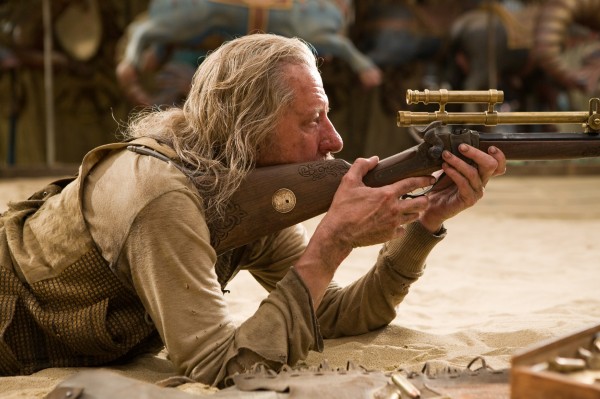
Running away from violence is easier said than done for our protagonist. He winds up in the inauspicious town of Lode. The citizens welcome Yang and April but Yang learns that his old friend has died. Lode ran a laundry and Yang decides that this might be the best thing to do to throw his enemy off his scent. Yang meets a cute sexy gal, Lynne (Kate Bosworth of “Blue Crush”), and she falls head-over-heels in love with our hero and little April. Unfortunately, like the remote frontier settlement in Don Siegel’s made-for-TV western “Stranger on the Run” with Henry Fonda, the town of Lode suffers from the depredations of an insanely evil man called the Colonel (Danny Huston of “Edge of Darkness”) rode into the town with his army of men to rape and pillage. He attacked Lynne when she was much younger, but she retaliated with a skillet of sizzling potatoes that permanently scarred his face and drove him out of town. Eventually, the Colonel returns looking like the Phantom of the Opera with another army of killers to finish what Lynne started.

No sooner has our hero arrived in Lode looking for anonymity than the Colonel and his army of sadistic killers threaten to destroy the town. A drunken gunslinger, Ron (Academy Award winning Geoffrey Rush of “Shine”), swears off his cactus juice long enough to wield a high-powered rifle to perforate the Colonel’s low-down minions as they storm the town. Ron’s strategy resembles the sharp-shooting protagonist in Tonino Valerii’s classic Spaghetti western “My Name Is Nobody” where Henry Fonda targeted saddle bags stuffed with dynamite on the backs of an army of horsemen. Every time that he put a bullet in the shining conchos of the saddle bags, a horseman vanished in a dusty explosion. Predictably, Ron eliminates his share of riders before Yang slices up the rest with his razor-sharp sword. In the middle of this mayhem, Saddest Flute shows up with his army of ninjas and all hell really breaks loose.

“The Warrior’s Way” features stoic Korean superstar Dong-gun Jang. This handsome, dark-haired individual exudes presence as he peers out from beneath his Veronica Lake hairstyle and wields a samurai saber with the finesse of a chef slashing up a meal. Oddly enough, this dust raiser of a western was lensed in location in Australia with the liberal use of computer-generated imagery so it has a contrived “Wizard of Oz” staginess that some critics have derided. Nevertheless, Lee displays enviable style as he orchestrates several ultra-violent showdowns between the heroes and villains. “Lies” cinematographer Woo-Hyung Kim provides visually compelling compositions galore that clinch your attention. Indeed, Lee and Kim have conjured up a very kinetic piece of blood and gore that should make “The Warrior’s Way” an eventual cult hit on video since audiences aren’t turning out in droves to see it. Basically, “The Warrior’s Way” is a glorified B-movie actioneer brimming with eccentric characters and wholesale bloodshed.
Monday, December 6, 2010
FILM REVIEW OF "DIARY OF A MAD BLACK WOMAN"
African-American playwright/comedian Tyler Perry takes impersonating older black women to a whole new level in director Darren Grant's crowd-pleasing comedy "Diary of a Mad Black Woman," a riotously funny, but romantically soapy, revenge fantasy about a wife of 18 years who finds herself abandoned by her rich, philandering husband and forced to fend for herself. Like Eddie Murphy, Perry spreads himself throughout "Diary" in three separate roles. He plays a mild-mannered lawyer; a hormone-addled geezer, and his crowning glory: Madea, a wild and woolly grandma who would curl the Terminator's toe-nails. Indeed, Flip Wilson paved the way for black female impersonators back in the 1960s with his hit TV show where he popularized the character of Geraldine. Later, Eddie Murphy and Martin Lawrence set new standards with their side-splitting portrayals of black matriarchs respectively in "The Nutty Professor" flicks and "Big Momma's House." Whereas Murphy played an older, fatter woman fairly straight in the "Nutty Professor" farces, Lawrence played an FBI agent masquerading as an armed and dangerous big momma-type out to collar crooks. Not only does Perry let his falsetto-voiced grandma pack an automatic pistol, but also he puts her behind the wheel of a Cadillac that she drives as if it were a Bradley Assault Vehicle. When you aren't busting a gut laughing at the antics of Madea, you'll be cheering on Kimberly Elise as she matches wits with her villainous husband played by Steve Harris in a game of one-oneupmanship. Imagine the Ice-Cube ghetto comedy "Friday" criss-crossed with "Waiting to Exhale" and "Soul Food," and you'll have a fair idea what to expect from the PG-13 rated "Diary of a Mad Black Woman." The dominant theme here is forgiveness, and characters learn about the meaning of forgiveness.
Basically, "Diary" details three stories. The first concerns an elite Atlanta, Georgia, attorney Charles McCarter (Steve Harris) who kicks his wife of 18 years, Helen (Kimberly Elise of "Beloved"), out of his palatial mansion. He evicts Helen, because he feels like he isn't spending enough time with his sexy Hispanic mistress (Lisa Marcos) and the two kids that he conceived with her. When Helen refuses to go quietly, Charles turns into a Neanderthal and drags her by the hair out the door. Charles has already loaded all Helen's stuff into a U-Haul truck, and he has hired a friendly steelyard worker, Orlando (debonair Shemar Moore of "The Brothers"), to take her wherever she wants. Eventually, Helen winds up back in the ghetto at her grandma's house. Grandma Madea (Tyler Perry in drag) lets Helen stick around until she can get back on her feet. Seems Helen signed a prenup, so she isn't entitled to squat. Nevertheless, Madea brandishes her pistol and convinces Helen that she has a right to payback. "This is for every black woman who ever had a problem with a black man!" Meanwhile, in the second story, which occurs twenty minutes into "Diary," Helen falls in love with the U-Haul driver. Talk about too good to be true! This tale resembles a Harlequin romance. Orlando pleads with Helen, "I want to be your knight in shining armor." The third plot involves another attorney, Brian (Tyler Perry straight), who worries about the effect that his estranged crack-head wife, Deborah (Tamara Taylor of "Senseless"), may have on their young daughter and the fear that the child may follow in her mom's footsteps.
First-time director Darren Grant knows when to pour on the sap and splash on the slapstick. Just when "Diary" gets incredibly sticky with feel-good, religious sentiment, Grant brings on the comic relief in the form of Perry either as the outrageous Madea or as her vulgar brother Joe who saves this melodrama from sinking beneath the weight of its own treacle. Perry penned the screenplay based on a couple of black gospel stage plays that are available on video. He alternates comedy with drama so that there's nary a dull moment. Moreover, like any good scenarist, Perry tosses in a surprise or two, so that "Diary" doesn't get stuck in a rut. Kimberly Elise, who looks like an African-American Brigitte Bardot, is both sympathetic and believable as the woebegone wife who gets mad but ultimately gets even. Any woman--black, white, or any color—will savor those moments with great relish when Helen extracts her pound of flesh from her arrogant spouse. Despite the inherently contrived quality of the material, which consists of tried-and-true clichés and conventions, the first-class cast makes us believe in the storybook romantic as much as the unusual about-face changes in behavior that other characters make. While it may sound like Grant and Perry are out to bash men, this is far from true. They balance the negative with the positive, then provide insight the like of which rarely appears in most mainstream Hollywood movies, because it would seem artificial. Although aimed primarily at African-American audiences, "Diary of a Mad Black Women" deals in truths about the human condition that know no color barrier and will tickle any funny bone.
Basically, "Diary" details three stories. The first concerns an elite Atlanta, Georgia, attorney Charles McCarter (Steve Harris) who kicks his wife of 18 years, Helen (Kimberly Elise of "Beloved"), out of his palatial mansion. He evicts Helen, because he feels like he isn't spending enough time with his sexy Hispanic mistress (Lisa Marcos) and the two kids that he conceived with her. When Helen refuses to go quietly, Charles turns into a Neanderthal and drags her by the hair out the door. Charles has already loaded all Helen's stuff into a U-Haul truck, and he has hired a friendly steelyard worker, Orlando (debonair Shemar Moore of "The Brothers"), to take her wherever she wants. Eventually, Helen winds up back in the ghetto at her grandma's house. Grandma Madea (Tyler Perry in drag) lets Helen stick around until she can get back on her feet. Seems Helen signed a prenup, so she isn't entitled to squat. Nevertheless, Madea brandishes her pistol and convinces Helen that she has a right to payback. "This is for every black woman who ever had a problem with a black man!" Meanwhile, in the second story, which occurs twenty minutes into "Diary," Helen falls in love with the U-Haul driver. Talk about too good to be true! This tale resembles a Harlequin romance. Orlando pleads with Helen, "I want to be your knight in shining armor." The third plot involves another attorney, Brian (Tyler Perry straight), who worries about the effect that his estranged crack-head wife, Deborah (Tamara Taylor of "Senseless"), may have on their young daughter and the fear that the child may follow in her mom's footsteps.
First-time director Darren Grant knows when to pour on the sap and splash on the slapstick. Just when "Diary" gets incredibly sticky with feel-good, religious sentiment, Grant brings on the comic relief in the form of Perry either as the outrageous Madea or as her vulgar brother Joe who saves this melodrama from sinking beneath the weight of its own treacle. Perry penned the screenplay based on a couple of black gospel stage plays that are available on video. He alternates comedy with drama so that there's nary a dull moment. Moreover, like any good scenarist, Perry tosses in a surprise or two, so that "Diary" doesn't get stuck in a rut. Kimberly Elise, who looks like an African-American Brigitte Bardot, is both sympathetic and believable as the woebegone wife who gets mad but ultimately gets even. Any woman--black, white, or any color—will savor those moments with great relish when Helen extracts her pound of flesh from her arrogant spouse. Despite the inherently contrived quality of the material, which consists of tried-and-true clichés and conventions, the first-class cast makes us believe in the storybook romantic as much as the unusual about-face changes in behavior that other characters make. While it may sound like Grant and Perry are out to bash men, this is far from true. They balance the negative with the positive, then provide insight the like of which rarely appears in most mainstream Hollywood movies, because it would seem artificial. Although aimed primarily at African-American audiences, "Diary of a Mad Black Women" deals in truths about the human condition that know no color barrier and will tickle any funny bone.
Tuesday, November 30, 2010
FILM REVIEW OF ''THE NEXT 3 DAYS''
Academy Award winning writer & director Paul Haggis puts Oscar winner Russell Crowe and Elizabeth Banks through the ringer as a husband breaking his wife out of jail in the American remake of the 2008 French thriller “Anything for Her.” “The Next 3 Days” (*** out of ****) qualifies as an exciting but implausible suspense saga enhanced by adroitly staged action scenes, top-notch performances from a seasoned cast, and enough red herrings and obstacles to make you want to gnaw your fingernails. Best known for scripting and helming "Crash," Haggis took home an Oscar for writing and directing and the film clinched Best Picture. He received an Oscar for his “Million Dollar Baby” screenplay, and he is credited as one of the creators for the long-running Chuck Norris television series “Walker, Texas Ranger.” Recently, Haggis wrote two of the less James Bond extravaganzas: “Casino Royale” and “Quantum of Solace.”
Basically, Haggis knows a thing or two about actioneers, and he makes an incredible jailbreak seem credible in “The Next 3 Days.” Moreover, aside from its hefty two hour plus length, this pulse pounding, distaff version of “The Fugitive“ remains largely faithful to its Gallic source material. The City of Pittsburgh plays an important part in the plot and “The Next 3 Days” serves as a first-class travelogue for the town. Unlike many movies that shoot city landmarks to authenticate their yarns and then shoot urban scenes in Canada, Pittsburgh has no stand-ins. Pittsburgh natives will probably be the only ones to groan about some of the logistical contradictions of the town. Anybody who has seen the “Mythbusters” television show will know that utilizing air pressure by means to a tennis ball to unlock a door won’t work. However, there are many sites about bump keys on YouTube like the one featured here that our protagonist watches for information. As gripping as PG-13 rated “The Next 3 Days” is, Haggis never lets the violence, drug material, profane language, and sexuality become gratuitously gritty.
“The Next 3 Days” opens in a restaurant as John Brennan (Russell Crowe of “Robin Hood”) and his wife Lara (Elizabeth Banks of “Role Models”) are dining with John’s brother Mick (Michael Buie of “Mystery, Alaska”) and Mick’s wife Erit (Moran Atias of “Land of the Lost”). Workplace politics precipitates an argument, and Erit insists a woman can serve under a man better than a man can serve under a woman. Lara suspects Erit is trying to seduce John, and the two ladies clash. Later, the next morning, Lara and John are enjoying breakfast with their young son Luke. Lara snaps a photo of them. No sooner has this scene of domestic happiness transpired than the Pittsburgh Police Department converge on John’ house. They arrest Lara for the murder of her boss. Lara’s boss was a woman and Haggis inserts a flashback of Lara and her superior arguing. Eventually, Lara storms down to the parking lot and collides with an unknown woman. We see Lara pick up a fire extinguisher. A bystander entering the high rise parking lot spots Lara leaving and notices a woman sprawled on the concrete by her car. Since Lara got into an argument with her boss, the Pittsburgh Police arrest her. They find Lara’s trench coat that she was in the process of washing out a blood stain. The blood stain matches the DNA of her murdered boss. Based on this evidence, the jury finds Lara guilty.
John refuses to believe that Lara could coldly kill her boss and then sit through a diner date without betraying herself. Over the course of the next three years, the predicament John and Lara face grows steadily worse. John’s attorney, Meyer Fisk (Daniel Stern of “Home Alone”), tries to get John to examine the evidence from an objective perspective so he can understand why their appeal failed. Things come to a boil quickly as Lara tries to commit suicide. She doesn’t want to endure a twenty year stretch for murder.
John decides to take matters into his own hands. He contacts an ex-con, Damon Pennington (Liam Neeson of “The A-Team”), who has penned a book about his prison exploits, specifically his many escapes. Damon warns John to be prepared because the police will catch him by blocking off the bridges around Pittsburgh and shoot him on sight. John devises an elaborate escape plan which requires him to enter the criminal underworld. Primarily, John needs forged passports authentic enough to fool the authorities so he can relocate his family to South America. John learns quickly that trying to break Lara out of prison is no picnic. He is nearly caught at one point in the prison using a bump key. Nevertheless, John explores all the possibilities with a scrapbook map plastered onto one wall of his house. This scene and setting recall the ABC-TV series “Prison Break” where the hero sought to break his brother out of prison. John discovers that breaking Lara out of jail isn’t so easy so he tampers with Lara’s diabetes medical folder. Initially, Lara refuses to accompany him when John gets the drop of the cops escorting her.
The last half hour of “The Next 3 Days” moves like a rollercoaster with many surprises to heighten the suspense. A paunchy Crowe looks believable as John Brennan; Brennan teaches English literature at a community college teacher. He is the last person who would embark on such a desperate mission. John doesn’t discuss his ideas with his father and mother. Elizabeth Banks is good as his imprisoned wife. Somewhere along the way, Lara confides in John that she did kill her boss. John doesn’t let this revelation alter his plans. Haggis keeps the action careening along at top speed, and Crowe makes the hero a sympathetic fellow. Crowe’s character shift from a peaceful community college to a gun-toting thug is impressive.
“The Next 3 Days” ranks as an exciting melodrama with surprises galore.
Basically, Haggis knows a thing or two about actioneers, and he makes an incredible jailbreak seem credible in “The Next 3 Days.” Moreover, aside from its hefty two hour plus length, this pulse pounding, distaff version of “The Fugitive“ remains largely faithful to its Gallic source material. The City of Pittsburgh plays an important part in the plot and “The Next 3 Days” serves as a first-class travelogue for the town. Unlike many movies that shoot city landmarks to authenticate their yarns and then shoot urban scenes in Canada, Pittsburgh has no stand-ins. Pittsburgh natives will probably be the only ones to groan about some of the logistical contradictions of the town. Anybody who has seen the “Mythbusters” television show will know that utilizing air pressure by means to a tennis ball to unlock a door won’t work. However, there are many sites about bump keys on YouTube like the one featured here that our protagonist watches for information. As gripping as PG-13 rated “The Next 3 Days” is, Haggis never lets the violence, drug material, profane language, and sexuality become gratuitously gritty.
“The Next 3 Days” opens in a restaurant as John Brennan (Russell Crowe of “Robin Hood”) and his wife Lara (Elizabeth Banks of “Role Models”) are dining with John’s brother Mick (Michael Buie of “Mystery, Alaska”) and Mick’s wife Erit (Moran Atias of “Land of the Lost”). Workplace politics precipitates an argument, and Erit insists a woman can serve under a man better than a man can serve under a woman. Lara suspects Erit is trying to seduce John, and the two ladies clash. Later, the next morning, Lara and John are enjoying breakfast with their young son Luke. Lara snaps a photo of them. No sooner has this scene of domestic happiness transpired than the Pittsburgh Police Department converge on John’ house. They arrest Lara for the murder of her boss. Lara’s boss was a woman and Haggis inserts a flashback of Lara and her superior arguing. Eventually, Lara storms down to the parking lot and collides with an unknown woman. We see Lara pick up a fire extinguisher. A bystander entering the high rise parking lot spots Lara leaving and notices a woman sprawled on the concrete by her car. Since Lara got into an argument with her boss, the Pittsburgh Police arrest her. They find Lara’s trench coat that she was in the process of washing out a blood stain. The blood stain matches the DNA of her murdered boss. Based on this evidence, the jury finds Lara guilty.
John refuses to believe that Lara could coldly kill her boss and then sit through a diner date without betraying herself. Over the course of the next three years, the predicament John and Lara face grows steadily worse. John’s attorney, Meyer Fisk (Daniel Stern of “Home Alone”), tries to get John to examine the evidence from an objective perspective so he can understand why their appeal failed. Things come to a boil quickly as Lara tries to commit suicide. She doesn’t want to endure a twenty year stretch for murder.
John decides to take matters into his own hands. He contacts an ex-con, Damon Pennington (Liam Neeson of “The A-Team”), who has penned a book about his prison exploits, specifically his many escapes. Damon warns John to be prepared because the police will catch him by blocking off the bridges around Pittsburgh and shoot him on sight. John devises an elaborate escape plan which requires him to enter the criminal underworld. Primarily, John needs forged passports authentic enough to fool the authorities so he can relocate his family to South America. John learns quickly that trying to break Lara out of prison is no picnic. He is nearly caught at one point in the prison using a bump key. Nevertheless, John explores all the possibilities with a scrapbook map plastered onto one wall of his house. This scene and setting recall the ABC-TV series “Prison Break” where the hero sought to break his brother out of prison. John discovers that breaking Lara out of jail isn’t so easy so he tampers with Lara’s diabetes medical folder. Initially, Lara refuses to accompany him when John gets the drop of the cops escorting her.
The last half hour of “The Next 3 Days” moves like a rollercoaster with many surprises to heighten the suspense. A paunchy Crowe looks believable as John Brennan; Brennan teaches English literature at a community college teacher. He is the last person who would embark on such a desperate mission. John doesn’t discuss his ideas with his father and mother. Elizabeth Banks is good as his imprisoned wife. Somewhere along the way, Lara confides in John that she did kill her boss. John doesn’t let this revelation alter his plans. Haggis keeps the action careening along at top speed, and Crowe makes the hero a sympathetic fellow. Crowe’s character shift from a peaceful community college to a gun-toting thug is impressive.
“The Next 3 Days” ranks as an exciting melodrama with surprises galore.
Subscribe to:
Posts (Atom)