Translate

Friday, September 7, 2012

FILM REVIEW OF "NAVAJO JOE" (ITALIAN-1966)


 This cynical Sergio Corbucci horse opera about the eponymous Native American hero exacting vengeance on a murderous gang of cutthroat renegades for murdering his woman and massacring his village qualifies as a stalwart, traditional Spaghetti western with nonstop riding, shooting, and killing galore.  Killing constitutes a virtual reflex action in this savage, above-average shoot'em up.  “Gunsmoke” actor Burt Reynolds must have been in the best shape of his life to pull off some of his stunts.  He leaps and he lunges as if he were a born acrobat. For example, trussed upside down by the evil villains, he gets a little help from a sneaky city slicker and crunches up to untie his ankles. Remember how Richard Gere did sit-ups dangling by his ankles from the ceiling of his apartment in "American Gigolo?" Burt performs similar stunts and is as nimble as a ninja.  Masquerading as Leo Nichols, "Fistful of Dollars" composer Ennio Morricone conjures up another memorable, atmospheric orchestral soundtrack with traditional Indian chanting, screaming, and steel string guitar thumping.  Quentin Tarantino thought so much of it and he sampled Morricone’s score in his two sword-wielding “Kill Bill” bloodbaths.  “Hercules, Samson, and Ulysses” lenser Silvano Ippoliti confines all the rampaging violence very skillfully with his widescreen compositions so everything looks aesthetically cool.  Some of Ippoliti’s more imaginative images occur when he hides the identity of one of the villains during a saloon conference scene.


"Navajo Joe" is one of a fistful of westerns where the only good Indian isn't a dead one. Few American westerns would celebrate the Native American as Corbucci does in "Navajo Joe." Joe is pretty doggoned smart for a savage. Veteran Spaghetti western villain Aldo Sambrell is as treacherous as they come. So filled with hate is he that he kills without a qualm. No sooner has Mervyn 'Vee' Duncan  (Aldo Sambrell of "For A Few Dollars More") shot, killed, and scalped Joe's Indian wife than Joe hits the trail in pursuit of Duncan and his gang. Gradually, Joe begins to whittle down the opposition. Meanwhile, Duncan discovers that the authorities in the town of Pyote where he once sold scalps have posted a bounty of both himself and his half-brother.  Just before Duncan’s blonde-headed brother Jeffrey (Lucio Rosato of “4 Dollars of Revenge’’) drills the sheriff with his six-shooter, the lawman informs an incredulous Duncan that he is wanted for murder.  Duncan points out that he has been bringing the sheriff the scalps of Indians for years. “The scalps you brought then were those of troublemakers,” the lawman points out.  According to the sheriff, things have changed. “Now, you’re attacking peaceful tribes, killing even the women and the children.” A prominent doctor convinces Duncan to rob a train heading for the town of Esperanza. He warns Duncan not to try and blow up the safe because an explosion will destroy the half-million dollars in the safe. He knows the combination and they can split the loot.  This part of the “Navajo Joe” screenplay by “Fistful of Dollars” scribe Fernando Di Leo, “Hills Run Red” writer Piero Regnoli, and “Mafia” scribe Ugo Pirro sounds somewhat like “For a Few Dollars More” when Colonel Mortimer persuades El Indio to let him open the safe because too much dynamite might destroy the loot.  Before Duncan leaves town, his gang and he set it ablaze.   

Predictably, Joe intervenes and steals the train from Duncan after the villainous dastard has massacred all the passengers, including a woman and her baby, along with the U.S. Army escort. Joe takes the train to Esperanza and offers to liquidate the gang if they will pay him a dollar for each head.  Eventually, Duncan captures Joe and tries to learn the whereabouts of the money, but Joe does not talk. Duncan ranks as one of the most heartless outlaws. He shoots a preacher point blank in the belly with his six-gun after the minister thanks him for not wiping out their town!  This trim 93-minute oater features a lean, mean Burt Reynolds wielding a Winchester like a demon and decimating the ranks of the bad guys. The Spanish scenery looks as untamed as the ruthless desperadoes that plunder one town after another.  “Django” director Sergio Corbucci never allows the action to slow down.  Despite its many sterling qualities, “Navajo Joe” never achieved the status of other Corbucci westerns like “The Mercenary,” “The Grand Silence” and “Companeros.” The no-frills MGM DVD presents the action in widescreen with several languages in subtitles.


Sunday, September 2, 2012

FILM REVIEW OF ''LAWLESS" (2012)


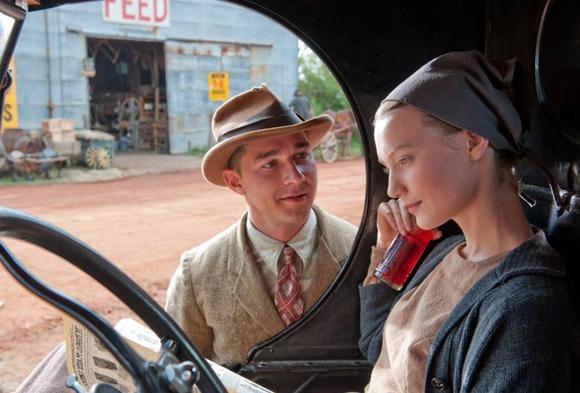
“Lawless” (**** OUT OF ****) amounts to a first-rate, fiercely violent, but surprisingly entertaining crime thriller about Prohibition-era bootleggers in rural Virginia.  Not only does this exceptional 115-minute moonshine melodrama boast a gallery of memorable characters but also several unforgettable performances.   Although Shia LaBeouf takes top billing as the youngest of the three Bondurant brothers who brewed white lightning, Tom Hardy is the actor to watch in this rugged R-rated epic about turf wars in the woods.  Keep in mind, “Lawless” constitutes another of those movies “based on a true story.”  Interestingly, Australian director John Hillcoat of “The Proposition” and scenarist Nick Cave have adapted Matt Bondurant’s bestselling 2008 historical novel “The Wettest County in the World” and delivered a colorful, sometimes savage saga about the American free enterprise system.  What truth lies in the novel deserves scrutiny since Bondurant wrote about his own grandfather, Jack Bondurant, along with his two grand uncles and their high octane, Depression Era exploits as bootleggers who refused to bow to outside competition.   Most of “Lawless” chronicles the efforts of corrupt lawmen as they shake down rural moonshiners.  Anybody who doesn’t grovel pays a terrible price.  These sadistic dastards with badges tar and feather one unfortunate bootlegger and leave him for dead on his kin's front porch.  Despite the eruptions of sudden, noisy violence that will startle some and shock others, “Lawless” has more than its share of quiet, introspective moments to offset its abrupt Sergio Leone style violence. Indeed, Hillcoat and Cave slip in two love stories.  Cinematically, this atmospheric yarn resembles the Coen brothers' Depression-Era opus "O Brother, Where Art Thou," but it takes itself far more seriously.  Just as “O Brother” was inspired by Homer’s heroic poem "The Odyssey," the characters participating in the Great Franklin County Moonshine Conspiracy emerge as titans-of-industry themselves.


Forrest (Tom Hardy of “The Dark Knight Rises”), Howard (Jason Clarke of “Public Enemies”), and Jack (Shia LaBeouf of “I, Robot”) are the brothers Bondurant.  Howard survived World War I as the one man in his regiment who didn’t die.  During the pandemic 1918 Spanish Flu influenza, neither Howard nor Jack contracted the fatal illness. Miraculously, Forrest recovered from it but their parents perished.  Forrest believes his brothers and he are invincible, and the events that unfold in “Lawless” make that description of their longevity appropriate.  The first time we see the Bondurant boys, Jack’s older brothers are egging him on to shoot a pig for them for vittles.  Staring down the barrel of a .22 rifle, Jack cannot muster the nerve to squeeze the trigger.  One of his brothers intervenes and shoots it; the gunshot reverberates like an artillery blast.  Afterward, “Lawless” picks up in 1931. The Bondurants operate a money-making moonshine business and use their country store and filling station as a front.  Forrest calls the shots.  Howard serves as the muscle.  Jack sweeps the floors. Surprisingly, the Bondurants even sell shine to the local constabulary.  This is one of many surprises that occur throughout “Lawless” and make it a lively, off-beat genre exercise.


“Lawless” presents its larger-than-life events from the perspective of Jack.  The runt of the litter, Jack struggles to measure up to his two imposing brothers.  They are always ridiculing his best efforts.  Jack’s closest friend is a nerdy backwoods boy, Cricket Pate (Dane DeHaan of “Chronicle”), who was crippled during his infancy by Rickets.  Cricket conjures up clever means to manufacture moonshine.  When Jack visits Cricket, he finds Cricket brewing whiskey in a huge still beneath his backwoods mansion in the basement. Cricket pipes the brew up through a spigot at the sink and dispenses it in a Mason jar.  At one point, young Jack observes that the fires illuminating hundreds of illegal stills in the woods of Franklin County appear like a constellation of stars.  
 

Things change for both good and bad for the Bondurants and their kind.  A dancer from Chicago, Maggie Beauford (Jessica Chastain of “The Help”), hits Forrest up for a job as a waitress.  Eventually, Forrest and she grow fond of each another.  Meantime, Virginia Commonwealth District Attorney Mason Wardell (newcomer Tim Tolin) prefers to skim the profits from the bootleggers rather than shut them down.  He deputizes some unsavory Chicago troublemakers with few sentiments about the sanctity of human life.  The most prominent is sadistic Charlie Rakes (Guy Pearce of “L.A. Confidential”) who dresses like a stockbroker. Rakes behaves like a Nazi, wears gloves, dyes his hair black, and arms himself with only the best weapons.  He assaults defenseless Jack with a shotgun and sends the battered twentysomething home with a message that should Forrest anticipate rougher treatment.  Two thugs arrive at Forrest’s bar and inflict maximum pain on him. Later, after other depredations, Rakes kills somebody close to the Bondurants.


Director John Hillcoat keeps things moving swiftly enough so the story never bogs down.  After the gunsmoke settles and the bodies are hauled off, Hillcoat wraps up the history neatly and gives us a glimpse of what the actual participants looked like in a 1917 black and white photograph.  Hillcoat stages several above-average shoot-outs, especially the bullet-blasting finale at a covered bridge.  Film editor Dylan Tichenor and Hillcoat have done a splendid job of editing the action scenes so the violence is more dramatic than gratuitous.  In other words, the violence may make you flinch, but you won’t be sickened by unnecessary gore.  The attention to period detail seems scrupulous, too.  Hillcoat substitutes Georgia for Virginia.  The rustic settings, the wooden barns, and the country stores as well as the clean-scrubbed urban cityscapes with period advertisements give “Lawless” an authentic feel.  Cinematographer Benoît Delhomme of “1408” captures those hundreds of fires blazing against the majestic backdrop of rural Virginia with his panoramic widescreen lens.  Memorable movies about moonshiners in the south are few and far between.  “Lawless” ranks as the best example about rural bootleggers since director Richard Quine's “The Moonshine War” (1970) with Alan Alda and Patrick McGoohan.


Monday, August 27, 2012

FILM REVIEW OF ''HIT AND RUN" (2012)


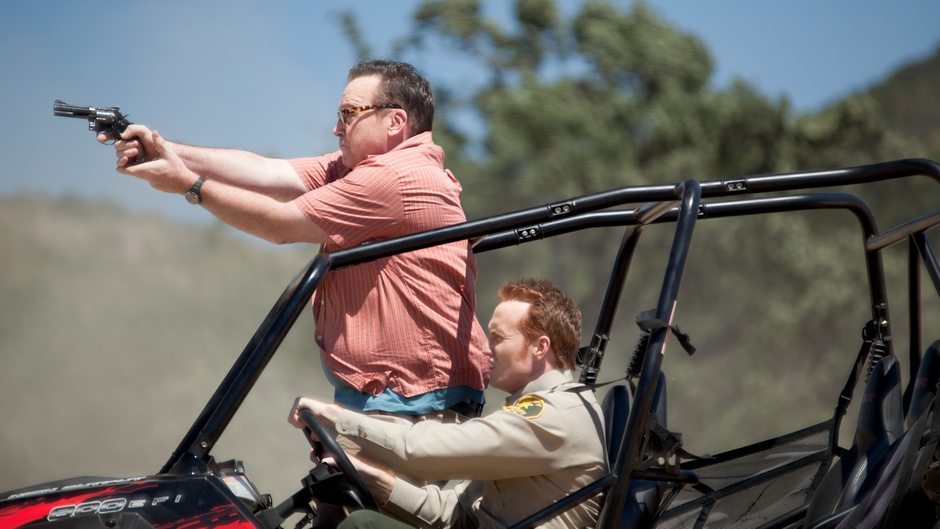
 Dax Shepard and his fiancée Kristen Bell co-star in the witless romantic comedy “Hit and Run”(* OUT OF ****) that Shepard wrote and co-directed with his pal George Palmer. Palmer and Shepard helmed the video short “Reunited” (2010) as well as the spoof documentary “Brother’s Justice.” The style of comedy that they espouse mingles dry humor with slapstick. The garrulous characters never cease making asses of themselves. This half-baked buffoonery about a goofy getaway driver in the Witness Relocation Program who shacks up with a brainiac, drop-dead gorgeous, community college professor delivers more run than hit. Nothing about this low-brow, tread-burning, crime melodrama will make you either smile or flinch. The grossest scene resembles something that Sasha Baron Cohen might have removed from one of his offensive comedies. Our hero and heroine are on the run when they check into a motel. They find a sex orgy in their room with participants who are old, fat, and ugly. This tasteless scene qualifies as so gratuitous that the MPAA probably had no choice but to slap “Hit and Run” with an R-rating for nudity. Shepard and Palmer aren’t content to show this unsightly scene once but twice for maximum impact. Meantime, you’ll lose count of the number of times that the F-word is uttered. The violence remains relatively mild by today’s standards. A felon takes a slug in the back with a splash of blood for realism. A man is shown mercilessly slugging another. An assailant smashes our hero’s nose with a golf club. Nevertheless, despite their lame-brained humor and lackluster car chases, Shepard and Palmer have assembled a first-class, straight-faced cast that contributes a modicum of hilarity to the antics. Bradley Cooper, Tom Arnold, Kristin Chenoweth, Michael Rosenbaum, and David Koechner run circles around our leads. “Hit and Run” amounts to one long, drawn-out, vehicular chase with no memorable stunts. The biggest stunt involves a dune buggy hurtling “Dukes of Hazard” style over several parked cars. Nothing about the driving will turn your knuckles white and make you gasp, but the automobiles look ultra-cool.


“Hit and Run” starts out in a backwater California town named Milton with a community college. Basically, our heroine Annie Bean (Kristen Bell of “Forgetting Sarah Marshall”) learns that she is about to be fired from her job as a community college professor. Happily, Annie’s potty-mouthed boss, Debby (Kristin Chenoweth of “You, Again”), alerts her about an opening at UCLA where she can land her dream job as the head of a conflict-resolution department. The major drawback for our ambitious heroine is when her tattooed boyfriend, Charlie Bronson (Dax Sheppard of “When In Rome”), divulges his participation in Witness Relocation.  Charlie is pretty much condemned to live an eternity in the sleepy little town of Milton because his former partners-in-crime want to track him down and terminate him with extreme prejudice. Eventually, Charlie changes his mind about Witness Protection and pulls the tarp off his jacked-up 1967 Lincoln Continental with suicide doors to chauffeur Annie in style to Los Angeles. Annie’s green-eyed, ex-boyfriend, Gil (Michael Rosenbaum of TV’s “Smallville”), gets wind of Charlie’s real identity and sends a message via Facebook to Charlie’s number one nemesis. As it turns out, and Annie discovers later, Charlie is really Yul Perrkins. Charlie’s father Clint Perrkins (Beau Bridges of “Max Payne”) named him after legendary actor Yul Brynner of “The Magnificent Seven.” Charlie hated the name Yul so much that he changed it to Charles Bronson.  Mind you, Yul wasn’t thinking about  movie superstar Charles Bronson of “Death Wish” fame, but the notorious British inmate Charles Bronson who is known as the most violent man in British prisons. Naturally, Annie is appalled by these revelations. What she really isn’t prepared for the gun-toting trio that come calling on them as they are about to leave for L.A.  Alex Dmitri (Bradley Cooper of “The A-Team” in dreadlocks) hates Charlie because Charlie’s testimony put him behind bars long enough for a Phillipino prisoner to rape him. Now, Alex yearns to kill Charlie as much his accomplices Neve Tatum (Joy Bryant of “Spider-Man 2”) and Allen (Ryan Hansen of “Friday the 13th”). Predictably, our hero has a savior, bungling U.S. Marshal Randy Anderson (Tom Arnold of “Exit Wounds”) who doesn’t know where the brakes are on his car. The people who make FX's "Justified" have used this gag before. Worse, he has to dodge the bullets that his own gun bangs out at him as it bounces around in his car.  The scene with the bowling ball in his smashed up car will make you grin.


“Hit and Run” blends elements of both “True Romance” and “Smokey and the Bandit.” The romance between Annie and Charlie and their flight from the desperate villains recalls the predicament that Clarence and Alabama face in “True Romance.”  Bradley Cooper’s arch villain resembles the Gary Oldman bad guy that Christian Slater tangled with in “True Romance” when he went to fetch Alabama's luggage. Shepard has made it well known in the media how much he loved the Burt Reynolds' comedy "Smokey and the Bandit," and the plot follows it, especially the use of a series of careening car chases. U.S. Marshal Randy is the equivalent of "Smokey." Unfortunately, this sloppy, low-octane, pursuit potboiler conjures up little tension and delivers few thrills.  Meantime, Shepard struggles to capture the spontaneous, off-the-cuff Tarantino dialogue about controversial subject matter. Instead, they wind up sounding nothing less than loquacious. Shepard and Palmer look like they not only shot this 96-minute feature on the shoe-string but also improvised many scenes. They stage their dialogue scenes with the same lack of finesse that they do their automotive maneuvers. You should sit and shun “Hit and Run.”