Translate

Thursday, May 10, 2012

FILM REVIEW OF ''THE ISLAND OF DOCTOR MOREAU" (1996)


Sitting through “Prophecy” director John Frankenheimer’s pretentious, half-baked, horror fantasy “The Island of Dr. Moreau,” (** out of ****) starring Oscar-winning actor Marlon Brando and Val Kilmer, may be enough to turn anybody into an animal.  Presumably, the financial success of genetic thrillers such as “Jurassic Park” and “Species” prompted producer Edward R. Pressmen to reanimate H.G. Wells’ literary classic for its third rendition.  Ironically, this deeply flawed but imaginatively updated version suffers a fate similar to that of the genetic mutants created by the titular villain on his remote island.

The movie opens on three plane crash survivors who have been adrift in the Java Sea for days.  Two of them are killed by a shark leaving our hero, Edward Douglas (David Thewlis of “Naked”), a United Nations peace negotiator.  Douglas awakens to the sight of a sailing vessel hovering over him.  He collapses from exhaustion and reawakens to find Montgomery (Val Kilmer of “Tombstone”) attending him.  Douglas is too weak to do anything more than swoon.  Eventually, the ship deposits them at an exotic island where the research center of Dr. Moreau is located.  Montgomery persuades Douglas to join him; on the basis that they have a telecommunications system on the island that Douglas can use to contact the UN.  As we soon learn, however, Montgomery is lying.  The island is actually the home and refuge of Dr. Moreau, a brilliant geneticist who was forced into seclusion due to his controversial experiments on animals.  Moreau has learned how to transform common animals into human beings, or almost human beings.

 Douglas finds himself trapped on the island, surrounded by Moreau’s beastly creations.  He tries to escape several times to no avail.  First, he stumbles in on an ungodly birth scene, and then finds himself in a half-man, half-animal zoo at an abandoned military airfield.  Finally, Douglas meets Moreau.  They argue about which way the scales of morality should tilt and dredge up Biblical passages to support their arguments.  Moreau tries to explain how his experiments will help mankind.  He reveals that he has discovered that the devil is a collection of genes.  Moreau means to sort out those bad genes and produce an ideal human.  He is even willing to accept a failure or two along the road to success, which accounts for the vast number of beast-men.  Moreau keeps these ugly creatures under his thumb by means of implants which he uses to shock them into paralysis.  Meanwhile, Montgomery keeps the creatures dazed and confused with narcotics.
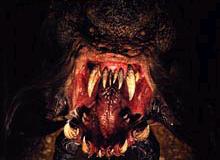
The inventive but predictable Richard Stanley and Ron Hutchinson screenplay updates the 1896 Wells novel and does a good job of establishing the action in the 1990s.  The opening 40 minutes introduces audiences to everyone and everything they need to know about the plot.  Sadly, the script packs no surprises.  If you cannot figure out what’s going to happen from one moment to the next in the film then you must be on horse tranquilizers.  Suffice it to say, “Moreau” doesn’t qualify as a date movie, (unless you never want to see your date again).  Some of the gruesome looking creatures may even go on to inhabit the island of your dreams.  Stan Winston’s creature designs are impressive.  His mutants look as convincing as mutants could possibly look.  Sometimes, they are even nauseating.  Typically, they retain the basic shape of the animal from which they were mutated so they have a beastly looking head, hands and feet, while the rest of them is hidden beneath their apparel to conserve on costs.  The first grisly glimpse that Douglas gets is a multi-breasted beast mother siring an “E.T.” infant.  The other animals are a hideous collection of mutants with claw hands and snaggled teeth.  They gallery of beast men and women appears twice as grisly, gyrating their horrid bodies as Montgomery peddles narcotics to kill them happy. 
Marlon Brando treats moviegoers to another of his characteristically peculiar performances.  There is nothing ordinary about Brando’s brilliant but eccentric Dr. Moreau.  Brando stages a dramatic entrance, swathed in white garments under a pagoda-style hat, resembling a Japanese Kabuki actor in sunglasses.  He tolerates the steamy island heat and wears chalky make-up to preserve his delicate skin from the sun.  Metaphorically, this sun allergy relates somehow to Moreau’s moral infamy; he cannot stand up to the light of morality.  He appears like the great white hope in the camp of the beast men.  Brando adopts the same sissified voice that he used for his Fletcher Christian in the 1962 version of “Mutiny on the Bounty.”  He also never appears twice in the same wardrobe.  One scene finds him garbed like a nocturnal fridge raider while in another scene he appears bundled up like an Arab sultan.

A similar air of mystery surrounds Val Kilmer’s Montgomery.  Montgomery gravitates between moments of extreme clarity and apathetic zombie like drug dazes.  Either the script is purposefully vague or (more realistically) the editors sheared Kilmer’s performance to reduce the film’s running time to 90 minutes so they could squeeze in more showings and parlay a quick profit.  Ultimately, Montgomery assumes a Lucifer-like character in his apparent rivalry with Moreau.  Again, the script doesn’t clarify this part of the story.  Is Montgomery Moreau’s rival?  We never know for certain.
Audiences are meant to identify with the David Thewlis’ narrator.  Incidentally, Thewlis replaced actor Rob Morrow of CBS-TV’s “Northern Exposure.”  As Douglas, Thewlis is required to make his eyes bulge and to act in a manner that makes him appear ineffectually wimpy. The Stanley &  Hutchinson screenplay doesn’t allow Thewlis to cut the heroic profile that Michael York did in the 1977 version of “The Island of Doctor Moreau” with Burt Lancaster as the eponymous character.  The best that Thewlis can do is fire ill-aimed bullets at the rowdy beasts.

The trouble with this take on Wells classic is that movie audiences may find themselves frustrated because the only sympathetic character is a dud.  Thewlis does hold his own in his confrontations with Moreau as they argue about morality.  Moreau alleges that they has found evil and resolves to destroy it.  In destroying it, Moreau has recreated evil in his own warped image.  The atmospheric photography by William Fraker makes “Moreau” both fun and interesting to gaze at for long stretches.  Fraker lensed the action on location in sunny Australia.  In fact, “Moreau” looks as god as any movie that Frankenheimer has directed. The 66-year old director carved out his reputation back in the 1960s with classics such as “The Manchurian Candidate,” “Seven Days in May,” “Grand Prix,” and “Seconds.”  In his 1979 thriller “Prophecy,” Frankenheimer explored the theme of wildlife gone crazy because of polluted streams so he brings considerably artistry and some knowledge about the genetics in “Dr. Moreau.”
“The Island of Dr. Moreau” ranks as an ambitious but flawed horror fantasy.  Anybody who relishes Frankenheimer’s version of “Moreau” can hope that someday New Line Cinema will release a director’s cut that restores the lost parts of the film.  Indeed, an unrated director's cut was released, but it included on four extra minutes of footage. This well-made but routine epic concludes with Douglas moralizing about how Moreau’s island serves as a microcosm of the world and that we must all go in fear of man’s unstable nature.  The only thing that audiences can really go in fear of is the sequel that might lie over the horizon.  Troubled plagued the production from start to finish. Kilmer switched characters from Douglas to Montgomery.  Reportedly Kilmer--who was enduring a divorce at the time--clashed with director Richard Stanley.  Kilmer's clout was such that Stanley was gone and Frankenheimer took over the helm.  Frankenheimer experienced similar problems with Kilmer as well as Brando.


Saturday, May 5, 2012

FILM REVIEW OF ''GET THE GRINGO" (2012)

Mel Gibson is back in top form as a gimlet-eyed career criminal in freshman director Adrian Grunberg's "Get the Gringo," (*** OUT OF ****) a gritty, gory, hard-boiled crime thriller set inside a corrupt Mexican prison, like Tijuana's El Pueblito, where anything goes. Good movies don't dawdle, and rarely does this bullet-riddled, shoot'em up about life behind bars telegraph its next move. Any prison where an inmate's family can move in with him while he serves time is pretty unusual. This prison resembles something out of a trigger-happy Robert Rodriguez actioneer. Men come and go with loaded weapons in plain sight. You can even shell out bucks for a shot of heroin administered by needle in a grungy shop. Everything in this replica of Tijuana's El Pueblito has a price. As an anonymous convict, Gibson provides the kind of voice-over we usually hear in a loquacious Martin Scorsese film. Gibson's sarcastic commentary about El Pueblito with its unusual routines and procedures highlights the surreal nature of the squalid setting. Nobody delivers a bad performance, and Hollywood regulars like Bob Gunton, Patrick Bauchau, and Peter Stormare flesh out the film with familiar faces.


You never really know for certain where things are going in this violent, amoral, tongue-in-cheek, 95-minute melodrama."Get the Gringo" opens with Driver (Mel Gibson of “Payback”) and his wounded partner in clown outfits careening down the highway with cops in close pursuit. Desperately, Driver plows his car through the border fence, and the Mexican police arrest him. The Texas police try to persuade their Mexican counterparts to remand him into their custody. Instead, one glance at two duffel bags bulging with a million dollars prompts the Mexicans to keep him on their side of the border. Once Driver lands in the big house, he gets chummy with a 10-year-old kid (Kevin Hernandez of "The Sitter") who is plotting to exact revenge on another criminal, Javi (Daniel Gimenez Cacho of "Cronos"), who killed his father. The 10-year old's mother and father were incarcerated for selling narcotics. Initially, Driver uses cigarettes to bribe the youngster into silence. You see, the youngster saw Driver rob a fat, slimy heroin dealer after he set a fire to create a distraction. Afterward, Driver decides to use the youth as his eyes and ears inside the prison. Interestingly, "Get the Gringo" could be compared to the silent Charles Chaplin comedy "The Kid" because an adult sets out to help a less fortunate child. Primarily, the filmmakers use the child to make Driver appear more sympathetic. Gradually, Driver learns the ropes and uses them to get ahead of the opposition


Before long Driver's nemesis Frank (Peter Stormare of "The Million Dollar Hotel") dispatches professional killers to ferret out the millions that Driver stole from him. They track down the crooked cops who arrested Driver and start cutting off toes to recover the purloined millions. Meantime, Driver struggles inside the prison to gain Javi's confidence and engineer a deal so he can get out, go back to America, and kill Frank. Driver has no respect for anybody but himself, and he abhors Javi with a passion. It seems that the bathrobe-clad prison kingpin has singled out the 10-year old for preferential treatment. As it turns out, the youth has a liver compatible with Javi's blood type, and Javi needs a fresh liver.  Javi hires a surgeon (Patrick Bauchau of "A View to a Kill") to harvest the youngster's liver and transplant it into his body.  Interestingly, "Get the Gringo" could be compared to the silent Charles Chaplin comedy "The Kid" because an adult sets out to help a less fortunate child.  Indeed, aside from the urchin who befriends him, Gibson is as virtuous as Saint Peter compared with the murderous malcontents who populate the prison.
.


Life in "Get the Gringo" is cheap, and death occurs when you least expect it. Three armed guys stroll into the prison at one point and try to ice Driver. They hit everybody but Driver. Bodies litter the premises. The Warden (Fernando Becerril of "Ravenous") informs Javi, who rules the prison with his thugs, that the government plans to shut them down as a consequence of the gunfight. Of course, the whole point to any prison picture is how the hero manages to escape. Happily, Gibson survives with everything intact, while the treacherous villains bite the dust. Grunberg orchestrates several chaotic shoot-outs, and Gibson is by no means a typical convict. When they fingerprint him, the authorities discover that he has burned off his fingerprints. Everybody is out to take advantage of him, even some treacherous Americans, but Driver turns the tables on everybody.

 "Blackout" production designer Bernardo Trujillo has performed miracles with the closed down Veracruz prison where "Get the Gringo" was lensed on location. Grunberg and Trujillo have managed to recreate a world teeming with the dregs of humanity, a microcosm of Hell, where men degenerate into brutish savages and display no qualms about killing each other. Basically, what you've got is survival of the fittest in the worst place on Earth. This miserable hell hole turns out to be a paradise ripe for the plucking for the self-serving Driver who has just eluded the Texas police with several millions of dollars in loot.

Initially, "Get the Gringo" was entitled "How I Spent My Summer Vacation." At least the latter title has some irony, but "Get the Gringo" gets to the point quicker and summarizes the action. Director Adrian Grunberg gives a good account of himself. The prison setting looks thoroughly authentic, and Grunberg relies on Mexican music to evoke the culture. Fans of Mel Gibson who haven't seen him in a gripping action thriller since his "Lethal Weapon" days won't feel like they have been shortchanged. Gibson has done nothing like "Get the Gringo," and no Hollywood epic has depicted life behind bars as "Get the Gringo." Life below the border has never been presented so pungently unless you've seen something comparable like Luis Buñuel's 1950 crime movie "The Young and the Damned."  Incidentally, "Get the Gringo" is available in America only as a video-on-demand through Direct TV, while the film is showing in theaters in the rest of the world.


Friday, May 4, 2012

FILM REVIEW OF ''ABOVE THE LAW" (1988)


Steven Seagal looks emaciated in director Andrew Davis’ hard boiled crime thriller “Above the Law,” (*** out of ****) co-starring skull-faced Hollywood heavy Henry Silva as a knife-wielding psycho.  Reportedly, Seagal broke into the film business because one of his students, the highly respected Hollywood agent Michael Ovitz, made it happen. “Above the Law” qualifies as a formulaic law and order epic about narcotics smuggling and an assassination attempt on an incorruptible U.S. Senator.  Most of the action takes place in Chicago with Seagal defeating the loathesome villains with his usual brand of aggressive tenacity.  Seagal uses Aikiko on them when he isn’t swapping lead. The title refers to nobody being immune from justice.  Ironically, Davis emphasizes this point with newsreel footage of U.S. President Richard Nixon quoting Abraham Lincoln on the subject. Remember Nixon was the Republican who resigned in disgrace over the Watergate Scandal.  The Andrew Davis & Steven Seagal screenplay features more autobiographical material about the martial arts star than any of his other epics.  Indeed, “Above the Law” provides a glimpse of Seagal as a youngster with several genuine pictures of the actor.  Composer David Michael Frank betrays the late 1980s origins of “Above the Love” with his cheesy B-movie score.  Nothing surprising occurs as our stalwart hero tackles the villains with a vengeance.  The villains are merciless dastards, but Nico cuts them little slack.  As it turns out, the CIA has ties with organized crime. 


Making his motion picture debut, Seagal casts himself as an Italian-American born in Palermo, Italy, who immigrated to America at age seven.  He saw a martial arts demonstration at a baseball game later on when he was a teenager. Company agent Nelson Fox (Chelcie Ross of “Major League”) initially recruited Nicolo ‘Nico’ Toscani into the CIA. Before the Agency approached him at an Embassy function in Tokyo, Nico had studied and taught martial arts in Japan.  Our naïve protagonist totes an M-16 along the border of Vietnam and Cambodia on assist and observe missions. He witnesses some things that he should haven’t seen.  “Above the Law” gets off to a good start as Nico encounters Colonel Kurt Zagon (Henry Silva of “The Hills Run Red”) as the latter is interrogating a native in the jungle.  Somebody, it seems, has been tampering with Zagon’s opium.  Our hero doesn't understand what any of this has to do with acquiring intelligence about the enemy. Nico and Zagon clash, setting up expectations for a gory finale about an hour later.  


The action shifts years later to contemporary Chicago.  Toscani has a wife Sara (Sharon Stone of “Basic Instinct”), and they have just attended the communion of their first child  Giuliano.  Nico’s pals on the force laugh about him for having more relatives under federal indictment than any other cop in Chicago.  When he isn’t patrolling the streets, Detective Sergeant Tosconi takes care of personal business relating to the disappearance of his attractive young niece.  Seagal’s first cinematic fight takes place in a bar as he is searching for her.  Even the bartender knows what to expect when Nico enters.  “This ain’t nothing but trouble coming in my place tonight,” he observes with dread.  Nico gets a tip from the low-life, Alex (Christopher Peditto), who was getting his niece hopped up on drugs.  Alex doesn't want to go to jail so he babbles about a hooker and a cocaine lawyer setting up a deal.  Nico slaps him around enough until he provides a name.  Nico is the kind of cop who isn’t above breaking the rules.  He eavesdrops via a wiretap on a conversation between a couple of Columbians. He gets wind of a shipment arriving in an engine block at the Fulton Meat Market. Later, at the market, the Feds blow the case for them and Nico chases the villains in their car on foot.  He throws himself in front of their Lincoln and tumbles across the hood and atop the roof.  After they blow some holes in the roof, Nico smashes a passenger window and clamps a hand onto Tony Salvano, one of the lawyers.  This is a reasonably suspenseful scene.  Nico is shown spread-eagle clinging to the roof of the Lincoln while the driver swerves in an effort to dislodge him.  Eventually, the driver obeys his boss and pulls over. Afterward, Nico and his buddy Detective Lukich (Ron Dean of "Code of Silence") take apart the engine block.  Instead of narcotics, they discover several packages of C-4 explosives.  The Feds arrest Tony Salvano, but they let him off the hook because he is a government snitch.


After FBI agent Neeley releases Salvano and his driver, they check out St. Mary’s Church where Nico has attended.  While they are in the church, , Father Gennaro (Joe V. Greco) introduces Nico and Jackson to Father Tomasino and his refugees who are hiding in the basement of the church.  The next time Nico shows up for church, a bomb goes off.  The Father delivers a message about knowing the truth.  “Our leaders tell us and talk to us about them and us.  But almighty God talks to us about all mankind as one.  Now, we have an obligation to find out what is the truth.  We need to study.  We need to question.  We need to read and we need to find out what they are doing in our name.  And we must support those brave souls who seek the truth.”  Not long after the sermon, a woman departs the sanctuary.  Nico spots a suspicious sack moments before it explodes and kills Father Gennaro.  Later, Nico discovers that the blast was meant for Father Tomasino.  The blast kills Father Gennaro.  After the explosion, a carload of thugs tries to assault Nico and he shows them his stuff.

Afterward, the Feds come down hard on Nico and persuade the Chicago Police Department to suspend him.  He surrenders his gun and badge.  This doesn’t prevent Nico from carrying out his own investigation.  Nico meets Fox on a skyscraper.  We learn that Zagon has a four thousand acre ranch in Costa Rica.  Zagon wanted Senator Ernst Harrison assassinated because he was going to expose their plans to invade Nicaragua using cocaine money.  As it turns out, Father Tomasino learned about it while in Nicaragua and Zagon fears that he may have told the senator.  Zagon doesn’t want to kill the senator is word has been leaked about it.  Nelson holds Nico at gunpoint about the same time that Zagon and his cronies arrive in an underground garage.  A gunfight erupts and the bartender kills Nelson who slides Nico his gun.  More shots are fired and Salvano is hit.  Nico backs a car into Salvano and runs the car half out of the high rise parking lot so Salvano plunges onto the elevated railway and is electrocuted to death.  Zagon and his thugs pursue Nico in another car.  They run Nico down, pick up him, and prepare to torture him. Nico surprises them, breaks through his restraints, and devastating them.  He kills two with a shotgun and breaks Zagon’s arm when he threatens him with a knife.  Afterward. He snaps Zagon’s neck.  Later, Senator Harrison drops by Nico’s house and thanks him.  Apparently, Nico appears before Congress as “Above the Law” concludes with his testimony.  “Gentlemen, whenever you have a group of individuals who are beyond any investigation who can manipulate the press, judges, members of our Congress, you’re always gonna have within our government those who are above the law.”


Sunday, April 29, 2012

FILM REVIEW OF ''THE RAVEN" (2012)


The age old issue that arises for every generation is the impact of the media on society. Does watching movies, playing video games, and perusing literature prompt us to imitate the actions of fictional characters in certain situations?  “V for Vendetta” director James McTeigue with “Loverboy” scenarist Hannah Shakespeare and rookie writer Ben Livingston have contrived a complicated but uninspired serial killer murder mystery about Edgar Allan Poe.  Basically, an anonymous criminal has decided to use Poe as a blueprint for his diabolical deeds.  The idea isn’t even that original.  Back in 1973, horror icon Vincent Price played a vengeful Shakespearean actor in “Theatre of Blood” who murdered several callous theater critics in re-enactments of death in Shakespeare’s plays. No, Poe is not the serial killer stalking and killing innocent victims.  Beware, although “The Raven” (** out of ****) gets some of Poe’s biographical details correct, the filmmakers err horribly in other instances.  Ironically, the poor slob cut in two by a giant pendulum outlived Poe and did his best to destroy Poe’s literary legacy.  The individual referred to here is Rufus Wilmot Griswold.  Sadly, “The Raven” unravels about an hour into the narrative, and McTeigue and his scribes have tacked on a finale that looks like loose threads being tied up.  The biggest mistake that the filmmakers make is the absence of red herrings to throw us off the scent.  Simply put, "The Raven" never allows us to guess the identity of the villain and the alternatives to the villain are none.  Consequently, the mystery part of this movie is woefully underwritten.

  
 You can almost imagine how this formulaic thriller with gorgeous costumes and atmospheric locales came about during the pre-production phrase.  Presumably, the studio picked Poe not only because he was one of America’s leading literary lights of the nineteenth century, but also the copyright has long since lapsed on his literature.  Imagine this scenario at a production conference.  Studio Executive # 1: “Let’s make Edgar into an action hero like they did Sherlock Holmes?”  Studio Executive # 2: “Of course, the authorities will threaten to arrest Poe if he refuses to help them solve the crime.”  Studio Executive # 1:  “The police want Poe to psychoanalyze the killer to predict his next move.”  Studio Executive # 3: “Our killer must imitate the homicides from Poe's stories.”  Studio Executive # 2, “Naturally, Poe has a blonde girlfriend straight off the cover of Cosmo.  She must be abducted by the killer and held hostage.”  Finally, Studio Executive # 1 says: “Presto, we’ve got the greatest hits of Edgar Allan Poe.  We can make allusions to “The Pit and Pendulum,” “The Tell-Tale Heart,” "The Murders in the Rue Morgue," “The Cask of Amontillado,” and “The Mystery of Marie Roget.”

 “The Raven” opens with some minor biographical details about Poe and his mysterious death on May 7, 1849, in Baltimore, Maryland.  Typically, movies about a hero who dies are usually box office poison.  Moreover, Poe is such an obnoxious fellow that you don’t care what happens to him.  He admits at one point, “I’ve got nothing left,” adding, “I’ve used up all my tricks.”  The Edgar Allan Poe that “The Raven” presents is an egomaniac skidding into obscurity.  A hopeless alcoholic, Poe doesn’t possess enough money to purchase his next drink.  Initially, it appears that he has no friends except for a pet raccoon named Carl. If all this weren’t awful enough, Edgar learns he is not going to be published.  Earlier, he assured a bartender that he would be living like a sultan when the newspaper published his literary criticism.  Since he cannot pay for a drink, Poe appropriates a stranger’s drink. outside Before he realizes what has happened, Poe finds himself unceremoniously expelled from the taven.  Actor John Cusack strives to make this tortured, nineteenth century genius appear sympathetic, but there is little to like about him.

Predictably, the first image is a raven perched on a tree branch overlooking a park where our dour protagonist is sitting on a bench. Afterward, the filmmakers backtrack about a week before with a scene that looks straight out of the first “Sherlock Holmes” movie with Robert Downey, Jr.  A madman has slashed a woman’s throat with a razor, strangled her daughter, and stuffed the daughter’s body in a chimney. When the police arrive, they hear a key locking the door from within and have to smash their way into the room.  They are genuinely puzzled because they can find nobody else in the room.  Further, the window through which the suspect could only have escaped is nailed shut.  Detective Inspector Fields (Luke Evans of “The Three Musketeers”) arrives and manages to open the window.  Eventually, he remembers that he read about a similar incident in the macabre fiction of Edgar Allan Poe.  Fields recruits a reluctant Poe to serve as a crime consultant.

When Poe isn’t dabbling in real-life murders, he is having an affair with stunning Emily Hamilton (Alice Eve of “Sex in the City 2”) whose father has nothing but contempt for him.  Indeed, Captain Hamilton (Brendan Gleeson of “Safe House”) threatens to shoot Poe on sight if he catches the renowned author with his daughter.   No sooner does Poe propose to Emily than the insane psycho kidnaps her, and things really come to a boil. The murders in “The Raven” are not for the squeamish.  Make no mistake, McTeigue earns his R-rating for bloody violence and grisly images.  The pendulum scene ranks as the most graphic as the descending blade eviscerates a book critic and then gets jammed in the table where the man lay.  The problem with “The Raven” is that it lacks the compelling quality that a good murder-mystery requires if we the audience are to overlook some of the far-fetched plot logistics.  Reconsider the pendulum scene.  When Poe visits the scene of the crime, he is impressed by the size of the counterweight.  Where could a killer—insane or not—buy a pendulum of that size and install it without attracting attention?  This question and others—like the spring loaded window nails are things that shouldn’t concern us. Furthermore, The filmmakers never provide us with a gallery of suspects to choose from as the killer before the reprobate reveals himself.  Ultimately, the villain doesn't amount to much.  Despite his diabolical exploits, he comes off as hopeless colorless. Unfortunately, McTeigue doesn’t orchestrate the action with enough verve to distract us from these questions.  "The Raven" stumbles from one anemic scene to next with little energy. 


Cusack is acceptable as Poe, but looks morose and miscast.   Poe probably was never in the physical shape required to  pull off the stunts that Cusack's double does.  Luke Evans does an exceptional job as the police inspector who will go to any lengths to solve the crime and get his man.  Alice Eve is a feast for the eyes.  Meanwhile, Brendan Gleeson and Kevin McNally, who plays Poe’s editor, are squandered in thankless peripheral roles. "The Raven" qualifies as Poe-thetic!


Wednesday, April 25, 2012

FILM REVIEW OF ''THE RELIC" (1997)


Even the most jaded horror movie addicts may find themselves squirming in parts of Peter Hyams’ murky but well-made creature feature “The Relic” (*** out of ****) starring Penelope Ann Miller and Tom Sizemore.  Meanwhile the faint of heart may want to reconsider enduring this experience.  You’ll lose count of the number of severed heads.  You’ll also lose count of the number of times that the filmmakers dare you to accompany heroes and victims down a catacomb of spooky hallways.  Special effects wizard Stan Winston has created a huge, slimy, lizard critter with tusks for “The Relic” that would give “Alien,” “Predator,” and those “Jurassic Park” raptors a run for their money. 


“The Relic” is basically a haunted house chiller.  Most of its grisly action occurs inside a creepy Chicago museum, within scores of shadowy corridors, labs, and staircases.  A dinosaur reptile of amazing agility prowls these premises and feasts on flesh.  Mainly, this hybrid monster tears your head off and munches a chunk of your brains.  The melodramatic script pays homage to scary sagas such as “Jaws,” “Alien,” and “Jurassic Park.”  Penelope Ann Miller plays a dedicated but cute evolutionary biologist who pedals a bicycle to work and worries about who’ll fund her research.  She shares many of Ripley’s heroic characteristics from the “Alien” franchise, except Penelope doesn’t perform a strip tease for the monster.  She keeps her clothes on and relies on her wits to outsmart the creature.  Burly Tom Sizemore abets her as a superstitious Windy City cop.  He wants to close the museum, but the mayor needs it open for a gala fundraiser.

Naturally, the monster crashes the gala and heads roll.  When the monster isn’t terrifying the rich, the museum becomes an obstacle course. The monsters shuts down the power, and the wealthy patrons find themselves trapped in the dark, rained on by fire sprinklers.  “The Relic” aspires to be more than just a horror movie.  The worst thing about “The Relic” is its surplus of plot.  What might have been a small horror movie turns into not only a big-scale scary movie, but also a disaster movie. The film opens with a jungle witchcraft scene that is supposed to frighten but winds up being incomprehensible.  The filmmakers then build the plot and introduce their array of characters before the finally unleash the beast.
Part of the time the scenarists clobber us with a load of scientific, computer gibberish that makes the movie sound realistic.  Interestingly, everything that the monster devours becomes part of its DNA and guides it behavior.  


 Peter Hyams lights the museum as if it were the space ship in “Alien.”  Hyams, who helmed “Outland” and “Running Scared,” aims to scare the daylights out of you.  He resorts to every tried-and-true truck to elicit paranoia and hype suspense.  If you aren’t family with how horror movies manipulate their audiences, you may find some scenes in “The Relic” a little intense.  Predictability, of course, paralyzes the plot because Hyams spends too much time trying to be like other horror movies so that it breaks little new ground.  But the effects may be gruesome enough that you forget the formula that the story follows.  Hyams gets great help from composer John Debney whose tense, dramatic orchestral score heightens the tension.


“The Relic” qualifies as a good horror movie boosted by glossy production values.  This chiller is worth seeing at least once while you’re searching for a genuine classic.

Sunday, April 22, 2012

FILM REVIEW OF "THE THREE STOOGES" (2012)


If you’ve never seen a “Three Stooges” comic short or any of their feature length comedies, the new Farrelly Brothers’ farce is an awful way to acquaint yourself with Moe, Curly, and Larry.  Indeed, it is difficult to believe the same guys who created “There’s Something about Mary” and “Kingpin” concocted this sophomoric comedy.  Unlike the television biography that Mel Gibson produced about the Three Stooges back in 2000, the Brothers Farrelly wanted to revive the fictional morons rather than chronicle their real-life counterparts.  Further, the Farrellys decided to let the “Stooges” wreck havoc in a contemporary setting.  Basically, the Farrellys cannot rekindle the comic genius of these maniac Jewish comics who acquired a reputation for poking eyes, slapping heads, and twisting noses.  Sadly, the laughs are few and far between.  This $30 million imitation of the Three Stooges qualifies as fair.  Juveniles may giggle at the geysers of urine, but neither the Farrellys nor the new Stooges generate a third as many laffs as the originals. 


Chiefly known for their crude and rude movies, the Farrellys usually get a PG-13 or an R-rating for vulgar content.  “The Three Stooges” (** out of ****) marks their first PG-13 release.  The PG-rating covers violent slapstick action and some rude and suggestive humor, including language.  Nevertheless, the Farrellys give the eponymous threesome every opportunity to slap, punch, and gouge each other with glee.  Every “Three Stooges” movie basically is a comedy of errors.  Before the dust settles, the trio has inflicted enough pain and injury on each other to land them in the emergency room.  The colossal stupidity that these three display in their best efforts to perform a task is side-splitting.  The best scene the Farrellys conjure up occurs in a hospital newborn ward.  The Stooges juggle babies, and the infants empty their bladders on them in a shower of urine.  Were this not enough, the Farrellys convinced the cast of the hit reality TV show “Jersey Shore” to suffer the wrath of Moe.  Watching Moe reprimand the “Jersey Shore” regulars is entertaining.  Most of the other gags in “The Three Stooges” have a Rube Goldberg quality.  When they try to remove a bell from a roof, the Stooges lose the head of a sledge hammer.  The sledge head flies off into a water bucket.  The last thing that happens in that scene involves the use of that particular water bucket.  The person intending to refresh another doesn’t know about its’ contents.  

Sean Hayes, Will Sasso and Chris Diamantopoulos do a credible job of impersonating Larry, Curly and Moe.  The complicated material that “Me, Myself & Irene” scenarist Mike Cerrone and the Farrellys serve up defeat their efforts.  “The Three Stooges” unfolds in three back-to-back episodes, each slightly longer than the Columbia Pictures shorts.  The Farrellys and Cerrone have treated this “Stooges” saga as an ‘origins’ film.  They provide some background about the trio.  The protagonists appear as children in the first episode and later predominantly as adults in the second and third episodes.  Believe me; nothing in any of these three episodes will have you in stitches.  “The Three Stooges” resembles an inferior pilot for a proposed television series.  Our threesome land on the front steps of the Sisters of Mercy Orphanage after a car careens up and a duffle bag flies out the window.  The first nun to inspect the duffle, Sister Mary-Mengele (Larry David of “Seinfeld”), takes two fingers in the eyes and topples backwards off the steps.  Eventually, Sister Mary-Mengele becomes their chief adversary.  If the name Mengele sounds familiar, Nazi Josef Mengele was the notorious SS Officer who presided over the destiny of prisoners at Auschwitz.  Anyway, Sister Mary doesn’t cut them any slack.  Another nun follows up and finds three infants in the duffle.  They look like tyke-sized replicas of the adult Moe, Larry, and Curly. 

Mother Superior (Jane Lynch of “Role Models”) and the sisters try to trick a gullible husband and wife, the Harters (Stephen Collins of “Star Trek: The Motion Picture” and Carley Craig of “The Heartbreak Kid”) into adopting Moe.  Rather than letting the prospective parents see every child, the sisters trot out just the Three Stooges.  When it appears the nuns have fooled the Harters into taking the trio off their hands, another child, Teddy (Jake Peck), enters the room by accident.  The trio end up stuck at the orphanage for life.  Twenty-five years later, they are still living at the Sisters of Mercy.  Moe (newcomer Chris Diamantopoulos with a distinctive bowl-shaped haircut) emerges as the boss of the bunch.   Larry (Sean Hayes of “The Bucket List”), Curly (Will Sasso of “Southland Tales”), and Moe perform chores for the sisters.  


As a consequence of the Stooges’ audacious exploits, the orphanage cannot afford its insurance premiums.  Monsignor Ratliffe (Brian Doyle-Murray of “Caddyshack”) shows up to warn the Mother Superior about this crisis.  They have about a month before they must close the orphanage.  Ratliffe tells the Stooges that $830-thousand is required to save the place.  The remainder of this shallow comedy concerns the cockeyed antics of the Stooges as they struggle to obtain that $830-thousand.  The obstacles they face are well-nigh insurmountable.  Furthermore, these knuckle-heads are completely clueless about how they can save the day.  Quite by accident, they encounter Lydia (Sofía Vergara of “Four Brothers”) and her shady boyfriend Mac (Craig Bierko of “Sour Grapes”) as they are searching for somebody to kill her husband.  Of course, the Stooges think that Mac is married to Lydia.  In reality, Lydia is married to grown-up Teddy (Kirby Heyborne of “Saints and Soldiers”) the kid from the orphanage.  Mac convinces them that he wants to die and they plan his demise.  When Lydia offers our numbskulls $830-thousand, they prepare to let blood.  

“The Three Stooges” looks like the Farrellys made it for elementary school age kids. You’d be better off watching any of the 190 genuine “Three Stooges” comic shorts or their six feature length films.  Worst, “The Three Stooges” rates as the worst Farrellys’ movie ever.

Monday, April 16, 2012

FILM REVIEW OF ''ESCAPE FROM L.A." (1996)

If Snake Plissken had an attitude problem in "Escape from New York," wait until you behold the havoc he wrecks in the long-awaited, slam-bang sequel "Escape from Los Angeles,"(***1/2 OUT OF ****)  a memorable apocalyptic science fiction satire that more than compensates for many of the shortcomings in the original.


In August 2000, an earthquake separates Los Angeles from the California mainland. An ultra-conservative Jerry Falwell-type politician (Cliff Robertson of "PT-109"), who predicted the earthquake, has managed to exploit his good fortune to win the presidency in the next election. The term of his presidency, however, is lifetime. He rewrites the laws so that he can hang on to the post for life then relocates the nation's capital to Lynchburg, Virginia. A new morally white-washed America has emerged by the year 2013. Cursing, smoking, pre-marital as well as extra-marital sex, and eating red meat now constitutes crimes. The government deports anybody who doesn't conform to this new order and sends them to the gang-infested cesspool of Los Angeles. The U.S. Police Force maintains a chain of forts along the coastline to repel the efforts of a South American revolutionary, Cuervo Jones (George Corraface of "Christopher Columbus"), who plans to spearhead a Third World invasion to reclaim America. 


Things take a turn for the worse when the President's naïve daughter Utopia (A.J. Langer) steals a black box. The black box contains the remote control to activate a necklace of lethal satellites designated 'the Sword of Damocles.' These satellites encircle Earth, and they can fire a magnetic pulse beam with pinpoint accuracy that can disable any kind of electric engine. Utopia hijacks Air Force 3 and the jetliner crashes in L.A. She allies herself with Cuervo Jones who threatens to use the weapon against America. The U.S. Police Force dispatches a rescue team, but they all die. Enter 'war hero' Snake Plissken (Kurt Russell of "Tombstone"), unshaven, sporting a black patch over his left eye, his typically surly attitude toward authority in general, in handcuffs with a police escort. The only thing Snake seems to be interested in is where he can get his next cigarette. The police infect Snake with a deadly virus that gives him less than ten hours to retrieve the black box.  Snake remembers being infected by a scratch from a person who walks past him but he puts down this brief episode as nothing until he realizes the enormityof what has happened.  Reluctantly, Snake agrees to take the mission and rides a nuclear mini-sub into Los Angeles.


Snake shares the sentiments of Marlon Brando's motorcycle maverick from "The Wild One." When asked what he rebels against, Brando's black-leather clad biker replies: "What have you got?" Whatever it is, Snake is against it. Snake thumbs his nose at the rules as well as the rule makers. He is the ultimate anti-hero, sent to save a civilization that he abhors. Former Disney star Kurt Russell reprises the tough guy tongue-in-cheek role he created in "Escape from New York." No, you don't have to have seen the original to appreciate "Escape from Los Angeles." His fastidious performance boasts equal amounts of put-on and posturing. Russell delivers his dialogue in a low, rasping monotone that parodies Clint Eastwood's 'Man with No Name" bounty hunter character. Snake resembles a fashionably rode-hard but put-up-wet Marvel Comic super hero clad in skin-tight, black garb, with matching automatic pistols. Nevertheless, Snake hardly qualifies as a super hero. The filmmakers have a great time poking fun at their one-eyed protagonist. Instead of calling him 'blue eyes,' they refer to him as 'blue eye.' Everybody who comes into contact with Snake for the first time expresses surprise that Snake isn't taller. Snake acts rather gullible on occasions when he has to depend on characters who double-cross him.


While the first "Escape" represented a triumph of style over substance, the "Escape" sequel triumphs both in style and substance. "Escape from New York" attained classic cult status as a darkly comic, industrial-strength escapade where Snake rescued a U.S. President from a grim maximum security prison on Manhattan Island. The story generated at least a modicum of tension because Snake had to contend with the severe time restriction. He had been injected with a poison that would kill him if he failed to accomplish his mission by its deadline. In the first "Escape," Snake sought to retrieve a cassette tape to bring about world peace. Strictly a follow-the-numbers formula melodrama, "Escape" benefited from its gritty looks, Carpenter's fantastic orchestral score, and the eerie atmosphere between the time that Snake landed his glider on New York City's World Trade Center and the violent shoot'em up finale on a bridge. The first "Escape" suffered because the scene between the inventive opening and concluding set pieces were synthetic and forgettable. The beauty of "Escape from Los Angeles" lies in the producer's refusal to stray from its formulaic origins. Moreover, the filmmakers have beefed up the budget, broadened the scope, and pumped up the story. Once again Snake battles the clock in his strenuous efforts to recover a device that can trigger world-wide destruction. There is a far greater sense of urgency in this "Escape" as we see Snake cutting corners and blowing away the opposition at every turn to save time. The sequence where he first tires to kill Cuervo Jones has a frenetic Indiana Jones quality.  Snake commandeers motorcycles and leaps from one vehicle to the next, swapping lead with a horde of unsavory villains.  Perhaps the strangest scene involves the deranged cosmetic surgeon (Bruce Campbell of "Evil Dead") who carves his victims up to get their useful body parts.


Director John Carpenter never lets the story slow down so we can catch our breath. Just when you think that you have it all figured out, he pulls a fast one with a clever surprise or two that enlivens this "Escape." "Escape from Los Angeles" pushes the envelope further in all directions. Carpenter penned the script with producer Debra Hill and Kurt Russell. Snake's mission is no picnic. The filmmakers plunge Snake headlong into one rigorous, hair-raising adventure after another. Snake spends the nine and a half hours of the literal storyline jumping through one flaming hoop after another in his quest for the black box. Of course, Carpenter and company have wisely compressed the time and super-charged the action so that the movie hurdles along at a breakneck pace.  Several familiar faces pad out the cast. Stacy Keach of "Mike Hammer" fame plays the same role Lee Van Cleef had in the original. Keach ranks as the top cop who coordinates between Snake and Cliff Robertson's scene-chewing president. "Rain Man" co-star Valerie Golino and "Pulp Fiction's" Steve Buscemi help Snake navigate through the rubble of Los Angeles. The only thing "Escape from L. A." doesn't do better is repeat the same orchestral score. John Carpenter received credit for the music, but Shirley Walker of "Batman") puts a spin on the theme that doesn't compare favorably to the original. If you thought the first "Escape" remotely entertaining, "Escape from L.A." should blow your mind. Watch out for all that R-rated violence and profanity.