Translate

Tuesday, November 11, 2008

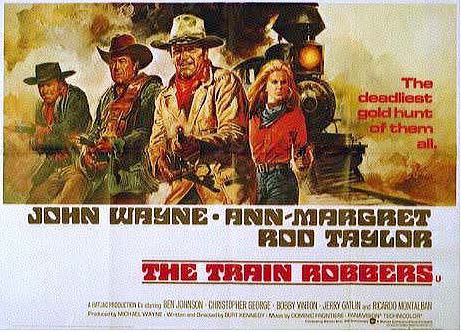
FILM REVIEW OF ''THE TRAIN ROBBERS'' (1973)


John Wayne and voluptuous Ann-Margret co-star in writer & director Burt Kennedy's "The Train Robbers" (**1/2 stars out of ****), a traditional but rambunctious western shoot'em up about a notorious outlaw's widow who hires the Duke to recover a half-a-million in stolen gold from her husband's last robbery five years old. She wants the money returned to Wells Fargo so she clear her husband’s name as well as keep her young son from growing up thinking that his father went around robbing trains. Wayne summons his trusty old saddle pals Rod Taylor, Ben Johnson and Bobby Vinton to accompany him on this perilous journey. Taylor brings along a couple of young gunmen, Christopher George and Jerry Gatlin, to find the buried treasure. No sooner has Wayne, Ann-Margret, and company saddled up and crossed the border into Mexico to find the fortune in gold than a train load of gunslingers show up and pursue them. Meanwhile, lurking on the fringes of the action is a mysterious but elegantly-attired, cigar-smoking hombre who never loses sight of them. He turns out to be a pretty fair shot with a Winchester rifle.


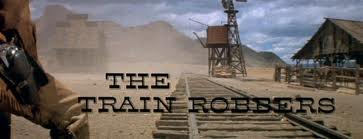
Our heroes meet at an isolated railway station in Liberty, Texas, rather like the one in Sergio Leone's "Once Upon a Time in the West." The small town appears empty. The wind gusts across the boardwalk at the hotel and sways the rocking chairs back and forth. A metal sign buckles in the breeze. Jesse (Ben Johnson of "Rio Grande") awaits the arrival of Lane (John Wayne) on a train that was due in the day before, and everybody is astonished when Mrs. Lowe (Ann-Margret of "Viva Las Vegas") gets off the train with Lane. Jesse and Grady (Rod Taylor of "Dark of the Sun") remember Lane as "bull-headed" and they discover to their relief that he hasn't changed an iota. Later, we learn that Jesse and Grady served together under Lane in the Union Army during the American Civil War where they endured their baptism under fire at Vicksburg. Life for these three has been going up one hill of adversity after another. Feisty Calhoun stands up to Lane, and Lane wallops Grady. Grady thinks that Lane ought to be happy that Calhoun stood up to him. Conversely, Lane wants men who will stand alongside him not against him. Calhoun demands to know what they are getting themselves into, and Lane observes that they are doing what any hired gun does . . . risking their lives. Earlier, before Lane and Mrs. Lowe got off the train, Grady told Jesse that he has shown up for the job simply because it amounted to "something to do."
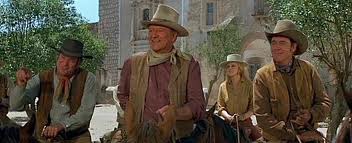

After initial misgivings about endangering a woman on a long ride through the desert, Lane and company head out. Before they leave the station, Lane has Mrs. Lowe's shirt boiled so that she will stand out and her late husband’s pallbearers won't mistake her as a man and try to shoot her. An army of gunmen—we never see these guys up close—shadow our heroes across the parched terrain to the accompaniment of "Rat Patrol" composer Dominic Frontiere's giddy-up score that signals the change of locale when everybody plunges across the Rio Grande into old Mexico. Along the way, during several campfire scenes we learn more about our heroes. Eventually, the feuding between Calhoun and Lane ends and they become friends. Finally, our heroes find the railroad train in the middle of the Mexican desert. They dig into the boiler and find the gold, but they aren't about to go anywhere because that ubiquitous army of gunmen that has been trailing them arrives. As our heroes fortify themselves for the ensuing gun battle, Jesse and Grady swap memorable but pithy dialogue. "Don't get old," Grady warns Jesse, "you'll live to regret it." The twenty gunmen attack them, but our heroes emerge unscathed largely because—in Lane's words—"they could shoot worth a damn."


 Our heroes head back across the border, but the remaining gunmen beat them back to Liberty and prepare a reception for them. Everything ends with a bang-up shoot-out at the railway station where Lane met Jesse and Calhoun. Our heroes virtually blow the town to bits with dynamite so they can defeat the villains. During this fracas, Mrs. Lowe pulls a fast one on our heroes in what constitutes an O’Henry reversal. The well-dressed stranger (Ricardo Montalban of "Star Trek: The Wrath of Khan") turns out to be a Pinkerton detective who has been on Mrs. Lowe for five years. He explains that she was never married and that Lowe died with a bullet in the back in the bordello where Mrs. Lowe worked. She reveals that Mrs. Lowe’s name is Lily. Our heroes scramble after the departing train that carries the pseudo Mrs. Lowe and the gold.

Burt Kennedy got his start writing laconic but entertaining oaters for director Budd Boetticher in the 1950s. Wayne’s film production company Batjac produced many of Boetticher’s existential westerns so it is no surprise that Kennedy went on to pen westerns for Wayne. The first collaboration between Wayne and Kennedy was the superlative "The War Wagon." Mind you, "The Train Robbers" isn't half as exhilarating as "The War Wagon," but this nifty little sagebrusher never runs out of steam and the dialogue is fun to hear. Rod Taylor is nothing short of brilliant as Wayne and Johnson's friend. Okay, all the characters are pretty much stereotypical and of them gets so much as a scratch. Wayne plays his usual stalwart hero and leathery Ben Johnson is his wise sidekick. Naturally, Ann-Margret is a feast for the eyes. The scene where Wayne tries to get her drunk so she will reveal the whereabouts of the gold is amusing. Later, when she comes onto Wayne, he deflects her amorous advances with the line, "M'am, I've got a saddle older than you."
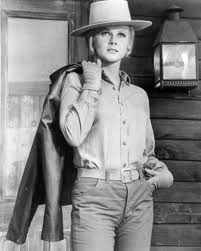

Although it is painfully predictable from fade-in to fade-out, "The Train Robbers” is a rip-snorting adventure that benefits immeasurably from veteran Wayne lenser William H. Clothier's gorgeous widescreen photography. Veteran stunt & wrangler Cliff Lyons orchestrates the hard-riding horsemen scenes. Special photographic effects veteran Albert Whitlock does some nice things with his hand-painted visuals. Check out the long shot where our heroes appear to be riding near a river with a waterfall. No, "The Train Robbers" is not "The Searchers" or "El Dorado," but John Wayne fans will enjoy this familiar but engaging western.

Thursday, November 6, 2008

FILM REVIEW OF ''ZACK AND MIRI MAKE A PORNO" (2008)

"Zack and Miri Make a Porno" (**** out of ****) is "Clerks" director Kevin Smith's best blue-collar, romantic comedy since "Chasing Amy.” The eponymous protagonists have been best friends since the first grade who make a porno to pay off their mounting rent and utility bills during chilly Thanksgiving in Pittsburgh. Zack and Miri live together in the same apartment, but they sleep in separate rooms and in separate beds. In other words, they do not have sex. They share the rent and the utilities, alternating who pays what each month. Unfortunately, these two slackers barely make ends meet because they blow their bucks on sex toys. The heroine relies on a vibrator, she says, because no man has ever made her cum the way that a vibrator does, while the hero maxs out his credit card so that he can buy a flesh light, a portable pocket pussy that resembles a flashlight. Clearly, if you’re a prude about sex and profanity, “Zack and Miri Make a Porno” will probably offend you with its alphabet soup of A-words, C-words, F-words, and s-words that pervade the dialogue.

The first funny gag in “Zack and Miri” involves the use of those palm-sized chemical packets that provide warmth when the user kneads them with their hands. Miri (Elizabeth Banks of "W.") breaks out one as she awaits Zack (Seth Rogen of “Knocked Up”) to join her as she drives them to work. Zack snatches the chemical packet from Miri and unceremoniously stuffs it into his crotch. Later, as they drive to work, Miri smells something toasty and poor Zack realizes that his genitals are on fire and struggles to remove the packet. Miri has to pull off the road, and Zack has to shed his coat to remove the packet from his crotch. When he claims that the packet singed his hairy testicles, Miri laughs out loud at the absurdity of it all.

The action finally cranks up when our protagonists decide to attend their high school reunion. Miri is dressing for the occasion in the back room at a coffee shop called "Bean'N Gone” where Zack works as a counter attendant. Two slackers see Miri changing out of her clothing and freak at the granny panties that Miri has on. No sooner have they video-taped Miri’s derrière than Zack walks in front of their cell phone camera and moon them. Anyway, Miri wants to hook up with former high school football player and all-around jock, Bobby Long (Brandon Routh of “Superman Returns”), while Zack cruises the party. Zack runs into Brandon (Justin Long of “Live Free or Die Hard”) and learns that Brandon is attending the festivities with his homosexual lover. Brandon explains to Zack that he is a gay male porno star and that he is rolling in dough. Predictably, Miri reacts with shock when she discovers Bobby’s sexual orientation.

Our heroine and hero leave the reunion and go back to their apartment. Since Zack forgot to pay the light bill because he had to buy a pair of ice hockey skates, our heroine and hero find themselves plunged into darkness. Miri observes over a brew at a nearby bar that their predicament is what forces some people to prostitute themselves or appear in a porno. Since neither Zack nor Miri have any living relatives, they are not ashamed to flaunt their sex organs. Our protagonists decide to make a porno movie in the hopes that the over 800 people in their high school graduating class will buy a copy for twenty dollars a DVD.

Zack approaches his fellow employee, Delaney (Craig Robinson), about serving as the producer. Delaney scraps his dream of buying a big-screen TV so that he can finance Zack's porno. However, the racially sensitive Delaney, who lives with an abrasive wife with sagging breasts, throws himself into the production when he realizes that he gets to ogle breasts during actress auditions. The first male that they hire is none other than Kevin Smith's co-hort from his "Jay and Silent Bob" comedies. Zack and Miri select Lester (Jason Mewes) strictly on the basis that he can attain an erection almost instantly. Later, Lester saunters around in the nude with his beans and franks hanging out for all to see. The audience that I sat with the second time that I saw “Zack and Miri” nearly choked on their collective breath at the sight of his genitals.

Notorious real-life former teen porn star Traci Lords of "Blade" plays a character named "Bubbles" who farts into a bubble-blowing loop and makes bubbles. Yes, "Zack and Miri Make a Porno" has front frontal nudity but the sexual exploits are clearly simulated. Nude bar hostess Stacy (Katie Morgan of "Hot Cherry Pies 3") displays her ample breasts in one scene with Lester as our heroes videotape after hours in their workplace. They lose their first studio because a huckster named Jenkins (make-up artist Tom Savini of “Night of the Living Dead”) took a month’s rent from them but refused to tell them that the building that houses their studio is scheduled to be destroyed. Our resourceful protagonists decide to relocate the setting of their porno to the coffee shop after everyone has gone for the evening.

If profane, randy, politically-incorrect language about sex offends you, then you should skip "Zack and Miri Make a Porno.” Seth Rogan is perfectly cast as a wise-acre coffee shop server who has a deep crush on Miri and their romantic involvement in each other takes on a different light when they shoot their own porno. Each is so self-conscious about themselves and absorbed in each other that they forget to remove their clothing. Miri realizes that she has found true love at long last. Smith shoots this scene with an overhead camera as Miri sprawls out on coffee bean sacks. It almost looks like a homage to a similarly shot scene in Sergio Leone's "Once Upon A Time in the West" when Claudia Cardinale laid back on a huge bed with a gauzy canopy.

The usual complications that occur when two people become intimate create problems that drive them apart and forces the shutdown of the movie. Despite the formulaic plot, "Zack and Miri Make a Porno" is a sweet, sometimes sour, sentimental romantic plot about the wacky way that love works. The 'Dutch rudder' scene between Seth Rogen and Jason Mewes at the end is hilarious.

FILM REVIEW OF ''THE HAUNTING OF MOLLY HARTLEY" (2008)

Since he produced 50 episodes of “Everwood,” executive producer Mickey Liddell has gotten some other ideas about the trials that single fathers face raising their teenage daughters. Liddell transplants the “Everwood” premise to a horror setting in his directorial debut with “The Haunting of Molly Hartley” (** out of ****), a lukewarm supernatural chiller about the demonic possession of a paranoid 17-year old prep school student and her single dad who worries about her safety. Clearly, Liddell and his scenarists missed the spectacular “Omen” sequel “Damien: Omen II” (1978) about a 13-yeard old private school student who took advantage of his powers as the anti-Christ to wreak anarchy. Imagine what the Roman Polanski classic “Rosemary’s Baby” (1968) would have been like if the infant had been forced to wait until her 18th birthday to emerge as evil incarnate, and you’ve got a good idea what is in store for you with this predictable PG-13 thriller.

Additionally, “The Haunting” does itself no favors with its negative frontal assault on mainstream evangelical Christianity. As one of the villains, a deranged female Christian teen tries to drown our troubled heroine so Satan cannot claim her soul. “The Haunting” may rake in millions at the box office east, west, and north, but you can already hear Tupelo-based Donald Wildman leveling broadsides against it here in the South. Aside from some intense scares that may startle some, this low-budget, derivative thriller lacks the element of surprise. “The Haunting” qualifies as a revisionist horror movie, too. In traditional horror pictures, Good conquers Evil. In revisionist horror epics, however, Evil triumphs over Good. “American Zombie” scenarist Rebecca Sonnenshine rewrote freshman writer John Travis’ script, but neither Mickey Liddell nor she can do much with this hokum. Banal dialogue, contrived predicaments, incoherent writing, and hopeless stereotypes eviscerate the horror content.

“The Haunting” opens with a pre-credit scene whose characters that have nothing to do with the rest of the film, but serve to put the plot into context. The year is 1997, and Laura (Jessica Lowndes) has a rendezvous with her boyfriend Michael (Randy Wayne) in the woods at an abandoned house. Laura’s father (Jamie McShane) appears unexpectedly and hauls his daughter away from Michael and into his truck. Careening off down the road with her, the father pulls into the path of a laden farm vehicle that T-bones them in a violent crash. The grieving father grabs a broken piece of mirror and stabs his daughter to death to save her from ‘the darkness.’ “The Haunting” then shifts to the present day and the problems that Molly Hartley (Jodie Foster look-alike Haley Bennett of “Music & Lyrics”) faces as she shows up at an elitist prep school Huntington Academy.

Molly’s life has been anything but a picnic. Molly’s mom Jane (Marin Hinkle of “Quarantine”) tried to kill her by stabbing her in the chest. Since the incident occurred, Jane Hartley has been locked away in an asylum near the town that Molly’s dad Robert (Jake Webber of “U-571”) has decided to locate near so they can visit her. Molly is neither crazy about her new school nor its atrocious uniform apparel. Strange things happen when Molly enters an English class where they are analyzing British poet John Milton’s “Paradise Lost.” At one point, blood drips from her nose when she opens the Bible. Clearly, old Nick isn't happy. Moreover, Molly has begun to hear voices. Worse, she hallucinates that her mother is trying to finish what she started. Desperate to save herself, Molly converts to Christianity at the insistence of Alexis who tries to drown her in the baptistery.

“The Haunting” relies on a gallery of stereotypes. Molly’s father forever frets about her welfare. Huntington Academy hunk Joseph Young (Chase Crawford of “The Covenant”) has babes smacking each other around over him. Joseph is the son of the wealthiest man in town. Joseph’s jealous, blond, ex-girlfriend Suzie (AnnaLynne McCord of “Transporter 2”) refuses to give him up without fighting Molly. Their catfight concludes too quickly, but Suzie’s comeuppance is amusing. You know dark-haired Leah (Shannon Marie Woodward of “The Comebacks”) is the bad girl because she smokes marihuana in the girl’s lavatory, pilfers cafeteria lunch items, and wears torn fishnet hose. Born-again scholarship babe Alexis (Shanna Collins of “War of the Worlds”) alienates everybody with her complete lack of tact.

Altogether, “The Haunting” qualifies as a chick-flick friendly horror opus about a teenager-in-turmoil. Hardcore horror fanatics will feel cheated by the scarcity of blood & gore. The menacing moments consist of birds flying out of nowhere and snarling dogs suddenly lunging up against chain-link fences. Mail plunging through a drop slot in the door at Molly’s house sounds like an avalanche. Indeed, Liddell suggests the violence more often than shows it. You won’t see any knives penetrating flesh. Several characters die, but Liddell artfully conceals the gruesome details. Typically, mainstream PG-13 movies for teens cannot show them imbibing alcoholic beverages without receiving an R-rating that cuts into the film's box office earnings. Molly’s mother takes a header off a balcony, somersaulting between the floors before she lands face down on the bottom with virtually no damange done to her physique. Clocking in at 86 marginal minutes, “The Haunting of Molly Hartley” will leave you wanting for something more stimulating like “Rosemary’s Baby.”

Tuesday, November 4, 2008

FILM REVIEW OF ''SCORPION'' (1986)

Wooden acting and inept helming undermine this blatant, low-budget rip-off of the classic Steve McQueen police thriller "Bullitt" with 1965 International middleweight Karate champion Tonny Tulleners, who defeated "Walker, Texas Ranger" star Chuck Norris, in the lead role as a tough-as-nails government agent on the trail of an international terrorist. Everybody goes through the motions in this convention white-knuckled epic.

Writer & director William Riead, a former CBS-TV White House news reporter and Hollywood documentary filmmaker who produced over 15 "Making of" movie shorts for Columbia Pictures, directed this derivative actioneer with distinction about an elite Defense Intelligence Agent. Picturesque takes place in Spain, Hawaii, and the U.S and the hero's sporty Porsche add little to the half-baked histrionics in this 98-minute Crown International release.

Several seasoned Hollywood veterans such as Don Murray of "Advise & Consent," perennial western character actor John Anderson, "Time Tunnel" co-star Robert Colbert, and "Wilderness Family" star Robert Logan, flesh out a cast of unknown thespians. Interestingly, the real-life Billy Hayes whose exploits provided the basis for Alan Parker's controversial "The Midnight Express," is cast as a paid assassin.

Although Riead distinguished himself as a newsman, he sorely lacked the talent to be an auteur of any merit. He cannot stage an action scene, even with the services of a legendary stunt coordinator like the late Dar Robinson, and he makes top-flight actors like Murray appear as if they were appearing for the first time on camera. Only Robert Logan manages to acquit himself as the hero's right-hand man without looking like a neophyte. Indeed, Riead is no Peter Yates and nothing about "Scorpion" generates a modicum of either suspense or excitement. Incredibly, the fight scenes with karate expert Tonny Tulleners look half-hearted. This may explain why Tulleners never starred in another picture.

Top D.I.A. Steve Woods (Tonny Tulleners) with the code name 'Scorpion' is called on to thwart terrorists that have hijacked a flight. Woods masquerades as an ordinary policeman who the terrorists allow to board the jetliner to assure the authorities that nobody has been harmed. No sooner has Woods gotten onto the aircraft than he surprises the antagonists with his karate expertise, renders three guys harmless, and puts a bullet through a female hijacker at the end of the aisle who is armed with a submachine. The story hits the newspapers the next day and Steve is surprised himself when his identity is revealed in the story.

Consequently, our redoubtable hero finds himself reassigned to provide protection for one of the terrorists on the plane, Faued (TV actor Adam Ageli), that has agreed to betray his cause and turn informant for a headline grabbing attorney, Gifford Leese (Don Murray), who cuts a deal with him. Woods, his childhood pal Phil Keller (Allen Williams of "The Onion Field"), and Gordon Thomas (Robert Logan) take round-the-clock shifts guarding the informant. Repeatedly, Phil warns Faued to stay away from the windows. Without warning, Faued pulls the curtains back and two assassins burst into the room, mow down Phil in a blaze of machine gun fire, and then riddle Faued. Faued takes several shots in the stomach, but the bulletproof vest that he has on saves his life.

Initially, Leese wants Steve off the case, but Steve resolves to find Phil's killer and ignores Leese. At the hospital, the two assassins show up again and Steve tangles with them and captures one while blond Wolfgang Stoltz (Billy Hayes) escapes. Sadly, after this failed assassin attempt, Faued dies. Steve conceals Faued's death in hopes that he can lure the remaining hit-man to take another chance on rubbing the turn-coat terrorist out. Predictably, Leese is infuriated and pleads with Steve's superiors to take him off the case.

Steve discovers to Leese's chagrin that the Faued that Leese had set up in the safe-house was impostor. The real Faued (John Lazar of "Deathstalker 2") is on his way to take a cruise when Steve and Gordon confront him. Faued flees, commandeers a launch, and Steve appropriates a helicopter and a minor chase ensues.

"Scorpion" (* out of ****) steals virtually everything from "Bullitt" except for the careening car chase on San Francisco hilltops. The scene where Steve pursues an African-American assassin into the underground garage parking lot even has the scene where a laundry bag plunges from a chute and freaks out our hero. Steve spends most of his time when he isn't on the case on his boat at a marina and his fellow agents have to buzz him to get past the gate. This is similar to Steve McQueen's two-story townhouse where he has to throw a lever half-way down the staircase to unlock his door for his partner to visit him. Mind you, the low-budget probably prohibited Riead from staging a car chase.

Karate champion Tonny Tulleners resembles a young Kevin Costner with his football jacket and his mustache. Tulleners is clearly no actor and Riead doesn't really give the guy the chance to emote in this formulaic fodder. The opening scene in Spain serves as our introduction to Steve Woods. Again, Riead orchestrates the action with no finesse and the hero lacks charisma. Skip this abysmal nonsense unless you want to see how closely Riead sticks to basic premise of "Bullitt."

FILM REVIEW OF ''SAMSON & THE SEVEN MIRACLES OF THE WORLD" (1961-ITALIAN)

Call him Samson.

Call him Goliath.

Can him Maciste.

Whatever you call him, former 1950s Tarzan star Gordon Scott calls himself Samson in this lavishly produced but low-budget sword and sandal epic set in China during the 13th century. Peplum movies about strong men didn't last as long as their producers would have liked. As many as 300 of these muscle man melodramas appeared between 1959 and 1963. The genre can be broken down into those muscle man movies that occurred in the world around the Mediterranean Sea and those that transpired in foreign countries far off the beaten path, like "Samson and the Seven Miracles of the World."

Our beefy protagonist sets out to destroy murderous Mongol warriors who want to rule China by killing its virgin princess (Yoko Tani of "Koroshi") and sacrificing its prince to a tiger. Samson behaves like the Lone Ranger here roaming the world to right wrongs. Not surprisingly, Scott has been dubbed by somebody else, which is a real shame, because Scott ranks as one of the few big-screen beefcakes who possessed acting talent.

Anyway, Samson wanders in to save the day in customary style. All the guy wears is shoes and an elaborate red diaper. Mind you, the fight between Samson and a tiger appears apocryphal, but things improve. There's a complex chariot scene where our mighty hero saves the lives of several Chinamen buried up to their necks and awaiting certain death when the aforementioned chariot tries to run them down and cut their heads off. In fact, Scott does one of his own stunts as he clings for dear life to the tongue of the chariot as it careens around the open ground of an arena. The best thing about the screenplay penned by Oreste ("The Witch's Curse"—another 'fish out of water' strongman saga) Biancoli, based on a story that Duccio ("A Fistful of Dollars") Tessari and he wrote, is that it doesn't bog down in machinations.

Clocking in at a really lean, mean 79 minutes, "Samson" doesn't linger. The best scene in what amounts to a generic rebellion plot occurs near the end when an apparently dead Samson precipitates an earthquake. Indeed, Samson's last act is truly his best act. After the villains capture an apparently dead Samson, they bury him in a claustrophobic vault in the bowels of a mountain of solid rock. They even go to extent of having a midget creep into the crawlspace of a tomb and shackle Samson in snugly, but when the strongman awakens to a priest's summons, nothing can keep him down.

Thoroughly average in script and action, "Samson and the Seven Miracles of the World" is marginally entertaining. Scott makes a more than serviceable muscle-bound hero. An amusing scene takes place in a restaurant that Samson pretty much demolishes when he goes toe-to-toe with the many villains. Afterward, he discards a support beam as if it were a toothpick, then apologizes to the owner for all the destruction that he has wrought before leaving. People who love dubbed Italian muscle man spectacle will enjoy this run-of-the-mill muscle man movie. Clearly, the Samson as he is so-called here has little in common with the Biblical Samson, because Gordon Scott wears his hair far too short.

The version that I watched came from Alpha Video and they appear to have semi-letter-boxed their grainy print, so that its 2.35.1 ratio is squeezed down to 1.85.1, but a little letter-boxing beats none at all. "Lady Frankenstein" lenser Riccardo Pallottini gives this mediocre adventure a sprawling, larger-than-life look.

FILM REVIEW OF ''KINGDOM OF HEAVEN'' (2005)

The grisly spectacle of blood splattered medieval era warfare in "Gladiator" director Ridley Scott's swashbuckler "Kingdom of Heaven" (** out of ****) overshadows the less-than-compelling 12th century chronicle about an obscure French blacksmith who attains fame as the guardian of Jerusalem. Set during the second crusade to the Holy Land where European Christian knights have clashed with Muslims for occupation of the famous city, this lavishly-produced but tedious combat epic lacks a virile, charismatic hero, because leading man Orlando Bloom of "The Lord of the Rings" trilogy projects little in the way of authority. Not only does elegant but inexpressive Bloom appear wholly miscast, but also he gives such a low-key performance that you cannot work up much enthusiasm for him when he plunges into battle. Meanwhile, newcomer Ghassan Moassoud doesn't qualify as a villain in the conventional sense of the word. As the Muslim leader of the opposing forces, he behaves more like a static figure head, giving us little to get angry about toward him. Therein lays the ambivalence of the "Kingdom of Heaven." The hero isn't heroic enough, and the villain isn't hateful enough.

Far and away better than either Oliver Stone's disastrous "Alexander" or Antoine Fuqua's "King Arthur," "Kingdom of Heaven" isn't nearly as enthralling as Wolfgang Petersen's "Troy." British director Ridley Scott and freshman scenarist William Monahan (also British) seem to have bitten off more than they can chew in this elaborate, serious-minded, but ironic commentary about the Middle Ages and the hypocrisy that the Church wallowed in with their crusades to occupy Jerusalem. Parallels between what occurred in the so-called Holy Lands back in the 1100s and the current unrest in Iraqi are inevitable. Interestingly, Scott and Monahan display more sympathy for the Islamic world than for the Europeans, perhaps in a gesture of political correctness to atone for the sins of Europeans and the Catholic Church. Indeed, like last year's East meets West horse opera "Hidalgo," "Kingdom of Heaven" clearly espouses revisionist sentiments. Al Qaeda leader Osama Bin Ladin might enjoy this impartial depiction of his countrymen. Imagine what might have happened in a Middle-Eastern Alamo, and you've got a fair idea what to expect from the "Kingdom of Heaven." In fact, "Kingdom of Heaven" reminded me of those westerns from the 1930s and the 1950s where a few good white man struggled to save the noble American savage from the depredations of scalp-hungry Caucasians.

The sprawling saga opens in France in the year 1184 after a battle weary knight, Sir Godfrey (Liam Neeson of "Batman Begins"), has left his knights back in Jerusalem and set out to find the son that he never knew. Godfrey's illegitimate son turns out to be a humble Gallic blacksmith, Balian (Orlando Bloom of "Black Hawk Down"), in mourning over the death of his wife. Balian's spouse committed suicide after their first-born died. When Godfrey rides into Balian's village, the gravediggers are preparing to bury Balian's wife. A shady priest (Michael Sheen of "Underworld") steals the crucifix from Balian's dead wife and takes Godfrey to meet the blacksmith. Not only does Godfrey seek Balian's forgiveness for impregnating and abandoning his mother, but also he asks Balian to accompany him back to the Holy Land. Initially, Balian refuses. Later, when our hero discovers that the priest stole his dead wife's amulet, an enraged Balian slays him with a sword still glowing from the furnace. With the local authorities hot on his trail, Balian rides after Godfrey and joins him. Principally, Balian goes to Jerusalem, because Godfrey has assured him that he can obtain remission for his wife's suicide as well as his own murderous deeds.

Had Scott elicited the performance from Bloom that he got from Russell Crowe in "Gladiator," "Kingdom of Heaven" might have been more entertaining. Indeed, every shot of Bloom casts him in a heroic mould, but the young actor delivers a performance that consists more of posture than passion. Several other flaws afflict this film. First, "Heaven" moves at a leaden pace. The first act deals with our hero's initial encounter with the father he never knew. Liam Neeson blows everybody off the screen during his small part at the outset, while a scar-faced Jeremy Irons as the Marshal of Jerusalem towers over everybody else in the second half. Second, "Kingdom of Heaven" has too many characters clutter up the screen, and the story is hard to follow. Unless you're a medieval scholar, you going to have difficulty keeping track with what is going on. When Scott choreographs combat scenes, he can do no wrong. He provides us with enough geography so you don't get disoriented in all the fighting, unlike similar scenes in Oliver Stone's shoddy "Alexander." Clearly revisionist in sentiment, William Monahan's show-both-sides screenplay makes the Muslims more heroic than they have ever been, while it shows the Christians knights are racist, warmongering fanatics out for the spoils of war rather than the salvation of Godly deeds.

Ridley Scott stages several explosive battles with such virtuosity that you may forget about the reasons for the crusade. While the battle scenes are nothing short of excellent, the climactic Moslem attack on Jerusalem suffers by comparison with a similarly staged fray from "The Two Towers" with its monumental onslaught against the cliff fortress at Helm's Deep.

Several good actors languish in supporting roles, such as Brenda Gleeson of "Lake Placid" as an unrepentant scoundrel whose shaggy mane has turned blood red from all the helpless Muslims that he has slaughtered with extreme prejudice. You won't be able to recognize William Norton of "The Score" as a character called the King Baldwin IV who rules Jerusalem. Called the Leper King, Norton wears an ornate mask and stands between the rabid Europeans and the peaceful Muslims.

Clocking in at 145 minutes (reportedly with a longer version due out on DVD at 220 minutes), the "Kingdom of Heaven" is far, far from heavenly.

FILM REVIEW OF ''JOHNNY WAS'' (2006)

Just because Vinnie Jones appears in a movie is no reason to watch it. If you've seen the former British soccer star in "The Condemned," "Played," and "Number One Girl," you know that his cinematic track record isn't consistent. Yes, he's made good movies, such as "Lock, Stock, and Two Smoking Barrels," "Swordfish," and "Snatch," but too many of his films are best for rainy days when you have nothing else to eyeball. It is like they want Vinnie Jones for his compelling presence, but the films lack the dramatic firepower of Vinnie Jones' persona. Happily, while it isn't top-drawer, "Johnny Was" (**1/2 out of ****) is an above-average opus with a polished look, and persuasive performances. It's worth watching at least once, especially if you are a Vinnie Jones fan.

Freshman helmer Mark Hammond manages to keep things moving at a fast pace in this Irish-produced, crime thriller about a group of oddball thugs that circumstances bring together in a London flat. Hammond's fellow Irishman Brendan Foley penned this slightly better-than-average yarn about a former Irish-Republican Army bomber Johnny Doyle (Vinnie Jones) trying to lay low for the last five years despite his unusual, obstreperous neighbors. Unfortunately, Doyle has chosen the worse safe place to conceal himself. He lives beneath a noisy, pirate radio station run by a Rastafarian disc jockey named Ras (former boxer Lennox Lewis) and above a well-dressed but ruthless Jamaican drug dealer Julius (Eriq La Salle of NBC's "E.R.") with a beautiful junkie girlfriend Rita (Samantha Mumba of "The Time Machine" remake) who was briefly once a nurse. During his illegal broadcasts, Ras condemns the bondage that narcotics holds his people in, while he puffs on his marihuana. Meanwhile, Doyle suffers from nightmares about his last terrorist bombing. The memory of his unsuccessful effort to save the life of an innocent female painter haunts him and drives him into hiding.

Were these complications not enough, our quasi-hero of sorts finds himself up to his neck in problems when his sadistic mentor Flynn (Patrick Bergin of "Sleeping with the Enemy") and Flynn's latest protégé Michael (Laurence Kinlan of "Ned Kelly") show up on his doorstep after having escaped from Brixton Prison with the cops searching everywhere for him. Flynn is an old-school IRA terrorist who considers innocent bystanders suffering from his bombings as little more than "collateral damage." During the escape, Michael injured his ankle so he spends a lot of time in bed in pain with nurse Rita attending to him. Of course, the jealous Jamaican is none too pleased with this relationship, but Johnny has enough nerve and muscle to keep the lethal drug dealer in line.

Just when things appear to be spiraling down for the worse, Flynn makes a deal with Julius to eliminate the latter's competition by blowing them up and then becoming Julius' fifty-fifty partner. Flynn needs money and guns so that he can leave London. Julius buys into Flynn's offer because Flynn plans to knock off the first of Julius' competitors for free. Meanwhile, Julius forces Johnny—because of his experience working for an apothecary—to cut his drugs. Flynn winds up cutting the drugs and he displays his particular brand of cruelty in the amounts that he cuts.

Eventually, everything is settled in a blaze of gunfire and explosions with what appears to be the entire equivalent of the London Swat teams surrounding hero and villain at a trail station. Just to keep you on your toes, the ending comes with a little surprise of its own. Mind you, there are some other surprises in "Johnny Was," and we even learn during a final fist-smashing fight between Flynn and Doyle what the significance of the title "Johnny Was" means.

Foley's screenplay suffers at times from clichés and stereotypes. For example, Johnny amounts to another one of those tortured heroes who wants to walk the straight and narrow, but he finds himself in unable to because of his old friends and unruly neighbors. Eventually, Johnny gets his wish, but outcome seems reminiscent of those gangsters that changed their stripes at the end of a 1930s movie. Johnny comes off as a fairly sympathetic hero. However, there is nothing sympathetic about either Patrick Bergin's Flynn or Eriq La Salle's vicious drug dealer. Bergin and La Salle deliver excellent, hard case performances, especially La Salle who plays a character that is 180 degrees different than his doctor in "E.R."

"Johnny Was" qualifies as strictly minor league stuff, done with some assurance by Hammond, especially the gunfights, and featuring all-around solid performances by a convincing cast. You won't feel bad about watching this Vinnie Jones movie.