"To Have and Have Not" (***1/2 out of ****)grew out of a conversation between Ernest Hemingway and Howard Hawks. Hawks had tried to persuade Hemingway to write screenplays, but Hemingway refused. Hawks told Hemingway, "I can make a picture out of your worst story." Hemingway asked, "What's my worst story?" Hawks replied "a bunch of junk" called "To Have and Have Not." "You can't make anything out of that," Hemingway argued. Hawks retorted, "Yes, I can." The novel "To Have and Have Not" concerned a charter boat captain, Harry Morgan, who loses the money owed to him by a client who leaves him in the lurch without paying his bill. Reluctantly, Morgan accepts money from rumrunners to ship their contraband merchandise. He gets shot-up, loses an arm, and his boat. Later, Morgan dies after he contends with bank robbers who force him to take them to safety using his boat. Hawks sold the story for a quarter interest in the movie to Warner Brothers, and in 1943 the studio cast Humphrey Bogart as the lead.
Initially, when Howard Hawks began work on the film, the U.S. Government objected to the use of Cuba as the setting. They worried that audiences might confuse the political regime in the Hemingway novel with America's current ally, the Batista government running Cuba. Hawks and his good friend William Faulkner changed the setting to the French territory of Martinique. Furthermore, Faulkner advised Hawks to rewrite the politics of the movie so that it dealt with the clashing aims of Vichy France and Free France.
Like Hemingway's novel, the film "To Have and Have Not" opens with professional skipper Harry Morgan (Humphrey Bogart) taking his client, Mr. Johnson (Walter Sande), fishing off the coast of Fort de France, Martinique. After sixteen days of bad luck, Johnson quits, lies about having no money, and tries to leave Morgan without paying his bill. When Harry discovers Johnson's lies, he confronts him and Johnson is about to sign over $825 worth of traveler's checks. During a shoot out between Vichy police and suspected Free French resistance agents, Johnson is caught in the crossfire and dies. Earlier, the Free French had tried to hire Harry to smuggle one of their members onto the island. Reluctantly, since the police have confiscated his cash and the money owed him by Johnson, Harry accepts the Free French offer. By this time, Harry has gotten involved with a beautiful but mysterious woman, Marie Browning (Lauren Bacall), only recently arrived in Martinique and short of finances herself. She had tried to steal Johnson's wallet, but Harry caught her and discovered Johnson's financial solvency.
Harry and his longtime alcoholic sidekick Eddie (Walter Brennan) pick up Helene De Bursac (Dolores Moran) and her husband Paul (Walter Szurovy) but encounter a Vichy patrol boat. Harry shoots out its search light and loses the patrol boat in the fog. Unfortunately, Paul De Bursac catches a slug in his chest. Predictably, Vichy Police Captain Renard (Dan Seymour) questions our heroes at their hotel about their trip. Harry and Eddie lie that they were fishing for marlin when a German U-boat frightened them. Later, Harry digs the spent bullet out of De Bursac's chest with Marie's help. Captain Renard renews his suspicions and arrests Eddie. Later, Renard and his agents corner Harry at the hotel where he lives when he is not taking customers on fishing trips. Harry catches the dastardly Renard with his guard down, kills one of his henchmen, and then claps Renard and company in handcuffs. After slugging the police captain on the head, Harry convinces Renard to turn Eddie loose. Eddie, Marie, and Harry get De Bursac off the island to safety.
"To Have and Have Not" deals with the usual themes that obsessed Hawks. All good Hawksian characters are professionals in the strictest sense and a later scene between Harry and Paul De Bursac establishes the quintessential characteristics of the Hawks hero. De Bursac describes the chief characteristic, "When you meet danger, you never think of anything except how you will circumvent it. The word failure does not even exist for you . . ." "To Have and Have Not" boasts some memorable dialogue, especially between Bogart and Bacall. The "whistle" scene is now the stuff of legends, like the horse race dialogue in their next movie "The Big Sleep." Interestingly, Bogart and Bacall fell in love during filming while Bogart was still married to his alcoholic wife actress Mayo Methot. Eventually, Bogart divorced Methot and married Bacall. Walter Brennan's shtick about "was you ever bit by a dead bee?" is hilarious.
Enough similarities exist between "To Have and Have Not" and "Casablanca" to make comparisons inevitable. Like the Bogart hero in "Casablanca," necessity compels Harry to abandon his isolationist attitude and aid the Free French. Unlike "Casablanca," no actual Nazi German characters appear in "To Have and Have Not," but Madame De Bursac does mention them in passing. Furthermore, World War II does not play a major role in the story apart from the street shoot-out between Vichy authorities and the Free French as well as Renard's search for De Bursac. Unlike the doomed "Casablanca" romance between Rick and Ilsa, Marie and Harry have never met, and nobody comes between Harry and Marie. Unlike Rick, Harry owns a charter fishing boat rather than a tavern. Indeed, Paul De Bursac and his wife do resemble fugitive Czech Resistance leader Victor Laszlo, but De Bursac has come to Martinique to rescue a Free Frenchman imprisoned on Devil's Island.

CINEMATIC REVELATIONS allows me the luxury of writing, editing and archiving my film and television reviews. Some reviews appeared initially in "The Commercial Dispatch" and "The Planet Weekly" and then later in the comment archives at the Internet Movie Database. IMDB.COM, however, imposes a limit on both the number of words and the number of times that an author may revise their comments. I hope that anybody who peruses these expanded reviews will find them useful.
Showing posts with label World War II thriller. Show all posts
Showing posts with label World War II thriller. Show all posts
Saturday, January 3, 2009


Wednesday, December 31, 2008
FILM REVIEW OF ''VALKYRIE'' (2008)
The new Tom Cruise movie "Valkyrie," a dutiful but dreary reenactment of the 20th July 1944 Hitler bomb plot is no blast. Clocking in at a tedious two hours, this military procedural potboiler about the last of 15 flawed efforts to assassinate Adolf Hitler displays immaculate production values and a first-class cast. Nevertheless, "Superman Returns" director Bryan Singer serves up no thrills or chills. Further, "Valkyrie" provides no surprises or suspense, primarily because we know already that the pusillanimous generals botched the bomb plot.
Mind you, "Valkyrie" isn't the first movie about the fateful events leading up to another bungled German Army High Command conspiracy to kill Hitler and salvage the Third Reich. The Germans themselves produced an award-winning, made-for-TV movie "Stauffenberg" about the Hitler bomb attempt in 2004. Previously, CBS-TV aired "The Plot to Kill Hitler" with "Midnight Express" star Brad Davis playing Colonel von Stauffenberg in 1990. The bomb plot played a peripheral role in the Richard Burton World War II film "Breakthrough" (1978) with Robert Mitchum. The classic Peter O'Toole World War II thriller "The Night of the Generals" (1967) contained a subplot about von Stauffenberg's fiasco. Earlier, back in 1955, West German filmmakers unveiled the first theatrical version of the same events entitled "The Plot to Assassinate Hitler" with Wolfgang Priess starring as von Stauffenberg. Even if World War II film fanatics haven't heard of Priess, they have seen him in several W.W. II films, notably "The Longest Day," "A Bridge Too Far," "Raid on Rommel," and "Von Ryan's Express."
"Valkyrie" opens in Tunisia, North Africa 1943, with the German Army's 10th Panzer Division in the desert. Colonel von Stauffenberg (Tom Cruise) writes in his diary about his determination to kill Hitler and save lives. Later, he speaks with a Wehrmacht officer general who resembles Field Marshal Erwin Rommel, but this officer (Bernard Hill of "Titanic") clearly isn't the legendary Desert Fox. Moments later, British fighter planes swoop down to strafe and bomb the Germans. Explosions kill the Rommel looking general while von Stauffenberg loses his left eye, his right hand, and two fingers on his left hand. Miscast as he is, Tom Cruise earns some credit for playing a radically different type of hero than he usually plays. However, the top-notch British and German actors who surround him blow him off the screen with their heavyweight performances. Terence Stamp, Kenneth Branagh, Bill Nighy, Tom Wilkinson, and even comedian Eddie Izzard upstage him at every turn.
After von Stauffenberg recovers from his wounds, he joins the general staff of General Friedrich Olbricht (Bill Nighy of "Underworld") and fellow conspirators Major-General Henning von Tresckow (Kenneth Branagh of "Henry V") and General Ludwig Beck (Terence Stamp of "Yes Man") tap him to devise a better plan to kill Hitler. Ironically, von Stauffenberg concocts a new plan when he is reunited with his family on holiday. His children spin a copy of Wagner's "Ride of the Valkyries" on their turntable. Allied bombers break up the reunion and the needle skips off the 78 RPM record. As he huddles in an air raid shelter, von Stauffenberg hears the tone arm skip back to play the Wagner opera and his eyes glitter. The generals approve of von Stauffenberg's plan to mobilize Hitler's reserve army--codenamed 'Valkyrie'--to help them take control of the Third Reich after they have killed the dastardly dictator. Our hero sets about the task of recruiting more members for the conspiracy and devising an explosive charge that will kill Hitler. Unfortunately, von Stauffenberg begins to see why all previous assassinate attempts failed. The political and military titans of the conspiracy lack conviction and quarrel about petty details. The indecision on the part of these conspirators and von Stauffenberg's own crusade to kill the little corporal seal their doom and safeguard Hitler.
Technically, while "Valkyrie" is correct in every respect with regard to history, Singer and writers Christopher McQuarrie of "The Usual Suspects" and newcomer Nathan Alexander have made a thriller than generates monotony more often than momentum. "Valkyrie" plays out in rooms and on roads. We watch German officers get out of either planes or cars, march into buildings, enter rooms, and talk, talk, talk. Afterward, we watch these same officers exit rooms, walk out of buildings, get into either cars or planes, and head off to other interiors where they babble some more. Incredibly, there are only two quotable lines in the entire movie! Singer and company provide a few scenes between our hero and his wife, but each lacks intimacy because they are either disrupted by a bombing raid or music drowns out their dialogue.
Worse, Adolf Hitler (David Bamber of "The Bourne Identity") spends most of his time on screen puttering about in a daze. Why would any filmmaker trot out the most maniacal villain in 20th century history and reduce him to a simpering sad sack? Indeed, "Valkyrie" arouses more sympathy for Hitler than the people who proved themselves too incompetent to eliminate him. Ultimately, "Valkyrie" isn't so much a tragedy of errors as it is a humdrum movie about a conspiracy of well-meaning imbeciles who wanted to strike a bargain with the Allies before the Allied armies trampled the Fatherland. Anybody who knows their history knows about the newsreel footage of der Fuehrer stomping happily about after the debacle of the bomb attempt. Hitler is never shown performing this shtick.
Suffice to say, avoid "Valkyrie!"
Mind you, "Valkyrie" isn't the first movie about the fateful events leading up to another bungled German Army High Command conspiracy to kill Hitler and salvage the Third Reich. The Germans themselves produced an award-winning, made-for-TV movie "Stauffenberg" about the Hitler bomb attempt in 2004. Previously, CBS-TV aired "The Plot to Kill Hitler" with "Midnight Express" star Brad Davis playing Colonel von Stauffenberg in 1990. The bomb plot played a peripheral role in the Richard Burton World War II film "Breakthrough" (1978) with Robert Mitchum. The classic Peter O'Toole World War II thriller "The Night of the Generals" (1967) contained a subplot about von Stauffenberg's fiasco. Earlier, back in 1955, West German filmmakers unveiled the first theatrical version of the same events entitled "The Plot to Assassinate Hitler" with Wolfgang Priess starring as von Stauffenberg. Even if World War II film fanatics haven't heard of Priess, they have seen him in several W.W. II films, notably "The Longest Day," "A Bridge Too Far," "Raid on Rommel," and "Von Ryan's Express."
"Valkyrie" opens in Tunisia, North Africa 1943, with the German Army's 10th Panzer Division in the desert. Colonel von Stauffenberg (Tom Cruise) writes in his diary about his determination to kill Hitler and save lives. Later, he speaks with a Wehrmacht officer general who resembles Field Marshal Erwin Rommel, but this officer (Bernard Hill of "Titanic") clearly isn't the legendary Desert Fox. Moments later, British fighter planes swoop down to strafe and bomb the Germans. Explosions kill the Rommel looking general while von Stauffenberg loses his left eye, his right hand, and two fingers on his left hand. Miscast as he is, Tom Cruise earns some credit for playing a radically different type of hero than he usually plays. However, the top-notch British and German actors who surround him blow him off the screen with their heavyweight performances. Terence Stamp, Kenneth Branagh, Bill Nighy, Tom Wilkinson, and even comedian Eddie Izzard upstage him at every turn.
After von Stauffenberg recovers from his wounds, he joins the general staff of General Friedrich Olbricht (Bill Nighy of "Underworld") and fellow conspirators Major-General Henning von Tresckow (Kenneth Branagh of "Henry V") and General Ludwig Beck (Terence Stamp of "Yes Man") tap him to devise a better plan to kill Hitler. Ironically, von Stauffenberg concocts a new plan when he is reunited with his family on holiday. His children spin a copy of Wagner's "Ride of the Valkyries" on their turntable. Allied bombers break up the reunion and the needle skips off the 78 RPM record. As he huddles in an air raid shelter, von Stauffenberg hears the tone arm skip back to play the Wagner opera and his eyes glitter. The generals approve of von Stauffenberg's plan to mobilize Hitler's reserve army--codenamed 'Valkyrie'--to help them take control of the Third Reich after they have killed the dastardly dictator. Our hero sets about the task of recruiting more members for the conspiracy and devising an explosive charge that will kill Hitler. Unfortunately, von Stauffenberg begins to see why all previous assassinate attempts failed. The political and military titans of the conspiracy lack conviction and quarrel about petty details. The indecision on the part of these conspirators and von Stauffenberg's own crusade to kill the little corporal seal their doom and safeguard Hitler.
Technically, while "Valkyrie" is correct in every respect with regard to history, Singer and writers Christopher McQuarrie of "The Usual Suspects" and newcomer Nathan Alexander have made a thriller than generates monotony more often than momentum. "Valkyrie" plays out in rooms and on roads. We watch German officers get out of either planes or cars, march into buildings, enter rooms, and talk, talk, talk. Afterward, we watch these same officers exit rooms, walk out of buildings, get into either cars or planes, and head off to other interiors where they babble some more. Incredibly, there are only two quotable lines in the entire movie! Singer and company provide a few scenes between our hero and his wife, but each lacks intimacy because they are either disrupted by a bombing raid or music drowns out their dialogue.
Worse, Adolf Hitler (David Bamber of "The Bourne Identity") spends most of his time on screen puttering about in a daze. Why would any filmmaker trot out the most maniacal villain in 20th century history and reduce him to a simpering sad sack? Indeed, "Valkyrie" arouses more sympathy for Hitler than the people who proved themselves too incompetent to eliminate him. Ultimately, "Valkyrie" isn't so much a tragedy of errors as it is a humdrum movie about a conspiracy of well-meaning imbeciles who wanted to strike a bargain with the Allies before the Allied armies trampled the Fatherland. Anybody who knows their history knows about the newsreel footage of der Fuehrer stomping happily about after the debacle of the bomb attempt. Hitler is never shown performing this shtick.
Suffice to say, avoid "Valkyrie!"
Thursday, October 2, 2008
FILM REVIEW OF ''WHERE EAGLES DARE''

Clint Eastwood probably killed more of Adolf Hitler's German soldiers in director Brian G. Hutton's "Where Eagles Dare" (**** out of ****) than he did western outlaws as either Sergio Leone's Man with No Name in the "Dollars" trilogy or criminals as "Dirty Harry" in his five Warner Brothers crime movies. Bestselling British author Alistair MacLean penned the splendid screenplay that he later converted into a much tamer novel about a team of elite British M.I. 6 secret agents that parachute into Germany to rescue one of the top-ranking officers with a mother lode of knowledge about the June 6th Normandy landings. This MGM blockbuster that runs 158 minutes is probably the greatest action-adventure movie with a World War II setting ever produced. We're talking wall-to-wall gunfire with more surprises and complications than most movies ever attempt. Richard Burton and Eastwood as in top form and they get considerable help and guidance from busty Ingrid Pitt and Mary Ure as undercover female agents. "Where Eagles Dare" is also notable for its percussive orchestral soundtrack by composer Rod Goodwin, who carved a niche for himself in World War II movie soundtracks with "633 Squadron," "Force 10 from Navarone," "Operation Crossbow," and "The Battle of Britain." Some war movies take an anti-war stance, but neither Hutton nor MacLean had higher ideals on their collective minds when they made this war-as-an-adventure epic. If you are a World War II movie buff and you haven't seen "Where Eagles Dare," then you need to get yourself a copy of this memorable massacre.
 Admiral Rolland (Michael Hordern of "Royal Flash") sends a group of British commandos on a suicidal mission to rescue U.S.A.F.F. General George Carnaby, (Robert Beatty of "2001: A Space Odyssey") one of the overall coordinators of planning for the second front who is imprisoned in an impregnable mountain fortress called the Schloss Adler, a.k.a 'the Castle of the Eagles.' As it turns out, the Schloss Adler is the headquarters for the German Secret Service in Southern Bavaria. Colonel Wyatt Turner, DSO MC (Patrick Wymark of "The League of Gentlemen") informs them that the castle is named appropriately "because only an eagle can get to it." Apparently, on a night flight to Crete, Carnaby's British Mosquito was shot down by a wandering Luftwaffe Messerschmitt and the Mosquito crashed in near the town of Werfen. Major Jonathan Smith (Richard Burton of "Raid on Rommel"), Lieutenant Morris Schaffer (Clint Eastwood of "Kelly's Heroes"), Captain James Christiansen (Donald Houston of "633 Squadron"), Sergeant Harrod (Brook Williams of "The Wild Geese"), Captain Philip Thomas (William Squire of "Alexander the Great"), Sergeant Jock MacPherson (Neil McCarthy of "Zulu"), and Edward Berkeley (Peter Barkworth of "Seven Keys") are to parachute into Germany, enter the castle and snatch Carnaby.
 One of the sergeants suggests at the briefing that the R.A.F. fill a bomb-laden plane and crash it into the mountain fortress. Rolland reminds him that killing an American general might anger General Eisenhower. No sooner have our heroes bailed out than one of them, the radio operator, is found dead in the snow with a broken neck. The Gestapo raids a tavern in Werfen and arrests the rest and takes them separately for questioning. Smith and Schaffer are hauled away together, but they manage to escape after their car crashes. Smith and Schaffer then climb atop the cable car that ascends to the Schloss Adler. Simultaneous, one of their undercover agents, Mary Ure, is being escorted by a suave but sadistic Gestapo officer in the cable car to work in the castle.
Once our heroes have gotten into the castle, Smith interrupts a meeting between high ranking German officers and General Carnaby. Smith proves beyond a doubt to SS-Standartenführer Kramer (Anton Diffring of "Heroes of the Telemark") and Gen. Rosemeyer (Ferdy Mayne of "The Fearless Vampire Killers") that he is a double-agent working for the Nazis as well as the British with a night-time call to another high-ranking German general.

Eventually, when it comes time to break out of the castle, Smith relies on Schaffer who plasters the place with trip-wire explosives. Once the Nazis realize what is going on, all hell breaks loose. "Where Eagles Dare" the movie surpasses MacLean's own novel; he wrote the screenplay and he provides Richard Burton with some of the greatest lines that you'll ever hear in the World War II movie. Indeed, "Where Eagles Dare" is the best World War II thriller that Burton and Eastwood ever made, with Burton making more W.W. II thrillers than Eastwood. The rest of the cast is first-rate and composer Rod Goodwin of "633 Squadron" provides a memorable score that ramps up the action and intrigue. At 158 minutes, "Where Eagles Dare" never lets up on either action or excitement. The surprises that crop up in the narrative match the sizzling action sequences. Clearly, this is Brian Hutton's most memorable film, far better than the action comedy romp that he went on to direct "Kelly's Heroes" with Clint Eastwood after "Where Eagles Dare" wrapped. For the record, the propeller driven plane that appears during the opening credits is vintage Nazi plane. Unfortunately, the same cannot be said about the fighter planes that Smith and Schaffer blow up in the last major shoot out sequence.
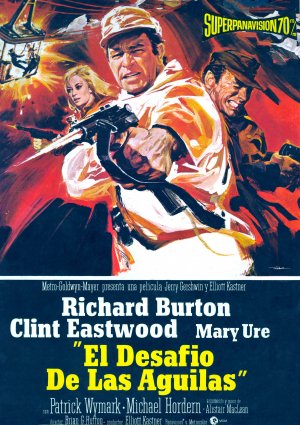
Hollywood has yet to equal "Where Eagles Dare."

Subscribe to:
Posts (Atom)