Remaking a classic movie is often a risky proposition. More often than not, Hollywood filmmakers aim high but wind up shooting low. "O, Brother Where Art Thou?" co-writer and directors Ethan and Joel Coens' remake of director Henry Hathaway's "True Grit" (1969), with John Wayne in his only Oscar winning performance, qualifies as the exception to the rule. Not only do the Coens aim high, but they also hit the bull's-eye. Ostensibly, they have done a splendid job with their first horse opera, and Jeff Bridges has filled some mighty big boots without stumbling. Strictly speaking, the Coens' "True Grit" (***1/2 OUT OF ****) isn't the first remake. Few remember director Richard T. Heffron's TV remake of "True Grit" with character actor Warren Oates donning the eye patch as Marshal Rooster Cogburn. Heffron's 1978 television pilot for a proposed TV series went belly up. Meanwhile, the salient differences between Hathaway's version and the Coens' remake boils down to the differences in the respective performances between Wayne and Bridges. Mind you, Bridges doesn't impersonate Wayne so much as deliver his own interpretation of the cantankerous protagonist from author Charles Portis' western bestseller. Indeed, Bridges sports his eye patch over his right eye rather than the left as Wayne did. The Coens have gone back to the Charles Portis novel and shifted the emphasis from the pugnacious Cogburn to plucky teenage heroine Mattie Ross.
When family man Frank Ross is gunned down in cold blood in Fort Smith, Arkansas, his 14-year old daughter Mattie (newcomer Hailee Steinfeld) leaves her ranch in Yell County near Dardanelle to avenge his death. Hired hand Tom Chaney (Josh Brolin of "Jonah Hex") murdered the Ross patriarch, robbed him, stole his horse and then disappeared into the Indian Territory. The Indian Territory here is what eventually became the state of Oklahoma . Mattie arrives in Fort Smith by train determined to bring her father's killer to justice. She learns that the Fort Smith authorities have issued a warrant on Chaney. Unfortunately, they can't arrest Chaney since the Indian nation lies beyond their jurisdiction. Eventually, Mattie finds the right man to help her. U.S. Marshal Reuben J. Cogburn, better known thereabouts as 'Rooster,' is described to her by the sheriff as "a pitiless man, double-tough, and fear don't enter into his thinking." The sheriff adds that Rooster craves liquor. Mattie manages to recruit Rooster (Jeff Bridges of "The Big Lebowski") with an offer to pay him $100. About that time an upstart, cocksure Texas Ranger, LaBoeuf (Matt Damon of "The Departed"), shows up and derails Mattie's plans. LaBoeuf convinces Rooster to leave Mattie behind. Chaney, it seems, shot a Texas senator, and LaBeouf has been tracking him for the enormous reward that the family will pay. LaBoeuf promises to share the reward with Rooster.
Tenacious little Mattie refuses to be left behind. She pursues Rooster and LaBoeuf, swims her horse across a treacherous river, and demands that the marshal return her money. She threatens to prosecute Rooster for betraying her, and LaBoeuf gives her a spanking to silence her. The sight of LaBoeuf whipping the poor teen changes Rooster's mind, and he allows Mattie to ride along with them. A disgusted LaBoeuf parts company with them. Later, Rooster and Mattie sneak up on two grubby gunmen inside a remote cabin. Rooster shoots one of them after the other kills his criminal cohort. The two outlaws fell out with each other after the younger one informed Rooster that they were holding fresh horses for notorious outlaw Lucky Ned Pepper. When Ned (Barry Pepper of "Saving Private Ryan") and his gang show up at the cabin, they run into LaBoeuf. LaBoeuf finds himself caught up in the cross-fire between Rooster and Ned. Accidentally, Rooster wounds LaBoeuf in the melee, and Ned escapes. Inexplicably, this is the only scene that the Coens changed substantially that Portis did not have in his novel.
Mattie cannot believe they have lost their only lead to Tom Chaney. Earlier, the Fort Smith authorities said that Chaney had thrown in with Ned and helped rob a train. Everybody is set to ride their separate ways when Mattie stumbles onto Chaney. She has gone to the river to fetch water for Rooster when she encounters Chaney. Without a qualm, Mattie brandishes her father's black powder revolver and shoots Chaney. The villainous Chaney survives Mattie's shot and takes her prisoner. Ned rides up and warns Rooster that he will kill Mattie if Rooster doesn't ride off. Ned leaves Mattie with Chaney and warns the outlaw to refrain from harming her. Naturally, Chaney has other ideas. Anybody who has seen the original knows about the infamous snake pit scene when Mattie tumbles into the craggy rocks and gets snake bitten. The consequences are more realistic in this version.
You'll have to look long and hard to complain about the differences between the Coens' "True Grit" and the Hathaway original. Sure, some differences are obvious. Ultimately, however, those differences don't amount to much. The opening and the ending scenes differ. The original "True Grit" dramatized the exposition that opens the new "True Grit." Mattie appears as a fully grown woman in the ending. Bridges doesn't leap a four-rail fence with his horse, and co-star Matt Damon fares better than country music crooner Glen Campbell did in the Wayne version. Actually, Damon winds up in what constitutes a supporting role rather than a co-starring role. Josh Brolin is probably too luminous a star to be shoe-horned into his cameo as the villain that character actor Jeff Corey created. Barry Pepper has a difficult time banishing the memory of Robert Duvall who played the first Lucky Ned Pepper. As Mattie Ross, Hailee Steinfeld is closer in actual age to the heroine than 21-year old Kim Darby was in the first film. The audiences that may be most upset with the new "True Grit" will likely be those who have seen every Coen movie. "True Grit" doesn't bristle with their usual trademark helping of irony and eccentricity. Surprisingly, for a change, the Coens play things pretty much straight down the line. In other words, their remake of the Hathaway classic is reverential.

CINEMATIC REVELATIONS allows me the luxury of writing, editing and archiving my film and television reviews. Some reviews appeared initially in "The Commercial Dispatch" and "The Planet Weekly" and then later in the comment archives at the Internet Movie Database. IMDB.COM, however, imposes a limit on both the number of words and the number of times that an author may revise their comments. I hope that anybody who peruses these expanded reviews will find them useful.
Thursday, December 30, 2010


Saturday, December 11, 2010
FILM REVIEW OF ''THE WARRIOR'S WAY'' (2010)
Freshman writer & director Sngmoo Lee pays tribute to all those East-meets-West horse opera/samurai adventure epics from the 1970s with “The Warrior’s Way.” This action-paced saga synthesizes elements of vintage Shaw Brother martial arts spectacles and violent revenge-themed Spaghetti westerns. A number of these culture-clash oaters appeared in the 1970s where coiffed swordsmen and kung fu masters teamed up with swift-shooting serape-clad gunslingers. Some of these memorable mash-ups with Asian warriors and frontier ruffians were Terence Young’s “Red Sun” (1971) co-starring Charles Bronson and Toshirô Mifune; Antonio Margheriti‘s “The Stranger and the Gunfighter” (1974) with Lee Van Cleef and Lieh Lo; Mario Caiano‘s "The Fighting Fists of Shanghai Joe" (1974) with Klaus Kinski and Chen Lee, and Sergio Corbucci‘s “Shoot First . . . Ask Questions Later” (1975) Eli Wallach and Tomas Milian. Contemporary audiences probably remember Jackie Chan and Owen Wilson in Tom Dey’s “Shanghai Noon” (2000) and perhaps Takashi Miike’s more recent “Sukiyaki Western Django” (2007) with Quentin Tarantino and Hideaki Itô. “The Warrior’s Way” (***½ out of ****) teems with gravity-defying ninjas that magically materialize out of thin-air and hordes of plug-ugly pistoleros who look like they are taking a siesta from the “Mad Max” franchise.

“The Warrior’s Way” opens with our hero, Yang (South Korean superstar Dong-gun Jang of “Tae Guk Gi: The Brotherhood of War”), wiping out an entire clan of swordsmen and ending a 500-year rivalry between the Sad Flutes army of assassins and an anonymous clan. Yang has emerged from his final battle without a scratch and needs only to slay a defenseless infant princess. Before he can carve up the adorable little girl, he feels the petal of a flower float down onto his cheek and he experiences a change of heart. Mind you, Yang has been taught from youth by his wise master, Saddest Flute (Lung Ti of “A Better Tomorrow”), to slash anything to ribbons for which he feels the slightest affection. Something about the infant princess, Baby April (Analin Rudd) alters our pugnacious warrior’s attitude. Yang embarks on a journey with the child in tow. Most critics compare these two to the “Lone Wolf and Cub” film franchise, but the Charlie Chaplin and Jackie Coogan silent classic “The Kid” (1921) where the Little Tramp befriends a cast off child seems far more appropriate.

Since Yang and Baby April aren’t safe in Asia, they climb aboard a sailing ship to America. Nevertheless, Yang is hounded every step of the way by Sad Flute assassins. Some of these killers are quite inconspicuous at first glance, but Yang can spot them just by the murderous vibes that they exude. One such incident occurs at a café as a hunched over woman with more wrinkles than a shar pei dog serves them food and tries to slip a knife out of a scabbard cleverly disguised as a plank in the table. Yang skewers her left eye with matched chopsticks, torches the café and continues on his way. Trouble is that our hero has left behind clues to his destination and the Sad Flutes follow. Yang knows that the Sad Flutes are committed to following him to the far corners of the earth, but he also realizes that the only thing that will give away his location is the sound of his sword unsheathed. He decides to look up an old friend Smiley who has taken up residence in a town smack in the middle of nowhere with a desert sealing it off from the outside world.

Running away from violence is easier said than done for our protagonist. He winds up in the inauspicious town of Lode. The citizens welcome Yang and April but Yang learns that his old friend has died. Lode ran a laundry and Yang decides that this might be the best thing to do to throw his enemy off his scent. Yang meets a cute sexy gal, Lynne (Kate Bosworth of “Blue Crush”), and she falls head-over-heels in love with our hero and little April. Unfortunately, like the remote frontier settlement in Don Siegel’s made-for-TV western “Stranger on the Run” with Henry Fonda, the town of Lode suffers from the depredations of an insanely evil man called the Colonel (Danny Huston of “Edge of Darkness”) rode into the town with his army of men to rape and pillage. He attacked Lynne when she was much younger, but she retaliated with a skillet of sizzling potatoes that permanently scarred his face and drove him out of town. Eventually, the Colonel returns looking like the Phantom of the Opera with another army of killers to finish what Lynne started.

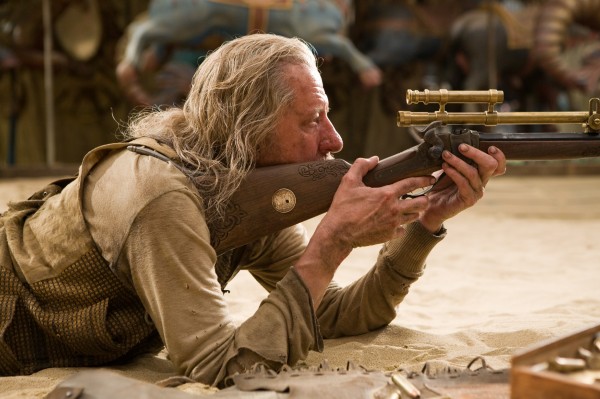
No sooner has our hero arrived in Lode looking for anonymity than the Colonel and his army of sadistic killers threaten to destroy the town. A drunken gunslinger, Ron (Academy Award winning Geoffrey Rush of “Shine”), swears off his cactus juice long enough to wield a high-powered rifle to perforate the Colonel’s low-down minions as they storm the town. Ron’s strategy resembles the sharp-shooting protagonist in Tonino Valerii’s classic Spaghetti western “My Name Is Nobody” where Henry Fonda targeted saddle bags stuffed with dynamite on the backs of an army of horsemen. Every time that he put a bullet in the shining conchos of the saddle bags, a horseman vanished in a dusty explosion. Predictably, Ron eliminates his share of riders before Yang slices up the rest with his razor-sharp sword. In the middle of this mayhem, Saddest Flute shows up with his army of ninjas and all hell really breaks loose.

“The Warrior’s Way” features stoic Korean superstar Dong-gun Jang. This handsome, dark-haired individual exudes presence as he peers out from beneath his Veronica Lake hairstyle and wields a samurai saber with the finesse of a chef slashing up a meal. Oddly enough, this dust raiser of a western was lensed in location in Australia with the liberal use of computer-generated imagery so it has a contrived “Wizard of Oz” staginess that some critics have derided. Nevertheless, Lee displays enviable style as he orchestrates several ultra-violent showdowns between the heroes and villains. “Lies” cinematographer Woo-Hyung Kim provides visually compelling compositions galore that clinch your attention. Indeed, Lee and Kim have conjured up a very kinetic piece of blood and gore that should make “The Warrior’s Way” an eventual cult hit on video since audiences aren’t turning out in droves to see it. Basically, “The Warrior’s Way” is a glorified B-movie actioneer brimming with eccentric characters and wholesale bloodshed.

“The Warrior’s Way” opens with our hero, Yang (South Korean superstar Dong-gun Jang of “Tae Guk Gi: The Brotherhood of War”), wiping out an entire clan of swordsmen and ending a 500-year rivalry between the Sad Flutes army of assassins and an anonymous clan. Yang has emerged from his final battle without a scratch and needs only to slay a defenseless infant princess. Before he can carve up the adorable little girl, he feels the petal of a flower float down onto his cheek and he experiences a change of heart. Mind you, Yang has been taught from youth by his wise master, Saddest Flute (Lung Ti of “A Better Tomorrow”), to slash anything to ribbons for which he feels the slightest affection. Something about the infant princess, Baby April (Analin Rudd) alters our pugnacious warrior’s attitude. Yang embarks on a journey with the child in tow. Most critics compare these two to the “Lone Wolf and Cub” film franchise, but the Charlie Chaplin and Jackie Coogan silent classic “The Kid” (1921) where the Little Tramp befriends a cast off child seems far more appropriate.

Since Yang and Baby April aren’t safe in Asia, they climb aboard a sailing ship to America. Nevertheless, Yang is hounded every step of the way by Sad Flute assassins. Some of these killers are quite inconspicuous at first glance, but Yang can spot them just by the murderous vibes that they exude. One such incident occurs at a café as a hunched over woman with more wrinkles than a shar pei dog serves them food and tries to slip a knife out of a scabbard cleverly disguised as a plank in the table. Yang skewers her left eye with matched chopsticks, torches the café and continues on his way. Trouble is that our hero has left behind clues to his destination and the Sad Flutes follow. Yang knows that the Sad Flutes are committed to following him to the far corners of the earth, but he also realizes that the only thing that will give away his location is the sound of his sword unsheathed. He decides to look up an old friend Smiley who has taken up residence in a town smack in the middle of nowhere with a desert sealing it off from the outside world.
Running away from violence is easier said than done for our protagonist. He winds up in the inauspicious town of Lode. The citizens welcome Yang and April but Yang learns that his old friend has died. Lode ran a laundry and Yang decides that this might be the best thing to do to throw his enemy off his scent. Yang meets a cute sexy gal, Lynne (Kate Bosworth of “Blue Crush”), and she falls head-over-heels in love with our hero and little April. Unfortunately, like the remote frontier settlement in Don Siegel’s made-for-TV western “Stranger on the Run” with Henry Fonda, the town of Lode suffers from the depredations of an insanely evil man called the Colonel (Danny Huston of “Edge of Darkness”) rode into the town with his army of men to rape and pillage. He attacked Lynne when she was much younger, but she retaliated with a skillet of sizzling potatoes that permanently scarred his face and drove him out of town. Eventually, the Colonel returns looking like the Phantom of the Opera with another army of killers to finish what Lynne started.

No sooner has our hero arrived in Lode looking for anonymity than the Colonel and his army of sadistic killers threaten to destroy the town. A drunken gunslinger, Ron (Academy Award winning Geoffrey Rush of “Shine”), swears off his cactus juice long enough to wield a high-powered rifle to perforate the Colonel’s low-down minions as they storm the town. Ron’s strategy resembles the sharp-shooting protagonist in Tonino Valerii’s classic Spaghetti western “My Name Is Nobody” where Henry Fonda targeted saddle bags stuffed with dynamite on the backs of an army of horsemen. Every time that he put a bullet in the shining conchos of the saddle bags, a horseman vanished in a dusty explosion. Predictably, Ron eliminates his share of riders before Yang slices up the rest with his razor-sharp sword. In the middle of this mayhem, Saddest Flute shows up with his army of ninjas and all hell really breaks loose.

“The Warrior’s Way” features stoic Korean superstar Dong-gun Jang. This handsome, dark-haired individual exudes presence as he peers out from beneath his Veronica Lake hairstyle and wields a samurai saber with the finesse of a chef slashing up a meal. Oddly enough, this dust raiser of a western was lensed in location in Australia with the liberal use of computer-generated imagery so it has a contrived “Wizard of Oz” staginess that some critics have derided. Nevertheless, Lee displays enviable style as he orchestrates several ultra-violent showdowns between the heroes and villains. “Lies” cinematographer Woo-Hyung Kim provides visually compelling compositions galore that clinch your attention. Indeed, Lee and Kim have conjured up a very kinetic piece of blood and gore that should make “The Warrior’s Way” an eventual cult hit on video since audiences aren’t turning out in droves to see it. Basically, “The Warrior’s Way” is a glorified B-movie actioneer brimming with eccentric characters and wholesale bloodshed.
Monday, December 6, 2010
FILM REVIEW OF "DIARY OF A MAD BLACK WOMAN"
African-American playwright/comedian Tyler Perry takes impersonating older black women to a whole new level in director Darren Grant's crowd-pleasing comedy "Diary of a Mad Black Woman," a riotously funny, but romantically soapy, revenge fantasy about a wife of 18 years who finds herself abandoned by her rich, philandering husband and forced to fend for herself. Like Eddie Murphy, Perry spreads himself throughout "Diary" in three separate roles. He plays a mild-mannered lawyer; a hormone-addled geezer, and his crowning glory: Madea, a wild and woolly grandma who would curl the Terminator's toe-nails. Indeed, Flip Wilson paved the way for black female impersonators back in the 1960s with his hit TV show where he popularized the character of Geraldine. Later, Eddie Murphy and Martin Lawrence set new standards with their side-splitting portrayals of black matriarchs respectively in "The Nutty Professor" flicks and "Big Momma's House." Whereas Murphy played an older, fatter woman fairly straight in the "Nutty Professor" farces, Lawrence played an FBI agent masquerading as an armed and dangerous big momma-type out to collar crooks. Not only does Perry let his falsetto-voiced grandma pack an automatic pistol, but also he puts her behind the wheel of a Cadillac that she drives as if it were a Bradley Assault Vehicle. When you aren't busting a gut laughing at the antics of Madea, you'll be cheering on Kimberly Elise as she matches wits with her villainous husband played by Steve Harris in a game of one-oneupmanship. Imagine the Ice-Cube ghetto comedy "Friday" criss-crossed with "Waiting to Exhale" and "Soul Food," and you'll have a fair idea what to expect from the PG-13 rated "Diary of a Mad Black Woman." The dominant theme here is forgiveness, and characters learn about the meaning of forgiveness.
Basically, "Diary" details three stories. The first concerns an elite Atlanta, Georgia, attorney Charles McCarter (Steve Harris) who kicks his wife of 18 years, Helen (Kimberly Elise of "Beloved"), out of his palatial mansion. He evicts Helen, because he feels like he isn't spending enough time with his sexy Hispanic mistress (Lisa Marcos) and the two kids that he conceived with her. When Helen refuses to go quietly, Charles turns into a Neanderthal and drags her by the hair out the door. Charles has already loaded all Helen's stuff into a U-Haul truck, and he has hired a friendly steelyard worker, Orlando (debonair Shemar Moore of "The Brothers"), to take her wherever she wants. Eventually, Helen winds up back in the ghetto at her grandma's house. Grandma Madea (Tyler Perry in drag) lets Helen stick around until she can get back on her feet. Seems Helen signed a prenup, so she isn't entitled to squat. Nevertheless, Madea brandishes her pistol and convinces Helen that she has a right to payback. "This is for every black woman who ever had a problem with a black man!" Meanwhile, in the second story, which occurs twenty minutes into "Diary," Helen falls in love with the U-Haul driver. Talk about too good to be true! This tale resembles a Harlequin romance. Orlando pleads with Helen, "I want to be your knight in shining armor." The third plot involves another attorney, Brian (Tyler Perry straight), who worries about the effect that his estranged crack-head wife, Deborah (Tamara Taylor of "Senseless"), may have on their young daughter and the fear that the child may follow in her mom's footsteps.
First-time director Darren Grant knows when to pour on the sap and splash on the slapstick. Just when "Diary" gets incredibly sticky with feel-good, religious sentiment, Grant brings on the comic relief in the form of Perry either as the outrageous Madea or as her vulgar brother Joe who saves this melodrama from sinking beneath the weight of its own treacle. Perry penned the screenplay based on a couple of black gospel stage plays that are available on video. He alternates comedy with drama so that there's nary a dull moment. Moreover, like any good scenarist, Perry tosses in a surprise or two, so that "Diary" doesn't get stuck in a rut. Kimberly Elise, who looks like an African-American Brigitte Bardot, is both sympathetic and believable as the woebegone wife who gets mad but ultimately gets even. Any woman--black, white, or any color—will savor those moments with great relish when Helen extracts her pound of flesh from her arrogant spouse. Despite the inherently contrived quality of the material, which consists of tried-and-true clichés and conventions, the first-class cast makes us believe in the storybook romantic as much as the unusual about-face changes in behavior that other characters make. While it may sound like Grant and Perry are out to bash men, this is far from true. They balance the negative with the positive, then provide insight the like of which rarely appears in most mainstream Hollywood movies, because it would seem artificial. Although aimed primarily at African-American audiences, "Diary of a Mad Black Women" deals in truths about the human condition that know no color barrier and will tickle any funny bone.
Tuesday, November 30, 2010
FILM REVIEW OF ''THE NEXT 3 DAYS''
Academy Award winning writer & director Paul Haggis puts Oscar winner Russell Crowe and Elizabeth Banks through the ringer as a husband breaking his wife out of jail in the American remake of the 2008 French thriller “Anything for Her.” “The Next 3 Days” (*** out of ****) qualifies as an exciting but implausible suspense saga enhanced by adroitly staged action scenes, top-notch performances from a seasoned cast, and enough red herrings and obstacles to make you want to gnaw your fingernails. Best known for scripting and helming "Crash," Haggis took home an Oscar for writing and directing and the film clinched Best Picture. He received an Oscar for his “Million Dollar Baby” screenplay, and he is credited as one of the creators for the long-running Chuck Norris television series “Walker, Texas Ranger.” Recently, Haggis wrote two of the less James Bond extravaganzas: “Casino Royale” and “Quantum of Solace.”
Basically, Haggis knows a thing or two about actioneers, and he makes an incredible jailbreak seem credible in “The Next 3 Days.” Moreover, aside from its hefty two hour plus length, this pulse pounding, distaff version of “The Fugitive“ remains largely faithful to its Gallic source material. The City of Pittsburgh plays an important part in the plot and “The Next 3 Days” serves as a first-class travelogue for the town. Unlike many movies that shoot city landmarks to authenticate their yarns and then shoot urban scenes in Canada, Pittsburgh has no stand-ins. Pittsburgh natives will probably be the only ones to groan about some of the logistical contradictions of the town. Anybody who has seen the “Mythbusters” television show will know that utilizing air pressure by means to a tennis ball to unlock a door won’t work. However, there are many sites about bump keys on YouTube like the one featured here that our protagonist watches for information. As gripping as PG-13 rated “The Next 3 Days” is, Haggis never lets the violence, drug material, profane language, and sexuality become gratuitously gritty.
“The Next 3 Days” opens in a restaurant as John Brennan (Russell Crowe of “Robin Hood”) and his wife Lara (Elizabeth Banks of “Role Models”) are dining with John’s brother Mick (Michael Buie of “Mystery, Alaska”) and Mick’s wife Erit (Moran Atias of “Land of the Lost”). Workplace politics precipitates an argument, and Erit insists a woman can serve under a man better than a man can serve under a woman. Lara suspects Erit is trying to seduce John, and the two ladies clash. Later, the next morning, Lara and John are enjoying breakfast with their young son Luke. Lara snaps a photo of them. No sooner has this scene of domestic happiness transpired than the Pittsburgh Police Department converge on John’ house. They arrest Lara for the murder of her boss. Lara’s boss was a woman and Haggis inserts a flashback of Lara and her superior arguing. Eventually, Lara storms down to the parking lot and collides with an unknown woman. We see Lara pick up a fire extinguisher. A bystander entering the high rise parking lot spots Lara leaving and notices a woman sprawled on the concrete by her car. Since Lara got into an argument with her boss, the Pittsburgh Police arrest her. They find Lara’s trench coat that she was in the process of washing out a blood stain. The blood stain matches the DNA of her murdered boss. Based on this evidence, the jury finds Lara guilty.
John refuses to believe that Lara could coldly kill her boss and then sit through a diner date without betraying herself. Over the course of the next three years, the predicament John and Lara face grows steadily worse. John’s attorney, Meyer Fisk (Daniel Stern of “Home Alone”), tries to get John to examine the evidence from an objective perspective so he can understand why their appeal failed. Things come to a boil quickly as Lara tries to commit suicide. She doesn’t want to endure a twenty year stretch for murder.
John decides to take matters into his own hands. He contacts an ex-con, Damon Pennington (Liam Neeson of “The A-Team”), who has penned a book about his prison exploits, specifically his many escapes. Damon warns John to be prepared because the police will catch him by blocking off the bridges around Pittsburgh and shoot him on sight. John devises an elaborate escape plan which requires him to enter the criminal underworld. Primarily, John needs forged passports authentic enough to fool the authorities so he can relocate his family to South America. John learns quickly that trying to break Lara out of prison is no picnic. He is nearly caught at one point in the prison using a bump key. Nevertheless, John explores all the possibilities with a scrapbook map plastered onto one wall of his house. This scene and setting recall the ABC-TV series “Prison Break” where the hero sought to break his brother out of prison. John discovers that breaking Lara out of jail isn’t so easy so he tampers with Lara’s diabetes medical folder. Initially, Lara refuses to accompany him when John gets the drop of the cops escorting her.
The last half hour of “The Next 3 Days” moves like a rollercoaster with many surprises to heighten the suspense. A paunchy Crowe looks believable as John Brennan; Brennan teaches English literature at a community college teacher. He is the last person who would embark on such a desperate mission. John doesn’t discuss his ideas with his father and mother. Elizabeth Banks is good as his imprisoned wife. Somewhere along the way, Lara confides in John that she did kill her boss. John doesn’t let this revelation alter his plans. Haggis keeps the action careening along at top speed, and Crowe makes the hero a sympathetic fellow. Crowe’s character shift from a peaceful community college to a gun-toting thug is impressive.
“The Next 3 Days” ranks as an exciting melodrama with surprises galore.
Tuesday, November 16, 2010
FILM REVIEW OF ''SKYLINE" (2010)
“Skyline,” the latest entry in “The War of the Worlds”/ “Independence Day” science fiction genre about aliens invading Earth, qualifies as an above-average opus with spectacular-looking alien spaceships as well as exotic airborne creatures with twitching tentacles galore. The first forty-five minutes of the Brothers Strause epic draws you into its enigmatic storyline with its vast horde of aliens and their way of mesmerizing their victims with blinding lights before they gobble them like snacks. Unfortunately, the second half of “Skyline” doesn’t provide any exposition and we are left watching helpless humans playing cat and mouse games with these ugly “Cloverfield” style predators. Meanwhile, the human characters in “Skyline” (**1/2 out of ****) are neither compelling nor sympathetic. First, they consist of clueless civilians confined to a high-rise apartment complex. Indeed, unlike the original “War of the Worlds” (1953) and “Independence Day,” “Skyline” doesn’t trot out the usual array of high ranking military leaders plotting strategy from secluded bunkers while bespectacled scientists scramble to invent technology capable of exterminating the aliens. Second, the cast consists of actors who are virtually unknown and lack even a modicum of charisma. It doesn’t help matters that nobody seems to know anything about these intergalactic predators. Indeed, you can either stun them if you smash a car into them or blast them to smithereens with anything from a high-powered assault rifle to explosive missiles. Nevertheless, these foes outnumber the heroes, and they give no quarter. Mind you, the aliens themselves never let us in on why they have decided to devastate the planet. Instead, they pig out on humans as if mankind were a seafood buffet, and the prime human delicacy for these entities is the human brain. They suck off the heads and eat the brains. Okay, a mind is a terrible thing to waste in “Skyline,” but there is something unusual about these aliens that distinguish them from most aliens. When they shine their blinding lights on these poor humans, the light turns humans into slightly grilled zombies. Sometimes the light enables our heroes to muster enough energy to fight back. Worst of all, “Skyline” doesn’t so much end as it screeches to a halt on a cliffhanger, leaving the hero and heroine in a beauty and the beast situation.
Elaine (Scottie Thompson of “Star Trek”) and Jarrod (Eric Balfour of “The Texas Chainsaw Massacre”) are recuperating for a birthday party in Los Angeles thrown for Jarrod's best friend Terry (Donald Faison of “Next Day Air”) when blinding lights penetrate the shutters of Terry’s penthouse. Elaine awakens with a case of morning sickness and stumbles into the shower. Afterward, she rouses Jarrod who checks out the light. Suddenly, his skin crinkles into a veil of lines. At this point, sophomore co-directors Colin and Greg Strause, who helmed “AVPR: Aliens vs. Predator – Requiem,” and freshmen scenarists Joshua Cordes and Liam O'Donnell abruptly back up the action by fifteen hours. We see Elaine and Jarrod deplaning at Los Angeles International Airport. Jarrod is surprised to find a uniformed chauffeur waiting for them at the curb with a limo. The chauffeur takes them to a scenic Marina del Rey luxury penthouse apartment with giant windows where they meet Terry and the celebration begins. This is about the time that we learn Elaine is sick and Terry wants Jarrod to relocate from New York to Los Angeles to work for him. Later, after everybody has passed out from too much liquor, a shower of incandescent meteors scintillate the night skies over L.A. One of Terry’s friends who sacked out in the living room opens the shutters, and the dazzling lights lure him onto the balcony. Veins appear like burn wounds on his face, and protoplasm-like extraterrestrial invaders suck him and thousands of others into their mouths. Eventually, Jarrod and Terry investigate, principally through a telescope that they had used the evening before to spy on other residents. They are overwhelmed at the flotilla of bizarre-looking alien spacecraft filling the skyline. They figure out that they must not look into the light and close the shutters. Before long the alien creatures, flying around like inquisitive squid, send their tentacles into the apartments to feed on the residents. Naturally, our heroes learn nothing from television news sources and they venture outside for a better look. Initially, the military respond with marauder jets and snipers armed with .50 caliber rifles. Jarrod notices that nothing appears to be happening over the marina. Terry and he pile into cars with their girlfriends and c0-workers and head for the marina. They don’t get far before a humongous “Godzilla” like predator stomps Terry’s car. This gigantic beast chases them around the high-rise about the same time that a new character, Oliver (David Zayas of “The Expendables”), joins them. Earlier, during Terry’s birthday part, Oliver had warned them to tone down the racket. He has keys to everything in the high-rise, and the survivors regroup in Terry’s apartment. Helplessly, they stand by and watch the ensuing battle between mankind and these aliens.
Basically, if you’ve seen one alien invasion epic or television mini-series, you’ve seen them all. Only the aliens change. “Skyline” boasts some terrific looking aliens and these elaborate predators steal the show. Meantime, the humans are a dull, dreary lot waiting to be eaten. After the novelty of the aliens wears off and the Strause brothers show that these invades are vulnerable to conventional weapons, “Skyline” loses its grip on us. We still don’t know anything about these predators, except that they love to feed on brains. Undoubtedly, the Strause brothers were trying to figure out ways to avoid formula, but leaving out crucial scenes—such as the military and the scientists grappling with this alien threat—means that the suspense and tension evaporate. The last thing that the Strauses do is take us within the belly of these beasties where our heroes wind up with little hope for them and then “Skyline” ends with a whimper. Clearly, a sequel is in the works from this cliffhanger ending, but you walk out of this movie feeling like you have been cheated despite the film’s trim 92 minute running time. The only thing worse than a bad movie is a half of a bad movie!
Tuesday, October 12, 2010
FILM REVIEW OF "MY SOUL TO TAKE" (2010)
“Scream” trilogy director Wes Craven must have been brushing up on his slasher movie skills for his forthcoming “Scream 4” when he decided to make his latest thriller “My Soul to Take.” This strictly sophomoric exercise in formulaic murder and mayhem in a high school setting with a capable cast of no-name teens qualifies as a rental when you acquire a free movie coupon. Surprisingly, writer & director Wes Craven has penned and helmed a predictable as well as incoherent serial killer thriller that lacks everything that made the “Scream” movies so memorable. Worse, “My Soul to Take” (** out of ****) is another one of those 3-D movies that wasn’t originally lensed in 3-D. Instead, the studio converted it to 3-D like “Clash of the Titans.” In other words, the 3-D effects--even in a digital presentation—don’t have in-your-face, visually dynamic quality of genuine 3-D effects. Meaning, nothing comes flying out of the screen at you, like either ‘My Bloody Valentine” or “Resident Evil: Afterlife.” “My Soul to Take” generates minimal atmosphere, but this 107 minute, R-rated nonsense never musters any compelling characters, spine-tingling suspense, or even a big last-minute surprise. If you’re the kind of person who spots the killer long before the movie outs the killer, you’ll quickly tire of this unexceptional epic.
“My Soul to Take” opens with an absorbing action scene. A happily married husband and father, Abel (Raúl Esparza of “Find Me Guilty”), is putting the finishing touches on a wooden rocking horse in his downstairs workshop when his pregnant wife Sarah (newcomer Alexandra Wilson) asks him to join her upstairs. A television newscast about a savage serial killer in Riverton, Massachusetts, appropriately nicknamed the “Riverton Ripper,” is making Abel’s wife feel paranoid. As he is leaving his workshop, Abel slips on a tool, smashes his head on a work bench, and hits the floor. Upstairs, Sarah learns from the newscast that the authorities cannot identify the killer, even though he has been recorded on a high definition surveillance camera. Nevertheless, they have been able to magnify the murder weapon sufficiently to make out the word ‘vengeance’ on the blade. Abel spots the exact same knife with ‘vengeance’ on the blade under his work bench. Suddenly, his multiple personalities—triggered by the fall—begin to argue with him.
Abel’s homicidal personality warns him that he will slaughter his entire family if he calls his doctor. Abel phones his physician, Dr. Blake (Harris Yulin of “Scarface”), to warn him about his episode. Before the police arrive, Abel kills Sarah and is poised to stab his daughter Leah. Riverton detective Paterson (Frank Grillo of “Pride and Glory”) bursts in and shoots Abel twice. Like any standard-issue serial killer, Abel doesn’t just lie down and die. He distracts Paterson, disarms him, and shoots the detective twice in the chest. Luckily, Paterson has on a bullet-proof vest. In the ambulance, on the way to the hospital, Abel slips out of his restraints and slashes away at the ambulance nurse. All these sudden hysterics prompts the ambulance driver to swerve and the vehicle flips over and lands on a river bank. The ambulance explodes into flames as Paterson and the nurse are thrown free. Abel manages to escape into the night. The authorities never find a trace of his body.
The action fast-forwards to sixteen years later. A crowd of teenagers are holding a late night ceremony near the scorched remains of the ambulance. The teens are observing what they call “Ripper Night.” As it turns out, during the eventful night when the Abel embarked on a killing rampage, seven children were prematurely born at the hospital. Word has it that either Abel died that night or his murderous soul migrated into one of the seven prematurely born babies. Our shy, clueless protagonist ‘Bug’ (Max Thieriot of “The Astronaut Farmer”) doesn’t know anything about his desperado dad. Not only does Bug suffer from chronic migraines, but he also displays signs of schizophrenia. Bug’s vindictive sister Leah (Emily Meade of “Burning Palms”) has spread a vicious rumor that Bug has been institutionalized for mental instability. Miraculously, Bug survived the slaughter. Bug’s mischievous buddy, Alex (John Magaro of “The Box”); high school coed Brittany (television actress Paulina Olszynski); a hormone-addled jock Brandon O’Neal (Nick Lashaway of “The Last Song”); religious zealot Penelope Bright (Zena Grey of “The Shaggy Dog”); a blind African-American, Jerome (Denzel Whitaker of “The Great Debaters”); and an Asian-American, Jay (Jeremy Chu of “Mr. Deeds), constitute the other six of the ‘Riverton Seven.’
The Ripper kills Jay first. Jay is crossing a bridge on his way home when a masked killer with dreadlocks reminiscent of the alien from the “Predator” movies attacks him. A day later the authorities find Jay’s body. Not long afterward, the Ripper slashes Zena’s throat in the generator room adjacent to the school swimming pool. Brandon is chasing Brittany through the woods because he wants a blow-job from her when they stumble onto Zena’s corpse. The Ripper surprises them and stabs them to death. Craven incriminates Bug at every turn with a number of clues that make him look like the prime suspect. Bug has a way of going into different personalities and speaking like other people. Primarily, during a school prank in the girl's restroom, Bug’s cell phone winds up in Brittany's purse. Later, the police find Brittany when Bug’s mother calls his cell phone and the ringing leads them to Brittany's body.
Nothing about “My Soul to Take” is either scary or suspenseful. Mind you, the performances are pretty good, but Craven doesn’t distinguish himself with either is “Scream” like wit or staging. “My Soul to Take” is every bit as forgettable as Craven’s second-rate werewolf movie “Cursed” and never generates a third of the tension of “Red Eye.” Ultimately, the slasher here referred to as the “Riverton Ripper” isn’t very terrifying in comparison with either hockey mask clad Jason of the “Friday the 13th” franchise or Michael Myers of the “Halloween.” The slasher attacks are timed when you least expect them, but Craven doesn’t give his mass murderer anything in the way of traits or an attitude to make him intimidating. Worse, anybody who ever saw the classic Marx Brothers’ comedy “Duck Soup” will spot a rip-off of the mirror scene between Groucho and Harpo. Ultimately, “My Soul to Take” takes your money and your time with nothing to show for either.
Wednesday, September 29, 2010
FILM REVIEW OF ''8MM" (1999)
Columbia Pictures should have kept “8mm” (* OUT OF ****) in the can. If you thought Nicolas Cage’s previous movie “Snakes Eyes” was crappy, director Joel Schumacher’s second-rate, slipshod, murder-mystery about a runaway girl, a snuff movie, and our pornographic society may alter your opinion. Co-starring Joaquin Phoenix and James Gandolfini, “8mm” lacks originality, kinky intensity, and catharsis. Although the filmmakers take audiences on a tour of the sleazy hindquarters of American society, “8mm” balks at pushing the envelope in its depiction of decadence. Never as disturbing as the Al Pacino movie “Cruising,” the George C. Scott film “Hardcore,” or the Charles Bronson’s thriller “Kinjite: Forbidden Subjects,” this darkly lensed pseudo-suspenser simmers far too long before the plot comes to a boil. Fans of “Se7en” scenarist Andrew Kevin Walker may wonder how much Columbia diluted his script to yield such comatose claptrap.
When an industrial czar’s rich widow, Mrs. Christian (Myra Carter of “The Witches of Salem: The Horror and the Hope”), opens her recently deceased husband’s safe, she discovers what she suspects is a snuff movie. In this one-reel film, a young girl appears to die at the hands of a leather-clad sadist. The elderly Mrs. Christian hires clean-cut, buttoned-down Tom Welles, a small potatoes private eye, to determine the authenticity of the snuff film. Welles accepts the assignment without high hopes. He treats it as a missing person’s case. Once he has identified the girl as May Anne Matthews (Jenny Powell), he contacts Mary Anne’s working class mom (Amy Morton) and snoops around the runaway’s room.
The trail takes Welles to the West Coast where he hires a smart-aleck porno-store clerk, Max California (Joaquin Phoenix), with an encyclopedic knowledge of kink to guide him through the underworld of hardcore pornography. Max warns Tom before he begins his tour, “There are things you’re going to see that you can’t unsee.” Max is a tough young man who has not let the filth and pornography affect him. When Tom Welles meets him, Max has a clover of a cheap porno novel wrapped around a copy of Truman Capote’s bestseller “In Cold Blood.” Throughout the case, Tom grapples with the question that bugs him about the dead millionaire: “Why did he want to film a little girl being butchered?” Tom keeps L.A. porno producer Eddie Poole (James Gandolini of “True Romance”) under surveillance until Poole leads him to a guy who produced the snuff movie, the infamous Dino Velvet (Peter Stormare of “Armageddon”), who has his headquarters in New York City.
Tom and Max fly to the Big Apple, contact the fiendish Dino, and give him the front money for the movie. Tom has one condition: they must allow him to observe them as they film. At this point, Tom sends Max packing out of harm’s way, before he confronts the pornographers in an abandoned warehouse at the edge of town. The killers surprise Tom and turn the tables on him. “Satan ex machine,” quips the nasty Dino with relish as he shows Tom that they knew about him from the start. Further disclosure would spoil what little suspense Schumacher conjures up.
“Se7en” scenarist Andrew Kevin Walker has inked a lukewarm murder-mystery yarn shot on surprises but long on clichés. The co-scenarist on “Hideaway” (1995), Walker provides standard set-pieces such as a rain swept graveyard fight, a “Silence of the Lambs” confrontation in a creepy house, an “In Cold Blood” style murder sequence, and a “Death Wish” vigilante hero. The villains epitomize stereotypical predators who pose little threat to the sanitized knight hero. The action plods more often than it pulsates. Obviously, Schumacher deploys atmosphere (i.e. , set design) as a smoke screen to cover up the pornographic material that good taste and censorship prevent him from showing. Indeed, as prudish as “8mm” is, the filmmakers had to contrive something more than prurience to attract an audience.
“8mm” makes the most of Nicolas Cage and shows Joaquin Phoenix at his best. Cage imbues “8mm” with his unique brand of underdog charm and antithetical heroism. Cage plays Welles as a sad-faced Sam Spade with a nagging wife (Catherine Keener) and an infant daughter. Young, ambitious, mobile, and polished, Tom devotes himself to his family. When he isn’t on a case, he’s raking the front yard. Tom is the heart and soul of “8mm,” and the filmmakers make him tough, resourceful, but vulnerable and hen-pecked. Tom Welles serves as the conscience and custodian of morality of “8mm.” A great deal of John Wayne’s Ethan Edwards from director John Ford’s “The Searchers” jostles for prominence in Nicolas Cage’s performance. Eventually, Tom begins to obsess over poor Mary Anne Matthews and her plight. Cage struggles to make straight-arrow Tom Welles a flesh and blood fellow, but Schumacher doesn’t abet him. Tom Welles doesn’t have much of a back-story. He is a cipher defined only by Cage’s repertoire of looks and gestures. Mind you, Cage gives a soulful, serious performance. Tom Welles may be too tightly wrapped, and Cage never lets his guard down. Welles can be defined by how much he can absorb before he buckles. “8mm” is another exercise in masculine control, and the film charts his growth from law-abiding private eye to lone vigilante.
The bad guys in “8mm” wear their villainy like placards. Four villains menace Tom Welles, but the fourth is not unmasked until the climax. All deserve to die, and as the offal of humanity they earn miserable, ignominious deaths. As a porno-movie producer, Eddie Poole (James Gandolfini) elicits nothing but contempt as the kind of verminous scum who sodomizes women, guzzles liquor, curses blasphemously, and dresses like a lout. He is a repository of politically-incorrect and socially unacceptable traits. As another porno producer, Dino Velvet (Peter Stormare) hams it up with a crossbow and the beard of a vaudeville villain. Chris Bauer creates evil incarnate as ‘Machine,’ the leather-clad star of S & M videos who kills because he enjoys it. Machine’s speech at the end of “8mm” serves as a commentary on the face of evil.
The villains in “8mm,” like some in real-life, do what they do because they can afford it and they enjoy it. They are not pawns of a disease. The late tycoon commissioned a snuff movie because he had the money, and wealth represents power in American society. The one real film lay in his safe like a scalp in a poacher’s bag. Eddie Poole made the snuff movie because “it was something I did for money.” Machine dismisses societal reasons for his homicidal behavior. “I was beaten as a child. I didn’t hate my parents. I like it.” Machine makes these comments as he slips on a pair of dorky glasses and leers at Tom.
Director Joel Schumacher has helmed several classy Hollywood movies, such as “Falling Down,” “The Client,” “A Time to Die,” “Batman Forever,” “Batman and Robin,” “The Lost Boys,” and “Flatliners.” The veteran director imitates Tim Burton this time out with his emphasis on Stygian lighting, gothic color schemes, and prosaic storytelling. Sadly, the story is presented in such a procedural manner with the accent on reality that it amounts to a bore. Cage takes breaks from the case to call up his plain-Jane wife and his baby daughter to apologize for not being with them. When things go too far, his wife reads him the riot act and threatens to leave him.
Essentially, Schumacher has gone too far in the other direction. From splashy comic book super heroes, he has retreated to dreary, world-weary ordinary mortals forced to make life’s disasters his omelets. Rather than immerse audiences in sex and nudity, Schumacher approaches the obscene then swings the camera on Cage’s face to see the effect it registers on Tom Welles. Always the epitome of subtlety, when he wants to suggest sleaze, Schumacher punches up the volume on composer Michael Danna’s electronic, Arabic-flavored music score. “8mm” drags along with a burst of energy near the end that does little to redemn the long wait to which the filmmakers subject their audience.
Altogether, “8mm” is a dull, clammy, little exercise in voyeurism and perversion. Columbia Pictures and director Joel Schumacher couldn’t have contrived a better bedtime story for the Super Court Justices to lull themselves asleep to than “8mm.”
Subscribe to:
Posts (Atom)