Translate

Showing posts with label hangings. Show all posts

Sunday, January 27, 2013

FILM REVIEW OF "THE LEGEND OF THE LONE RANGER (1981)


Scenic locales, gorgeous cinematography, superb set design, atmospheric art direction, and a first-class supporting cast cannot salvage "Monte Walsh" director William A. Fraker's lame western "The Legend of the Lone Ranger" with a impassive Klinton Spilsbury cast as the Masked Man. Spilsbury is a tall, lean gent with a strong chin and a dashing profile. In other words, he would have made a great Marlboro Man, but he conveys no sense of presence. Not only is this western an origins epic establishing the genesis of the Lone Ranger, but it is also an abduction opus since the hero must rescue President Ulysses S. Grant from the villainous Major Bartholomew 'Butch' Cavendish (Christopher Lloyd of "Back to the Future") who attacks his train. You would think President Grant would have surrounded himself with an army of soldiers as his bodyguards, but they are nowhere to be seen.
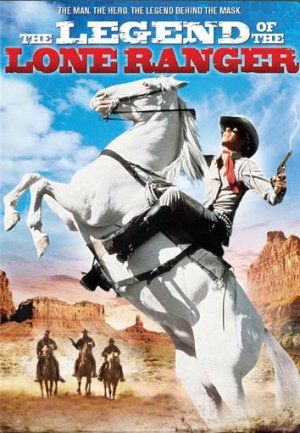
The Legend of the Lone Ranger

 When we get our first glimpse of the Lone Ranger, John Reid is an adolescent who saves a young Tonto from a gang of ruthless ruffians. No sooner has young Reid saved Tonto from these villains than he scrambles back to his home to find these same dastards attacking his ranch. They gun down both his mother and father in cold blood, and later his big brother packs him off to Detroit. Of course, Detroit would be the perfect place since the original "Lone Ranger" radio series aired there on WXYZ in the first place in 1933. Later, after he has grown up and graduated from law school, he visits his brother, Captain Dan Reid (John Bennett Perry of "Independence Day"),and they ride off in pursuit of the gunmen who hanged a crusading newspaper publisher (John Hart of "The Lone Ranger") in the dusty town of Del Rio, Texas. It seems that Lucas Striker has printed some unkind words about Cavendish, and he repays the favor by dispatching his hooligans to slip a noose around his neck.
The ambush at Bryant's Gap—one of the few events that distinguish this horse opera-- is staged with gusto. Cavendish's men launch wagons laden with explosives off promontories at either end of the gap and cut the Rangers off from escaping while his army of riflemen massacre them. They use a Gatling gun to mow down the poor lawmen. In this version of the legend, Cavendish is no longer an ordinary outlaw but a former U.S. Army officer court-marshaled by Grant. Cavendish plans to establish his own kingdom in Texas and intends to use Grant as his bargaining chip to realize his dream. Christopher Lloyd plays Cavendish as a tight-lipped martinet, and he does some strange things himself. When he orders the execution of two of his henchmen (Ted Gehring and Buck Taylor of TV's "Gunsmoke"), he has them blindfolded and seated in chairs before a firing squad. Believe it or not, one of Cavendish's other henchmen is portrayed by no less than Tom Laughlin of "Billy Jack" fame.

THE LEGEND OF THE LONE RANGER, from left: Michael Horse, Kointon Spilsbury, 1981. ©Universal Pictures 

This 98-minute horse opera perished at the box office partially because of an ill-fated public relations campaign that stripped the original Lone Ranger--Clayton Moore--of his mask. After he finished making "The Lone Ranger and the Lost City of God," Moore appeared in various commercials with sidekick Jay Silverheels and attended movie conventions where he signed autographs. The was the primary way that the former Masked Man generated revenue for himself and his family in his later years. Something must have gone wrong in the process of making the movie because the producers used John Hart, who took over the role momentarily after a contract dispute. Particularly objectionable is the reliance upon a balladeer (country singer Merle Haggard) to provide musical narration that serves no purpose. We know everything that we need to know and then here comes Merle underlining what we already know.  


The problems with the script are numerous. A relationship between John Reed and Amy Striker has its moments when they swap spit, but it goes no farther. Instead of the outlaws killing Amy's father, they should have killed her accidentally when she got in their way. This would have ended the romance and given the Lone Ranger another reason to ride the back trails for justice. The scene where the Masked Man gallops alone into Del Rio to rescue Tonto from a hangman's noose is inferior. He faces little opposition from the townspeople. Although the finale with the Lone Ranger and Tonto infiltrating Cavendish hidden fort turns out to explosive stuff, this entire scene makes it too easy for our heroes who encounter no trouble. The screenplay includes historical figures such as Buffalo Bill Cody, Wild Bill Hickok, and General George A. Custer. Jason Robards is good as Grant, but the story is formulaic. 

If you didn't know any better, "The Legend of the Lone Ranger" might make a tolerable rainy day movie. Michael Horse plays Tonto, but the two generate little sense of camaraderie. "Your sins will be paid for in the fires of hell," proclaims Grant when he sentences Cavendish to prison. He could have been the idiots who took away Clayton Moore's mask and came up with this oater. Stacy Keach's younger brother James dubbed Klinton Spilsbury's dialogue, but not even he can cry "Hi, Yo-Silver" with any enthusiasm. I grew up watching Clayton Moore and Jay Silverheels ride across the small screen as well as the big screen in "The Lone Ranger" and "The Lone Ranger and the Lost City of Gold," and both of these outings surpass this technically elegant looking sagebrusher. The DVD release of this inferior western is just as lame because it is presented in the Pan & Scan format until the end credits roll and the images appear in widescreen letterb0xed format. 


Thursday, May 13, 2010

FILM REVIEW OF "BAD COMPANY" (1972)

"Bad Company" (**1/2 out of ****) qualifies as a modest, offbeat, revisionist western. No, this unconventional oater about youth in revolt with Jeff Bridges and Barry Brown doesn't celebrate the golden opportunities that awaited settlers out west like the typical John Ford horse opera would have. Instead, everybody complains about the lack of hospitality and the arduous ordeals that the pioneers weathered on the rugged frontier. Benton's directorial debut with this tale of the survival of the fittest won't overwhelm you, but neither will it underwhelm you. Think of "Bad Company" as art-house fare. Benton is more indebted to Charles Dickens than Zane Grey.

"Bonnie and Clyde" scenarist Robert Benton teams up again with co-scribe David Newman, but Benton is calling the shots now rather than somebody else. He depicts crime on the prairie as neither glamorous nor simple. Moreover, he presents violence as impersonal, arbitrary, and without a shred of sentiment. For example, a young thief steals a pie on the window ledge of a farm house. As the youth scampers away with the pie, the back of the head erupts in a geyser of blood and the impact of the bullet hurls him headlong into the dirt. Benton stages an impressive hanging scene without the usual ostentation. A small group gathers around the convicted man. They place him astride a horse, and a deputy ambles away with the horse without warning so that the criminal slips off it and sways momentarily with a kick or two. Everything about the hanging takes place in such a matter-of-fact way that the punishment itself lacks any impact, except for the strung-up casualty.

Our protagonists are a footloose Union Army draft dodger from Ohio and an ill-bred ruffian who preys on the unsuspecting. As "Bad Company" unfolds, the Union Army is rounding up young men who have tried to avoid enlisting in the military. An idealistic Ohio youth, Drew Dixon (Barry Brown of "Halls of Anger") evades the Union troopers when they search his house and then his parents pack his belongs, give him some dough, and send him on to Fort Joseph, Missouri, where he plans to catch a wagon train west to Virginia City. When he arrives in St. Joseph, Missouri, naive Drew falls in with the unprepossessing likes of roguish Jake Rumsey (Jeff Bridges of "Rancho Deluxe") who leads him down a side alley and clubs him. Drew has a wad of cash stashed in his shoe, but Jake walks off with less than ten dollars. Later, Drew looks for a Methodist woman. Jakes' cohorts rob her, but he returns her purse and breaks into her house without realizing that Drew is waiting for her return. Drew and Jake tangle in a knock-down, drag-out brawl, and Jake is so impressed with Drew's sparring skills that he takes a liking to him. The Methodist woman returns to her home and screams at the sight of destruction, prompting Jake and Drew to exit before they are caught on the premises. Whereas Jake is a cheerful thief, Drew tries to stick to the straight and narrow. For example, Jake and his gang coerce Drew into proving his mettle by robbing a storekeeper. Drew takes money from his shoe and smashes up his fist to prove that he dealt with resistance from the storekeeper. Jake and his riff-raff accept Drew as one of their own. They are all teenagers and they dress like the children of Eastern settlers. Nobody wears traditional western gear.

Two well-helmed scenes illustrate the theme of the West as a land of woes rather than promise. Benton has an amusing incident happen when the boys encounter a farmer with his wife on a wagon in the middle of the prairie. The farmer warns them the nothing good can come of the west. They tried to till the land, but Mother Nature threw one obstacle after another in their way. Finally, the farmer, Zeb (Ted Gehring of "The Thomas Crown Affair") strikes a bargain with the boys that they can have intercourse with his wife, Min (Monika Henreid of "The Omega Man"), for eight dollars. Of course, Jake is the first one to mount her and he finishes up in lightning fast time. Zeb comments about Jake's celerity, and Jake is proud that he came so rapidly, not realizing the onus attached to premature ejaculation. Later, our heroes are caught off-guard by an older gang of outlaws led by Big Joe (David Huddleston of "McQ") who laments the day that he went west. Big Joe and his minions rob the boys, but they leave them their horses. Inevitably, Jake's gang begins to fall apart, especially after the encounter with Big Joe and his outlaws. They dine with a farmer who keeps them covered with a shotgun. At one point, they steal chickens from another farm and one of them dies ignominiously stealing a pie. Before long, Jake and Drew are set afoot when their friends betray them. Jake and Drew turn on each other and Drew joins a posse led by a marshal (Jim Davis of "The Honkers") and he catches up with Jake, but he cannot stand to see Jake swing.

Altogether, irony permeates "Bad Company," and our two anti-heroic leads dabble with little success in crime until the last scene when they emerge as bank robbers. In a sense, the end is the beginning for them as mature criminals. Most of the action occurs on the prairie, and the prairie here looks dreary, overgrown with foliage, and never scenic. Mountains don't crouch ominously on the horizons. Despite the lackluster setting, Benton's low-budget oater is blessed by the cinematography of "Godfather" lenser Gordon Willis. Willis imparts a sense of muted beauty to the surroundings of this Spartan tale shot in the Flint Hills area near Emporia, Kansas. Again, "Bad Company" isn't a traditional western and only one important character sports a Stetson. Nobody dresses like the usual cowboy, though the sets have a western flavor. The big shoot-out between our heroes and Big Joe’s gang is realistically handled, but nothing truly stands out about the action. "Bad Company" ranks as an above-average movie, probably more sophisticated than it needed to be. Newman and Benton has written an interesting tale of initiation, but the stakes here are pretty low and the filmmakers are more prone to poking fun—subtle fun—at the genre rather than delivering slam-bang shoot-outs, breathless chases, and knuckle-bruising bar room brawls. Geoffrey Lewis, John Quade, and Ed Lauter make memorable henchmen.