Watching "Quest for Fire" director Jean-Jacques Annaud's World War II spectacle "Enemy at the Gates" reminded me of the "Sgt. Rock" comic books that I used to peruse as an adolescent when I was growing up in Mississippi during the Cold War years of the 1960s. Those fiendishly duplicitous Nazis in "Sgt Rock" always set up ingenious ambushes, concealing themselves in places where the unsuspecting American G.I.s would least expect to spot them, such as either disabled tanks or the rubble of fallen buildings. "Enemy at the Gates" keeps that Nazi skullduggery intact. Although French director Annaud, whose credits include "Seven Years in Tibet" and "In the Name of the Rose," condemns the Nazi, he goes to heavy-handed lengths near the end to rekindle our antipathy to National Socialism. You'll know the scene when you see it. I hate movie critics would give away too much of a movie plot.
Anyway, the aristocratic Nazi Major Konig (Ed Harris of "Stepmom") dispatched to kill our heroic Red Army sniper disguises a department store mannequin in a gray Wehrmacht uniform with a rifle. Talk about symbolism!? Weren't the Wehrmacht supposed to be the good guys, and the Nazis the evil villains? Although this large-scale, $80 million, World War II epic glorifies the marksmanship of real-life Russian sniper Vassili Zaitsev (Jude Law of "Cold Mountain") who bagged 300 Germans, Annaud condemns the Soviet ideology that Vassili defended. At the same time, no matter how magnificent the set design, costume design, and overall production of the film remains, "Enemy at the Gates" is painfully predictable, though far better than its American counterpart "Saving Private Ryan." Indeed, while both films feature snipers, "Enemy" achieves far greater realism and far less sentimental loquacity than Steven Spielberg's highly-overrated D-Day saga. Nevertheless, "Saving Private Ryan" and "Enemy at the Gates" both celebrate the supremacy of the individual.
Anybody that marches into "Enemy at the Gates" with the impression that the Nazis will triumph is hopelessly naïve, so Annaud's cinematic strategy of making this movie into a cat-and-mouse duel between sympathetic snipers falters in the last half-hour when the Nazi foe unveils his murderous colors. Ultimately, "Enemy" shares more in common ideologically with director Howard Hawk's patriotic 1941 film biography about World War I Tennessee sharpshooter Alvin York in "Sergeant York." York captured hundreds of German troops single-handedly by using his sniping skills in World War I. Warner Brothers produced "Sergeant York" during the tumultuous days of 1941 to drum up patriotism among Americans and give them somebody to emulate. Similarly, Vassili rise to prominence as a Red Army war hero occurs when a young Communist political officer Danilov (Joseph Fiennes of "Elizabeth" and "Shakespeare in Love") suggests the way to inspire morale during among the infantry is to reinvent Vassili Zaitsev as a hero for the army to worship. One of the problems about being a film critic and film lover is that you spot some things that nobody else would care about, like Danilov's "Battleship Potemkin" eyewear. Real cute, Jean-Jacques.
Anybody that has read anything about the brutal battle of Stalingrad in 1942 knows that it emerges as one of the savage battles of all time. Imagine Dante's "Inferno" as the genuine article, and you have a fair idea how devastating the fighting was. "Enemy's" opening scenes show literally thousands of young Soviet troops piling aboard filthy railroad cattle cars and freighted to the war-ravaged city on the Volga where most would die. As "Enemy" unfolds, our protagonist, young Vassili Zaitsev, finds himself among scores of comrades as their officers issue rifles to every other soldier while those soldiers-in-between receive a mere magazine clip of bullets. Basically, the Soviets hurled more men into combat than they had rifles to arm! Sounds rather anti-Soviet to me. If an individual survived, he had to participate in the gory art of battlefield salvage. In other words, taking rifles off the dead! Anyway, Vassili charges off courageously into the fray with a fistful of bullets and bides his time until he can acquire a rifle. ("Enemy" loves to flashback to childhood memories of Vassili in the snowy Urals lining up a wolf in the cross-hairs as it attacks a staked out horse. The outcome of this flashback is pretty predictable, too.) Meanwhile, Soviet officers gun down without qualm any infantrymen that retreat from the Nazi horde. Neither side emerges from "Enemy" as white-washed as the American G.I.s in "Saving Private Ryan." The Soviets aren't quite as diabolical as the Nazis. After all, remember who won World War II. When we first meet Comrade Khrushchev (Bob Hoskins of "The Long Good Friday"), he forces a high-ranking Soviet general to commit suicide because he cannot repel the Nazi invaders. Usually, this scene appears in only Nazi war movies where suicide is deemed the simple way out.
Basically, "Enemy" chronicles not only the cat-and-mouse showdown between Nazi Major Konig and Vassili, but also a love triangle with Vassili, Danilov, and a beautiful Jewish girl, Tanya (Rachel Weisz of "The Mummy") whose parents died at the hands of the Nazis. Indeed, Annaud manages successfully to blow soap bubbles amid bullets. Imagine "Jules and Jim" in Stalingrad and you know what to expect. The outcome is a predictable as who survives the duel, but Annaud gives it the kind of noble gravity that it requires to rupture your tear ducts.
Guys who like war movies where you can see authentic vintage bombers dropping loads on the battleground, especially the Junkers 87, aka "Stuka" dive-bombers, will love this war movie despite its romantic interludes. Had Annaud gone against the grain on certain plot elements and characters, "Enemy at the Gates" might have qualified as a contemporary classic.

CINEMATIC REVELATIONS allows me the luxury of writing, editing and archiving my film and television reviews. Some reviews appeared initially in "The Commercial Dispatch" and "The Planet Weekly" and then later in the comment archives at the Internet Movie Database. IMDB.COM, however, imposes a limit on both the number of words and the number of times that an author may revise their comments. I hope that anybody who peruses these expanded reviews will find them useful.
Wednesday, November 26, 2008


FILM REVIEW OF "DOOM'' (2005)
As the latest entry in the video game inspired action movie genre, "Doom" (* out of ****) more than lives up to its nihilistic promise. Nothing about director Andrzej Bartkowski's tame science fiction thriller proves either original or exciting. Basically, the monsters amount to genetically mutated humanoids that not only appear ghoulish (what glimpses we catch of them) but also whose skeletal carcasses are covered with raspberry jam-like gore. In other words, the people that made "Doom" settled for lowest common denominator chills. Exotic alien predators don't prowl this mediocre melodrama that ranks as an all new career low for former WWE wrestling champ Dwayne 'the Rock' Johnson. Okay, these monsters might frighten those under age twelve or women dragged to this drivel on a date, but blood & terror gorehounds will yawn at these murderous, run-of-the-mill fiends. For the record, these carnivores consist of either ancient Martians or zombies.
Nevertheless, "Doom" rightly deserved its R-rating for the amounts of blood, gore, and mayhem that saturate its occasionally atmospheric but wholly predictable plot. No, this dull, formulaic movie won't induce nightmares. Based on the popular first-person shooter video game where players assume the identity of an armed psychopath on a shooting spree, "Doom" recycles material from better movies, such as the "Resident Evil" epics, "Alien," (1979) and "Stargate"(1994). The best of the few surprises in "Doom" occurs as a twist near the end but it may alienate fans who revere the Rock.
Noisy, rambunctious, darkly shadowed, sporadically profane, but entirely idiotic, "Doom" follows a squad of macho U.S. Marines dispatched to the planet Mars. Their orders call for them to contain a security breach at a privately owned research institute and retrieve top secret company records. Some exposition is required to bring non-video gamers up to speed about this intergalactic gobbledygook set in the year 2046. According to freshman scenarist David Callaham and co-writer Wesley ("Cape Fear") Strick's cliché-riddled screenplay, archeologists uncovered a portal in the Nevada desert that enabled them to travel through space to the Red Planet with minimal ill effects. Sounds like "Stargate," right? Mysteriously, super humanoid creatures have begun to kill scientists in the underground labs. The institute issues a distress call that activates a Rapid Response Team led by Sarge (the Rock), a combat-seasoned Marine with Semper Fi tattooed across his back, and his crackerjack commandos.
Unlike the sexually diverse Marines in James Cameron's classic "Aliens," the "Doom" Marines are all red-blooded males with nicknames that encapsulate their one-dimensional characters. Among Sarge's troops is a God-fearing but profane grunt who craves crosses into his forearm with a razor-sharp knife when he takes the Lord's name in vain. Another Marine appears to have been modeled on the Jesse Ventura character from "Predator," because he lugs around an electric-powered Gatling gun that can turn anything into a sieve. John Grimm (Karl Urban who played Eomer in the "Lord of the Rings" trilogy) constitutes the most reluctant RRT team member. It seems that he once lived on Mars with his archaeologist parents and has nightmares about the experience. The trip back to Mars gives Grim a chance to re-establish contact with his estranged twin sister Samantha (Rosamund Pike of "Die Another Day") who guides Sarge and his men through the treacherous confines of the facility. Although Mars serves as the setting for "Doom," "Cradle 2 the Grave" director Bartkowski only provides us with fleeting glimpses of the planet's bleak, barren surface.
Dwayne 'the Rock' Johnson gives his least charismatic performance as the hard-as-nails Sarge. He utters no clever one-liners and plays Sarge with a straight face. Meaning, the Sarge character is about as lively as a cadaver. Richard Brake of "Death Machine" takes top honors as one of Sarge's low-life jarheads who gets his comeuppance in the least likely place. Poor Rosamund Pike alternates between being a heady scientist and helpless damsel-in-distress. As it turns out, we learn that the researchers on Mars have discovered the 24th chromosome that endows humans with supernatural strength. About the worst that these monsters do is cough up large sausage-shaped worms that bore into the victims' neck, similar to the squirming critter in the "Hidden" films that entered its victims' ears and drove them psychotic. The much touted first-person shooter scene has been far over-hyped and lasts for about five minutes. This first-person shooter scene like many of the stalking scenes in the claustrophobic institute suffer from a shortage of suspense and tension. Bartkowski keeps the lights turned low on his bargain basement monstrosities and his efforts to make them intimidating rarely yield results. Altogether, "Doom" is filled with so much gloom that the plot generates few thrills and chills and emerges as just another standard-issue, testosterone-laced, mutant monster hunt.
Nevertheless, "Doom" rightly deserved its R-rating for the amounts of blood, gore, and mayhem that saturate its occasionally atmospheric but wholly predictable plot. No, this dull, formulaic movie won't induce nightmares. Based on the popular first-person shooter video game where players assume the identity of an armed psychopath on a shooting spree, "Doom" recycles material from better movies, such as the "Resident Evil" epics, "Alien," (1979) and "Stargate"(1994). The best of the few surprises in "Doom" occurs as a twist near the end but it may alienate fans who revere the Rock.
Noisy, rambunctious, darkly shadowed, sporadically profane, but entirely idiotic, "Doom" follows a squad of macho U.S. Marines dispatched to the planet Mars. Their orders call for them to contain a security breach at a privately owned research institute and retrieve top secret company records. Some exposition is required to bring non-video gamers up to speed about this intergalactic gobbledygook set in the year 2046. According to freshman scenarist David Callaham and co-writer Wesley ("Cape Fear") Strick's cliché-riddled screenplay, archeologists uncovered a portal in the Nevada desert that enabled them to travel through space to the Red Planet with minimal ill effects. Sounds like "Stargate," right? Mysteriously, super humanoid creatures have begun to kill scientists in the underground labs. The institute issues a distress call that activates a Rapid Response Team led by Sarge (the Rock), a combat-seasoned Marine with Semper Fi tattooed across his back, and his crackerjack commandos.
Unlike the sexually diverse Marines in James Cameron's classic "Aliens," the "Doom" Marines are all red-blooded males with nicknames that encapsulate their one-dimensional characters. Among Sarge's troops is a God-fearing but profane grunt who craves crosses into his forearm with a razor-sharp knife when he takes the Lord's name in vain. Another Marine appears to have been modeled on the Jesse Ventura character from "Predator," because he lugs around an electric-powered Gatling gun that can turn anything into a sieve. John Grimm (Karl Urban who played Eomer in the "Lord of the Rings" trilogy) constitutes the most reluctant RRT team member. It seems that he once lived on Mars with his archaeologist parents and has nightmares about the experience. The trip back to Mars gives Grim a chance to re-establish contact with his estranged twin sister Samantha (Rosamund Pike of "Die Another Day") who guides Sarge and his men through the treacherous confines of the facility. Although Mars serves as the setting for "Doom," "Cradle 2 the Grave" director Bartkowski only provides us with fleeting glimpses of the planet's bleak, barren surface.
Dwayne 'the Rock' Johnson gives his least charismatic performance as the hard-as-nails Sarge. He utters no clever one-liners and plays Sarge with a straight face. Meaning, the Sarge character is about as lively as a cadaver. Richard Brake of "Death Machine" takes top honors as one of Sarge's low-life jarheads who gets his comeuppance in the least likely place. Poor Rosamund Pike alternates between being a heady scientist and helpless damsel-in-distress. As it turns out, we learn that the researchers on Mars have discovered the 24th chromosome that endows humans with supernatural strength. About the worst that these monsters do is cough up large sausage-shaped worms that bore into the victims' neck, similar to the squirming critter in the "Hidden" films that entered its victims' ears and drove them psychotic. The much touted first-person shooter scene has been far over-hyped and lasts for about five minutes. This first-person shooter scene like many of the stalking scenes in the claustrophobic institute suffer from a shortage of suspense and tension. Bartkowski keeps the lights turned low on his bargain basement monstrosities and his efforts to make them intimidating rarely yield results. Altogether, "Doom" is filled with so much gloom that the plot generates few thrills and chills and emerges as just another standard-issue, testosterone-laced, mutant monster hunt.
FILM REVIEW OF ''DOWN TO THE SEA IN SHIPS" (1922)
The silent 1922 epic movie "Down to the Sea in Ships" looks more like a documentary about the whaling business and the religious practices of Quakers than a nail-biting melodrama about a young man who desperately wants to wed his childhood sweetheart. Today, director Elmer Clifton's seafaring saga is primarily remembered as "It" actress Clara Bow's theatrical film debut at age seventeen. The Whaling Film Corporation produced this vintage adventure and they lensed it on location at New Bedford, Massachusetts. Of course, by the time that "Down to the Sea in Ships" was produced, the whaling industry in America was on the decline because oil pumped out of the ground had replaced whale oil in most instances.
The authenticity of several sequences at sea is noted in the opening screen credits which praises the work of both cameramen A.G. Penrod and Paul H. Allen "who, in small boats, stood by their cameras at the risk of their lives to photograph the fighting whales." Literally, "Down to the Sea in Ships" reenacts the practices of New England whalers. Fans of "Flipper" may not enjoy the scene where the hero harpoons a dolphin, and the animal enthusiasts may regard the whale harvesting techniques are barbaric. Unfortunately, restored though the film is, it looks terrible and can be a real chore to watch for those that aren't accustomed to silent cinema. Moreover, you have to pause to read some of the lengthy title cards, some of which contain allusions to Herman Melville's "Moby Dick." However, on the whole, "Down to the Sea in Ships" proves to be a rewarding experience, more for its realistic depiction of religion and whale fishing than its melodrama.
"Down to the Sea in Ships" takes place in mid-19th century New Bedford. Thomas Allan Dexter (Raymond McKee) loves Patience Morgan (Marguerite Courtot) but her devout father, whaling ship-owner William Morgan (William Walcott), forbids her to marry any man that isn't a whaler. Early in the film we learn during a Quaker worship service that anybody that marries anyone that is not a Quaker is expelled and ostracized. A college graduate, Dexter refuses to let a little thing like not having served as sea aboard a whaling ship to prevent him from having Patience. Meanwhile, Jake Finner (Patrick Hartigan) and Samuel Siggs (Jack Baston) scheme to undermine Morgan's business. First, Siggs masquerades as a Quaker so that Morgan will hire him as an accountant, while Finner signs onto Morgan's whaling ship so that he can steal it. At the same time, Siggs sees the hand of Patience with her father's approval which is almost assured because Siggs has great references. You see, old man Morgan's son perished in a whaling accident and he wants grand children so he compels Patience against her will to betroth herself to the villainous Siggs. Siggs fears Dexter and Finner drugs the young suitor and shanghais him for the voyage. As it turns out, this works out to Dexter's advantage.
Similarly, Morgan's granddaughter Dot Morgan (Clara Bow) has a crush on Jimmie (James Thurfler), the cabin boy. Dot disguises herself as a boy and sneaks aboard the ship, only to be discovered by Jimmie after the vessel has gone to sea. Unbelievably, Dot remains hidden below deck in a cloth covered box until the evil Finner finds her. Finner kills the captain and takes over the ship, but Dexter recovers the ship from Finner and imprisons him. The whalers catch a whale and Dexter is instrumental in harpooning the beast and bringing it back. The scene where Dexter's boat capsizes after the whale attacks it is fabulous stuff, especially when the real-life shark swims into view and menaces the men as they scramble back into their boat. Eventually, the sailors exhaust the whale and return to the ship with it.
Film historians and film buffs will enjoy this glimpse of the past. The film covers the themes of man versus man, man versus society, women versus society and their confining role in society. For the record, this version of "Down to the Sea in Ships" has nothing to do with 20th Century-Fox's 1949 whaling saga starring Richard Widmark, Dean Stockwell and Lionel Barrymore.
Interestingly, director Elmer Clifton worked as an assistant director to the famed D.W. Griffith on "The Birth of a Nation" and "Intolerance." One of his more notorious films that he helmed was the 1937 cautionary movie "Assassin of Youth," also known under the title "Marihuana!"
The authenticity of several sequences at sea is noted in the opening screen credits which praises the work of both cameramen A.G. Penrod and Paul H. Allen "who, in small boats, stood by their cameras at the risk of their lives to photograph the fighting whales." Literally, "Down to the Sea in Ships" reenacts the practices of New England whalers. Fans of "Flipper" may not enjoy the scene where the hero harpoons a dolphin, and the animal enthusiasts may regard the whale harvesting techniques are barbaric. Unfortunately, restored though the film is, it looks terrible and can be a real chore to watch for those that aren't accustomed to silent cinema. Moreover, you have to pause to read some of the lengthy title cards, some of which contain allusions to Herman Melville's "Moby Dick." However, on the whole, "Down to the Sea in Ships" proves to be a rewarding experience, more for its realistic depiction of religion and whale fishing than its melodrama.
"Down to the Sea in Ships" takes place in mid-19th century New Bedford. Thomas Allan Dexter (Raymond McKee) loves Patience Morgan (Marguerite Courtot) but her devout father, whaling ship-owner William Morgan (William Walcott), forbids her to marry any man that isn't a whaler. Early in the film we learn during a Quaker worship service that anybody that marries anyone that is not a Quaker is expelled and ostracized. A college graduate, Dexter refuses to let a little thing like not having served as sea aboard a whaling ship to prevent him from having Patience. Meanwhile, Jake Finner (Patrick Hartigan) and Samuel Siggs (Jack Baston) scheme to undermine Morgan's business. First, Siggs masquerades as a Quaker so that Morgan will hire him as an accountant, while Finner signs onto Morgan's whaling ship so that he can steal it. At the same time, Siggs sees the hand of Patience with her father's approval which is almost assured because Siggs has great references. You see, old man Morgan's son perished in a whaling accident and he wants grand children so he compels Patience against her will to betroth herself to the villainous Siggs. Siggs fears Dexter and Finner drugs the young suitor and shanghais him for the voyage. As it turns out, this works out to Dexter's advantage.
Similarly, Morgan's granddaughter Dot Morgan (Clara Bow) has a crush on Jimmie (James Thurfler), the cabin boy. Dot disguises herself as a boy and sneaks aboard the ship, only to be discovered by Jimmie after the vessel has gone to sea. Unbelievably, Dot remains hidden below deck in a cloth covered box until the evil Finner finds her. Finner kills the captain and takes over the ship, but Dexter recovers the ship from Finner and imprisons him. The whalers catch a whale and Dexter is instrumental in harpooning the beast and bringing it back. The scene where Dexter's boat capsizes after the whale attacks it is fabulous stuff, especially when the real-life shark swims into view and menaces the men as they scramble back into their boat. Eventually, the sailors exhaust the whale and return to the ship with it.
Film historians and film buffs will enjoy this glimpse of the past. The film covers the themes of man versus man, man versus society, women versus society and their confining role in society. For the record, this version of "Down to the Sea in Ships" has nothing to do with 20th Century-Fox's 1949 whaling saga starring Richard Widmark, Dean Stockwell and Lionel Barrymore.
Interestingly, director Elmer Clifton worked as an assistant director to the famed D.W. Griffith on "The Birth of a Nation" and "Intolerance." One of his more notorious films that he helmed was the 1937 cautionary movie "Assassin of Youth," also known under the title "Marihuana!"
FILM REVIEW OF ''HIGH TENSION" (2003)
Scary films—like nightmares—shun logic. After all, what else would you expect from movies about vampires, werewolves, ghosts, zombies, mutated creatures, and sadistic maniacs?
Searching for logic in a scary movie is like skinny dipping in quicksand.
If the vampires, werewolves, ghosts, zombies, creatures, and madmen defy logic, their victims fare no better. Folks in horror movies behave foolishly. When they confront horror, they freeze in their footsteps and belt out a blood-curdling screams. Or they flee in the wrong direction, fall down, and sprain an ankle. Even if the girl doesn't sprain her ankle, she will run in a circle and collide with the villain. If the victims reach their car, they must crank up their jalopy repeatedly before the engine finally turns over, just as the monster or killer looms large in their rearview mirror. Indeed, the only reason that the engine doesn't fire-up the first time out is that it would make it too easy for the victims to escape.
Alas, horror movie villains are as unreal as they are undead, and their victims qualify as the least resourceful humans on earth. Now, keeping this in mind, do you watch scary movies to see the victims apply cold, hard logic to an illogical crisis while keeping a cool head under pressure? Anybody that goes to horror movies hoping that the villain will be realistic or that the victims won't do idiotic things clearly doesn't know much about horror movies and life-in-general. Some moviegoers love to berate the victims for their crazy behavior. If you saw a vampire, werewolf, zombie, mutated creature, or homicidal maniac, you'd probably freeze-up and howl, too. If logic has no place in horror movies, neither does realism. People ridicule creature-features routinely because Godzilla doesn't look like the genuine article. Has anybody seen a radioactive prehistoric monster? Werewolves aren't real, so how can they look genuine? Basically, criticizing horror movies for lapses in logic or lack of realism makes no sense. Criticizing horror movies as a type of movie makes better sense, and people who hate horror movies have no right to single out horror movies that abuse logic and defy realism.
The French horror movie "High Tension" (***1/2 out of ****) definitely gives both logic and realism the axe. As the best and bloodiest horror chiller since "Saw," "High Tension" qualifies as a ghastly valentine for gorehounds. First, "High Tension" narrowly avoided an NC-17 rating from the Motion Picture Association of America, but the MPAA must have been in a generous mood when they gave this nerve-jangler an R-rating. You'll see more blood and gore on display here than those recent remakes of "The Texas Chainsaw Massacre," "House of Wax," or nail-biters like "Bogyman." Second, director Alexandre Aja doesn't waste time with a lot of cheap false alarms to make the hair rise on the back of our necks. He is too busy showing a homicidal maniac killing people to indulge in those moments designed to make you jump when he can plunge you up to your neck into a blood-soaked situation.
Just for the record, don't see this movie if you are the squeamish. "High Tension" will scare the puke out of you. Aja doesn't pull any punches when it comes to depicting violence. The scene where the maniac breaks out a huge buzz saw that resembles something firefighters wield to free people trapped in cars illustrates this idea. The villain approaches a stalled-out car that his victim has flagged down on a deserted road. As the driver frantically cranks the vehicle, the maniac smashes the windshield then mangles the driver with this hideous weapon, turning the interior of the car into a bloodbath. In some horror circles, gorehounds call these movies splatter movies instead of slasher movies.
Actually, "High Tension" combines slasher with splatter for a bloodbath of a life-time. Plot wise, "High Tension" concerns two female college students in contemporary France who spend a weekend in the country to catch up on their school work. Marie (Cecile De France of "Around the World in 80 Days") and Alex (Maiween Le Besco of "The Fifth Element") cruise into remote Southern France where Alex's family live on an isolated farm house. No sooner has everybody turned in for the evening than a homicidal madman (Philippe Nahon of "Irreversible") barges into their house. This one-man home invasion army slashes the father, jams his head in the rails of the staircase, and decapitates the breadwinner with a piece of furniture. This madman opens the wife's throat from ear to ear like a watermelon and pursues the little boy into a cornfield with a shotgun. He shackles poor Alex in chains, gags her, and prowls the rest of the house in vain to find anybody else. Miraculously, Marie avoids detection in scenes of heart-stopping suspense. The maniac tools around in a rusty old truck like the monster drove in the "Jeepers Creepers" movies and sticks Alex in the back. At the last second, unbeknownst to the killer, Marie scrambles aboard with Alex. Marie resolves to save her best friend.
Before it's all over with, "High Tension" evokes chilling memories of the original "Texas Chainsaw Massacre." Compared with "Friday the Thirteen's" Jason or "Halloween's" Michael Myers, the maniac her make them look like pansies. Although the first hour or so of "High Tension" is a brutally straight-forward exercise in stomach-churning terror, the last half-hour takes a bizarre 180 degree spin reminiscent of the Brad Pitt movie "Fight Club." Already, Aja has been tapped to helm the remake of "The Hills Have Eyes." If you're looking for a movie that will make you scream and wet your pants at the same time, look no farther than "High Tension."
Searching for logic in a scary movie is like skinny dipping in quicksand.
If the vampires, werewolves, ghosts, zombies, creatures, and madmen defy logic, their victims fare no better. Folks in horror movies behave foolishly. When they confront horror, they freeze in their footsteps and belt out a blood-curdling screams. Or they flee in the wrong direction, fall down, and sprain an ankle. Even if the girl doesn't sprain her ankle, she will run in a circle and collide with the villain. If the victims reach their car, they must crank up their jalopy repeatedly before the engine finally turns over, just as the monster or killer looms large in their rearview mirror. Indeed, the only reason that the engine doesn't fire-up the first time out is that it would make it too easy for the victims to escape.
Alas, horror movie villains are as unreal as they are undead, and their victims qualify as the least resourceful humans on earth. Now, keeping this in mind, do you watch scary movies to see the victims apply cold, hard logic to an illogical crisis while keeping a cool head under pressure? Anybody that goes to horror movies hoping that the villain will be realistic or that the victims won't do idiotic things clearly doesn't know much about horror movies and life-in-general. Some moviegoers love to berate the victims for their crazy behavior. If you saw a vampire, werewolf, zombie, mutated creature, or homicidal maniac, you'd probably freeze-up and howl, too. If logic has no place in horror movies, neither does realism. People ridicule creature-features routinely because Godzilla doesn't look like the genuine article. Has anybody seen a radioactive prehistoric monster? Werewolves aren't real, so how can they look genuine? Basically, criticizing horror movies for lapses in logic or lack of realism makes no sense. Criticizing horror movies as a type of movie makes better sense, and people who hate horror movies have no right to single out horror movies that abuse logic and defy realism.
The French horror movie "High Tension" (***1/2 out of ****) definitely gives both logic and realism the axe. As the best and bloodiest horror chiller since "Saw," "High Tension" qualifies as a ghastly valentine for gorehounds. First, "High Tension" narrowly avoided an NC-17 rating from the Motion Picture Association of America, but the MPAA must have been in a generous mood when they gave this nerve-jangler an R-rating. You'll see more blood and gore on display here than those recent remakes of "The Texas Chainsaw Massacre," "House of Wax," or nail-biters like "Bogyman." Second, director Alexandre Aja doesn't waste time with a lot of cheap false alarms to make the hair rise on the back of our necks. He is too busy showing a homicidal maniac killing people to indulge in those moments designed to make you jump when he can plunge you up to your neck into a blood-soaked situation.
Just for the record, don't see this movie if you are the squeamish. "High Tension" will scare the puke out of you. Aja doesn't pull any punches when it comes to depicting violence. The scene where the maniac breaks out a huge buzz saw that resembles something firefighters wield to free people trapped in cars illustrates this idea. The villain approaches a stalled-out car that his victim has flagged down on a deserted road. As the driver frantically cranks the vehicle, the maniac smashes the windshield then mangles the driver with this hideous weapon, turning the interior of the car into a bloodbath. In some horror circles, gorehounds call these movies splatter movies instead of slasher movies.
Actually, "High Tension" combines slasher with splatter for a bloodbath of a life-time. Plot wise, "High Tension" concerns two female college students in contemporary France who spend a weekend in the country to catch up on their school work. Marie (Cecile De France of "Around the World in 80 Days") and Alex (Maiween Le Besco of "The Fifth Element") cruise into remote Southern France where Alex's family live on an isolated farm house. No sooner has everybody turned in for the evening than a homicidal madman (Philippe Nahon of "Irreversible") barges into their house. This one-man home invasion army slashes the father, jams his head in the rails of the staircase, and decapitates the breadwinner with a piece of furniture. This madman opens the wife's throat from ear to ear like a watermelon and pursues the little boy into a cornfield with a shotgun. He shackles poor Alex in chains, gags her, and prowls the rest of the house in vain to find anybody else. Miraculously, Marie avoids detection in scenes of heart-stopping suspense. The maniac tools around in a rusty old truck like the monster drove in the "Jeepers Creepers" movies and sticks Alex in the back. At the last second, unbeknownst to the killer, Marie scrambles aboard with Alex. Marie resolves to save her best friend.
Before it's all over with, "High Tension" evokes chilling memories of the original "Texas Chainsaw Massacre." Compared with "Friday the Thirteen's" Jason or "Halloween's" Michael Myers, the maniac her make them look like pansies. Although the first hour or so of "High Tension" is a brutally straight-forward exercise in stomach-churning terror, the last half-hour takes a bizarre 180 degree spin reminiscent of the Brad Pitt movie "Fight Club." Already, Aja has been tapped to helm the remake of "The Hills Have Eyes." If you're looking for a movie that will make you scream and wet your pants at the same time, look no farther than "High Tension."
Tuesday, November 25, 2008
FILM REVIEW OF ''QUANTUM OF SOLACE'' (2008)
Cobra-faced actor Daniel Craig—the fifth to play James Bond—is in better shape than the new 007 epic “Quantum of Solace." If the previous Bond movie “Casino Royale” struck you as abysmal, the threadbare “Quantum of Solace” (* out of ***) scrapes the bottom of the barrel. David Bradley’s rough & tumble second-unit action sequences and Simon Crane’s stunts provide the only bright spots. Unfortunately, neither Craig’s virile 007 nor the gripping fisticuffs can salvage this mundane melodrama that resumes the narrative where “Casino Royale” left off with Bond confronting one of the villains. Subsequently, if you missed “Casino Royale,” “Quantum's” plot convolutions may mystify you. Since Bond producer Cubby Broccoli died, the Bond movies have hit the skids. “Quantum” is the briefest Bond in history and the least compelling if you’re a traditional 007 fan. In fact, “Monster’s Ball” director Marc Forster looks like he is making a replica of a Jason Bourne thriller rather than a James Bond movie.
Ian Fleming’s secret agent hero made his cinematic debut in 1962 with a lean, mean Sean Connery in Terence Young’s “Dr. No,” and the Bond movies revolutionized spy thrillers. Before most people could pick up a Fleming novel, United Artists churned out a sequel “From Russia, With Love." The third 007 caper “Goldfinger” created the template for Bonds and "Thunderball" ensured the longevity of the franchise. No sooner had Bond redefined the spy thriller than everybody cloned the amoral, womanizing British secret agent with his double-entendre puns in knock-off versions.
Of course, Bond extravaganzas have always embraced adventure rather than espionage. Incredibly, in the Cold War era, the Bond producers—unlike most others—refused to demonize the evil Soviet empire. Instead, 007 battled S.P.E.C.T.R.E, a.k.a. Special Executive for Counter-Terrorism, Revenge, and Extortion with larger-than-life villains straight out of old cliffhanger movies like Ming the Merciless from the Flash Gordon serials. The Bond movies displayed no qualms about occasionally slamming the Red Chinese. After "You Only Live Twice" in 1967 the Bonds backed off Mao’s minions.
Since “Casino Royale,” the new Bonds have forsaken everything that made the longest running franchise original. Audiences watch Bond movies for 007’s gadgets, the sexy bikini-clad babes, Bond's wisecracks, the exotic locales, and the outlandish stunts. Not only were the Bond foes arch villains who wanted to destroy the world and remake it in their own demented images, they hatched bizarre plans to achieve these means. Sometimes, Bond movies scuttled credibility to keep up with the times. For example, “Star Wars” inspired “Moonraker.” Nevertheless, 007 gallivanted from one bed to the next for nymphs with naughty names, trumping a gallery of deadly henchmen, and saving the world from extinction.
By 1989, Cubby Broccoli overhauled the series with the gritty, hard-as-nails “License to Kill.” Cubby's strategy backfired, and United Artists refused to promote the picture. After the “License to Kill” debacle, Pierce Brosnan donned the tuxedo and Cubby restored the Roger Moore formula. When production costs escalated, the new Bond producers sacked Brosnan and started from scratch. “Casino Royale” harkened back to the level-headed “For Your Eyes Only,” but the success of prequels—primarily George Lucas’s second “Star Wars” trilogy—caught on and convinced daughter Barbara Broccoli to re-start the franchise with Bond earning his license to kill.
“Quantum of Solace” goes where no Bond has gone. The trademark gun barrel opening scene that started the 20 previous Bonds precedes the end credits. Actually, “Quantum” qualifies as a sequel to “Casino,” something the Bonds have never done. Neither Ms. Moneypenny or Q return. “Casino Royale” wrapped with Bond getting the drop on the villainous Mr. White. “Quantum” opens with 007 careening in his Aston Martin through scenic Italy with a carload of trigger-happy thugs blasting away at him. (Sean Connery's Bond would have made short work of them with a oil slick.) Bond has Mr. White of “Casino Royale”) stashed in the trunk. He delivers White to M for interrogation. No sooner has their interrogation begun than M’s bodyguard Mitchell (utility stunt man Glenn Foster) starts blasting and White makes a break for it. Before he escapes, White chuckles about how the anonymous criminal syndicate that he belongs to has infiltrated virtually every intelligence agency in the world. Scenarists Paul Haggis, Neal Purvis, and Robert Wade reveal nothing about this syndicate and their screenplay is virutally incoherent where details are concerned. Bond cruises throughout "Quantum" on a mission to find who made Vesper die, but surprisingly we never see Vesper in a flashblack, so it is difficult for newcomers to savor the depth of Bond's rage.
Bond chases Mitchell and kills him. Meanwhile, British Intelligence traces the money Le Chiffre, the chief “Casino Royale” villain, used to a geologist in Panama. Bond tangles briefly with a goon hiding in the dead geologist’s motel room. Every time 007 grapples with a bad guy, Green’s people kill Bond's opponent and frame 007 for the killing. Mistakenly, M believes that Bond has gone amok in his quest to exact revenge on those who killed Vesper in "Casino Royale." Anyway, 007 recovers an attaché case that leads him to a mysterious dame. Camille (Olga Kurylenko of “Hitman”)has been sleeping with Dominic Green (Mathieu Amalric of “Marie Antoinette”), a hypocritical megalomaniac environmentalist. Green plans to topple the Bolivian government so he can buy up the country’s water supply and resell it at higher prices to its new president. Green comments a deal with the corrupt General Medrano (Joaquín Cosio of “Hitgirl”) to install him in the presidential palace. Medrano, it turns out, murdered Camille’s father, strangled her mother and her sister. Moreover, Medrano set a fire that cremated her family and left our heroine with a permanent scar on her back. Unfortunately, Medrano doesn't amount to much of a villain. He does little more than rough up two women at the end of the movie and we have no reason to hate him as much as Camille. Camille’s pursuit of Medrano resembles the Roger Moore Bond movie “For Your Eyes Only,” but "For Your Eyes Only" was far exciting. Bond teams up with Camille to thwart both Green and Medrano.
Just as the villains in “Casino Royale” emerged as lightweights, the “Quantum of Solace” villains are twerps that pose little danger to our hero. Green tries to kill Bond with an axe and chops himself in the foot. Green’s scheme to monopolize natural global resources is negligible compared with better Bond villains. The stakes are small potatoes. The fights and the shoot-outs are monotonously repetitive. The dialogue is disposable, and both hero and heroine are too preoccupied with revenge to worry about romance. The Jack White & Alicia Keyes title theme song “Another Way to Die” is a yawner. Judi Dench returns as Bond’s matronly master, but she spends more time being duped while Bond is on the run. The oil covered corpse of Strawberry Fields here is a homage to "Goldfinger." The share the parachute scene recalls the opening stunt from "Moonraker." The fight with the Special Branch operative is straight out of the Cairo scene in "The Spy Who Loved Me." “Quantum of Solace” barely registers on the Richter scale of excitment.
Ian Fleming’s secret agent hero made his cinematic debut in 1962 with a lean, mean Sean Connery in Terence Young’s “Dr. No,” and the Bond movies revolutionized spy thrillers. Before most people could pick up a Fleming novel, United Artists churned out a sequel “From Russia, With Love." The third 007 caper “Goldfinger” created the template for Bonds and "Thunderball" ensured the longevity of the franchise. No sooner had Bond redefined the spy thriller than everybody cloned the amoral, womanizing British secret agent with his double-entendre puns in knock-off versions.
Of course, Bond extravaganzas have always embraced adventure rather than espionage. Incredibly, in the Cold War era, the Bond producers—unlike most others—refused to demonize the evil Soviet empire. Instead, 007 battled S.P.E.C.T.R.E, a.k.a. Special Executive for Counter-Terrorism, Revenge, and Extortion with larger-than-life villains straight out of old cliffhanger movies like Ming the Merciless from the Flash Gordon serials. The Bond movies displayed no qualms about occasionally slamming the Red Chinese. After "You Only Live Twice" in 1967 the Bonds backed off Mao’s minions.
Since “Casino Royale,” the new Bonds have forsaken everything that made the longest running franchise original. Audiences watch Bond movies for 007’s gadgets, the sexy bikini-clad babes, Bond's wisecracks, the exotic locales, and the outlandish stunts. Not only were the Bond foes arch villains who wanted to destroy the world and remake it in their own demented images, they hatched bizarre plans to achieve these means. Sometimes, Bond movies scuttled credibility to keep up with the times. For example, “Star Wars” inspired “Moonraker.” Nevertheless, 007 gallivanted from one bed to the next for nymphs with naughty names, trumping a gallery of deadly henchmen, and saving the world from extinction.
By 1989, Cubby Broccoli overhauled the series with the gritty, hard-as-nails “License to Kill.” Cubby's strategy backfired, and United Artists refused to promote the picture. After the “License to Kill” debacle, Pierce Brosnan donned the tuxedo and Cubby restored the Roger Moore formula. When production costs escalated, the new Bond producers sacked Brosnan and started from scratch. “Casino Royale” harkened back to the level-headed “For Your Eyes Only,” but the success of prequels—primarily George Lucas’s second “Star Wars” trilogy—caught on and convinced daughter Barbara Broccoli to re-start the franchise with Bond earning his license to kill.
“Quantum of Solace” goes where no Bond has gone. The trademark gun barrel opening scene that started the 20 previous Bonds precedes the end credits. Actually, “Quantum” qualifies as a sequel to “Casino,” something the Bonds have never done. Neither Ms. Moneypenny or Q return. “Casino Royale” wrapped with Bond getting the drop on the villainous Mr. White. “Quantum” opens with 007 careening in his Aston Martin through scenic Italy with a carload of trigger-happy thugs blasting away at him. (Sean Connery's Bond would have made short work of them with a oil slick.) Bond has Mr. White of “Casino Royale”) stashed in the trunk. He delivers White to M for interrogation. No sooner has their interrogation begun than M’s bodyguard Mitchell (utility stunt man Glenn Foster) starts blasting and White makes a break for it. Before he escapes, White chuckles about how the anonymous criminal syndicate that he belongs to has infiltrated virtually every intelligence agency in the world. Scenarists Paul Haggis, Neal Purvis, and Robert Wade reveal nothing about this syndicate and their screenplay is virutally incoherent where details are concerned. Bond cruises throughout "Quantum" on a mission to find who made Vesper die, but surprisingly we never see Vesper in a flashblack, so it is difficult for newcomers to savor the depth of Bond's rage.
Bond chases Mitchell and kills him. Meanwhile, British Intelligence traces the money Le Chiffre, the chief “Casino Royale” villain, used to a geologist in Panama. Bond tangles briefly with a goon hiding in the dead geologist’s motel room. Every time 007 grapples with a bad guy, Green’s people kill Bond's opponent and frame 007 for the killing. Mistakenly, M believes that Bond has gone amok in his quest to exact revenge on those who killed Vesper in "Casino Royale." Anyway, 007 recovers an attaché case that leads him to a mysterious dame. Camille (Olga Kurylenko of “Hitman”)has been sleeping with Dominic Green (Mathieu Amalric of “Marie Antoinette”), a hypocritical megalomaniac environmentalist. Green plans to topple the Bolivian government so he can buy up the country’s water supply and resell it at higher prices to its new president. Green comments a deal with the corrupt General Medrano (Joaquín Cosio of “Hitgirl”) to install him in the presidential palace. Medrano, it turns out, murdered Camille’s father, strangled her mother and her sister. Moreover, Medrano set a fire that cremated her family and left our heroine with a permanent scar on her back. Unfortunately, Medrano doesn't amount to much of a villain. He does little more than rough up two women at the end of the movie and we have no reason to hate him as much as Camille. Camille’s pursuit of Medrano resembles the Roger Moore Bond movie “For Your Eyes Only,” but "For Your Eyes Only" was far exciting. Bond teams up with Camille to thwart both Green and Medrano.
Just as the villains in “Casino Royale” emerged as lightweights, the “Quantum of Solace” villains are twerps that pose little danger to our hero. Green tries to kill Bond with an axe and chops himself in the foot. Green’s scheme to monopolize natural global resources is negligible compared with better Bond villains. The stakes are small potatoes. The fights and the shoot-outs are monotonously repetitive. The dialogue is disposable, and both hero and heroine are too preoccupied with revenge to worry about romance. The Jack White & Alicia Keyes title theme song “Another Way to Die” is a yawner. Judi Dench returns as Bond’s matronly master, but she spends more time being duped while Bond is on the run. The oil covered corpse of Strawberry Fields here is a homage to "Goldfinger." The share the parachute scene recalls the opening stunt from "Moonraker." The fight with the Special Branch operative is straight out of the Cairo scene in "The Spy Who Loved Me." “Quantum of Solace” barely registers on the Richter scale of excitment.
Sunday, November 23, 2008
FILM REVIEW OF ''THE MAGNIFICENT SEVEN RIDE!" (1972)
"The Magnificent Seven Ride!" (** out of ****) qualifies as a saddle sore sequel compared to the two previous sequels, Burt Kennedy's "Return of the Seven" (1966) and Paul Wendkos' "Guns of the Magnificent Seven" (1968) and the incomparable John Sturges original "The Magnificent Seven." Lee Van Cleef is the best thing about "The Magnificent Seven Ride." He looks like he belongs in this tame horse opera and his performance is top-notch. No, he doesn't resemble either Yul Brynner or George Kennedy. He lends a commanding presence that this woebegone western desperately needs. The rest of the cast look like they're collecting a paycheck. Moreover,this "Seven" lacks depth of character and generates no more than a modicum of sympathy, unlike their forerunners.

"Frogs" director George McCowan manages to keep the action galloping along for its 100 minutes, and seasoned TV scenarist Arthur Rowe has altered the formula for this outing. For example, unlike the original, our heroes attack the Hispanic villain's camp before they engage him in a fight to the death in the village at the end. Unfortunately, "The Magnificent Seven Ride!" breaks far too many rules. The villain amounts to a one-dimensional cipher with no personality. Indeed, he doesn't utter a word. The best part of this lackluster western occurs in the last twenty minutes as the seven prepare for the onslaught of De Toro's men. "The Magnificent Seven Ride!" looks tired, empty, and worn out owing to its ersatz back lot setting and familiar television locales. Clearly, McCowan could not surmount the obstacles inherent in the low budget. Interestingly, while he doesn't stage the action scenes with distinction, McCowan does frame the gunfights occasionally so that we see more participants in the same shot with the shooter killing his adversary, something that used to be frowned upon back in the Golden Age of Hollywood. Walter Thompson does a competent editing job, but he doesn't have much with which to work so the film has a routine rhythm to it. Talented "Patton" lenser Fred J. Koenekamp had little time to make this sagebrusher look as majestic as the earlier "Seven" entries.
Die-hard "Magnificent Seven" fans have every right to abhor this lame western. I saw it in the theatre when it came out in 1972 and found it nothing short of deplorable. "The Magnificent Seven Ride!" doesn't live up to the Sturges, Kennedy, and Wendkos films. In fact, Geoff Murphy's television pilot surpasses the McCowan film. I remember "Playboy" magazine film critic Bruce Williamson commented that "TM7R" got by "on bits and pieces." In retrospect, more than 30 years later, my aversion to this film has dissipated. Although the McCowan film has its good points, the bad points set aside most of its assets. The stupendous Elmer Bernstein orchestral score seems to have lost its grandeur, too.

"The Magnificent Seven Ride!" opens with Chris (Lee Van Cleef) and another horseman skedaddling out of town. One of Chris' pals from the past,former bounty hunter Jim McKay (Ralph Waite of "The Stone Killer"), is riding to see him in the hope that he can enlist Chris' help against a dastardly Mexican bandit called De Toro. Two of De Toro's men lay in ambush for Jim, but Chris guns down them without mercy and saves his old friend's life. When Jim asks Chris to ride with him, our pipe-smoking protagonist refuses. Not only has he ridden to Mexico three times before, but now he has taken a wife, Arrila (Mariette Hartley of "Barquero"), "who's still practically a bride." McKay reminds Chris that he saved his life, but Chris isn't about to budge. MacKay reminds them about the first time that they went south and earned only $50 dollars per man. Chris still turns him down.
Meanwhile, an out-of-work journalist, Noah Forbes (Michael Callan of "Cat Ballou"),wants to immortalize Chris the same way that Ned Buntline did Buffalo Bill Cody. While all this is transpiring, Arrila pleads with Chris to turn loose an 18-year old robber Shelly (Darrell Larson) who is about to be sent to serve a stretch in Tucson Territorial Prison. Eventually, Arrila wears her husband down and Chris frees Shelly. Shelly repays him by robbing the town bank, wounding him in the shoulder, and abducting Arrila. Chris and Noah track down Shelly's accomplices and Chris shoots them down in cold blood. Chris crosses trails with Jim again. Jim is the law in a Sonora village called Magdalena. Magdalena is a farming village that consists primarily of Mexicans with a few American families. De Toro (Ron Stein)and his army of gunmen terrorize the border. Neither the Rurales nor the U.S. Calvary have had any luck thwarting his notorious activities. Worse, neither refuse to work with the other. When Chris runs into Jim the second time, he learns that Shelly has ridden by and left. Chris learns later that Shelly joined De Toro's gang and showed them a rear approach (a la "The 300 Spartans")and the bandit killed Jim. As it turns out, Jim killed Shelly. "He's done my job," Chris observed, "I'll do his."

Chris rides into Magdalena and discovers a village comprised now of wives who are widows and some children. They don't have enough horses to escort the wives out of the village, and Chris refuses to let them walk across the desert where they would be easy targets for the villains. Since De Toro and his gang have ridden north across the border, Chris promises Mrs. Laurie Gunn (Stephanie Powers of "Hart to Hart")that he will return. She has her doubts. Noah and Chris ride to Tucson Territorial Prison where Chris presented pardons signed by the governor and the warden reluctantly paroles into his custody Walt Drummond (William Lucking), Scott Elliot (Ed Lauter of "The Longest Yard"), Matt Skinner (Luke Askew of "Pat Garrett & Billy the Kid"), Pepe Carral (Pedro Armendáriz Jr.), and ex-Army officer Andy Hayes(James B. Sikking of "Star Trek 3"). Chris warns them that he has to consign the pardons before they can be freed and that he dies under any circumstances that the law will track them down. Chris has Elliot, who is a demolitions expert, ride a
wagon filled with explosives. They set out for De Toro's hacienda and attack it. The closest thing to cool in this western is when Pepe sits perched on the roof with a cigar glowing in his mouth, ignites a stick of dynamite, and uses his bullwhip to deliver it under the awning where two Mexicans are operating a Gatling gun during their attack. The problem, however, is that you can see the dummy explode when the dynamite detonates. Our heroes takes De Toro's woman hostage and Chris lets one of De Toro's men go to warn his boss. Before he releases the Mexican, he identifies himself and the rest of his men. Now, the convicts cannot escape and hide in Mexico if Chris dies because De Toro will track them down, and they cannot escape across the border because the law will come after them. In other words, these five convicts aren't the saintly bunch that filled the ranks of the seven in the other movies. Okay, this serves as a nod to realism, but it doesn't endear them to us.

"The Magnificent Seven Ride!" looks completely different from the three earlier oaters. "The Magnificent Seven" was made in Mexico, and "Return of the Seven" and "Guns of the Magnificent Seven" were shot in scenic Spain. In fact, "TM7R" was shot at Universal Studios back lot where "Laredo," "Alias Smith & Jones," and "The Virginian" were made. The exterior desert scenes were lensed at Vasquez Rocks where Captain Kirk battled an alien in the "Star Trek" episode "Arena" and where virtually every cheapjack genre B-movie has been shot.

"The Magnificent Seven Ride! isn't very magnificent.
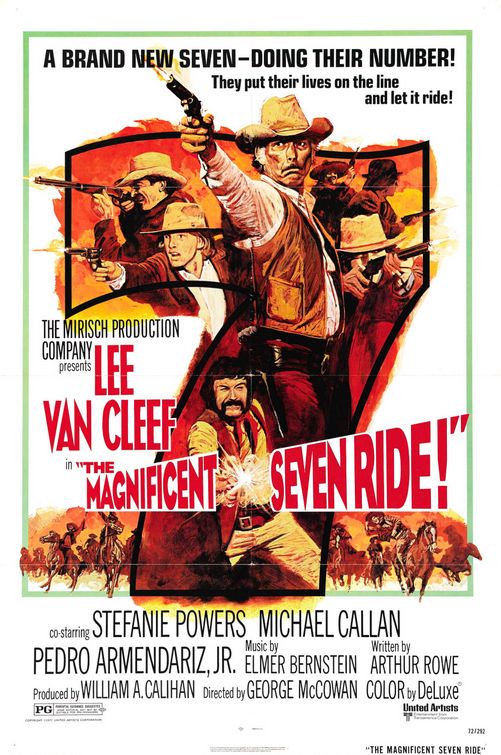
"Frogs" director George McCowan manages to keep the action galloping along for its 100 minutes, and seasoned TV scenarist Arthur Rowe has altered the formula for this outing. For example, unlike the original, our heroes attack the Hispanic villain's camp before they engage him in a fight to the death in the village at the end. Unfortunately, "The Magnificent Seven Ride!" breaks far too many rules. The villain amounts to a one-dimensional cipher with no personality. Indeed, he doesn't utter a word. The best part of this lackluster western occurs in the last twenty minutes as the seven prepare for the onslaught of De Toro's men. "The Magnificent Seven Ride!" looks tired, empty, and worn out owing to its ersatz back lot setting and familiar television locales. Clearly, McCowan could not surmount the obstacles inherent in the low budget. Interestingly, while he doesn't stage the action scenes with distinction, McCowan does frame the gunfights occasionally so that we see more participants in the same shot with the shooter killing his adversary, something that used to be frowned upon back in the Golden Age of Hollywood. Walter Thompson does a competent editing job, but he doesn't have much with which to work so the film has a routine rhythm to it. Talented "Patton" lenser Fred J. Koenekamp had little time to make this sagebrusher look as majestic as the earlier "Seven" entries.
Die-hard "Magnificent Seven" fans have every right to abhor this lame western. I saw it in the theatre when it came out in 1972 and found it nothing short of deplorable. "The Magnificent Seven Ride!" doesn't live up to the Sturges, Kennedy, and Wendkos films. In fact, Geoff Murphy's television pilot surpasses the McCowan film. I remember "Playboy" magazine film critic Bruce Williamson commented that "TM7R" got by "on bits and pieces." In retrospect, more than 30 years later, my aversion to this film has dissipated. Although the McCowan film has its good points, the bad points set aside most of its assets. The stupendous Elmer Bernstein orchestral score seems to have lost its grandeur, too.

"The Magnificent Seven Ride!" opens with Chris (Lee Van Cleef) and another horseman skedaddling out of town. One of Chris' pals from the past,former bounty hunter Jim McKay (Ralph Waite of "The Stone Killer"), is riding to see him in the hope that he can enlist Chris' help against a dastardly Mexican bandit called De Toro. Two of De Toro's men lay in ambush for Jim, but Chris guns down them without mercy and saves his old friend's life. When Jim asks Chris to ride with him, our pipe-smoking protagonist refuses. Not only has he ridden to Mexico three times before, but now he has taken a wife, Arrila (Mariette Hartley of "Barquero"), "who's still practically a bride." McKay reminds Chris that he saved his life, but Chris isn't about to budge. MacKay reminds them about the first time that they went south and earned only $50 dollars per man. Chris still turns him down.
Meanwhile, an out-of-work journalist, Noah Forbes (Michael Callan of "Cat Ballou"),wants to immortalize Chris the same way that Ned Buntline did Buffalo Bill Cody. While all this is transpiring, Arrila pleads with Chris to turn loose an 18-year old robber Shelly (Darrell Larson) who is about to be sent to serve a stretch in Tucson Territorial Prison. Eventually, Arrila wears her husband down and Chris frees Shelly. Shelly repays him by robbing the town bank, wounding him in the shoulder, and abducting Arrila. Chris and Noah track down Shelly's accomplices and Chris shoots them down in cold blood. Chris crosses trails with Jim again. Jim is the law in a Sonora village called Magdalena. Magdalena is a farming village that consists primarily of Mexicans with a few American families. De Toro (Ron Stein)and his army of gunmen terrorize the border. Neither the Rurales nor the U.S. Calvary have had any luck thwarting his notorious activities. Worse, neither refuse to work with the other. When Chris runs into Jim the second time, he learns that Shelly has ridden by and left. Chris learns later that Shelly joined De Toro's gang and showed them a rear approach (a la "The 300 Spartans")and the bandit killed Jim. As it turns out, Jim killed Shelly. "He's done my job," Chris observed, "I'll do his."

Chris rides into Magdalena and discovers a village comprised now of wives who are widows and some children. They don't have enough horses to escort the wives out of the village, and Chris refuses to let them walk across the desert where they would be easy targets for the villains. Since De Toro and his gang have ridden north across the border, Chris promises Mrs. Laurie Gunn (Stephanie Powers of "Hart to Hart")that he will return. She has her doubts. Noah and Chris ride to Tucson Territorial Prison where Chris presented pardons signed by the governor and the warden reluctantly paroles into his custody Walt Drummond (William Lucking), Scott Elliot (Ed Lauter of "The Longest Yard"), Matt Skinner (Luke Askew of "Pat Garrett & Billy the Kid"), Pepe Carral (Pedro Armendáriz Jr.), and ex-Army officer Andy Hayes(James B. Sikking of "Star Trek 3"). Chris warns them that he has to consign the pardons before they can be freed and that he dies under any circumstances that the law will track them down. Chris has Elliot, who is a demolitions expert, ride a
wagon filled with explosives. They set out for De Toro's hacienda and attack it. The closest thing to cool in this western is when Pepe sits perched on the roof with a cigar glowing in his mouth, ignites a stick of dynamite, and uses his bullwhip to deliver it under the awning where two Mexicans are operating a Gatling gun during their attack. The problem, however, is that you can see the dummy explode when the dynamite detonates. Our heroes takes De Toro's woman hostage and Chris lets one of De Toro's men go to warn his boss. Before he releases the Mexican, he identifies himself and the rest of his men. Now, the convicts cannot escape and hide in Mexico if Chris dies because De Toro will track them down, and they cannot escape across the border because the law will come after them. In other words, these five convicts aren't the saintly bunch that filled the ranks of the seven in the other movies. Okay, this serves as a nod to realism, but it doesn't endear them to us.

"The Magnificent Seven Ride!" looks completely different from the three earlier oaters. "The Magnificent Seven" was made in Mexico, and "Return of the Seven" and "Guns of the Magnificent Seven" were shot in scenic Spain. In fact, "TM7R" was shot at Universal Studios back lot where "Laredo," "Alias Smith & Jones," and "The Virginian" were made. The exterior desert scenes were lensed at Vasquez Rocks where Captain Kirk battled an alien in the "Star Trek" episode "Arena" and where virtually every cheapjack genre B-movie has been shot.

"The Magnificent Seven Ride! isn't very magnificent.
Tuesday, November 18, 2008
FILM REVIEW OF ''SOUL MEN'' (2008)
Samuel L. Jackson and the late comedian Bernie Mac team up as blues singers in “Undercover Brother” director Malcolm D. Lee’s new movie “Soul Men” (** out of ****), a raunchy, R-rated, musical comedy that co-stars late rhythm & blues legend Isaac Hayes. The camaraderie between the cantankerous Jackson and the comedic Mac surpasses their half-witted shenanigans as they embark on a cross-country trip to pay tribute to a dead lead singer with whom they once shared the limelight. Robert Ramsey and Matthew Stone's episodic script trots out all the obligatory jokes about Viagra, rectal exams, and infidelity. Our heroes emerge from obscurity and find redemption and success where they least expected. Ironically, “Soul Men” fares better as a drama about two washed-up blues brothers struggling to make a comeback than as a comedy of errors. Although neither Jackson nor Mac can tote a tune in a bucket, they conjure up more than enough charisma to compensate for their lack of vocal talent. Basically, “Soul Men” boils down to an African-American spin on “The Sunshine Boys” meet “Planes, Trains, and Automobiles” with a hefty part of the plot taking place in Memphis, Tennessee.
“Soul Men” unfolds like a VH-1 music documentary as we learn about the soul trio Marcus Hooks and the Real Deal. These fellas start out warbling on Memphis street corners and wind up in the big time. Eventually, Marcus (Johnny Legend, a.k.a. John Stephens) abandons his back-up singers, Louis Hinds (Samuel L. Jackson of “Pulp Fiction”) and Floyd Henderson (Bernie Mac of “Transformers”), to pursue a solo career. Marcus finds fame, but our heroes—the Real Deal—burn out as one-hit wonders. Creative differences drive them apart in 1979 and they go their separate ways. Floyd reaps greater monetary fame promoting an L.A. car wash with bikini-clad babes soaping up bumpers, while Louis botches a bank robbery and serves time in prison.
“Soul Men” shifts from the past to the present. Floyd finds himself put out to pasture in a luxurious retirement village by his goofy son Duane (Mike Epps of “Next Friday”) who has taken over his father’s business. Predictably, Floyd gets bored playing golf and has to gobble Viagra galore to keep up with a voluptuous neighbor who wants his body more than his soul. Floyd suffers from insomnia. One night while watching television, he learns that Marcus has died during a concert performance in Stockholm. No sooner does Floyd hear about this tragedy than record label owner Danny Epstein (Sean Hayes of “The Bucket List”) rings him up. Epstein wants Floyd and Louis to perform at Marcus’ tribute at the world famous Apollo Theatre in Harlem. Naturally, Floyd leaps at the offer and looks up Louis.
Louis, on the other hand, doesn’t jump at the offer. Out on parole, Louis toils as a mechanic and lives in hopeless squalor. After a tough day at the garage, Louis comes home to his depressing apartment to find Floyd rummaging through his things. Before Floyd can say something, Louis decks him with a right cross to the jaw that crumples Floyd to the floor. When he recovers, Floyd tries to reason with Louis and begs him to appear at the Apollo so that he can reboot their blues singing career. Louis flatly refuses until Floyd tells him that they can pick up an easy twenty grand. Shrewd, cynical Louis reluctantly agrees to join Floyd, but only if Floyd gives Louis sixty per cent of the split and they drive across country rather than fly.
A frustrated Floyd caves in to Louis’ demands. They hit the road in a lime-green Cadillac and do a series of one-night performances at motel lounges across Arizona, Texas, and Oklahoma. Things get complicated along the way when they try to visit an old girlfriend, discover that she is dead, and meet her beautiful daughter, Cleo (Sharon Leal of “Dreamgirls”), who contends with an abusive boyfriend. Louis and Floyd rescue her from the boyfriend, Lester (Affion Crockett of “Compton Cowboy”), and she accompanies them. She finds her voice as a blues singer on the road. When our heroes chill in Memphis, local sensation Isaac Hayes offers Cleo a contract. While things soar from Cleo, everything goes south for our protagonists. Louis and Floyd get into trouble, end up in jail, and then Floyd pulls a real boner. The Memphis Police release Floyd, but they hold Louis since he has violated his parole. Floyd realizes he cannot sing solo at the Apollo, so he breaks his old partner out of jail. The surveillance camera footage makes the news. Now, our heroes are the object of a nation-wide manhunt, so when they arrive in Harlem, they have to dodge the N.Y.P.D.
Predictably, everything works out. “Soul Men” qualifies as neither a great movie nor a good movie, more like a minor movie. However, you cannot take your eyes off either Samuel L. Jackson or Bernie Mac when they do their routines. They spend most of the film’s 100 minute running time hurling hardcore expletives at each other. Depending on your sense of humor, you'll either hurt yourself laughing when they badmouth each other or you will hang your head in despair. Jackson and Mac are fun to watch, especially when they don their flashy outfits and perform choreographed dance numbers. Isaac Hayes pretty much plays himself in a subplot. Bernie Mac deserved a better film than “Soul Men” to conclude his career. Spike Lee's younger brother director Malcolm D. Lee wraps up the film with a tribute to Mac’s career.
“Soul Men” unfolds like a VH-1 music documentary as we learn about the soul trio Marcus Hooks and the Real Deal. These fellas start out warbling on Memphis street corners and wind up in the big time. Eventually, Marcus (Johnny Legend, a.k.a. John Stephens) abandons his back-up singers, Louis Hinds (Samuel L. Jackson of “Pulp Fiction”) and Floyd Henderson (Bernie Mac of “Transformers”), to pursue a solo career. Marcus finds fame, but our heroes—the Real Deal—burn out as one-hit wonders. Creative differences drive them apart in 1979 and they go their separate ways. Floyd reaps greater monetary fame promoting an L.A. car wash with bikini-clad babes soaping up bumpers, while Louis botches a bank robbery and serves time in prison.
“Soul Men” shifts from the past to the present. Floyd finds himself put out to pasture in a luxurious retirement village by his goofy son Duane (Mike Epps of “Next Friday”) who has taken over his father’s business. Predictably, Floyd gets bored playing golf and has to gobble Viagra galore to keep up with a voluptuous neighbor who wants his body more than his soul. Floyd suffers from insomnia. One night while watching television, he learns that Marcus has died during a concert performance in Stockholm. No sooner does Floyd hear about this tragedy than record label owner Danny Epstein (Sean Hayes of “The Bucket List”) rings him up. Epstein wants Floyd and Louis to perform at Marcus’ tribute at the world famous Apollo Theatre in Harlem. Naturally, Floyd leaps at the offer and looks up Louis.
Louis, on the other hand, doesn’t jump at the offer. Out on parole, Louis toils as a mechanic and lives in hopeless squalor. After a tough day at the garage, Louis comes home to his depressing apartment to find Floyd rummaging through his things. Before Floyd can say something, Louis decks him with a right cross to the jaw that crumples Floyd to the floor. When he recovers, Floyd tries to reason with Louis and begs him to appear at the Apollo so that he can reboot their blues singing career. Louis flatly refuses until Floyd tells him that they can pick up an easy twenty grand. Shrewd, cynical Louis reluctantly agrees to join Floyd, but only if Floyd gives Louis sixty per cent of the split and they drive across country rather than fly.
A frustrated Floyd caves in to Louis’ demands. They hit the road in a lime-green Cadillac and do a series of one-night performances at motel lounges across Arizona, Texas, and Oklahoma. Things get complicated along the way when they try to visit an old girlfriend, discover that she is dead, and meet her beautiful daughter, Cleo (Sharon Leal of “Dreamgirls”), who contends with an abusive boyfriend. Louis and Floyd rescue her from the boyfriend, Lester (Affion Crockett of “Compton Cowboy”), and she accompanies them. She finds her voice as a blues singer on the road. When our heroes chill in Memphis, local sensation Isaac Hayes offers Cleo a contract. While things soar from Cleo, everything goes south for our protagonists. Louis and Floyd get into trouble, end up in jail, and then Floyd pulls a real boner. The Memphis Police release Floyd, but they hold Louis since he has violated his parole. Floyd realizes he cannot sing solo at the Apollo, so he breaks his old partner out of jail. The surveillance camera footage makes the news. Now, our heroes are the object of a nation-wide manhunt, so when they arrive in Harlem, they have to dodge the N.Y.P.D.
Predictably, everything works out. “Soul Men” qualifies as neither a great movie nor a good movie, more like a minor movie. However, you cannot take your eyes off either Samuel L. Jackson or Bernie Mac when they do their routines. They spend most of the film’s 100 minute running time hurling hardcore expletives at each other. Depending on your sense of humor, you'll either hurt yourself laughing when they badmouth each other or you will hang your head in despair. Jackson and Mac are fun to watch, especially when they don their flashy outfits and perform choreographed dance numbers. Isaac Hayes pretty much plays himself in a subplot. Bernie Mac deserved a better film than “Soul Men” to conclude his career. Spike Lee's younger brother director Malcolm D. Lee wraps up the film with a tribute to Mac’s career.
Subscribe to:
Posts (Atom)