Translate

Wednesday, October 30, 2013

FILM REVIEW OF "ESCAPE PLAN" (2013)


Action superstars Sylvester Stallone and Arnold Schwarzenegger co-star in “1408” director Mikael Hafstrom’s “Escape Plan” (*** OUT OF ****), an audacious but improbable prison break epic that delivers brawny thrills and chills galore.  Unlike the last two “Expendables” outings, Stallone and Schwarzenegger appear here on equal footing in more than rather than a couple of scenes.  Basically, we’ve got “Rocky” and “The Terminator” tangling with Mr. Reese from the provocative, CBS-TV thriller “Person of Interest.”  If you’re expecting another wise-cracking yarn with our heroes spouting clever one-liners, you’re going to be disappointed.  Indeed, little of the dialogue in “Escape Plan” deserves to be immortalized on bumper stickers.  Refreshingly, neither do our stars make any references to their previous Hollywood blockbusters.  Everybody plays it straight-forward in this survival-of-the-fittest saga.  Meanwhile, most of the testosterone-laden action consists of men either beating or shooting the living daylights out of each other in examples of outlandish, over-the-top violence.  Stallone is cast against type as a mature, serious-minded, MacGyver-like hero with a Houdini talent for crashing out of prisons, while Schwarzenegger plays one of the most dangerous men alive behind bars.  Jim Caviezel is cast against type, too, as a villain so dastardly that you will squeal with glee when he gets his comeuppance.  Former British soccer star Vinnie Jones chews the scenery with relish as Caviezel’s second-in-command.  Jones’ evil  prison guard shows no qualms about smashing inmates to a pulp as if they were drums.  

Scenarists Miles Chapman of “Road House 2: Last Call” and Jason Keller of “Machine Gun Preacher” generate plenty of suspense about the mysterious setting of the prison.  After an exciting introductory sequence at a Colorado prison where our hero demonstrates his masterly escape artist credentials, the remainder of “Escape Plan” occurs in an imposing penitentiary designed for the worst of the worst.  Essentially, the convicts occupy cells that resemble glass cages stacked atop each other and framed with steel beams.  “Source Code” production designer Barry Chusid has surpassed himself with this visually intriguing setting.  Well-armed, incorruptible, prison guards decked out from head to foot in black uniforms with sinister Guy Fawkes masks reminiscent of the police in director George Lucas’ dystopian sci-fi chiller “THX-1138” patrol the premises.  An around-the-clock surveillance system denies the inmates any privacy.  Hafstrom and his writers will keep you guessing for about an hour into the action where this impressive pen could be situated.  When Stallone finally figures out its whereabouts, the revelation is comparable to the lair of a James Bond villain.  While “Escape Plan” recycles some of the usual prison movie shenanigans, the imaginative setting sets this movie apart. 

Ray Breslin (Sylvester Stallone of “First Blood”) has broken out of 14 prisons over the last eight years.  He has formed his one-of-kind company with Lester Clark (Vincent D'Onofrio of “Full Metal Jacket”) along with Abigail (Amy Ryan of “Green Zone”) and computer wizard Hush (Curtis '50 Cent' Jackson of “Get Rich Or Die Tryin’”).  Out of the blue, the Central Intelligence Agency makes Ray an offer that he cannot refuse.  They challenge Ray to break out of their super-max slammer, and they are prepared to pay him twice his usual million dollar fee.  Initially, Ray doesn’t like the set-up.  Abigail and Hush share his dread.  Lester thinks it will be a picnic.  Reluctantly Ray accepts their dare against his better judgment.  Predictably, things go badly from the outset.  Our hero is abducted, drugged, and the homing device embedded in his body that enables Abigail and Hush to track him is removed.  The moment Ray awakens in his exotic prison cell, he wants out of the proposition.  Unfortunately, he learns that he is going nowhere.  It seems treacherous Lester has double-crossed him, and Warden Hobbes (Jim Caviezel of “The Thin Red Line”) has orders to keep him permanently on ice.  Ironically, Ray discovers Hobbes has designed his prison security measures based on Ray’s book about the most common structural flaws in prison security!

Ray finds himself surrounded by a formidable population of inmates that want to kill him.  Initially, one of these brutes is Emil Rottmayer (Arnold Schwarzenegger of “The Last Stand”), and they don’t cotton to each other.  When Ray clobbers Emil with his first blow, Emil observes with a smirk, “You hit like a vegetarian!”  When the Muslim brotherhood decides to gang up on Ray, Emil changes his mind and comes to our hero’s rescue.  Eventually, Ray and Emil become friends.  Ray explains that he has been paid to break out.  He suffers a number of set-backs, but he recovers from Hobbes’ savage treatment with Emil’s help.  Ray reveals his formula for success.  He must study the layout of the prison, and this means he must incite a riot so Hobbes can throw him in solitary confinement.  Solitary confinement is the equivalent of Hell where inmates are caged up and subjected to a blazing battery of search lights that turn the cage into an oven.  Ray notices the screws that in the floor plates are steel rather than aluminum.  He suspects the prison may be located in a vast underground cavern.  Next, he scrutinizes the rotation of the guards and their routines while they watch the inmates.  The most important part of Ray’s plan is finding somebody on the inside who will help them since he is cut off from Abigail and Hush.  The most likely candidate is the prison doctor, Dr. Kyrie (Sam Neill of “Jurassic Park”), but he displays considerable reluctance.

Sylvester Stallone and Arnold Schwarzenegger should have teamed up long before “Escape Plan” because they radiate convincing camaraderie.  Director Mikael Hafstrom never lets the momentum lag, and he minimizes the clichés that crop up in most prison flicks.  For example, the Muslim inmates are rehabilitated as heroes after they join Ray and Emil.  Our heroes suffer considerably at the hands of the sadistic warden and his lieutenant before they triumph.  The worst thing about “Escape Plan” is that its exterior computer-generated imagery appears less than spectacular.  
extravanza

Monday, October 7, 2013

FILM REVIEW OF ''THE COMANCHEROS" (1961)


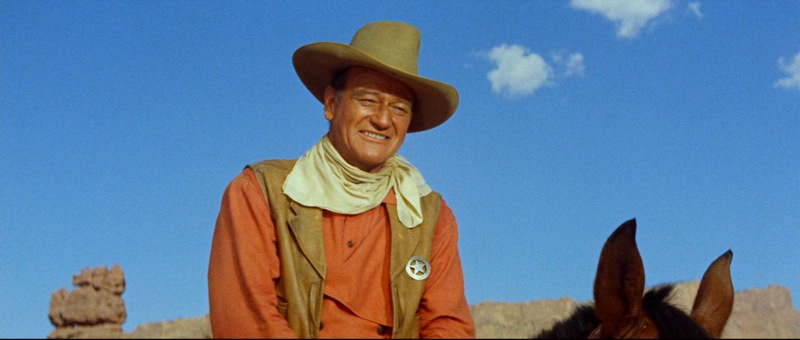
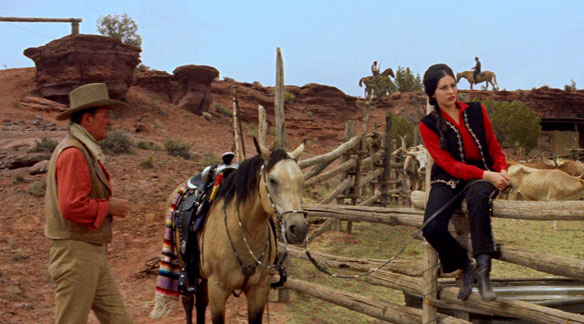
John Wayne plays 'Big' Jake Cutter, a seasoned Texas Rangers captain, searching for an army of desperadoes in "Casablanca" director Michael Curtiz's "The Comancheros" (**** OUT OF ****) who are selling rifles, ammunition, and whiskey to Indians that have turned the border into a battlefield. This top-notch frontier fracas co-starred Stuart Whitman and Ian Balin along with a veteran cast of supporting players, including Bruce Cabot, Jack Elam, Michael Ansara, Edgar Buchanan, Henry Daniell, Lee Marvin, Richard Devon, and Nehemiah Persoff. "The Comancheros" turned out to be Curtiz's final film, and the legendary Hungarian helmer, who had been celebrated for his malapropisms, was ill throughout most of the lensing. Nevertheless, Wayne made sure that he received sole directorial credit.If you look carefully, you'll spot at least one Curtiz shot that only he could have envisaged. When Wayne makes his entrance, his shadow is reflected off the wall before we see him walk into the shot. William H. Clothier's sprawling widescreen Cinemascope photography, "Angel and the Badman" scribe James Edward Grant's memorable dialogue, and "Ten Commandants" composer Elmer Bernstein's epic orchestral score all to bolster this exciting action-packed horse opera above the usual run-of-the-mill oater.


The action unfolds 1843 in Louisiana when Paul Regret (Stuart Whitman) guns down an opponent in a duel. Regret observes ruefully that had his opponent not moved, he would have only have winged him. Since the dead man was Judge Bouvier's son, one of the dueling referees assures Regret that he will swing from the gallows after he surrenders to the law. Regret clears out of Louisiana and boards a riverboat. A beautiful young woman, Pilar Graile (Ian Balin of "Charro"), pursues Regret. They dance and retire to her bedroom. “What passes between us tonight has nothing to do with love,” Pilar clarifies their status.  An incredulous Regret wonders, “You don’t believe there’s such a thing as love?”  Pilar cherishes no illusions about love.  “I believe this very night all over the world, men and women are saying to each other, “I love you,” when what theyreally mean is, “I desire you.”  The riverboat docks in Galveston, and Regret awakens to find himself handcuffed and under arrest. Captain Jake Cutter points out that the state of Louisiana wants to extradite Regret, and they embark on their on-again, off-again journey. They ride across a ranch where hostile Indians have massacred all the occupants. Cutter and Regret bury the family, and Cutter turns his back for a moment on Regret. The gentlemen who wears $300 dollar suit clobbers Cutter with a spade and then hightails it.


Cutter recovers, suffers derision when he shows up at the Rangers' Headquarters riding a mule. He learns Major Henry (Bruce Cabot of "King Kong") has an assignment for him. The Rangers have nabbed a gun runner recently released from Yuma Territorial Prison, McBain (Guinn 'Big Boy' Williams of "Santa Fe Trail'), who has a rendezvous with a member of the Comancheros in the town of Sweetwater. “You want me to take his place, take those guns to Sweetwater and meet the contact men,” Cutter figures out what Henry wants him to do.  Cutter goes undercover as McBain and encounters a sinister, uncouth gunman, Tully Crow (Lee Marvin of "Attack"), and transacts a deal for a six crates of repeating rifle. Crow appears as menacing as he acts. Scar tissue covers part of his skull where the Indians scalped him. Crow like doesn't Cutter.  Later in the evening, Crow has a falling out with Cutter because the former believes that the latter has cheated him at poker. One of the participants is Paul Regret, but Regret keeps his mouth shut about Cutter's real occupation. When Cutter tries to leave the table, Crow pulls his six-gun, and Cutter shoots him stone dead. No sooner has Cutter gunned down Crow than he re-arrests Regret.


On the way to headquarters, Cutter runs into Major Henry and the Rangers at the Schofield grain ranch of his good friend, Pa (Bob Steele of "The Big Sleep"), who is preparing to move his family into town until the Indians abandon the warpath. Cutter has Regret cuffed to a blacksmith's anvil. After Major Henry and his platoon of Rangers ride out, the Indians attack. During the battle, Regret catches a horse and rides away. Texas Rangers' newbie Tobe (Patrick Wayne of "The Searchers") points out to Jake that his prisoner has gotten away again, but both men react with surprise when Regret returns with Major Henry and the Texas Rangers. After saving the Schofields from rampaging Indians, Cutter and Major Henry are reluctant it to expedite the well-dressed young gentleman to Louisiana lawmen. Instead, Cutter and Henry persuade Circuit Court Judge Thaddeus Jackson Breen (Edgar Buchanan of "Texas") to sign and swear to a statement that Regret is a Texas Ranger and cannot be arrested. Jake and Regret set out to find the men who supply the guns to a secret society of smugglers. Not long after they venture off into the arid, mountain-ribbed wilderness does a band of Indians Chief Iron Shirt (George J. Lewis of "Saskatchewan") over take them and escort them to the hidden camp of the gunrunners. Graile (Nehemiah Persoff of "The Badlanders") has Cutter and Regret tied up and left to bake in the blistering sun when her headstrong daughter demands that Cutter and hebe released. Secretly, Pilar knows about Cutter being a Texas Ranger, but she doesn't confide this privileged information to anybody. Initially, Graile wants to hang Cutter and Regret because anybody who enters their 'secret society must die before they can leave. Pilar intervenes on behalf of the good guys and warns her father that his evil ways aren't going to last much longer.


In the last ten minutes of "The Comancheros," when everything looks bleak for our heroes, Major Henry and his troop of Texas Rangers thunder to the rescue and scatter the few remaining Indians. "The Comancheros" ranks as one of John Wayne's best westerns with an inspired Elmer Bernstein score that captures the outdoors majesty of the mountainous scenery. Wayne's running gag where he refers to Regret as 'Mon-soor' is hilarious. There is more than enough gunplay for dyed-in-the-leather western fans. Action director Cliff Lyons stages several vast battles between men on horseback. "The Comancheros" qualifies as one of Wayne's best straightforward western as well as a must-see John Wayne aficionados.
 

Sunday, October 6, 2013

FILM REVIEW OF ''RUSH'' (2013)


In “Rush,” Oscar-winning helmer Ron Howard returns to the subject matter that he cut his teeth on as a film director: fast cars.  In 1977, Howard made his directorial debut with the hilarious manhunt comedy “Grand Thief Auto” (1977) for executive producer Roger Corman about characters careening around in cars.  Like “Grand Theft Auto,” “Rush” focuses on fast cars.  Unlike “Grand Theft Auto,” where amateurs did the driving, skilled professionals are behind the wheels in “Rush.”  Not only do they travel at higher speeds, but they also tread more treacherous roads.  This polished but predictable saga has to do with the historic rivalry between Formula One British speedster James Hunt and Austrian automotive genius Niki Lauda.  “Rush” (*** OUT OF ****) spends most of its leisurely 123 minutes on its protagonists and their clashes rather than the experience of hurling along European thoroughfares at homicidal speeds in the equivalent of bobsleds on wheels with rocket fuel .  Aussie-born Chris Hemsworth of “Thor” has been cast appropriately enough as Hunt, while Spanish actor Daniel Brühl impersonates Niki Lauda.  Historically, Lauda and Hunt jostled each other for the top position during the 1976 Grand Prix racing season.  Ron Howard keeps the soap opera scenes with the love interests of both racers to a minimum so as to maintain momentum over the long haul.  Consequently, Olivia Wilde and Alexandra Maria Lara look dazzling but have little to say.  Ultimately, these two competitors would come to realize that their ruthless rivalry enhanced their racetrack performance.  An enduring, universal, life-truth lurks beneath all the scenic cities, challenging racetracks, and the charismatic performers in “Rush.”  In the self-help handbook for mercenaries and rogues in general, “The Seventy Maxims of Maximally Effective Mercenaries” observes: “The world is richer when you turn enemies into friends, but that's not the same as you being richer.”

“Rush” unfolds in 1976 as our protagonists are poised to race at the Nurburgring track in Germany.  No sooner has Howard and Morgan established this momentous setting than they flashback to show how Hunt and Lauda got their respective starts in Formula 3 racing.  Hunt’s father plead with his son to become a physician.  Lauda’s father had planned to take his son into the family business.  Naturally, neither patriarch funds their sons’ racetrack fantasies, and our heroes go out and make things happen for themselves.  Hunt finds a wealthy sponsor enamored of racing to put him behind the wheel, while Lauda buys his way onto the Ferrari team.  Hunt treats Lauda with utter contempt and refers to him as a rat.  Lauda points out rats possess a highly developed instinct for survival.  Howard cuts back and forth between these two and creates some palatable suspense as they chase each other throughout the Grand Prix.  Mind you, the suspense doesn’t so much lie in the actual driving sequences, where speeds of 170 mph is typical, but in their face-to-face confrontations.  Lauda doesn’t race to defy death as Hunt does.  Hunt claims woman are attracted to him because he lays his life on the line in every race.  On the other hand, Lauda races to survive rather than die.  He has a twenty per cent rule that governs his decision when to race.  Lauda refuses to participate if the chances are greater than twenty per cent that he may perish.  Hunt challenges Lauda at one point when the Austrian tries to convince his competitors to cancel the rain-swept Nurburgring track.  Hunt humiliates Lauda for urging them to cancel the race.  Eventually, Lauda allows himself to be brow-beaten into the race with horrendous results.  The courage Lauda musters to recover so swiftly from a nearly fatal accident is inspirational and a testament to his resilience.  Lauda’s car crashes during the race, and he is badly burnt.  Painful skin grafts and having his lungs vacuumed out ensue, and Lauda watches in horror from his hospital bed as Hunt makes up for lost time.  Hunt’s quick string of victories brings him close to surpassing Lauda.  The rivalry really kicks in at this point, and life becomes stranger than fiction. 

Hemsworth and Brühl resemble their real-life counterparts.  If you delay your departure when the end credits roll, you’ll see the actual Hunt and Lauda.  Howard slips under their collective skins with “Frost/Nixon” scenarist Peter Morgan to explore what drove them.  Each racer emerges as complex and three-dimensional.  Basically, they are iconoclasts who became heroic legends.  Wisely, Howard and Morgan never make either one appear more sympathetic than the other.  Most Hollywood movies divide and conquer when it comes to competitors.  “Warrior” (2011) pitted brother against brother, and one triumphed over the other simply because he generated greater sympathy.  Hemsworth has the more ostentatious role.  Essentially, Hunt was either behind the wheel or in a lady’s boudoir.  Comparably, Brühl creates a strong impression as Niki Lauda.  The ascetic Austrian driver shunned all forms of hedonism.  He constituted the polar opposite of the glib, fun-loving, skirt-chasing Hunt.  Lauda was a perfectionist who constantly devised ways to lighten the weight and improve the performance of his cars.  Unlike the milestone racing movies “Grand Prix” and “Le Mans,” “Rush doesn’t deal with a single race.  Instead, Howard provides a tour of the European championship racing circuit.  Anthony Dod Mantle's cinematography gives us some vivid glimpses of Formula One racing from behind the steering wheel.   Although we come to understand how dangerous driving a Formula One car can be, we are rarely given stretches where the drivers scramble to get beyond each other.  “Rush” contains the equivalent of a ‘greatest hits’ montage of the various races.  Spectators who don’t follow Formula One specifically or car racing in general may not know that these drivers harness themselves into the equivalent of rocket-sleds with jet fuel and roar through the countryside.  While speed denotes the winner, skill keeps the driver on the course. Strong characterization, some narrative surprises, and scenic locales distinguish this interesting but sedate racing epic.

Thursday, October 3, 2013

FILM REVIEW OF ''I, ROBOT" (2004)


Rule # 1: Hollywood shouldn't make some books into movies.

Take, for example, science fiction author Isaac Asimov's "I, Robot."  This is a classic collection of cautionary short stories about the unforeseen complications in a robot's logic as it struggles to obey the three laws of robotics. Even when the robots appeared insane, Asimov was careful to show that by the lights of the robot's "positronic brains," they are behaving logically.

Rule # 2: Movies with multiple stories don't make millions.

Too many characters.  Too many ideas.  Too much originality.  Too much segmentation.  Consequently, when Hollywood lays its hands on literary legends like Asimov, they dumb down his work.  In the Will Smith mystery-thriller "I, Robot," Australian director Alex Proyas of "The Crow," Oscar-winning "Beautiful Mind" scenarist Akiva Goldsman and "Final Fantasy" scribe Jeff Vintar have retained the three laws of robotics.  Unfortunately, they have turned an otherwise literary classic into a formulaic, action-paced, paint-by-the-numbers, potboiler about an heroic, wise-cracking Chicago cop in the year 2035 who abhors robots. 

"I, Robot" (** OUT OF ****) opens with the three laws of robots.  1. A robot may not injure a human being or, through inaction, allow a human being to come to harm.  2. A robot must obey orders given it by human beings, except where such orders would conflict with the First Law.  3. A robot must protect its own existence as long as such protection does not conflict with the First or Second Law.

An alarm clock awakens divorced homicide detective Del Spooner (Will Smith of "Bad Boys") to another wonderful day. After a shower scene designed to display Smith's buff body, especially his curiously scarred "Rambo" pectorals, the filmmakers have our swaggering stereotypical lone wolf hero don his ghetto street clothes, unpack a vintage pair of 2004 Converse All-Star sneakers, and cruise off to his first crime scene of the day in his tricked out Audi.  The headquarters of the U.S. Robotics Corporation--a Microsoft-type company—towers against the skyline of Chicago.  U.S. Robotics plans to put a robot in every home.  The company boasts that the ratio will be one robot per five humans.  An unexpected tragedy occurs to threaten this massive robotic roll-out. Apparently, U.S.R.'s chief robot designer, Dr. Alfred Lanning (James Cromwell of "Babe"), has committed suicide.  The visionary scientist hurled himself through his office window and fell hundreds of feet to the lobby.  Spooner learns that Lanning had requested him specifically, so Del could listen to a message Lanning recorded for him on a preprogrammed hologram. Initially, Lanning's cryptic remarks mystify Del.

When he visits Lanning's office, he discovers that the good doctor couldn't have jumped through the window. Del tries to break the window next to the window that Lanning shattered.  He barely makes a dent when he smashes a chair against it.  U.S. Robotics scientist, Dr. Susan Calvin (Bridget Moynahan of “Coyote Ugly) is assigned to escort Spooner around the premises.  No sooner does Del realize that the killer may still be in the room than the killer surprises him and escapes.

Eventually, Del captures the robot and interrogates him.  Before he can get far, U.S. Robotics' CEO Lawrence Robertson (Bruce Greenwood of "Thirteen Days") storms into the police station.  He demands the return of his property.  Robertson reminds Del that the authorities cannot charge robots with murder.  Not only have robots never posed a threat to humans, but also only humans can be charged with homicide.  Inevitably, Del's world-weary boss, Lieutenant John Bergin (Chi McBride of "Gone In 60 Seconds"), chews him out for crying 'robot' every time something happens to him. Del remains far from convinced, however, about the innocence of robots.  He bears a grudge against them.  During an accident, a truck rammed both his vehicle and another car with a 12-year old girl inside.  Both cars sank into a river.  A passing robot witnessed the accident and dived in to rescue Del. Our protagonist told the robot to save the little girl instead, so he feels guilty about her death and despises robots.

Gee, doesn't this sound familiar? Like a movie from the 1980s? A rebellious but maimed cop battling a corporation with a dark secret.  Hey, didn't Tom Selleck do something like that in the 1984 epic "Runaway?" Or what about 1982's "Blade Runner?" Or "Westworld," where the robots cannot kill humans either.  Del spends the rest of "I, Robot's" predictable 115 minutes trying to prove to everybody that robots are dangerous. He worries especially because his mother (Adrian Ricard of "Bulworth") has won a robot in lottery. Meanwhile, despite all this horrible publicity, Robertson plans to market a new line of robots, and he wants Del off his back permanently. Of course, hard-headed as Del is, he doesn't take no for an answer, even when Bergin takes his badge and suspends him from the force.

Basically, aside from his charismatic performance, Will Smith's futuristic detective doesn't appear too far removed from his wealthy playboy cop in the "Bad Boys" franchise.  Unfortunately, he doesn't have a sidekick like Martin Lawrence to take up the slack in this occasionally exciting but largely superficial sci-fi saga. Not even his quips seem catchy.  Smith spouts lines like: "Does believing you're the last sane man on the planet make you crazy? 'Cause if that's the case, maybe I am.”  Probably his best line, and that isn't saying much, is: "Somehow 'I told you so' just doesn't quite say it." "I, Robot" looks cool, if you don't think about some of the gaping plot holes. Wait until you see what Del's secret weapon is. Talk about a cop-out!  If you think about it, Del qualifies as a cyborg.  The villainous robots aren’t intimidating.   Meanwhile, two action sequences, a careening vehicular chase scene in a freeway tunnel and a demolition robot that destroys a mansion with Del in it, stand out from everything else thing.  Despite its plea for tolerance, which was handled better in "Bicentennial Man," "I, Robot" breaks no new ground in the robot genre.