Translate

Thursday, December 27, 2012

FILM REVIEW OF "MUTINY ON THE BOUNTY" (1935)


Director Frank Lloyd’s “Mutiny on the Bounty” deservedly received the 1936 Best Picture Oscar as well as Oscar nominations for Best Actor, Best Screenplay, Best Editing, Best Directing, and Best Original Musical Score.  This entertaining 140-minute version of the vintage Charles Nordoff and James Norman Hall novel, published in 1932, surpasses the costly remake that M-G-M launched with Marlon Brando in 1962 that clocked in at a grueling 178 minutes.  Indeed, everything about the 1935 “Mutiny on the Bounty” is superlative. Clark Gable reluctantly shaved off his characteristic mustache to play Fletcher Christian because British officers were prohibited from wearing upper lip facial hair.  Charles Laughton played the villainous Lieutenant William Bligh with immense relish, and Franchot Tone was cast as Midshipman Roger Byram on his first sea voyage.  Interestingly, these three thespians each received an Academy Award Nomination for Best Actor.  As good as Gable and Tone are as the protagonists, it is frog-faced Laughton with his imperious bearing that sticks in the memory long after the film has faded.  You’ll want to see Laughton swing from the yard arm for his performance because he is such a despicable villain.  Happily, Laughton radiates glimpses of humanity thanks to the skillful writing of scribes such as Talbot Jennings, Jules Furthman, and Carey Wilson.


His Majesty’s Ship Bounty disembarks from Portsmouth Harbor in 1787 and charts a course to Tahiti to gather breadfruit plants.  The plan was to grow breadfruit as an inexpensive food item to feed slaves in Jamaica.  As the action unfolds, Fletcher Christian and a press gang prowl the local taverns for seamen to shanghai for service. Meanwhile, young Roger Byram is itching to embark on his maiden voyage to Tahiti.  Byram has been assigned to compile a Tahitian dictionary.  Lieutenant Bligh has requested Fletcher Christian because he prefers to surround himself with gentlemen.  Bligh, it seems, is an admitted self-made man.  This marks their third voyage together, and Christian doesn’t like the captain.  The friction between these two eventually generates sparks that sets them at loggerheads.  In real-life, Gable abhorred Laughton because the latter was a notorious homosexual.  Some sources claim that M-G-M studio heads cast them opposite each other because they felt the homophobic Gable would give a stronger performance.  Laughton milks the insolent Bligh for everything he can.  Anyway, the question of stolen cheese and later purloined cocoanuts exacerbates their enmity for each other to the point that Christian is prepared to usurp Bligh as captain.  No sooner have they left Portsmouth than the energetic Byram gets into scuffle with a fellow midshipman and Bligh sends Byram aloft to weather a gale.


When they drop anchor in Tahiti, Bligh has had enough of Christian and openly goads the man.  Later, during the return voyage, Bligh cuts the water ration so that none of the breadfruit plants will perish.  Bligh already has too many plants on board and his decision to deprive his sailors of water backfires.  The inhumane treatment of prisoners aboard the Bounty is the last straw for Fletcher Christian and he leads a mutiny.  Roger Byram and another midshipman try to thwart Christian, but the mutineers overpower them.  Christian sets Bligh, several officers, and crew men in a launch.  Incredibly, Bligh manages to sail the open boat across 3-thousand miles or more of sea to a port.  Bligh returns to English and takes the Pandora back to search for Christian.  By now, Byram and Christian have resumed their friendship.  Meantime, Christian has married a native girl and they have a son.  When Bligh returns, the naïve Byram rushes out to meet the Pandora, and the vengeful Bligh puts him in chains.  Christian and the mutineers flee from Tahiti on the Bounty and eventually crash the ship on the reef of Pitcairn Island where they make a new life for themselves.  Bligh returns to English after he runs HMS Pandora on a reef.  Most of the mutineers are condemned to swing, including Ellison (Eddie Quillan of “The Grapes of Wrath”), who was kidnapped to serve as a sailor on the Bounty.  Through the intervention of a friend and a high-ranking Admiral, Byram wins a pardon and is allowed to continue as an officer in the British Navy.


Of course, Clark Gable was no Englishman, but he gives better performance than Marlon Brando’s hilariously awful performance as Fletcher Christian.  Laughton steals the show as the repugnant Bligh.  The only thing that the 1962 version has over this epic is its Technicolor cinematography and a replica of the actual Bounty.  Director Frank Lloyd depicts the challenging voyage that Bligh makes in an open boat.  This episode wasn’t emphasized in the Brando version.  Furthermore, Christian urges his men, against their wishes, to burn the Bounty once they have run it aground.  In the Brando version, Christian refuses to burn the vessel because he plans to return to England and confront the Admiralty with the facts of the matter.  Instead, Christian’s mutineers set the ship ablaze and Christian tries to save the ship.  In his efforts to preserve the Bounty, Christian is trapped below deck and burned so badly that he dies on the beach after his friends try to save him. Bottom line: watch this version of “Mutiny on the Bounty” rather than the 1962 version. Purists will want to watch the Mel Gibson & Anthony Hopkins rehash to see what actually happened.

FILM REVIEW OF ''JACK REACHER" (2012)


I enjoyed the new Tom Cruise thriller “Jack Reacher," and I'm not a big Tom Cruise fan.   Since I rarely have enough time to read the right stuff, I haven’t perused any of the seventeen Jack Reacher novels about a former U.S. Army investigator who roams the country like a lone wolf.  Sounds like Cruise is prospecting for another franchise to topline.  Award-winning, bestselling author Lee Child--who writes those novels--is an interesting fellow himself.  Actually, Jim Grant is his real name, and he was born in 1954. A former Granada Television producer, he hails from Great Britain, but has since moved to America.  He has acknowledged that Cruise looks nothing like his literary character.  Nevertheless, he has nothing but praise this Hollywood adaptation by writer & director Christopher McQuarrie.  Chris Hemsworth, Dwayne Johnson, and Liam Neeson might have been better as Child's hero.  Meantime, this intelligent but contrived murder/mystery couldn’t have been released at a more inopportune time.  It will be interesting to see how other major Hollywood blockbusters about gun-toting heroes fare in the wake of the Sandy Hook Elementary School massacre.  The worst thing you can say about “Jack Reacher” is that it is a gritty but formulaic police procedural with murky bad guys conducting calculated criminal acts of aggression.  No maniacs break into elementary schools and murder innocent lambs without a qualm. As exemplary as "Jack Reacher" is, this Paramount Pictures release doesn't eclipse better Cruises epics, such as "Collateral," "Top Gun," "Mission Impossible 2," "Mission Impossible: Ghost Protocol," and "The Last Samurai." 


Basically, “Jack Reacher” (*** OUT OF ****) qualifies as an energetic, above-average, but predictable murder mystery.  Tom Cruise and attractive leading lady Rosamund Pike kindle little chemistry.  At an imposing 130 minutes, “Jack Reacher” couldn’t have made time for a romance between the itinerant hero and the district attorney’s virtuous daughter.  Several scenes are questionable and some things just don’t seem right.  Happily, “Jack Reacher” boasts more hits than misses.  A restrained Cruise appears to be channeling Paul Newman with his laconic performance, but “Jack Reacher” isn’t a role that fits him like a glove.  Basically, this Spartan, low-key thriller could have used a rewrite or two to sharpen it.  Moreover, if screen veteran Robert Duvall—long past his prime—hadn’t shown up for the bullet-blasting finale, “Jack Reacher” wouldn’t be worth jack.  Comparisons between the film and a synopsis of the novel indicate writer & director Christopher McQuarrie hasn’t deviated drastically from the source material.  Consequently, “Jack Reacher” amounts to an origins epic.  Cruise plays an enigmatic character, not unlike the Jim Caviezel character John Reese in CBS-TV series “Person of Interest.”  Resourceful guys like these two live off the grid.  The chief difference is Reacher shuns the kind of high tech support Reese has in the form of computer genius Harold Finch. 


When a deadly sniper guns down several people in broad daylight without warning in Pittsburgh, the local authorities get a break and capture the unsuspecting assassin.  The local District Attorney tries to bully a confession out of their suspect, ex-Army sniper James Barr (Joseph Sikora of “Safe”), but Barr refuses to cooperate.  Instead, he asks them to contact Jack Reacher.  Before his case comes up for trial, Barr is badly beaten up in prison and his life hangs in the balance.  Out of nowhere, Jack Reacher materializes when everybody least expects him. Moments as coincidental as these made me roll my eyes.  Reacher discusses the case with the D.A., and later with Barr’s attorney, Helen Rodin (Rosamund Pike of “Die Another Day”), who has taken the case against her father’s stern advice.  Repeatedly, Reacher assures both Helen and the D.A. that he is not a defense witness.  He explains to Helen that Barr left the Army after going on a shooting spree when he didn’t have a chance to rack up any kills in his overseas combat zone.  The more that Reacher investigates the shootings, the more he comes to believe that Barr is a patsy.  Nothing that the real shooter did corresponds with anything that Barr would have done as a trained sniper.  Before it is over with, our hero reexamines the casualties of the massacre and finds the answer to a cover-up that looks like it goes into the highest levels of law enforcement in Pittsburgh, i.e., the Office of the District Attorney. 


Make no mistake, “Jack Reacher” isn’t a high-octane actioneer, but it is both believable and reasonably complex.  McQuarrie keeps our trim, clean-cut hero jumping through flaming hoops throughout most of the action.  An exciting, urban car chase and a no-nonsense street fight enliven the action when a variety of characters aren’t conferring over the business at hand.  Among film geeks, Christopher McQuarrie is known as the guy who wrote the classic thriller “The Usual Suspects.”  Not only did McQuarrie not adapt Lee Child’s crime thriller about a mysterious “Lone Ranger” type who spurns all twenty-first century conveniences to solve crime, but he also directed it.  McQuarrie proves once again that he is a better writer than a director.  Some scenes play better than others.  The supporting cast, including Richard Jenkins as the District Attorney and David Oyelowo as a Pittsburgh detective, are good.  “Jack Reacher” is worth seeing at least once in a movie theater.


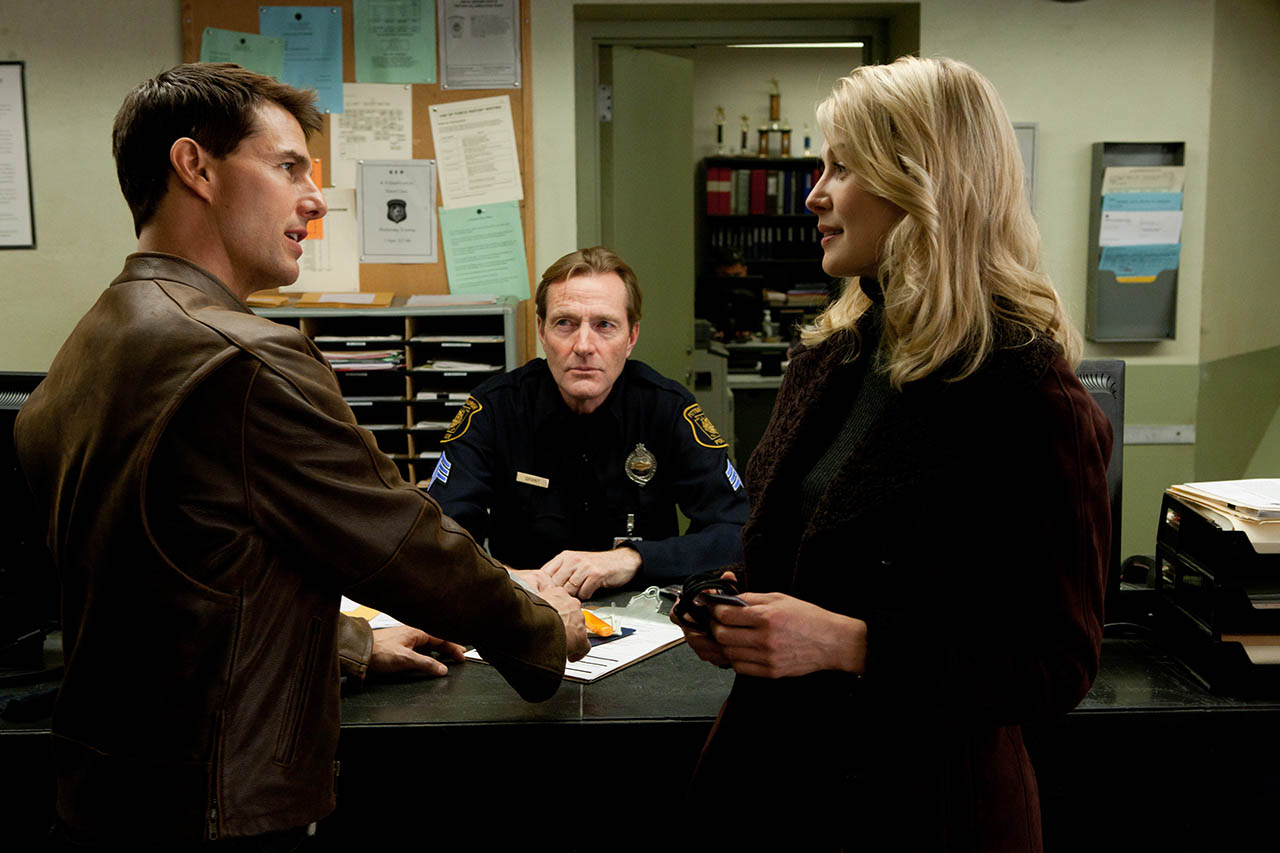
Tom Cruise discusses the case with Rosamund Pike while Lee Child, making a cameo as a Pittsburgh policeman, watches them.

Monday, December 24, 2012

FILM REVIEW OF ''DRUMS IN THE DEEP SOUTH" (1951)


Although the South lost the war, the Confederates win the battle in “Drums in the Deep South!”  Oscar-winning art designer William Cameron Menzies helmed this Civil War yarn based on a screenplay by “Whistle Stop” scribe Philip Yordan and Sidney Harmon from a story by Hollister Noble.  Later, Yordan collaborated with “Talk of the Town” writer Harmon on "Battle of the Bulge," but Harmon was now a producer.  One of the best B-movie directors in the business, B. Reeves Eason of “The Phantom Empire” handled the second-unit action.  Menzies treats us to a glimpse or two of slaves in the fields and those who worked in the houses.  As many commentators have written, movies about the Civil War are few in number and the good ones even fewer.  Guy Wilkerson has a bit part as a Confederate sentry, while Denver Pyle is cast as an obnoxious Union guard.


The explosive action unfolds in Georgia in 1861.  The first scene occurs at an antebellum mansion.  Colonel Braxton Summers (Craig Stevens of “Peter Gunn”) has returned from Atlanta.  According to Summers, the South has been planting too much cotton.  Uncle Albert cannot believe Braxton’s news.  “Cotton is king.  The whole south is built on it.  And the world is knocking down our doors for more.”  Braxton tells his beautiful wife, Kathy (Barbara Payton), Atlanta is a powder keg.  Furthermore, the militia has been called up.  He adds all West Pointers are being called back for duty.  Like Uncle Albert, Kathy believes the storm over succession will abate. Brax lacks her confidence.  Meantime, he shows Kathy a black scarf he purchased for her.  She isn’t overjoyed when he tells her about encountering two of his former roommates from West Point.  The soap opera component of “Drums” rears its amorous head.  Kathy refuses to see Clay Clayburn (James Craig of “Flying G-Men”) who has never stopped loving her.  She assures Brax anything she felt for Clay has passed.  Brax tells Kathy that Clay has changed.  As it turns out, Clay and Will Deming (Guy Madison of "Seven Winchesters for a Massacre"), lie about their thriving shipping business.  They ship cotton from New Orleans to Liverpool and then take wool to Boston.  At dinner, Brax reveals he is experimenting with a new cotton seed for export.  After Brax and Will excuse themselves to discuss his experiment, Clay confronts Kathy.  He admits he is not a ship captain but a common seaman.  Moreover, he has neither repaid his father’s debts nor bought back the family plantation.  Outside the mansion roars a storm that possesses all the fury of Armageddon.  Later, Albert forsakes his chair and proclaims amid thunder and lightning that the South has bombarded Fort Sumter.  


Menzies stages a timeline as the years march past to an artillery barrage.  By 1864, the Union Army has compelled the Confederacy to retreat.  General Sherman's Army is threatening Atlanta.  General Joseph Johnston (Lewis Martin of “Operation Pacific”) selects Major Clayburn for the mission.  Johnston orders Clayburn to sneak twenty men with four cannon through occupied lines and position them atop Devil's Mountain to blunt the Federal advance.  Johnston’s closest officers have doubts about Clayburn’s qualifications.  “Clayburn is reckless beyond all risk.  He exposes himself to enemy fire on all occasions.  How he has come through this war and still be alive . . ., one officer cannot understand Clayburn’s incredible luck.  Another officer observes, “The man seems to be seeking death.”  “A good soldier,” Johnston points out, “dies only once.  And death is someone he knows.” 


When Clayburn enters the headquarters tent, Johnston informs him he has “a difficult job for him.”  Johnston explains, “Sherman’s whole army poured out of Chattanooga three weeks ago.  They are moving straight along this single railroad and heading for Atlanta.  If he takes Atlanta, we’re doomed.  Our only chance is to draw him deep in Georgia, cut off his supply lines, and destroy his army bit by bit.  The bulk of his supplies are pouring through this same railroad and as fast as we destroy it, his men rebuild it.  What we’ve got to do is find a weak link in this railroad so we can keep destroying it faster than Sherman’s men can repair it.”

Clayburn is familiar with the terrain since he grew up there.  Johnston indicates Devil’s Mountain dominates the railway where it swings through Snake Gap.  The General believes this constitutes “the weak link in Sherman’s supply line.”  Johnston wants Clayburn to blast the railroad until the Confederate Army can regroup and counter-attack.  “General, Devil’s Mountain is a sheer cliff,” Clayburn warns. “I might be able to get twenty men up there, but four cannon that’s another question.”  Johnston relieves him when he tells him about a scout who can guide them from inside the cave to the top.  “General, if I can get the cannon on top of Devil’s Mountain, I could fight there until doomsday,” Clayburn vows with a gleam in his eyes.  “You may have to, Major,” they warn him.  No sooner have they embarked on their mission than things turn sour.  When our protagonists rendezvous with their guide, they find him swinging from a noose.  

Menzies never shows the Confederates whistling Dixie as they trundle their cannons across rugged terrain through enemy country to Devils’ Mountain.  Once they get inside the mountain, it’s quite a chore getting the artillery up to the top.  Menzies does a competent job of driving the action along without sacrificing g momentum.  It takes him approximately 26 minutes to get the Southerners to their objective.  Devils Mountain resembles the “Close Encounters of a Third Kind” mountain.  This is a rare Civil War epic with an interesting premise that anticipates the blockbuster 1961 World War II mission movie "The Guns of Navarone."  The music is excellent! Composer Dimitri Tiomkin provides an atmospheric orchestral soundtrack.  “Drums in the Deep South” is an entertaining epic.