Translate

Wednesday, September 4, 2013

FILM REVIEW OF ''LAST MAN STANDING" (1996)


International filmmakers have exerted great influence on American movies.  When Hollywood runs out of fresh ideas, the major studios often turn to foreign films for inspiration.  Sometimes, a moviemaker appears who can adapt a foreign film in such a revolutionary way that audiences sits up and pay attention.  Writer & director Walter Hill manages this ambitious feat in his cinematic version of the 1961 Japanese samurai epic “Yojimbo” by the brilliant director Akira Kurosawa.  Incidentally, “Yojimbo” translated means “bodyguard.” In the 1950s and 1960s, Kurosawa emerges as one of the few Asian filmmakers who commanded the respect of American audiences.  His film grew popular in the West.  Moreover, Kurosawa translated profitably in western s.  His films have served as the basis for John Sturges’ 1960 classic “The Magnificent Seven,” Sergio Leone’s landmark Spaghetti western “A Fistful of Dollars” (1964), and now Walter Hill’s “Last Man Standing.”  Hill recycles the venerable Kurosawa tale as a Prohibition Era gangster saga, casting Bruce Willis as a tight-lipped soldier of fortune with two guns and an attitude.  The story contains all the subtlety of a hail of lead, and “Last Man Standing” erupts with the fury of an artillery barrage.

The remote setting of Jericho, Texas, exists in a moral vacuum.  The gangsters have scared away all the good people and paid for the law as they have bought most of the women.  Women decorate the periphery of “Last Man Standing’ in minor roles as hostages, whores, and mistresses. These unhappy females are trapped in Jericho as male playthings and the consequences of defiance carry a high price as one girl learns.  When John Smith (Bruce Willis of “Die Hard”) wheels his Ford into the dusty, rundown town of Jericho, he is searching for a quiet place to lay low before he vanishes into Mexico.  What he encounters are two greedy Chicago bootlegging clans competing for supremacy over the illegal whiskey trade. Like Clint Eastwood in “A Fistful of Dollars,” Smith smells money galore in “Last Man Standing” so he hires out his guns to the highest bidders.

Smith plays the Italians and the Irish skillfully against each other in a suspenseful game of cat and mouse.  When he helps a young woman held hostage by the Irish, Smith finally pays for his interference.  The Irish gang, headed by Doyle (Daniel Patrick Kelly), captures and stomps our protagonist until he resembles a bruised tomato. Somehow, Smith endures this horrible beating and gets away.  Furiously, Doyle massacres the Italian leader, Strozzi (Ned Eisenberg), and his gang at a roadhouse where the Irish believe Smith has filed for protection.  Instead, Smith holes up out of town in a church to recover his strength.  Jericho’s corrupt sheriff (Bruce Dern of “The Cowboys”), decides to help Smith out by loaning him two guns. Smith takes the hardware and challenges the Irish to a Wild West showdown.  

As his own scenarist, director Walter Hill has kept most of the original story intact.  If you’re looking for comparisons, you might find it easier to correlate “Last Man Standing” with “A Fistful of Dollars” rather than “Yojimbo.”  As the writer, Hill fumbles in making the evil, Tommy-gun toting Hickey (Christopher Walken of “The Anderson Tapes”) a henchman rather than the boss, as the corresponding character was in “A Fistful of Dollars.”  He is the only match bullet-for-bullet with Smith. As Hickey, Christopher Walken adds another despicable villain to his cinematic gallery of rogues, playing second fiddle to Doyle.  Hill generates minor suspense when lesser characters refer to Hickey’s character and the hellishness that always follows in his wake.

“Last Man Standing” is a raw, hard-bitten, little, B-move shoot’em-up with A-class pretentions that pays homage to not only Kurosawa but also stylishly imitates the excessive violence from recent Hong Kong crime thrillers.  If you want to compare it to one of Bruce’s American thrillers, the Tony Scott directed bullet ballet “The Last Boy Scout” (1991) is the best example.  Hill the writer doesn’t waste time contriving an elaborate plot that hinges on small but crucial details.  When characters are not performing tasks on-screen, they are deployed off-screen in plot related activities.  This is one who where what the characters do off-screen is of integral importance to what others do on-screen.

cCompared with Clint Eastwood who played the Man with No Name in “A Fistful of Dollars,” Bruce Willis here is the Man With Anybody’s Name.  As he reveals to the Italians, he is simply John Smith from back East.  John Smith is a taciturn fellow.  He doesn’t make a big deal out of most things unless he finds his expertise challenged.  If you’re a Willis fan, “Last Man Standing” isn’t Bruce as usual.  He is neither “Die Hard” Detective John McClane nor is he David Addison from “Moonlighting.”  He is a man of few words and fewer wisecracks.  Smith is an unrepentant hardcase who admits as much without remorse during his opening narration.  Here Willis delineates the character of Smith more out of what is left unsaid.
The film amounts to a genre mash-up: a period crime drama crossed with a western.  In it, the Old West is a dying dream.  The New West, suggests Hill, is being taken over by business suits from back East with hardware.  Nevertheless, that Wild West justice might be out of sight but it’s not entirely out of mind.  Altogether, “Last Man Standing” qualifies as a loud, bloody shoot’em-up that shouldn’t disappoint action fans.

Monday, September 2, 2013

FILM REVIEW OF ''GETAWAY" (2013)

Everybody gets taken for a ride in “Dungeons & Dragons” director Courtney Solomon’s “Getaway” (** OUT OF ****), co-starring Ethan Hawke, Selena Gomez, and Jon Voight.  Spectacularly staged car chases and slam-bang stunts cannot compensate for the scarcity of suspense and dearth of characterization in this low-octane vehicular evasion thriller.  Undoubtedly, whether they would admit it or not, Solomon and freshman scribes Sean Finegan and Gregg Maxwell Parker drew inspiration for their cinematic demolition derby from cult 1970s era automotive epics such as “Vanishing Point” and “Gone in 60 Seconds” as well as the recent trilogy of “Transporter” films.  Other movies swirled into the soup for the derivative “Getaway” are abduction opuses like “The Chase,” “Taken 2” and “Ransom.”  The speeding cars in “Getaway” are more interesting than the shallow characters.  Oscar nominated lead Ethan Hawke spends most of his screen time ensconced behind the wheel of an armored, 2008, Ford Shelby GT500 Super Snake Mustang.  Eventually, Gomez joins Hawke, but these two conjure up nothing in the way of camaraderie.  Oscar winner Jon Voight appears primarily in dermatological close-ups of his mouth and eyes as an anonymous villain reminiscent of James Bond’s arch nemesis Ernst Stavro Blofeld.  Voight spends virtually all his time on the phone droning on interminably with an ersatz Teutonic accent.  Occasionally, actors are ridiculed for giving performances with all the spontaneity of a telephone conversation, but this is precisely what Voight does.  He gives our hero his marching orders.  None of these characters, however, possess a shred of sympathy.  The cast does little to enliven them with either traits or memorable lines of dialogue.  Meantime, Ryan Dufrene’s Cuisinart editing; the CGI-free car and motorcycle crashes, and an amoral ending which provides an excuse for a sequel make the implausible “Getaway” palatable.  Although it coined less than five million dollars at the box office during its opening weekend, “Getaway” could still break even.  Warner Brothers produced it for $18 million.  The southeastern European city of Sofia, Bulgaria, served as the setting, and the film producers got more bang for their budget because production costs are far less expensive. 

Essentially, “Getaway” amounts to little more than a tire-screeching Shelby Mustang advertisement.  Our protagonist, Brent Magna (a mustached Ethan Hawke of “Training Day”), is a former professional NASCAR driver who burned out on the circuit.  A gang of mysterious villains abduct Brent’s wife, Leanne (Rebecca Budig of “Batman Forever”), at Christmas and compel him to hijack a customized Mustang and then drive it wherever they say.  No, Brent doesn’t know these thugs, but he knows Leanne’s life hangs in the balance.  The entire film occurs at between dusk and dawn. At one point, the Voice (Jon Voight of “Heat”) orders Brent to careen through a crowded public skating rink.  Although our hero inflicts considerable damage to the premises, he doesn’t kill anybody like the homicidal Venice Beach maniac did not long ago.  Once he has trashed the area and stampeded the pedestrians, Brent receives orders to haul ass elsewhere.  Repeatedly, the Voice warns Brent if he doesn’t comply with his instructions that Leanne will die.  Along the way, our beleaguered protagonist encounters the Mustang’s owner, cherub-faced Selena Gomez, and this improbable pair collaborate to save Brent’s kidnapped wife.  The Gomez character doesn’t have name.  Officially, she is referred to during the end credits simply as ‘the Kid.’  She abhors the array of wireless, digital cameras that the villains have attached to her automobile, and her relationship with Brent gets off on the wrong foot.  The moment she jumps into the Shelby, the Kid brandishes a gun and tries to oust Brent from the vehicle.  The Voice knows everything that Brent and the Kid are doing because those cameras as well as a GPS keep tabs on them.  When our heroes aren’t trying to outwit the Voice, they have their hands full evading the local authorities.  Of course, Brent doesn’t have much trouble eluding those small Bulgarian police cars, but he faces greater challenges when the Voice dispatches cars and motorcycles driven by henchmen armed with bazookas and sub-machine guns.  The Voice plans to rob an investment bank where money is stashed in the form of computer files. 

Everything in “Getaway” has been meticulously scripted.  Brent serves as the hare who draws the hounds away from the Voice’s actual objective.  Later, we learn the Voice has admired Brent from afar and is giving the ex-NASCAR driver a chance to prove that he is still a top-notch driver.  Brent as well as the army of stunt car drivers displays some fearless, gear-grinding maneuvers.  The Kid isn’t just as kid.  She is a computer whiz with a tote bag of electronics gadgets, including a tablet.  She relies on her technical skills to thwart the constant surveillance that the cameras provide the Voice so he will always know their whereabouts.  As it turns out, the Kid’s father runs the bank where the millions that the Voice wants are stored.  “Getaway” is like a modular narrative.  Everything serves a purpose, but none of it is remotely credible.  Indeed, the filmmakers shun subtlety in favor of speed.  Ironically, despite all the mayhem both real and imagined, this 90-minute, PG-13-rated nonsense doesn’t have enough tread to be gripping.  Occasionally, something cool happens.  The henchmen at an intersection with a bazooka aimed at Brent get the surprise of the lives just as we do when the Voice pulls off his own amazing stunt. 

The cars and the stunt drivers qualify as the real stars of “Getaway.”  Presumably, Solomon and his 21 producers sought to make the stunts as genuine as possible because the script is a superficial, damsel-in-distress, crime thriller with one-dimensional characters.  The filmmakers smashed up 130 cars, and seven Shelby Mustangs were built specifically for the film.  Unfortunately, despite all the fascinating, behind-the-scenes, automotive trivia, “Getaway” runs out of gas long before its happy ending.  Stay away from “Getaway!”

Friday, August 2, 2013

FILM REVIEW OF ''THE WOLVERINE" (2013)

Buy The Wolverine on DVD or Blu-ray

Let me say up front without apology that “X-Men Origins: Wolverine” qualified as a fantastic piece of formulaic fodder.  Before I saw director James Mangold’s “The Wolverine,” I watched “X-Men Origins: Wolverine” again and wondered how anybody could top such a tour-de-force tale.  “X-Men Origins: Wolverine” boasted everything that a blockbuster movie requires: charismatic heroes, wicked villains both human and mutant, larger-than-life spectacle, tearful romance, treacherous betrayal, and histrionic revenge.  During its first weekend, this Marvel mutant masterpiece coined over $85 million.  Ultimately, it grossed $373 million globally.  Comparatively, “The Wolverine” raked in only $55 million during its first weekend.  Analysts had predicted $70 million.  Not surprisingly, “The Wolverine” (**1/2 OUT OF ****) isn’t half as entertaining as the incomparable “X-Men Origins: Wolverine.” Although James Mangold is a gifted director, “The Wolverine” ranks below his other epics.  He directed the brilliant Johnny Cash & June Carter biopic “I Walk the Line,” the complex Sylvester Stallone crime drama “Copland,” the gritty western remake “3:10 to Yuma” with Russell Crowe & Christian Bale, the aggressive Tom Cruise actioneer “Knight and Day,” and the critically acclaimed chick flick “Girl, Interrupted.”  Mangold isn’t a high-profile, Oscar winning, celebrity director whose name sells tickets like Alfred Hitchcock, Steven Spielberg, and James Cameron.  Capable and competent, Mangold has proven to be only as good as his material.  This above-average but uneven Twentieth Century Fox release suffers from undistinguished villains and a storyline that stalls out several times during its indulgent 129-minute running time.  Mangold excels when depicting the Wolverine’s woes.  Unfortunately, scenarists Mark Bomback of “Unstoppable” and Scott Frank of “Minority Report” have concocted a pedestrian yarn that doesn’t broaden our knowledge of the protagonist.    
The Silver Samurai and Hugh Jackman in The Wolverine (2013) Movie Image

Ostensibly, Bomback and Frank adapted Marvel’s limited-run “Wolverine” series written by Chris Claremont and illustrated by Frank Miller back in 1982.  Apparently, neither Bomback nor Frank fretted about fidelity to the source material.  They’ve altered several things for the worst, including Logan’s reason for visiting Japan.  Basically, “The Wolverine” is a sequel to “X-Men: The Last Stand,” not “X-Men Origins: Wolverine.”  The early part of the film differs from the limited series graphic novel.   First, Jean Grey (Famke Janssen of “GoldenEye”) invades Logan’s dreams.  (If you’re hoping Jean will play an integral role in “The Wolverine,” prepare to be disappointed.  She appears, vanishes, reappears, and then keeps on annoying Logan one time too often.  The “Wolverine” limited run series contained a reference to Jean Grey, but Scott ‘Cyclops’ Summers worried more about her than Logan.  Second, Wolverine is camping in the woods and grieving over Jean’s death when he encounters a huge grizzly bear.  Later, a hunter shoots this bear with a poisonous arrow but the bear doesn’t die.  In the comic, Wolverine plunges into the bear’s den to kill it after it has slain several people.  In “The Wolverine,” he finds the poor bear and puts it out of its misery before heading off to confront the hunter.  Third, unlike Bomback and Frank, Claremont and Miller didn’t knit World War II, Nagasaki, and Wolverine’s saving an enemy officer into their narrative.  
Hugh Jackman in The Wolverine (2013) Movie Image

“The Wolverine” unfolds on August 9, 1945, when the atomic bomb struck Nagasaki.  Across the bay from the city, the Japanese military maintain a prison camp.  The Wolverine, Logan (Hugh Jackman with his signature mutton chops), is sweating it out in solitary confinement when the atomic bomb falls.  (In “X-Men Origins: Wolverine,” Logan participated in the American Civil War, World War I, World War II in Europe, and The Vietnam War.  Evidently, our hero must have been re-deployed to the Pacific after he helped vanquish the Nazis in Europe.)  Anyhow, Logan saves Japanese prison camp officer, Yashida (Ken Yamamura), after his three superiors commit ritual suicide.  Miraculously, Yashida and Wolverine survive the historic blast.  The Wolverine looks like a scorched pepperoni pizza. Our hero’s regenerative powers, however, enable him to heal completely without a scratch.  Yashida escaped certain death through the Wolverine’s intervention.  The prison camp officer emerges with a facial scar as a testament to his presence at the blast.  
  Svetlana Khodchenkova in The Wolverine (2013) Movie Magazine Scan Image

In “The Wolverine,” the 68-year old Yashida refuses to succumb to death.  He has a doctor, Viper (Svetlana Khodchenkov), who keeps tabs on his health.  The affluent Yashida is the CEO of a lucrative, global, electronics empire.  He dispatches his daughter’s friend to find the Wolverine.  The agile, pink-haired, sword-wielding Yukio (Rila Fukushima) tracks him down to a bar in Canada as he is poised to eviscerate the bear hunter.  Yukio convinces Logan to fly with her to Japan to see Yashida.  Meantime, the comic took a different path.  After he deals with the hunter in the bar, Wolverine winged his way to Japan because his girlfriend Mariko had stopped talking to him.  When he arrived in the Land of the Rising Sun, Wolverine discovered that Mariko wanted nothing to do with him.  Mariko’s gangster father Lord Shingen has come back into her life.  Moreover, Shingen has forced her to marry another man so he can dominate the Japanese Underworld.  At this point, Wolverine found himself up to his ears in Yakuza.
Rila Fukushima in The Wolverine (2013) Movie Image

Hugh Jackman reprises his role as the tortured but sympathetic Logan for the sixth time.  The Wolverine is the only fully developed character in this mundane melodrama.  Meantime, the villainous Yashida emerges as a lackluster adversary who only wants to acquire Logan’s ability to withstand the effects of aging.  In the long run, the beautiful but bland Viper does little more than deceive Logan.  In the limited run series, all the X-Men showed up for our hero’s triumphant return.  Apart from one other character, Logan is the only mutant.  Mangold and company make their worse mistake when they pit Logan against well-armed humans who don’t have a chance in combat.  Mercifully, nothing is easy for our hero who comes full circle by fade-out.  The best scene occurs after the end credits of this half-baked hokum.  Despite its slick production values, the anti-climatic “Wolverine” comes up short as a seminal superhero saga.

Hugh Jackman in The Wolverine (2013) Movie Image

Wednesday, July 24, 2013

FILM REVIEW OF ''R.I.P.D.'' (2013)


R.I.P.D. (2013) Movie Poster


Actor Jeff Bridges chews the scenery ravenously in the supernatural action-comedy “R.I.P.D.” (**1/2 stars out of ****) where he camps it up as a posthumous Old West marshal.  “Red” director Robert Schwentke and “Clash of the Titans” scenarists Phil Hay and Matt Manfredi have adapted writer Peter M. Lenkov’s Bangsian fantasy that Dark Horse Comics published back in 1999. For the record, a Bangsian fantasy appropriates either a literary figure or a historical personage for a fable laid in the afterlife.  Like Lenkov’s graphic novel, Schwentke’s imaginative but formulaic melodrama emulates both “Ghostbusters” and “Men in Black.”  Ryan Reynolds of “Green Lantern” co-stars as Bridges’ straight-guy sidekick.  As Bridges’ co-star,  Reynolds takes his character a mite more seriously.  He plays a contemporary Boston policeman who perishes in the line of duty.  Meanwhile, charming Mary-Louise Parker of “Weeds” is cast as their supervisor in the Rest In Peace Department.  Despite its hopelessly derivative origins, “R.I.P.D.” qualifies as an above average epic.  Happily, “R.I.P.D.” isn’t a sequel.  This hybrid 'origins' thriller about the after-life often makes for murky melodrama, but the larger-than-life characters and the stalwart cast will keep you interested.  Impressive CGI visual effects, atmospheric cinematography, hilarious sight gags, and a lean and mean 96-minute running time constitute its best qualities.  The worst thing about this Universal Pictures’ comic book adaptation is that it doesn’t always provide enough details for many of its plot holes.  In other words, we learn little about the origins of the R.I.P.D. and its rules.  Nevertheless, the film adaptation is a vast improvement over Lenkov's graphic novel.

 Ryan Reynolds and Jeff Bridges in R.I.P.D. (2013) Movie Image


In “R.I.P.D.,” the dead struggle to evade eternal judgment and hole up indefinitely on Earth.  These amoral minions are designated as ‘deados,’ and they are dastardly.  Remember in the “Men in Black” movies how the bugs concealed themselves in animals and humans?  Just the opposite occurs here.  When the ‘deados’ are exposed, these apparently normal people swell up into misshapen Goliaths.  No, they aren’t as huge as the Marshmallow Man in director Ivan Reitman’s “Ghostbusters.”  Nevertheless, they can leap across vast spaces, scramble up the sides of skyscrapers like cockroaches, and raise a whole lot of Hell.  Unless lawmen like Roy Pulsipher (Bridges) and Nick Walker (Ryan Reynolds) expose these post-mortem madmen for the monsters that they are, the Earth will suffer.  According to their boss lady, Proctor (Mary-Louise Parker), the souls of the death continue to rot on Earth and create a stench that pollutes the environment.  Our heroes wield flashy, extra-large handguns with celestial white bullets like those in the “Underworld” movies.  Roy and Nick can shoot these ‘deados’ and permanently erase them.  Proctor recruited Roy and Nick after they died, and they fill the ranks of other legendary lawmen that prowl the Earth for these despicable ‘deados.’

Ryan Reynolds in R.I.P.D. (2013) Movie Image


Detective Sergeant Nick Walker is living ‘happily ever after’ with his pretty wife Julia (Stephanie Szostak of “Iron Man 3”) in Boston.  As the story unfolds, Julia awakens Nick and comments about an orange tree growing in their back yard.  What poor Julia doesn’t know is Nick and his shady partner Hayes (Kevin Bacon of “X-Men: First Class”) just made a drug bust and stumbled onto a cache of gold.  Rather than turning the precious ore over to the authorities, Hayes convinced Nick to split it with him.  Nick buries his gold in the hole that he carved out of his yard for the orange tree.  After Julia assures him that all she needs in life is his love, Nick has second thoughts and a guilty conscience.  He tells Hayes he must turn in his share of the gold.  Nevertheless, he assures Hayes that he would never inform on him if Hayes keeps his share.  Reluctantly, Hayes agrees that his dreams of buying a speedboat with his share were illusionary.  At that moment, the Boston Police receive a tip that the ‘most wanted’ meth dealer in town has been located.  Nick and Hayes barrel into the hide-out with the rest of Boston’s Finest either on their heels or swarming around them in helicopters.  During the melee, Hayes confronts Nick and shoots him repeatedly.  Nick plunges to his death.  No sooner has Nick died that his body is drawn aloft into a heavenly vortex.  All this action transpires efficiently during the first quarter hour of “R.I.P.D.” 


Mary Louise Parker in R.I.P.D. (2013) Movie Image


Proctor awaits Nick with a bottle of Fresca on her desk.  She explains that the Rest in Peace Department needs of men with his special skills.  She assigns him to Marshal Roy Pulsipher, but Pulsipher doesn’t want a new partner.  In some ways, Roy behaves like Dirty Harry.  He prefers to work solo, but Proctor persuades Roy to mentor Nick.  Although our heroes are deceased, they aren’t flesh-eating zombies.  They exist in another dimension, but they can tread the Earth the same way as humans and their ‘deado’ adversaries.  The first thing that Roy does for Nick is escort him to his own funeral.  Furiously, Nick watches helplessly as the treacherous Hayes consoles Julia.  Initially, Nick agrees to serve on the R.I.P.D. Boston chapter so he could be near his wife.  The catch is neither Roy nor Nick look like they did when they were alive.  Instead, they have been assigned avatars.  Roy’s avatar is drop-dead-gorgeous Opal Pavlenko (Victoria’s Secrets’ model Marisa Millar), while Nick’s avatar is an elderly Chinese man named Jerry Chen (James Hong of “Chinatown”).  “R.I.P.D.” switches back and forth between our protagonists and their avatars, but it doesn’t wear the joke out.  Eventually, Nick gets another avatar and the closing moments of the movie will have you laughing out loud at his new avatar.

Jeff Bridges in R.I.P.D. (2013) Movie Image


Jeff Bridges delivers an outlandish Yosemite Sam performance reminiscent of his Oscar-nominated performance as Marshal Rooster Cogburn in the “True Grit” remake.  Kevin Bacon makes a hopelessly obnoxious villain. He wants to build a mysterious tower of gold. The best thing about “R.I.P.D.” is that it’s derivative but different.  Hollywood abhors originality.  You won’t see another comic blockbuster like “R.I.P.D.” this summer, and this will be sufficient for most moviegoers.

James Hong and Marisa Miller in R.I.P.D. (2013) Movie Image

Monday, July 15, 2013

FILM REVIEW OF ''THE LONE RANGER'' (2013)


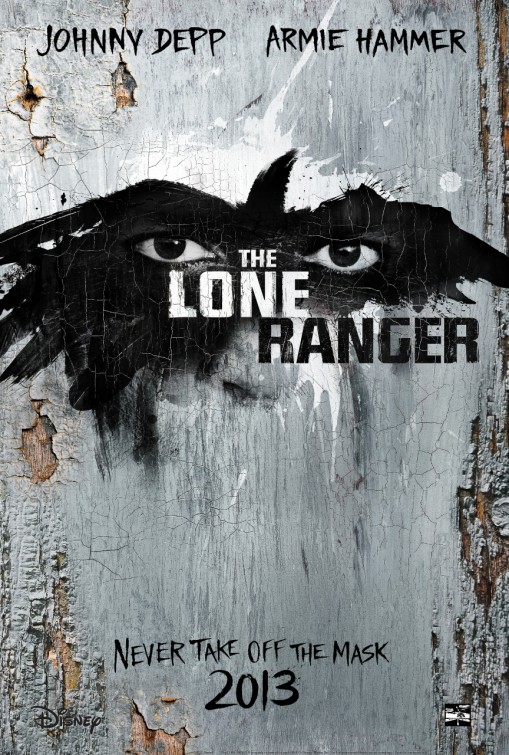
http://www.truemovie.com/2012Poster/lone_ranger.jpg
 “The Lone Ranger” (*** OUT OF ****) is an entertaining but outlandish western spoof aboutthe origins of the protagonist told from the perspective of his faithful Indian companion Tonto.  Since westerns are neither popular nor fashionable, Walt Disney Pictures and producer Jerry Bruckheimer must have felt that the only way to treat the subject matter without alienating audiences was to emphasize comedy.  Just about everybody I know has referred to it as “Pirates of the Caribbean” on the western frontier.  The comparison seems apt, too.  Director Gore Verbinski helmed the first three “Pirates” epics.  Johnny Depp starred in them, too.  Interestingly, Depp’s Tonto emerges as a far more tragic but sympathetic figure than Captain Jack Sparrow.  Some of the larger-than-life shenanigans, particularly the agile display of horsemanship atop a fast-moving train, can be attributed to co-scenarists Ted Elliot and Terry Rossio.  Not only did they write “The Mask of Zorro,” but they also penned “The Legend of Zorro.”  Antonio Banderas galloped his black stallion atop a trundling train, too.  Elliot and Rossio also wrote “Alladin,” “Small Soldiers,” and the first three “Pirates” movies.  A third scenarist, Justin Haythe of “Snitch” and “Revolutionary Road,” contributed to this sprawling saga.  Mind you, Armie Hammer’s Lone Ranger is nothing like Clayton Moore’s Masked Man.  Moore debuted as the eponymous character in the ABC-TV series “The Lone Ranger” back in 1949.  He wore the mask longer than any other actor.  Clayton Moore registered so deeply in the American psyche as the Masked Man that his clash with the copyright holders in 1981 about wearing the mask yielded enough bad publicity to sink “The Legend of the Lone Ranger.”  Apart from the WB Network, the Lone Ranger hasn’t fired any silver slugs since 2003.  Verbinski and his scribes poke fun at the most important convention of The Lone Ranger: the mask.  None of the previous Rangers worried about the mask. Armie Hammer’s Lone Ranger feels self-conscious about the mask and doesn’t understand its significance.  Everybody who encounters the Lone Ranger asks him about the mask.  

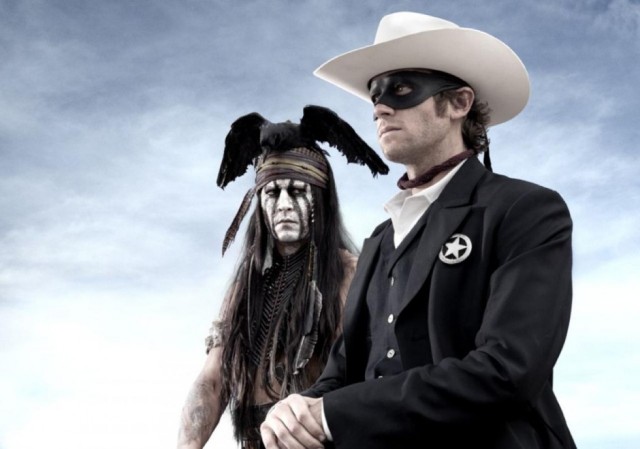
http://www.truemovie.com/2011photo/Johnny-Depp-and-Armie-Hammer-in-The-Lone-Ranger.jpg

“The Lone Ranger” opens in San Francisco in 1933.  A little boy in a cowboy outfit, hat, vest, mask, and matching cap pistols pays for a ticket to see a Wild West Show.  He stares at a number of exhibits, such as the buffalo, and then he meets a replica of a Noble Savage.  At this point, in the tradition of the “Night at the Museum,” the Indian surprises him and speaks.  A wizened Tonto (Johnny Depp of “Blow”) wears a black bird atop his head and looks like he should be at the Happy Hunting Ground.  He recognizes his old partner, the Lone Ranger, and blows the little guy’s mind so much that the kid whips out a cap pistol and blasts away.  Afterward, Tonto settles down to chronicle the legend of the Lone Ranger.  John Reid (Armie Hammer of “The Social Network”) has acquired a law degree and is returning home to Colby, Texas, to serve as the county prosecutor.  At the same time, treacherous railroad executive Lathan Cole (Tom Wilkerson of “The Green Hornet”) has pulled strings so he can hang one of the most notorious outlaws, Butch Cavendish (William Fichtner of “Heat”), wherever he wants as a warning to other desperadoes.  Awaiting the train at the station is John’s older brother Dan (James Badge Dale of “World War Z”).  John and Dan’s father served with the Texas Rangers.  Dan and his wife Rebecca (Ruth Wilson) watch in horror as the train derails. A huge lever designed to spin the wheels of the locomotive tumbles end-over-end from the sky and narrowly misses our heroes.  When we meet the chief villain, Butch Cavendish, this murderer is chained to the floor of a freight car.  Tonto sits nearby and watches as the outlaw finds a six-gun stashed under a plank.  Cavendish behaves like an unsavory villain.  He shoots both of sentries without a qualm.  Impetuous John Reid manages to get the drop on him.  Nevertheless, Cavendish escapes, and our heroes barely get off the train in time to save themselves.  Dan forms a posse and tosses John his father’s Texas Rangers badge.  Basically, John behaves like every western tinhorn that you’ve ever seen on the big-screen.  Dan’s trustworthy scout Collins (Leon Rippy of “Stargate”) betrays the Rangers and leads them into an ambush.  Everybody gets shot to ribbons.  The depraved Cavendish turns out to be a cannibal, but he isn’t shown chowing down. Meantime, John is shot twice, passes out, and appears dead for all practical purposes.  Tonto finds him later and tries to bury him.  At one point, a mysterious white stallion materializes and scrapes its hoof across John Reid’s Ranger badge.  Afterward, Cavendish kidnaps Dan’s widow Rebecca and her son Danny.  Eventually, Cavendish orders Collins to finish them off.  


“The Lone Ranger” occurs against the scenic backdrop of American history during the construction of the transcontinental railroad.  The infamous Cavendish and Cole are playing for high stakes.  They have struck it rich with silver mine and excavated over $30 million worth of ore.  Rather than remain content as a minor railway executive, Cole mounts a hostile takeover of the railway company while orchestrating the annihilation of the Comanche Indian nation.  John Reid bumbles along for the first 90 minutes trying to convince himself he can be a man of action.  Verbinski pulls out all stops late in this 149 minute melodrama when he stages a chase between two trains.  This incredible railway sequence is reminiscent of the unforgettable stunts that silent movie star Buster Keaton pulled off in “The General.”  Finally, near the end of the movie, John Reid understands why he must never remove the mask.  He also realizes why he can never have a relationship with Rebecca. As corrupt as society is, the only way to combat this corruption is to be an outlaw.  Altogether, despite its titanic length, “The Lone Ranger” has no shortage of death-defying exploits or spectacular desert scenery.  
http://www.truemovie.com/2012Poster/lone_ranger_ver2.jpg